Unqualified Opinion Language in SAS 134 Audit Reports
SAS 134 restructures audit reports fundamentally, not just updating the opinion language itself.

SAS 134 supersedes AU-C sections 700, 705, and 706 and creates the entirely new AU-C section 701 for Key Audit Matters. AU-C 700, governing the formation and communication of the opinion on financial statements, is the core section most practitioners encounter directly. The standard also amends a significant number of other AU-C sections, so its reach extends well beyond the face of the report itself.
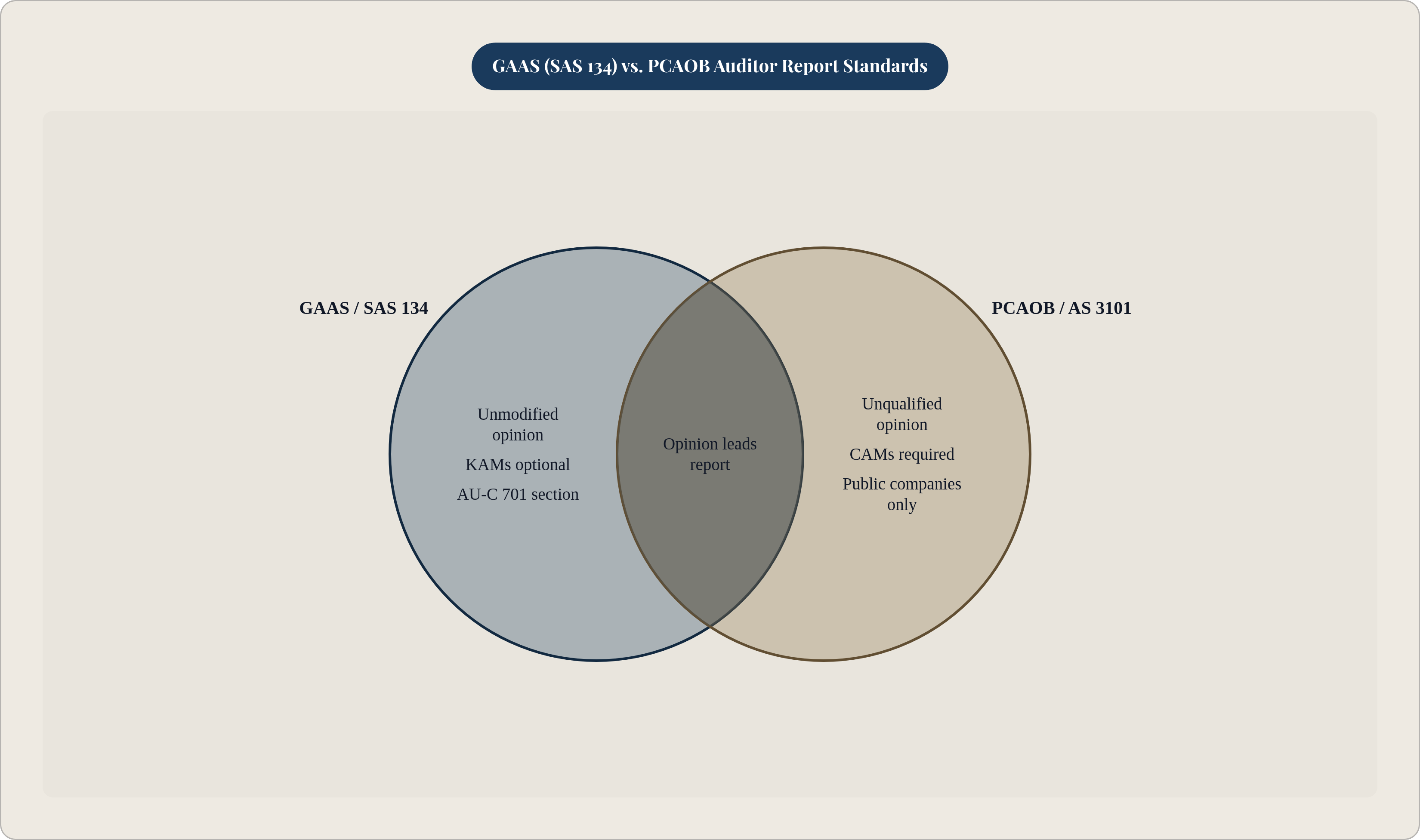
One terminological shift worth flagging early: GAAS now uses "unmodified opinion" where the older convention said "unqualified." The concepts are equivalent. The PCAOB retains "unqualified" in AS 3101 for public companies, so practitioners who work across both regimes carry both terms simultaneously. That is manageable, but it requires discipline in template language, and in my experience, that discipline is the first thing to slip under deadline pressure.
But what if a firm assumes the opinion language itself changed and focuses its remediation effort there? That is precisely where the misunderstanding tends to take root. The words of the conclusion are essentially what they were. What changed is the report's structure, the sections now required around that opinion, and the specificity of the disclosures that surround it. A firm that patches new language into an old shell has not complied; it has produced a non-compliant report in familiar clothing. The argument that updating a few paragraphs is close enough does not survive a compliance review. Same words, entirely different frame. That is the central interpretive challenge, and it is the one I have seen firms consistently underestimate.
Moving the Opinion to First Position and What That Signals
Under the prior format, the opinion appeared at the end of the report. Readers worked through management's responsibilities and the auditor's scope before arriving at the conclusion they came for. SAS 134 moves the opinion paragraph to the top.
The illustrative unmodified language, as reflected in commentary published in the CPA Journal following the standard's issuance, reads: "In our opinion, the accompanying financial statements present fairly, in all material respects, the financial position of ABC Company as of December 31, 20X1 and 20X0, and the results of its operations and its cash flows for the years then ended in accordance with accounting principles generally accepted in the United States of America."
That language has not changed. Its position has, and the repositioning is not cosmetic. It reflects the ASB's judgment that the opinion is the primary deliverable, not a concluding remark. Leading with the conclusion changes the reader's interpretive posture: everything that follows is contextualized as basis for and elaboration of a judgment already rendered, rather than as a preamble to one not yet revealed. It treats the reader as someone capable of handling the conclusion before the explanation, which is a more honest structure than the one it replaced.
The practical implication is unambiguous: report templates need to be rebuilt from the top down.
The Basis for Opinion Section, Now Required in Every Unmodified Report
Previously, a Basis for Opinion section was required only when the opinion was modified, that is, when the auditor issued a qualified, adverse, or disclaimer of opinion. If everything was clean, the section simply did not appear. That logic had a certain intuitive appeal: if something is wrong, explain why. SAS 134 dismantles it.
The section is now required in all reports, including clean ones, and its required contents are specific. It must include a statement that the audit was conducted in accordance with GAAS; a reference to the portion of the report describing the auditor's responsibilities under GAAS; a statement that audit evidence obtained is sufficient and appropriate to provide a basis for the opinion; and a statement that the auditor is independent of the entity and has met all other relevant ethical requirements. Where the auditor is engaged to report Key Audit Matters, a reference to that section is also required here.
The independence and ethics statement deserves attention. It makes explicit in every clean report what was previously implied or communicated through separate correspondence. For the reader, this section functions as the auditor vouching for the integrity of the process, not merely announcing the conclusion. Evidence of the process, not just the result, now belongs in every report regardless of outcome.
The Expanded Auditor's Responsibilities Section and What It Now Has to Say
The old responsibilities language was brief. Practitioners who came up through the prior format will remember a paragraph or two of fairly generic text describing the nature of audit procedures. SAS 134 requires materially more specific disclosure, and the specificity is not incidental.
Required statements now include an articulation that the auditor's objective is to obtain reasonable assurance that the financial statements as a whole are free from material misstatement, whether due to fraud or error. The standard then requires an explicit statement that reasonable assurance is a high level of assurance, but not absolute, and not a guarantee that a material misstatement will be detected. The auditor must also disclose that professional judgment is exercised and professional skepticism is maintained throughout the engagement. A new required paragraph addresses communication with those charged with governance: the auditor must disclose that it communicates with governance regarding planned scope and timing of the audit, significant findings, and certain internal control matters.
The reasonable assurance language is the element I find most significant, and the one most likely to be treated as boilerplate. The expectation gap has always been sustained, in part, by users who interpreted a clean opinion as a guarantee. The prior report format did nothing to correct that interpretation; it simply did not address it. SAS 134 requires the auditor to state directly, in the body of every report, that absolute assurance is not being provided and that material misstatements can still exist and go undetected. That raises an important question: if a firm treats this paragraph as filler while understanding it as legally and professionally material, what does that say about the integrity of the disclosure itself? That language is now on the record.
Going Concern Language in All Reports, Regardless of Whether Doubt Exists
Under the prior standard, going concern language appeared in the report only when the auditor had concluded that substantial doubt existed. No doubt, no mention. SAS 134 changes this categorically.
All reports must now reference management's responsibility to evaluate whether conditions or events raise substantial doubt about the entity's ability to continue as a going concern for one year after the financial statement issuance date. The going concern reference appears in two places: in the Management's Responsibilities section, describing management's obligation to perform the evaluation, and in the Auditor's Responsibilities section, describing the auditor's obligation to reach conclusions about any such uncertainty.
When substantial doubt does exist, it is reported in a separately headed section titled "Substantial Doubt about the Entity's Ability to Continue as a Going Concern." This replaces the former Emphasis-of-Matter paragraph, which the ASB found insufficiently specific. A named section is harder to miss and harder to mischaracterize.
The standard also draws a cleaner line of accountability than previously existed. Management evaluates. The auditor exercises judgment about the uncertainty. These are distinct roles, and the report now reflects that distinction explicitly. One downstream implication that many firms have not fully absorbed: the going concern statement is also now required in the engagement letter itself, whether or not doubt exists. The change reaches into client communications well before anyone drafts a report.
Key Audit Matters: What AU-C 701 Created and Who It Applies To
AU-C Section 701, Communicating Key Audit Matters in the Independent Auditor's Report, is the new section SAS 134 introduced. It did not exist in any prior form under GAAS. Key Audit Matters are those that, in the auditor's professional judgment, were of most significance in the audit, selected from matters already communicated to those charged with governance.
Three categories typically qualify: significant events or transactions during the period; areas requiring high degrees of management judgment or estimation; and areas where the auditor assessed higher or significant risk of material misstatement. The selection process is qualitative and requires judgment, which creates variability across firms, a reality the standard acknowledges implicitly.
The critical distinction for private-company practitioners: KAM reporting under GAAS is optional. The auditor must be specifically engaged by those charged with governance to include it. This contrasts directly with the PCAOB's equivalent concept, Critical Audit Matters, which are required for public company audits. KAMs are the private-company analogue, voluntarily adopted.
Meaningful adoption is most likely in audits of entities with private equity ownership or not-for-profit organizations whose stakeholders benefit from greater transparency into audit judgment. For most closely held private companies with active owner-management, the governance structure that would trigger KAM engagement rarely exists in practice. One might argue that recommending KAM reporting is simply a matter of auditor preference — but treating it as a unilateral auditor decision creates its own compliance risk, one I have seen surface when a firm recommends KAMs without having first established that the engagement threshold is met. The question of whether to include KAMs is a governance conversation before it is anything else.
How the Companion Standards SAS 135 Through 141 Interact with What SAS 134 Requires
SAS 134 cannot be implemented as a standalone exercise. The companion standards are not supplementary reading; they are operationally integrated, and firms that treat them otherwise tend to discover the gap at the worst possible moment.
SAS 135 amended AU-C 260, governing communication with those charged with governance, and AU-C 550, governing related parties. The amendments heighten auditor focus on related-party transactions and significant unusual transactions, directly reinforcing the new TCWG communication paragraph now required in SAS 134's Auditor's Responsibilities section. The two standards were designed to work in tandem. A firm that updates the report template without updating governance communication protocols has implemented one without the other.
SAS 138 addressed a specific and long-standing inconsistency: it aligned the AICPA's definition of materiality with the definitions used by U.S. courts and other U.S. standard setters and regulators. This matters because materiality underpins virtually every judgment an auditor documents, and a definition that diverged from judicial interpretation created exposure that was difficult to defend.
SAS 134 also changed pre-engagement communications in ways that carry forward into the report. The prior practice of a general planning letter to governance is replaced by a requirement to communicate specific, identified audit risks. For the first time under this framework, the highest-risk areas of a particular engagement must be disclosed to governance before the audit, not after. But how does this affect the report itself? Firms that update templates in isolation, without revising engagement letters, planning communications, and governance communication protocols, will have implemented SAS 134 incompletely. That incomplete implementation tends not to become visible until the file is opened for review.
What a Compliant Unmodified Report Now Looks Like from Top to Bottom
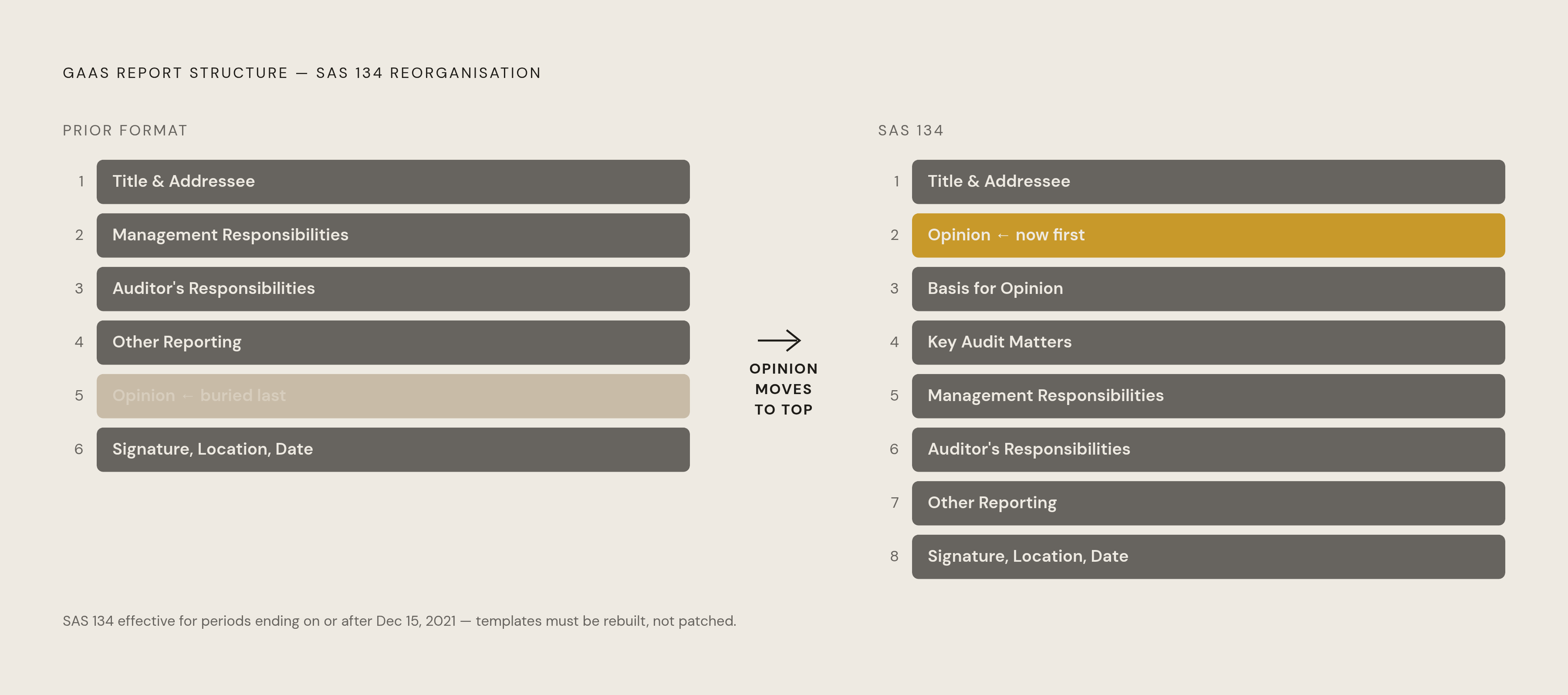
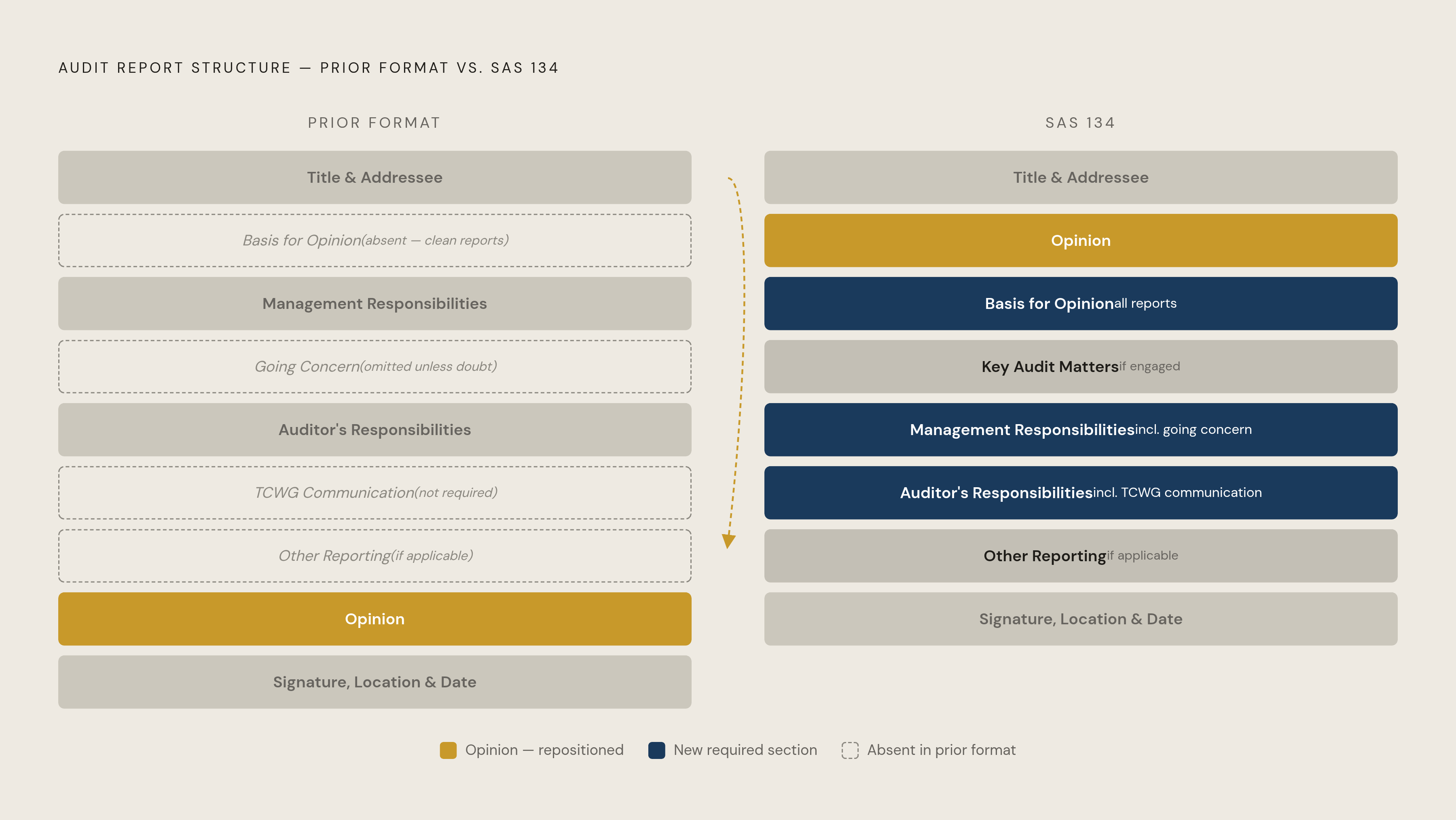
The required section sequence for a compliant unmodified GAAS report under SAS 134 is fixed. Title and addressee come first. The Opinion section follows as the first substantive paragraph, stating the conclusion. The Basis for Opinion section comes next, covering independence, GAAS compliance, evidence sufficiency, and, where applicable, a reference to Key Audit Matters. If KAMs are reported, the Key Audit Matters section appears here, before management's responsibilities. The Responsibilities of Management section follows, including the going concern evaluation obligation. The Auditor's Responsibilities section covers the audit objective, reasonable assurance language, professional judgment and skepticism, fraud and error, going concern conclusions, and TCWG communication. Other Reporting Responsibilities appear if applicable. Signature, location, and date close the report.
Each element is non-negotiable for an unmodified opinion. The prior clean-opinion format, which omitted several of these sections entirely, is no longer compliant. There is no transition period, no grandfather provision, and no informal practice of using old templates that has survived regulatory scrutiny.
A final terminology note, because it will surface in practice: "unmodified" is the current GAAS term. Practitioners who have used "unqualified" for decades are describing the same conclusion, but the report itself should use current terminology. That distinction is not merely stylistic; it signals whether the firm's templates have actually been updated or merely annotated. It is also worth considering the sequencing here: running existing templates against this structure as a compliance check before the next audit cycle, rather than after a report has gone out, is the more defensible course of action.