GAAS vs GAAP in Financial Reporting
GAAP sets the rules for what gets reported; GAAS sets the rules for how audits verify it.
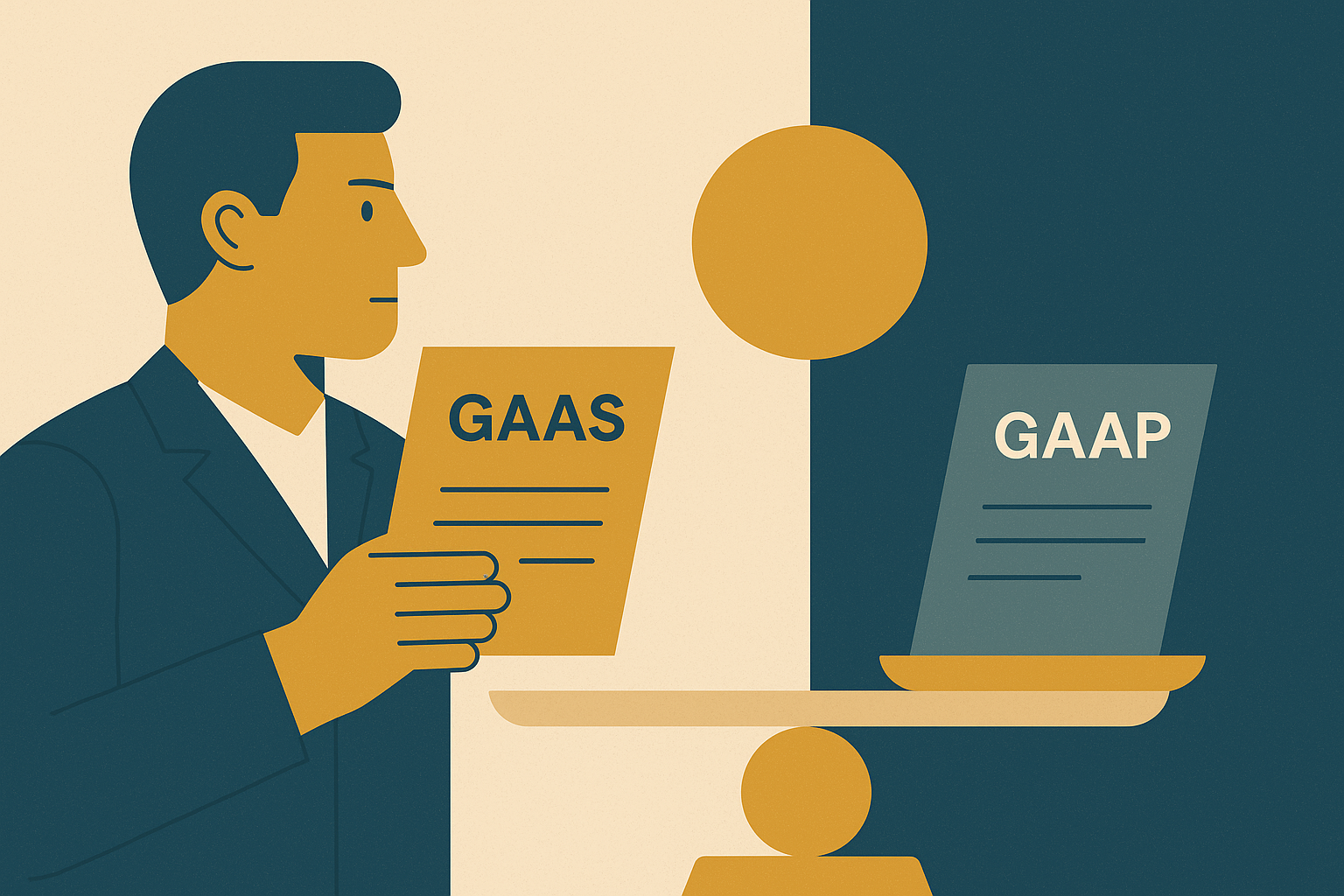
The relationship between GAAP and GAAS is one of the most consequential and most misunderstood dynamics in financial reporting. Having spent years inside audit engagements, watching accounting teams prepare statements while auditors independently examined them, I can say with some confidence that the two frameworks are treated as interchangeable by people who have never had to operate under either. They are not. One governs what gets reported; the other governs how that reporting gets examined. The distinction sounds clean in theory. In practice, it is where most of the complexity lives.
The Three Categories That Organize the Ten GAAS Standards
The ten generally accepted auditing standards, issued by the AICPA's Auditing Standards Board, are not a flat list. They are organized into three categories, and that structure is itself instructive. GAAS does not merely govern the opinion issued at the end of an engagement. It governs the auditor's qualifications before the work begins, the procedures applied during it, and the communication delivered when it concludes.
The first category, general standards, addresses the auditor as a person. Technical training and proficiency must be adequate for the engagement. Mental independence must be maintained throughout, not merely declared at the outset. Due professional care applies to both planning and execution. These standards exist because an auditor's opinion is only as credible as the auditor issuing it. No procedural standard can compensate for a practitioner who lacks the competence or objectivity to apply it.
Standards of Fieldwork
The second category governs what happens during the engagement itself. The auditor must plan adequately and supervise any staff involved. Internal controls must be understood and tested. Sufficient appropriate audit evidence must be gathered through substantive procedures. "Sufficient appropriate" is a phrase that carries enormous weight in practice. Sufficient speaks to quantity; appropriate speaks to relevance and reliability. An auditor who runs extensive procedures on immaterial accounts while underweighting a high-risk revenue stream has satisfied neither requirement, regardless of how many hours were logged.
Standards of Reporting
The third category addresses what the auditor communicates when the engagement ends. The report must state whether the financial statements conform to GAAP. It must identify any inconsistencies in GAAP application across periods. It must include an opinion on the financial statements taken as a whole, not a piecemeal view of individual line items.
Taken together, the three-category structure makes clear that GAAS is a framework for an entire professional engagement, not a template for a concluding document.
How GAAP and GAAS Connect Across the Three Stages of a Reporting Cycle
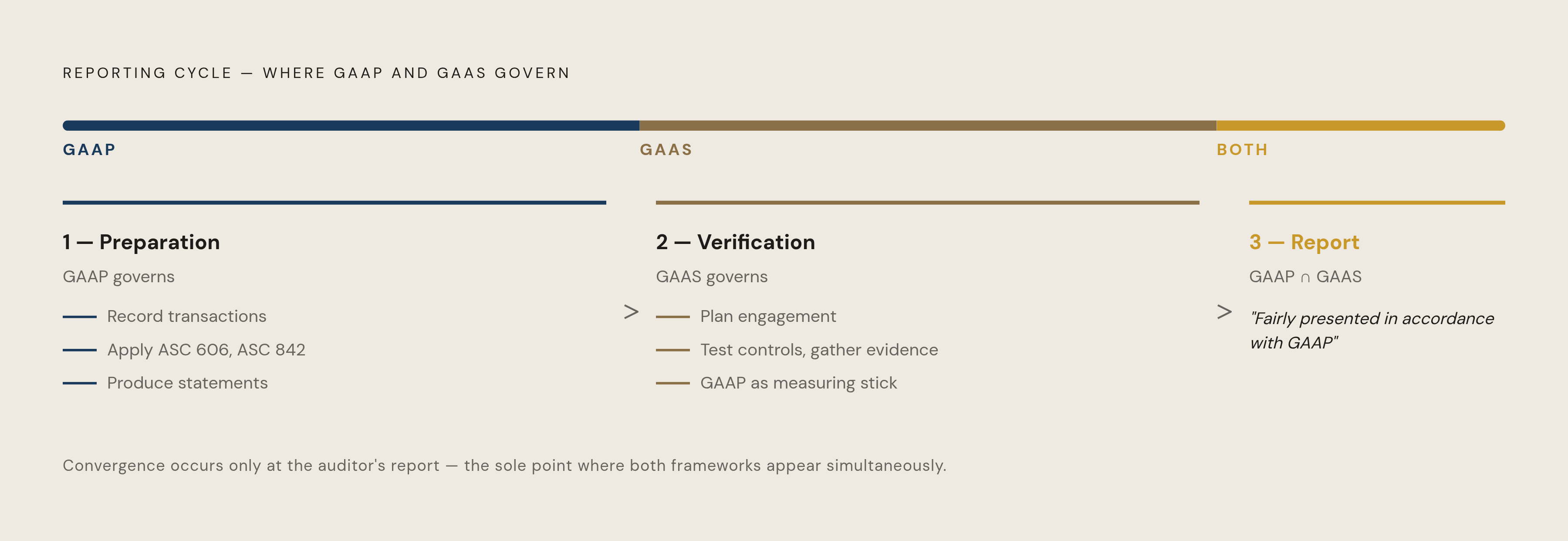
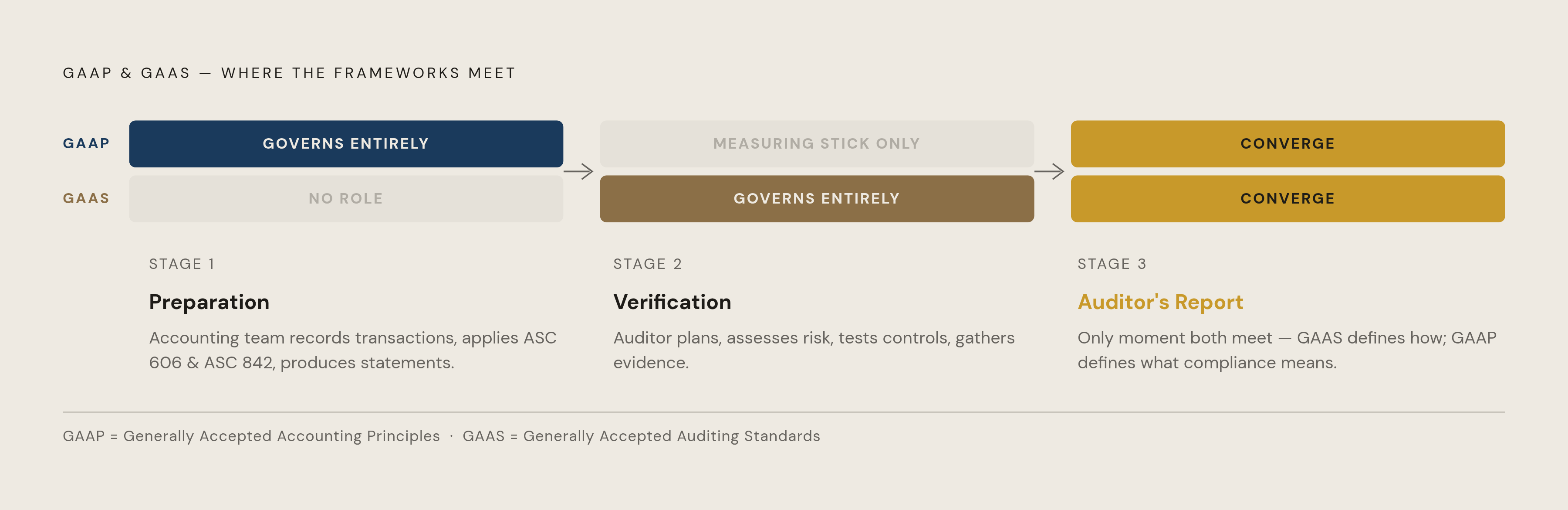
The reporting cycle has three distinct stages, and the two frameworks do not overlap as much as practitioners sometimes assume. They each dominate one stage and converge only at the end.
In the preparation stage, GAAP governs entirely. The accounting team records transactions, applies the relevant Financial Accounting Standards Board guidance, and produces financial statements with required disclosures. Revenue recognition follows ASC 606. Lease obligations are presented under ASC 842. Inventory is valued according to the applicable method selected and disclosed. No auditor is in the room at this stage; GAAS plays no role.
In the verification stage, GAAS governs entirely. The external auditor plans the engagement, assesses risk, tests internal controls, and gathers evidence. The auditor's objective is to determine whether the GAAP-prepared statements are free from material misstatement, whether caused by error or fraud. Here, GAAP functions as the measuring stick. GAAS defines the procedures used to apply it. The auditor is not reperforming the accounting; the auditor is evaluating it.
The two frameworks converge at the auditor's report. The opinion explicitly references GAAP: the auditor states whether the financial statements are presented fairly "in accordance with generally accepted accounting principles." GAAS governs how that conclusion was reached. GAAP defines what it means to comply. The report is the single public-facing document that ties both frameworks together.
The practical implication is that neither framework is self-sufficient. GAAS without GAAP has no standard to audit against. GAAP without GAAS has no independent verification. They are complementary by design.
Where GAAS Ends and PCAOB Standards Begin
GAAS, as issued by the AICPA's Auditing Standards Board, governs audits of private companies, nonprofits, and other nonpublic entities. The Public Company Accounting Oversight Board governs everything else. Created by the Sarbanes-Oxley Act of 2002 in the aftermath of major accounting scandals including Enron, the PCAOB sets and enforces auditing standards for all public company audits. Its standards supersede GAAS for those engagements.
The boundary matters operationally. An accounting firm auditing both public and private clients is operating under two different auditing frameworks depending on the engagement. Separate methodologies, separate quality control systems, and separate inspection regimes apply. Treating them as interchangeable is not a theoretical error; it is a deficiency waiting to be found.
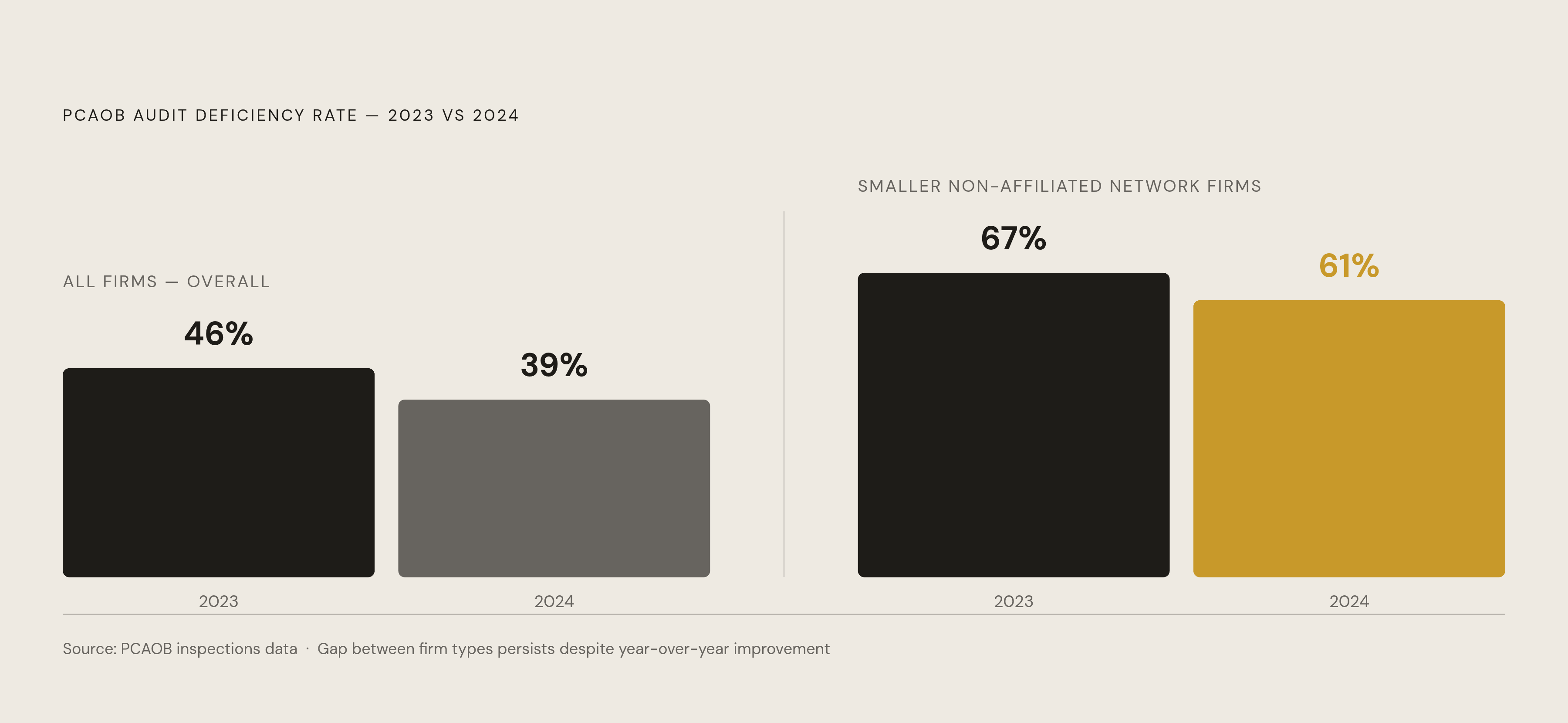
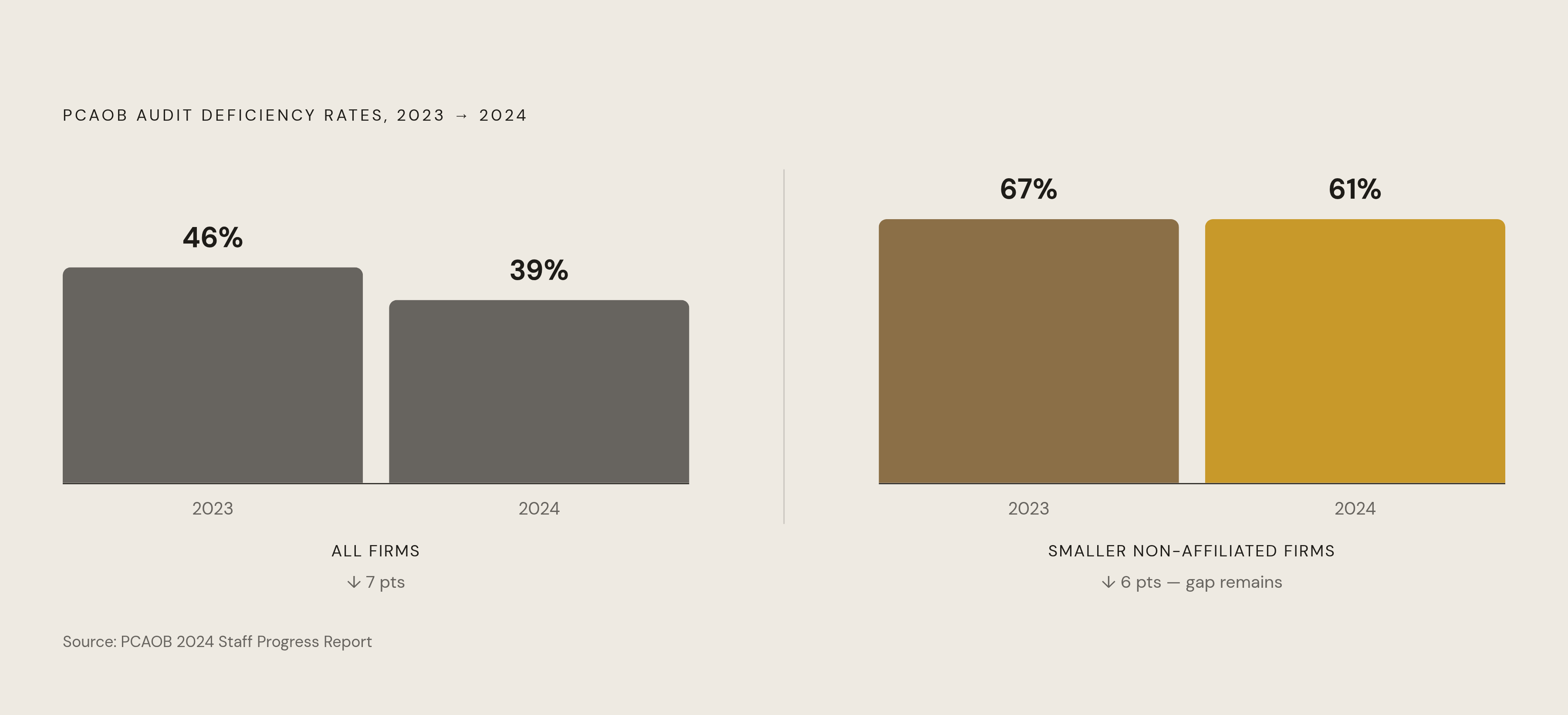
PCAOB inspection data illustrates the ongoing challenge. Deficiency rates dropped from 46% in 2023 to 39% in 2024, the most notable improvement across several inspection cycles. But smaller non-affiliated network firms still reported deficiency rates of 61% in 2024, down from 67% the prior year. The improvement is real; the gap between large and small firms is also real. Both things are true simultaneously, and anyone building audit infrastructure at a smaller firm should weigh the second number carefully.
It is also worth noting that private companies are generally not required to have audits at all under GAAS unless lenders, investors, contractual arrangements, or specific regulatory requirements impose one. GAAS is, in many contexts, a voluntary framework. That voluntary character shifts the dynamic entirely when a company does engage an auditor: the decision reflects a deliberate choice to seek independent verification, not a compliance checkbox.
When GAGAS, the Yellow Book, Applies on Top of GAAS
Government Auditing Standards, published by the U.S. Government Accountability Office and universally called the Yellow Book, represent a layered framework. For financial audits, GAGAS does not replace GAAS. It incorporates GAAS and adds requirements on top.
Those additional requirements are material. Independence rules are stricter. CPE requirements are specific: 80 hours every two years, with defined subject-matter constraints. Quality control and peer review standards are more demanding. Reporting obligations expand to include internal controls and legal compliance, not just the financial statements themselves.
The framework applies to auditors of federal grant recipients, Single Audits conducted under the Uniform Guidance, and most government engagements. For organizations subject to both, the question is never GAAS or GAGAS. It is always both, with GAGAS taking precedence where the two conflict. GAAS is the floor; GAGAS raises the ceiling.
I have watched auditors underestimate this layering until they are in the middle of a Single Audit with a GAGAS-trained reviewer flagging deficiencies that would have been invisible under GAAS alone. The lesson is not subtle: know which framework applies before the engagement begins, not after.
Three GAAS and Audit Standard Changes Taking Effect in 2025 and 2026
Three developments deserve attention from anyone managing audit engagements or compliance obligations over the next two years.
SAS No. 146 updates quality management requirements for firms performing GAAS engagements and takes effect for periods beginning on or after December 15, 2025. Firms should not treat this as a routine update. Quality management standards restructure how firms design, implement, and evaluate the systems that govern audit quality across their entire practice. The lead time exists for a reason.
The PCAOB's enhanced confirmation standard takes effect for fiscal years ending on or after June 15, 2025. The revision modernizes the confirmation process, expanding the use of electronic confirmations and tightening procedures for managing nonresponses. Firms operating parallel PCAOB and GAAS methodologies should reconcile their confirmation workflows across both sets of standards. Running divergent procedures for public and private clients on the same engagement type creates unnecessary operational risk.
ISA 570 (Revised 2024), addressing going concern, takes effect December 15, 2026. The revision updates how auditors evaluate and report on a company's ability to continue as a going concern. Given how prominently going concern conclusions feature in stakeholder decision-making, particularly for lenders and investors evaluating credit risk, the practical stakes of this update extend well beyond the auditing profession.
No AI-specific auditing standard exists yet. Auditors working AI tools into GAAS engagements are constructing their own approaches within existing risk frameworks, drawing on AU-C 315 risk assessment requirements alongside COSO's 2024 generative AI guidance and the IIA's updated AI Auditing Framework. The gap is real, and regulators will likely close it; the question is timing.
What Each Framework Actually Requires From the People Responsible for Compliance
GAAP responsibilities fall on the company's finance team and management. They select and consistently apply appropriate accounting policies. They prepare financial statements that include all required disclosures. Management signs off on the accuracy of the statements. The auditor does not.
GAAS responsibilities fall on the external auditor. Independence from the client is non-negotiable: any financial or personal interest that impairs objectivity disqualifies the auditor. Procedures must be designed and executed with sufficient rigor to support an opinion. The report must communicate clearly whether the statements are free from material misstatement.
The boundary between these two sets of responsibilities is not merely conceptual. Auditors do not prepare or co-prepare financial statements. Doing so would impair their independence under GAAS. Firms that have blurred this line, advising clients on accounting entries while simultaneously auditing them, have produced some of the profession's most consequential independence failures. The standard exists because the temptation to be helpful in ways that compromise independence is real and recurring.
The most persistent misunderstanding in practice is what a clean audit opinion actually means. It means the auditor found no material misstatements under GAAS procedures. It does not guarantee the statements are perfectly accurate. It does not certify that no fraud exists. GAAS procedures are designed to detect material misstatement; they are not omniscient. Stakeholders who treat an unqualified opinion as a guarantee of perfection are misreading the document.
Both frameworks ultimately serve the same person: the reader of the financial statements who relies on them to make decisions.
How AI Is Changing the Execution of GAAS Fieldwork Without Changing the Standards Themselves
AI adoption among finance teams roughly doubled from 23% in 2024 to 49% in 2025, according to a Leapfin report. The technology is moving into audit workflows considerably faster than standard-setters are moving to regulate it. That gap is worth sitting with.
In GAAS-governed fieldwork, machine learning and natural language processing are being applied across the engagement. Anomaly detection in transaction populations can replace or supplement traditional sampling, expanding coverage while compressing time. Document analysis tools can extract key terms from lease agreements and debt covenants, accelerating an auditor's assessment of ASC 842 treatment. Revenue contract review can surface the relevant elements of ASC 606's five-step model with speed that manual review cannot match. A 2026 systematic review of 100 peer-reviewed articles covering the decade from 2015 through 2025 found machine learning-based analytics and robotic process automation appearing across planning, risk assessment, control testing, and substantive testing. The adoption is not anecdotal.
What AI does not change is the auditor's professional judgment and responsibility for the opinion. GAAS still requires sufficient appropriate evidence. AI tools help gather and analyze it; the auditor must evaluate what it means. The BDO 2025 survey found 81% of finance leaders reporting greater trust in audit and advisory firms using advanced technologies, a figure suggesting that AI adoption has become a client expectation rather than a differentiator. That expectation is shifting the competitive landscape faster than the standards are.
The oversight imperative is this: firms deploying AI in GAAS engagements need audit trails, model transparency, and documented human review to demonstrate that GAAS evidence standards were met. The technology changes how evidence is gathered. It does not change what the standards require of it. Any firm that conflates procedural efficiency with evidential sufficiency is building a deficiency into its methodology before the first workpaper is opened.
The more interesting question, one the profession has not fully answered, is whether existing GAAS evidence standards are adequate for AI-assisted procedures, or whether the standards themselves need to evolve to address how evidence is generated, evaluated, and documented when the initial analysis is performed by a model rather than a person. Standard-setters are watching. So are inspectors.