Audit Opinion Types and Their Implications
Understanding the four audit opinion types helps stakeholders decode financial reliability.

Early in my career, I sat across from a CFO who had just received a qualified opinion on his company's financial statements. He was furious, not because he failed to grasp the technical finding, but because he didn't understand what it meant in practice. Would his lenders pull the line? Would investors bolt? Was his company, as he put it, "broken"? The answer was more nuanced than either his panic or his auditors' reassurances suggested, and that nuance is exactly what the four opinion types are designed to communicate, if you know how to read them.
A qualified opinion means the auditor found a material departure from GAAP or faced a scope limitation, but the problem is contained enough that the rest of the financial statements can still be relied upon. An adverse opinion means the departure from GAAP is so pervasive that the statements, taken as a whole, do not present fairly, and no portion of them can be trusted without reservation. For lenders and investors, that distinction is decisive: a qualified opinion typically triggers covenant review or additional due diligence but does not automatically void a credit agreement, whereas an adverse opinion almost universally causes lenders to declare a technical default and gives investors grounds to exit, because the opinion signals the statements cannot be used as a basis for any financial decision. The materiality-pervasiveness framework is the key: a qualification is contained, an adverse finding is not, and counterparties read that difference immediately.
The auditor's report is a formal expression of opinion on financial statements taken as a whole, or, in certain circumstances, an assertion that no opinion can be expressed at all. In the United States, PCAOB Auditing Standard AS 3105 governs departures from the standard unqualified report, establishing the conditions under which an auditor must modify what they say and how they say it. The four possible outcomes are: unqualified, qualified, adverse, and disclaimer of opinion. Each reflects a different level of assurance, not a grade on a scale from good to bad, but a signal about what the auditor could and could not conclude.
Two types of reservation drive modified opinions: a GAAP departure, meaning the statements don't conform to generally accepted accounting principles; or a scope limitation, meaning the auditor was unable to obtain sufficient appropriate evidence. Which opinion gets issued depends on two variables applied to those reservations: materiality and pervasiveness. That materiality-pervasiveness framework is the actual logic connecting all four opinion types, and naming it at the outset makes the rest of the terrain considerably easier to navigate.
What does a clean audit opinion actually guarantee, and when does it fall short?
An unqualified opinion means the auditor found no material misstatements and concluded that the financial statements present fairly, in all material respects, the company's financial position and results of operations in conformity with GAAP. For public companies, the term is "unqualified." For private companies, the identical outcome carries the label "unmodified." The distinction is terminological, not substantive, though conflating the two in formal settings signals carelessness.
What a clean opinion confirms is specific: sufficient evidence was obtained, the statements comply with GAAP, and note disclosures are adequate. But what does it not confirm? It does not confirm that the report is entirely free of additional signals. Emphasis of Matter paragraphs, Other Matter paragraphs, and Going Concern disclosures can all appear within an unqualified report without modifying the opinion itself. A reader who stops at the opinion paragraph and skips the supplemental language may miss material information the auditor was required to surface.
Critical Audit Matters, or CAMs, represent the most significant structural change to unqualified opinion reporting in recent years. Required for most public company audits of large accelerated filers and accelerated filers, though not for emerging growth companies, CAMs identify the most complex issues that arose during the engagement. They are expected to change year to year because they are tied to the specific circumstances of each audit, not to a standing checklist. Their intent is to move audit reporting away from a purely pass-fail structure toward greater transparency about what the auditor actually grappled with.
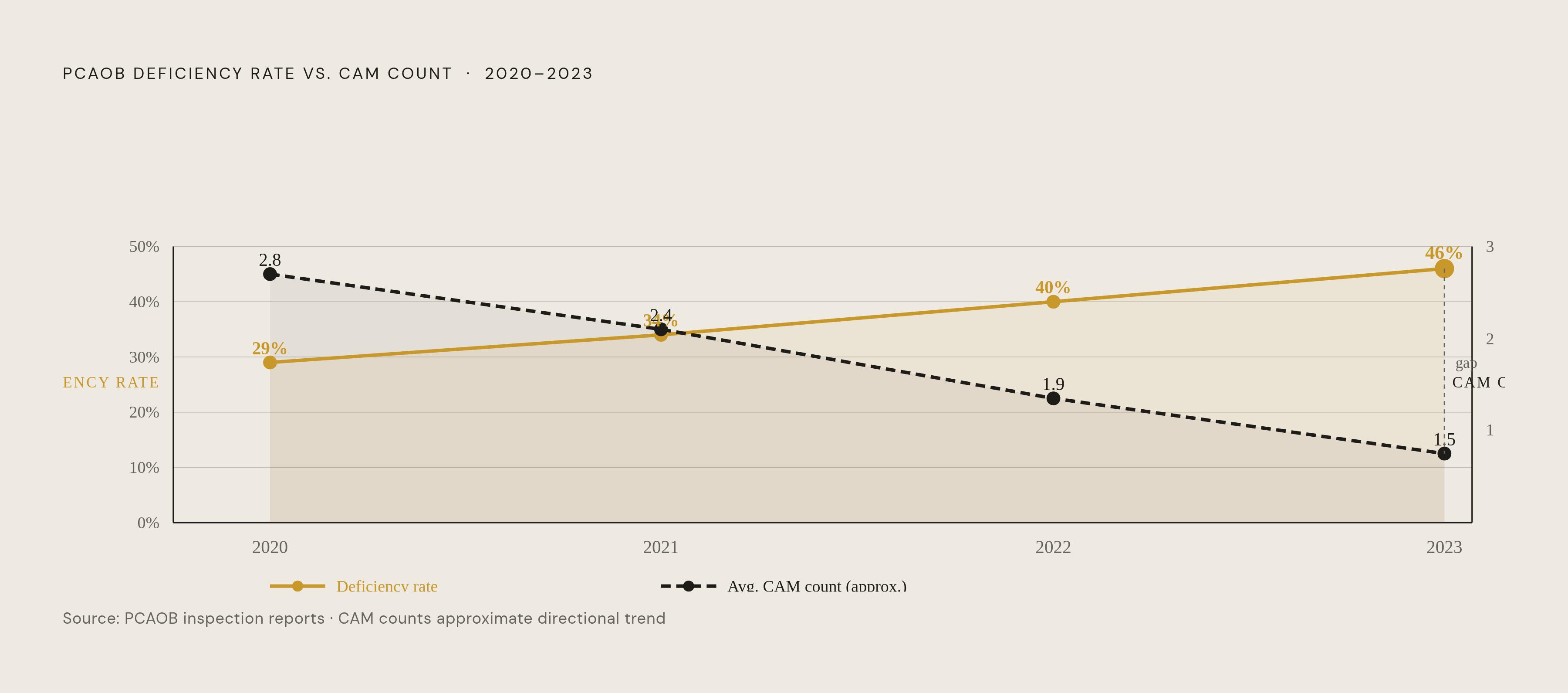
Here is where it gets interesting, and somewhat troubling. PCAOB inspection data shows deficiency rates climbing consistently over recent years, from 29% in 2020 to 34% in 2021, 40% in 2022, and 46% in 2023. Over that same period, average CAM counts have declined. The PCAOB's Investor Advisory Group has flagged this trend directly, noting that investors want more decision-useful detail from CAM disclosures, not less. That raises an important question: if inspectors are finding more problems while disclosed CAM counts are falling, what exactly is the clean opinion communicating? The gap between what inspectors are finding and what opinion reports are communicating is a live tension in the profession, and it begins right here, in the clean opinion.
The practical implication: an unqualified opinion is a necessary condition for stakeholder confidence, not a sufficient one. The supplemental paragraphs often carry the signal.
The qualified opinion: a specific carve-out, not a systemic failure
The language of a qualified opinion is precise and intentional: "except for the effects of the matter(s) to which the qualification relates, the financial statements present fairly." That "except for" construction does significant work. It tells the reader that something specific is wrong or unresolvable, but that the rest of the picture holds.
A qualified opinion can arise from either type of reservation: a GAAP departure or a scope limitation. In both cases, the defining characteristic is that the problem is material without being pervasive. Pervasiveness is what separates a qualified opinion from the two more severe outcomes. Pervasive means the misstatement or evidence gap affects so many elements of the financial statements that the statements as a whole cannot be trusted. Non-pervasive means the problem is isolated, locatable, and containable to a specific area or account.
The report must contain all the standard elements of an unqualified report, plus one or more separate paragraphs disclosing the substantive reasons for the qualification. That disclosure requirement is incidental to nothing. Its purpose is to alert statement users to specific limitations so they can make more informed decisions, not to condemn the entity's entire financial picture.
Stakeholder consequences are real but calibrated. A qualified opinion is less favorable than an unqualified one, and it can raise concerns with lenders and investors, potentially affecting financing access. But it does not signal systemic unreliability. In my experience, the companies that struggle most with qualified opinions are those that treat the disclosure as a reputational wound rather than a communication tool. The qualification is telling readers something specific; the question is whether the company has a coherent explanation for what happened and what they're doing about it.
The adverse opinion: when misstatements are both material and pervasive
An adverse opinion states that the financial statements do not present fairly the financial position, results of operations, or cash flows in conformity with GAAP. It arises exclusively from a GAAP departure, specifically one that is both material and pervasive. The majority of accounts are affected, not just an isolated area.
Consider a scenario that appears in the auditing literature: a company prepares its financial statements on a historical cost basis, but the auditor concludes that the company faces a going concern issue severe enough to require liquidation-basis accounting. Because the accounting basis is wrong, most accounts are thereby misstated. The GAAP departure is both material and pervasive; an adverse opinion follows. One might argue that a skilled negotiation between auditor and client could have resolved the matter before the report was issued — and often that is true. But when it isn't, the adverse opinion is the result.
Beyond the accounting error itself, adverse opinions signal things that matter to stakeholders independent of the financial statements: possible fraud, significant internal control weaknesses, and pervasive non-compliance with accounting standards. Those signals tend to trigger consequences beyond the audit report. Regulatory scrutiny follows. In certain industries, a clean audit is a prerequisite for maintaining licenses or contracts, so an adverse opinion can have operational consequences immediately.
Adverse opinions are rare, and the rarity is instructive. The conditions that produce them, an uncorrectable, pervasive GAAP departure, are serious enough that most companies either correct the statements before the report is issued or face consequences severe enough to force correction afterward. The process of negotiation between auditor and client that happens before the report is signed is often where adverse opinions are avoided, though not always for the right reasons.
The disclaimer of opinion: when the auditor cannot form a view at all
A disclaimer of opinion means the auditor was unable to obtain sufficient appropriate audit evidence to form an opinion, and the potential impact of that inability is both material and pervasive. The auditor is not saying the statements are wrong. The auditor is saying they cannot say anything at all.
This distinction from an adverse opinion is fundamental and frequently misunderstood. An adverse opinion means the auditor saw the statements and found them materially wrong. A disclaimer means the auditor could not see enough to say anything at all. A disclaimer can only arise from a scope limitation, never from a GAAP departure. If an auditor concludes the statements are wrong, they have formed a view; the only question is which modified opinion that view produces.
Common causes of scope limitation severe enough to produce a disclaimer include inability to access certain financial records, restrictions on audit procedures imposed by the client, circumstances beyond the auditor's control that prevent key procedures, and situations where a misstatement's effects are pervasive but cannot be quantified. It is also worth considering that last scenario carefully: the auditor knows something is wrong and knows it spreads widely, but cannot measure it. That is a different epistemic situation than the adverse case, and the disclaimer reflects that difference.
One procedural rule that follows from a disclaimer is worth understanding: the piecemeal opinion prohibition. When a disclaimer is issued, the auditor cannot turn around and express opinions on specific identified items within the statements. Doing so would tend to overshadow or contradict the disclaimer and create a false impression of partial assurance.
Market perception of a disclaimer is generally as harsh as that of an adverse opinion, even though no finding of error has been made. The ambiguity is itself the problem. Stakeholders cannot rely on the statements not because they're known to be wrong, but because no assurance was possible. That functional equivalence in market effect, despite the structural difference in what the auditor found, tells you something about how reliance actually works in practice.
How the materiality-pervasiveness matrix maps all four opinions
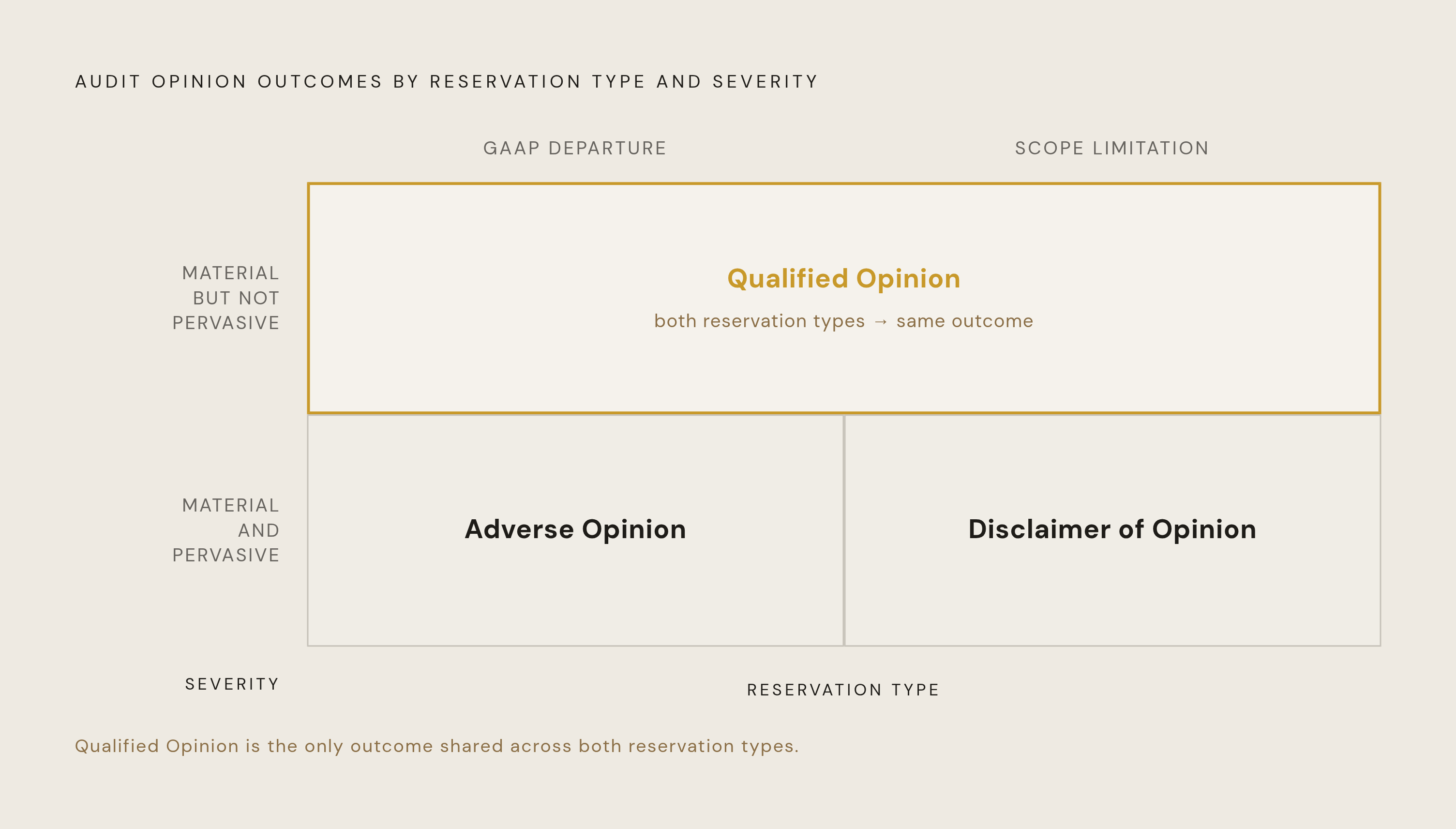
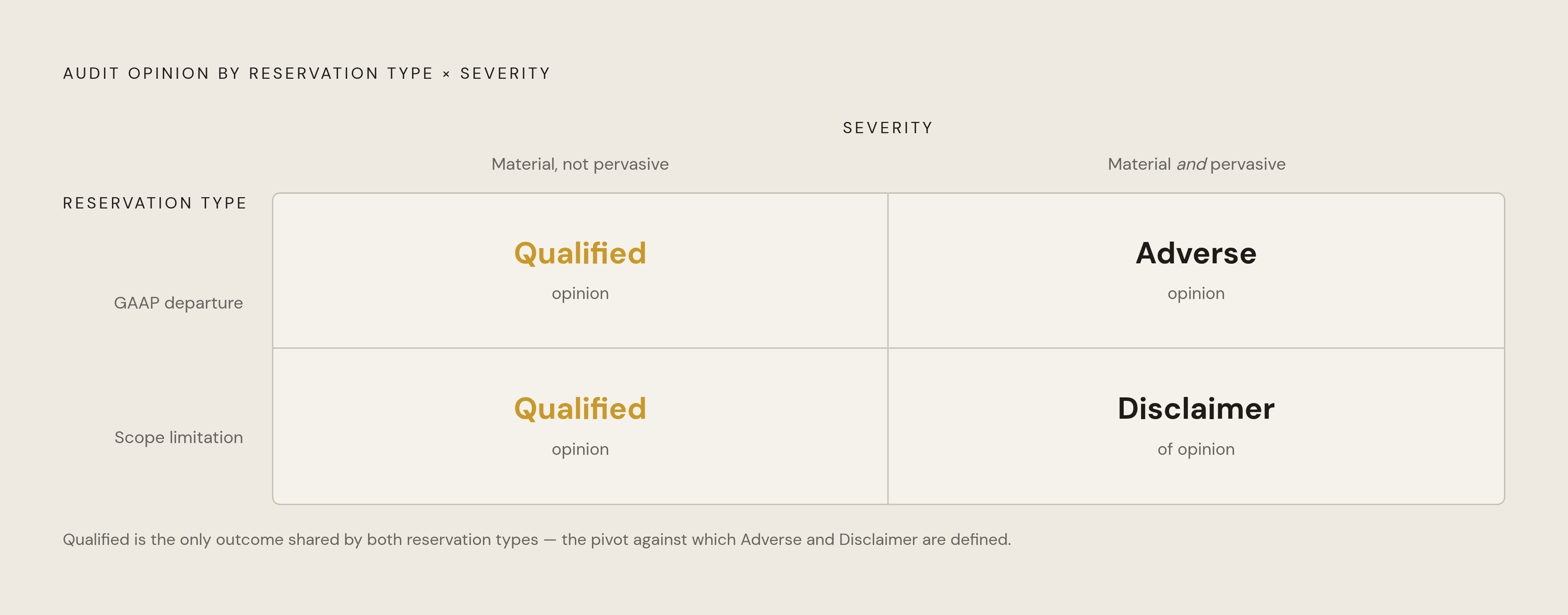
The logic underlying all four opinions reduces to a two-by-two. The two reservation types, GAAP departure and scope limitation, map against two severity levels, material but not pervasive, and material and pervasive.
A GAAP departure that is material but not pervasive produces a qualified opinion. A GAAP departure that is material and pervasive produces an adverse opinion. A scope limitation that is material but not pervasive also produces a qualified opinion. A scope limitation that is material and pervasive produces a disclaimer of opinion.
What this matrix reveals immediately is that the qualified opinion is the only outcome shared by both reservation types. It sits at the intersection where the problem is serious enough to require disclosure but contained enough to work around. Adverse and disclaimer occupy the same severity tier but are not interchangeable; the nature of the reservation determines which one applies.
For practitioners and their clients, the practical use of this framework is real. When encountering a modified opinion, the first question is: what type of reservation? The second is: how far does it spread? The answers locate the opinion precisely on the spectrum. More importantly, the framework clarifies why so much of the work in an audit happens before the report is issued. Moving a reservation from pervasive to non-pervasive changes the opinion type. Eliminating the reservation entirely restores the unqualified report. The matrix is not just a classification scheme; it maps the negotiating space between auditor and client.
What modified opinions mean for lenders, investors, and other stakeholders in practice
Capital access is the most immediate practical consequence of a modified opinion. Lenders and investors use audit reports to assess financial health and risk, and a negative opinion directly affects an entity's ability to secure financing. The specific consequences depend on which opinion was issued and why.
A qualified opinion raises specific concerns but does not typically render the financial statements unusable. Lenders may require explanation or additional disclosure; some may require that the underlying issue be resolved before credit terms are finalized. The statements can still function as a basis for decision-making, with appropriate caveats.
An adverse opinion is a different matter. Stakeholders typically will not accept statements as presented, and correction followed by re-audit is usually required before financing or regulatory approval can proceed. The reputational consequences compound quickly, and in some industries, the adverse opinion alone can trigger contract reviews or license conditions independent of what caused it.
A disclaimer occupies a peculiar position. No finding of error has been made, but no assurance has been provided either. For most sophisticated stakeholders, the functional effect is similar to an adverse opinion: the statements cannot be relied upon as a basis for decision-making. The ambiguity that is definitionally present in a disclaimer is not a softer version of an adverse; it is a different kind of problem, and in some respects a more unsettling one.
Regulatory scrutiny follows adverse and disclaimer opinions with some regularity, and this scrutiny can extend beyond the audit itself. Adverse opinions have historically been associated with indicators of fraud and weak internal controls, which can trigger investigations that proceed on their own logic, independent of the auditor's findings.
The positive case deserves equal treatment. A clean opinion is not merely the absence of bad news. It enhances reputation, boosts investor confidence, and signals that the organization's financial reporting infrastructure is functioning. For companies in competitive capital markets, that signal carries real value.
How the PCAOB's evolving standards are reshaping what audit opinions communicate
The regulatory environment governing audit opinions is in active motion, and the direction is not uniform.
AS 1000, effective for fiscal years beginning on or after December 15, 2024, reaffirms, consolidates, and modernizes the foundational principles and responsibilities of the auditor. It is a structural reorganization more than a substantive departure, but its consolidation of core responsibilities into a single standard matters for how firms document and defend their work. PCAOB amendments to AS 1105 and AS 2301 address technology-assisted data analysis in audit procedures, clarifying auditor responsibilities when using analytical tools. That standard takes effect for audits beginning on or after December 15, 2025. Confirmations standard amendments are effective for fiscal years ending on or after June 15, 2025. The Quality Control standard, QC 1000, takes effect December 15, 2025.
On individual accountability, the PCAOB amended Rule 3502 to lower the contributory liability threshold from recklessness to negligence for associated persons. This is a meaningful tightening. The prior standard required proof of recklessness to hold an individual auditor liable for a firm's violation; the new standard requires only negligence. The implications for audit culture and individual risk management are still working through the profession.
The deregulatory counterweight is also present. In early 2025, the PCAOB withdrew its final rules on firm and engagement metrics and firm reporting, following a shift in SEC leadership. Whatever one thinks of the merits of those rules, their withdrawal signals that the standards are moving in mixed directions rather than uniformly toward more disclosure. NOCLAR, the contested project on noncompliance with laws and regulations, remains in progress, with business groups arguing it would raise audit costs without proportionate benefit.
The declining CAM count against rising deficiency rates is the tension that threads through all of this. The PCAOB has specifically selected and reviewed audits to investigate why average CAM counts have fallen. No conclusive finding has been published, but the question itself is important: if inspectors are finding more deficiencies while auditors are disclosing fewer complex matters, something in the incentive structure of disclosure is worth examining carefully.
Why audit opinion quality is increasingly a function of firm capacity, not just auditor judgment
The opinion is only as reliable as the audit behind it. That sentence is obvious in the abstract and often overlooked in practice. But what if the conditions under which opinions are produced have changed so substantially that the formal output no longer reliably reflects the effort behind it?
The accounting and auditing workforce has contracted significantly. According to Bureau of Labor Statistics data cited in the brief, more than 300,000 professionals have exited the field since 2020, a decline exceeding 17%. The CFO Pulse Survey 2024 found that 83% of financial leaders said they could not find qualified accounting talent, up from 70% in 2022. The BLS projects more than 120,000 accounting and auditing job openings per year against a shrinking pipeline. These are not abstract labor market statistics; they describe the conditions under which audit opinions are produced.
The connection to opinion quality is direct. Scope limitations that produce qualified opinions or disclaimers are not always a company's doing. Understaffed audit teams, constrained timelines, and reduced review capacity can produce evidence gaps that modified opinions must reflect. An auditor who cannot complete certain procedures because of resource constraints faces the same documentation problem as one who was denied access by the client, at least as far as the opinion type is concerned.
Technology-assisted analysis, including AI-based tools, is frequently discussed as a remedy for capacity constraints. The PCAOB's new standards on technology-assisted analysis acknowledge that these tools are actively being used, but leave meaningful ambiguity about what constitutes acceptable AI-based audit evidence. That ambiguity creates a practical risk: firms uncertain about regulatory acceptance of AI-generated evidence may retreat toward manual sampling, which is precisely the opposite of the capacity relief the profession needs.
For firm leaders and their clients, this means the four opinion types describe outcomes, but the conditions inside the firm, staffing levels, technology, workflow, review depth, determine how reliably those outcomes are reached. A well-supported unqualified opinion from a well-resourced engagement is not the same instrument as a technically identical opinion produced under severe time and staffing pressure, even though the reports look the same. That gap between the formal output and the conditions of its production is where the real risk lives, and it is a question the rising PCAOB deficiency rates are beginning to make visible.
Understanding the opinion types is the starting point. Understanding what it takes to produce a well-supported opinion in a constrained environment is where firm-level strategy, talent investment, and technology decisions converge with audit quality in ways that matter to every stakeholder who relies on the report.