Financial Statement Audit Process Overview
Early preparation and a designated project lead materially compress audit timelines.

The timeline question comes up in almost every initial client conversation, usually within the first five minutes, and the straightforward answer rarely satisfies: it depends, primarily, on the client.
Preparation should begin sixty to ninety days before fieldwork starts. The full engagement lifecycle runs roughly three to six months for most organizations, but treating the auditor's arrival as the starting gun tends to produce delays that are difficult to reverse once the engagement is underway. Before fieldwork begins, management should designate a single internal project lead to coordinate document requests and serve as the primary communication channel with the audit team. Completed reconciliations, organized records, and staff who have been warned to expect document requests are the practical prerequisites that compress the overall timeline in measurable ways.
Fieldwork alone typically runs four to twelve weeks. The full engagement lifecycle, from initial planning through report issuance, spans roughly three to six months for most organizations. What compresses or extends that window is a mix of factors, some within the client's control and some decidedly not.
Here is where most organizations miscalculate: preparation should begin sixty to ninety days before fieldwork starts. Treating the auditor's arrival as the starting gun tends to produce delays. The audit team walks in and immediately encounters incomplete records, unperformed reconciliations, and staff who weren't warned to expect document requests. Those delays compound in ways that are difficult to reverse once the engagement is underway.
Several structural variables extend timelines independent of client readiness. Public companies subject to the Sarbanes-Oxley Act face longer engagements because the auditor must conduct an integrated audit of both the financial statements and internal control over financial reporting, commonly referred to as ICFR. Entities with multiple locations, subsidiaries, or high transaction volumes require proportionally more testing. Complex estimates, unusual account types, and significant related-party transactions introduce judgment-intensive work that cannot be rushed without compromising the opinion's defensibility.
The practical implication most organizations underappreciate: an audit is not something that happens while staff continues about normal business. Client personnel will be pulled into document requests, process walkthroughs, and question-and-answer sessions throughout the engagement. This is not an auditor's inefficiency; it is the nature of independent verification. Organizations that plan resource availability accordingly move through the process materially faster than those that react to each request as a surprise.
What should a company do to prepare for an external audit and how far in advance should they start?
Selecting an audit firm, often through a formal request for proposal process, is typically a management or board decision, with the audit committee playing a central role at organizations that have one. For public companies, independence requirements narrow the eligible field, particularly when the entity already has advisory or tax relationships with larger accounting practices.
Once a firm is selected, the foundational document is the engagement letter. This matters more than clients generally appreciate. The engagement letter defines scope: which entities, which fiscal periods, which financial reporting framework. It establishes what the auditor will do and what management is responsible for. It sets fee arrangements and timeline expectations. No substantive audit work should begin before both parties have signed it, because engagement letters treated as administrative afterthoughts tend to generate scope and responsibility disputes at precisely the moments when nobody has time to resolve them.
After signing, the audit firm assembles its team, assigns roles across the hierarchy from engagement partner through manager, senior associate, and staff, and develops a preliminary timeline for each phase.
There is one client-side organizational step whose absence causes disproportionate friction: management should designate a single internal project lead before fieldwork begins. This person coordinates document requests, serves as the primary communication channel with the audit team, and keeps competing internal priorities from creating bottlenecks. Without that person, auditors end up routing requests through multiple contacts, receiving inconsistent responses, and waiting. That time is billable.
How auditors assess risk and build the plan that drives all subsequent work
Planning is typically performed before year-end, not after, and the timing is not incidental. Conducting risk assessment while the year is still open means that if auditors identify a control gap, an unusual transaction pattern, or an area requiring additional documentation, there is still time to address it. Waiting until January to begin planning a December year-end audit eliminates that window entirely; whatever was going to be a problem will simply remain one.
During planning, the audit team is doing several things simultaneously. They are learning the business: its revenue model, organizational structure, industry context, competitive environment. They are conducting walkthroughs of key financial processes to understand how transactions originate, how they are recorded, and what controls exist to prevent or catch errors. They are also making risk judgments about which areas of the balance sheet and income statement are most susceptible to material misstatement.
The conceptual framework governing those judgments is the audit risk model, which describes three interlocking components. Inherent risk is the susceptibility of an account or assertion to misstatement before considering any controls, based on the nature of the item itself. Complex accounting estimates, related-party transactions, and non-routine transactions carry elevated inherent risk by their nature. Control risk is the likelihood that the entity's own internal controls would fail to prevent or detect a misstatement. Detection risk is the risk that the auditor's procedures would also miss any remaining misstatement; this is the lever auditors adjust through the volume and nature of testing.
Alongside risk, auditors establish materiality: a threshold, both quantitative and qualitative, below which a misstatement would not be expected to influence the decisions of a reasonable user of the financial statements. It is not a mechanical calculation. It requires professional judgment about the entity, its users, and the nature of the item in question. Risk assessments and materiality determinations, including the lower performance materiality threshold applied during testing, together control how much evidence auditors gather, and where.
The output of planning is an audit plan that assigns specific team members to specific accounts and procedures, calibrated to the risks identified for this client, this year, these conditions. It is not a template. From the client's perspective, planning generates its own document requests: process documentation, organizational charts, prior-year workpapers if the firm is new, access to personnel who can walk through financial processes. Early responsiveness shortens the overall engagement in measurable ways.
What internal controls testing looks for and why it comes before transaction testing
Internal controls testing precedes transaction-level testing by design. The sequence reflects a logical dependency: how much transaction testing auditors need to perform depends on whether the organization's own controls can be relied upon to catch errors. Skipping directly to transactions without understanding the control environment is not merely inefficient; it produces unreliable conclusions.
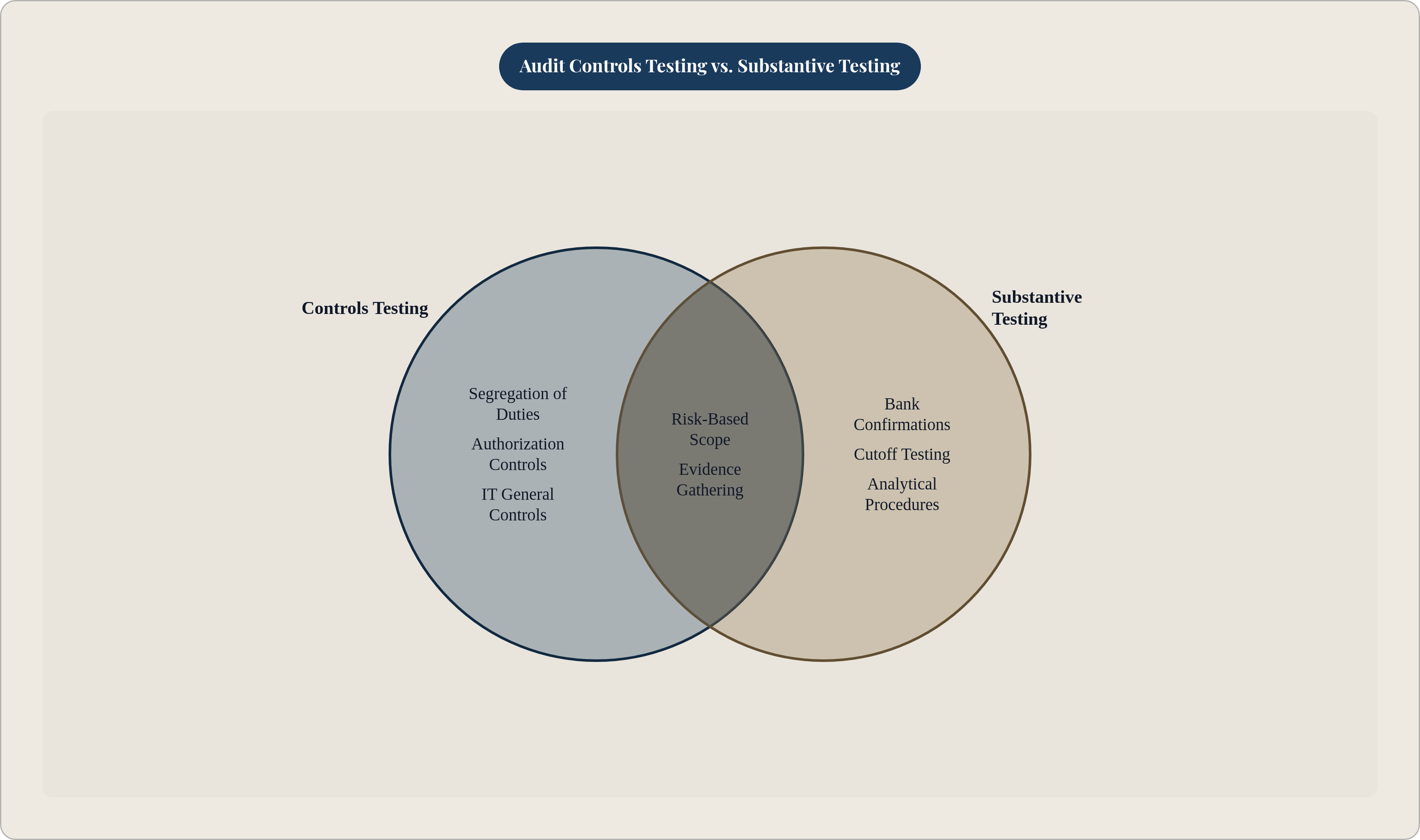
What auditors examine during controls testing spans several categories. Segregation of duties addresses whether the person recording transactions is different from the person approving payments, and whether both are separate from whoever reconciles accounts. Concentrating all three functions in a single individual, common in smaller organizations, is a structural weakness regardless of that person's integrity or tenure. Authorization controls address who can approve purchases, journal entries, or system access, and whether those approvals are documented in a form the auditor can inspect. Information technology general controls, or ITGCs, have grown increasingly significant as financial data migrates to cloud platforms; auditors examine access rights management, change management procedures, and system security configurations with a rigor that often surprises clients encountering it for the first time. Period-end close controls govern how management prepares the financial statements themselves, including how journal entries are reviewed and how account reconciliations are completed before the books close.
The consequences of what auditors find during controls testing flow directly into fieldwork cost and duration. Strong controls operating effectively allow auditors to place reliance on them, which reduces the volume of substantive transaction-level testing required. Weak or absent controls force auditors to compensate through additional substantive procedures. This is one of the clearest mechanisms through which investment in internal controls generates a measurable return: the organizations with strong control environments consistently face less extensive fieldwork and lower audit fees than their peers.
When deficiencies are found, auditors communicate them in a management letter, sometimes called an internal control letter, addressed to management and to the board or audit committee. This document is separate from the audit opinion. It identifies each deficiency, describes its potential impact, and offers remediation recommendations.
The FY 2024 audit of the U.S. Department of Education illustrates what is at stake. Auditors identified one material weakness and two significant deficiencies in internal control, findings that contributed directly to a disclaimer of opinion on the agency's financial statements. Control failures, in other words, are not merely operational concerns; they have direct and documented consequences for the final report. The question worth sitting with is what that implies for smaller organizations with fewer oversight resources and less audit infrastructure than a federal agency.
What happens during fieldwork and how auditors gather evidence across different account areas
Fieldwork is the phase most people picture when they think of an audit: the team present, the document requests arriving in waves, the questions that keep coming. Its duration is determined by the audit plan developed during risk assessment, not by the calendar, though clients rarely experience it that way.
The core evidence-gathering procedures fall into several categories. Detail testing, encompassing both vouching and tracing, involves following individual transactions end-to-end through the accounting system. A sale, for instance, might be traced from original customer order through shipping documentation, invoice, cash receipt, and bank deposit, confirming it was recorded in the right period, for the right amount, in the right account. Analytical procedures compare account balances, ratios, and trends against prior periods and auditor expectations; a sudden shift in gross margin or an unexplained spike in a specific expense category triggers inquiry precisely because it deviates from what the pattern predicts. Third-party confirmations, written verifications of balances obtained directly from banks, customers, or suppliers, carry substantial evidentiary weight because their source is independent of management. Review of management estimates addresses items like depreciation schedules, allowances for doubtful accounts, and warranty reserves, requiring auditors to assess the reasonableness of the assumptions underlying the numbers.
The depth of testing is not uniform across accounts. High-risk accounts flagged during planning receive detailed transaction-level testing. Lower-risk areas may be addressed through analytical procedures alone. The audit plan functions as a resource allocation document, directing the most intensive work toward the accounts where misstatement is most likely and most consequential.
Account-specific requests give a concrete sense of what clients should expect. For cash, auditors obtain bank confirmations directly from financial institutions and reconcile outstanding items. For accounts receivable, they send confirmation requests to customers and perform cutoff testing to confirm that sales were recorded in the period the delivery or service occurred. For marketable securities, they confirm holdings with custodians, verify fair market valuations, and review transactions executed during the period.
The hierarchy of evidence reliability shapes how auditors pursue high-risk items. Third-party documentary evidence obtained directly by the auditor is the most reliable. Auditor-generated evidence from independent procedures follows. Internal documents generated by the client carry less inherent weight than external sources. Management representations, while required, rank at the bottom of the evidentiary hierarchy and are not accepted as the sole support for a material assertion, because auditing standards require sufficient appropriate audit evidence from independent sources. Accepting weaker evidence in high-risk areas would undermine the entire risk-based approach.
Organizationally, fieldwork generates the largest document request volume the client will face during the engagement. Well-organized records and prompt responses compress the timeline measurably. The inverse is equally true.
How financial statements and disclosures are finalized after testing is complete
Once substantive testing concludes, attention shifts to the financial statements as the formal presentation of what has been tested. The complete package includes the balance sheet, the income statement, the statement of changes in shareholders' equity, the statement of cash flows, and the footnote disclosures.
The footnotes are frequently underestimated by clients, and that underestimation creates late-stage friction. Footnotes disclose accounting policies, revenue recognition methods including those governed by ASC 606, significant estimates and their underlying assumptions, related-party transactions, contingent liabilities, and a range of other items required under the applicable reporting framework. Auditors review them for completeness and accuracy with the same rigor applied to the numerical statements. A footnote that omits a significant accounting policy, mischaracterizes a commitment, or fails to disclose a contingency is as problematic as a misstated balance sheet figure. The audit opinion covers both.
For non-public companies, auditors may assist in drafting certain disclosures. Regardless of who prepares the statements, management bears full legal and professional responsibility for their content. Auditors reinforce this through the management representation letter, a written assertion from management confirming specific representations made during the engagement.
After substantive testing and disclosure review are complete, the engagement partner performs a final overall review of both the financial statements and the accumulated audit documentation. This is a quality-control step, and it can surface last-minute issues requiring resolution with management before the opinion can be signed. It is not perfunctory; experienced partners occasionally find things here that the team missed.
For public company audits, documentation completion is now governed by PCAOB AS 1000, effective for fiscal years beginning on or after December 15, 2024. Under this standard, audit documentation must be completed within 14 days of report release, a significant compression from the prior 45-day window.
The four types of audit opinions and what each one signals
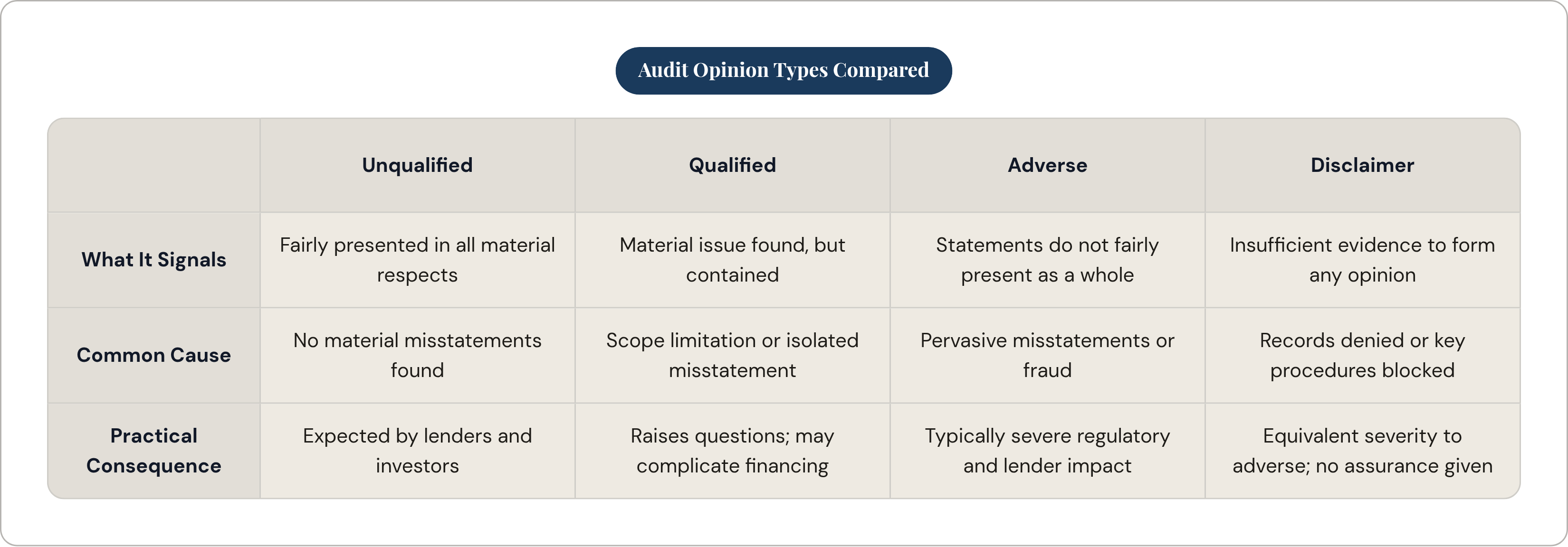
The audit opinion synthesizes the quantitative findings from testing and the qualitative understanding of the entity accumulated throughout the engagement. Its language is precise by design: the distinctions between opinion types carry real consequences for financing relationships, regulatory standing, and organizational credibility.
An unqualified, or clean, opinion states that the financial statements are fairly presented in all material respects in accordance with the applicable accounting framework. No material misstatements were found. This is what most organizations are working toward and what lenders and investors expect when they require an audit.
A qualified opinion is issued when auditors identify material misstatements that are not pervasive, or encounter a scope limitation that is material but similarly contained. The statements are largely reliable; the auditor can still express an opinion. But a specific identified issue prevents an unqualified conclusion. Practically, a qualified opinion raises questions among lenders and investors and can complicate financing arrangements. It signals that something was found, or something could not be examined, and the parties relying on the report will want to understand which.
An adverse opinion is the most serious negative conclusion available, distinct from a going concern emphasis paragraph, which flags doubt about an entity's ability to continue operations without modifying the opinion type itself. It is issued when misstatements are both material and pervasive, meaning the financial statements as a whole do not fairly present the entity's financial position or performance. This can result from pervasive non-compliance with accounting standards, significant internal control failures, or evidence of fraud. The consequences with lenders, regulators, and investors are typically severe, and in some regulated contexts, an adverse opinion triggers mandatory reporting obligations.
A disclaimer of opinion occupies a different category: the auditor is not expressing an opinion at all, because sufficient appropriate audit evidence could not be obtained. This most commonly arises when access to records is denied or key procedures cannot be performed. The FY 2024 audit of the U.S. Department of Education resulted in a disclaimer because auditors were unable to obtain sufficient appropriate evidence due to errors in the data used to calculate subsidy re-estimates, a clear illustration of how data integrity failures at the organizational level translate directly into audit consequences, regardless of organizational size or sophistication.
For public companies, the auditor's report must also identify Critical Audit Matters: the issues from the current period's engagement that were most difficult, most subjective, or required the most significant auditor judgment. This requirement represents a meaningful departure from the historic pass-fail structure of the opinion. Rather than a binary conclusion, investors receive insight into where auditor judgment was most heavily exercised during this specific engagement.
The standards governing opinion language differ by entity type. U.S. public companies are subject to PCAOB standards. Private company audits follow AICPA generally accepted auditing standards, codified in the AU-C sections. Internationally, the IAASB International Standards on Auditing govern engagements in most jurisdictions outside the United States.
What happens after the report is issued and how organizations should respond
Report issuance is not the end of the engagement. It is the beginning of the organization's response to what the engagement found, and the quality of that response shapes the trajectory of every audit that follows.
If internal control deficiencies were identified, auditors deliver a management letter separately from the opinion. This document identifies each deficiency, characterizes its severity, describes its potential impact on financial reporting, and provides remediation recommendations. Management letters deserve systematic attention. They rarely receive it.
Significant deficiencies and material weaknesses require documented management responses and formal remediation plans. At public companies, audit committees are required to receive and discuss these findings. Boards at private organizations should apply equivalent scrutiny, because unresolved control weaknesses compound. Prior-year findings that reappear in the following audit are a recognized risk escalation signal, one that auditors build into their planning through expanded testing and increased scrutiny. The organizations that treat the management letter as a compliance exercise tend to see the same findings return, typically at greater cost.
There is something else the audit cycle reveals that goes beyond the opinion itself. Document requests that caused delays during fieldwork identify where internal recordkeeping needs improvement before the next engagement. Estimate-related findings point to areas where more rigorous internal processes and documented methodologies would reduce both audit friction and misstatement risk. Organizations that use the management letter and the audit experience as operational inputs tend to move through subsequent engagements progressively more smoothly. Those that treat the report as a destination rather than a data point tend to repeat the same delays and findings with reliable consistency.
The audit is, in the end, a structured inquiry conducted by an independent party with defined professional obligations. I have seen organizations navigate it with minimal disruption and others spend months in reactive chaos over the same procedures. The difference is rarely technical competence; it is almost always preparation, communication, and a willingness to take the findings seriously once the report arrives.