Auditor Independence Requirements Under GAAS
Auditors must satisfy both objective independence and the appearance of it simultaneously.

Auditor independence is not a single condition to satisfy and set aside. It is an ongoing posture, one that must be maintained across every relationship, every service offering, every technology decision, and every shift in firm ownership. Most practitioners understand this in the abstract. What I have observed, across years working inside the compliance and quality management side of this profession, is that the abstract understanding rarely survives contact with a complex engagement or a lucrative non-audit opportunity. That is where the standard gets tested, and that is where firms tend to fall short.
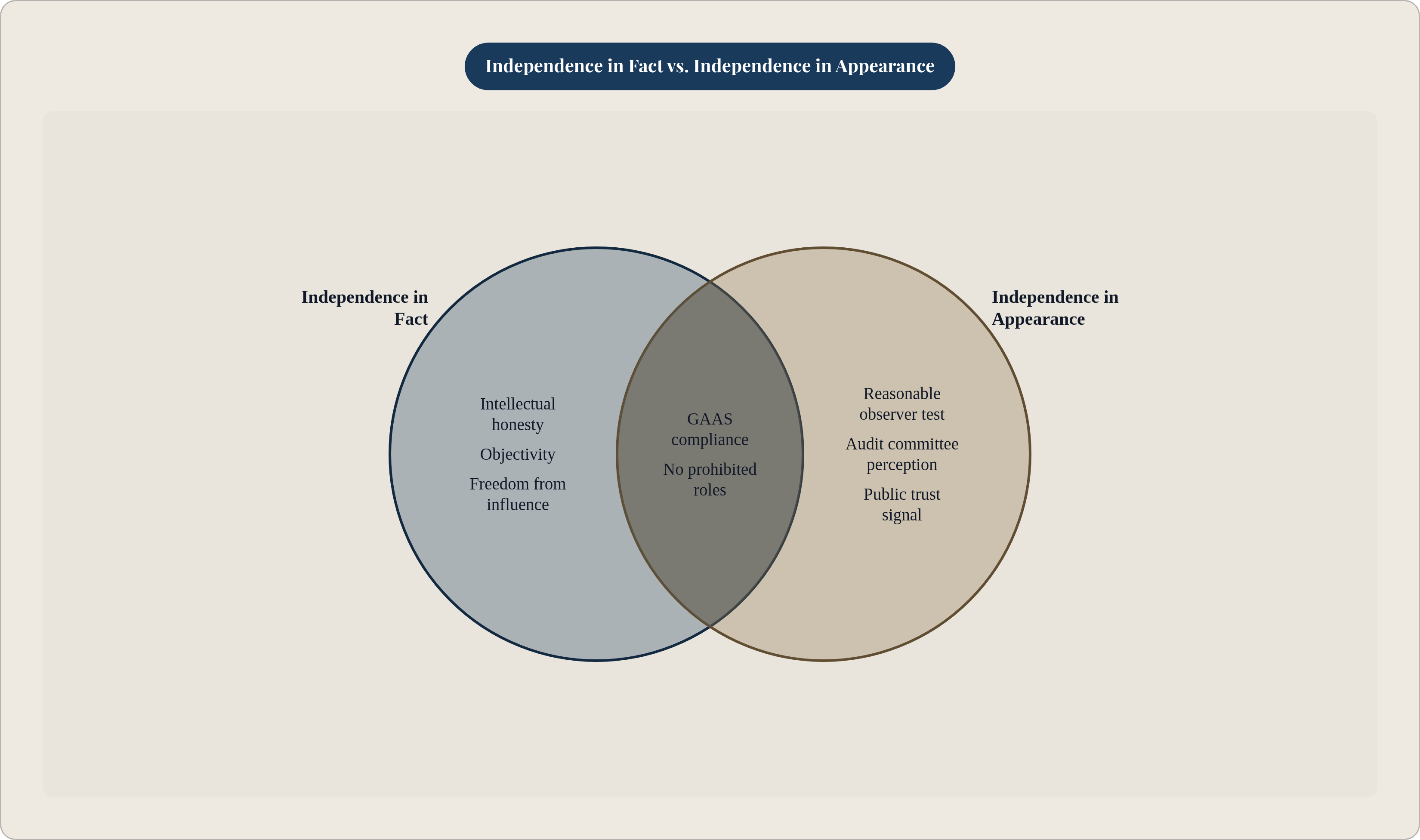
The organizing logic of the entire independence framework rests on two interlocking conditions: independence in fact and independence in appearance. Independence in fact is internal, a state of mind characterized by intellectual honesty, objectivity, and freedom from undue influence. Independence in appearance is external, the perception a reasonable and informed third party would form after examining the auditor's relationships and circumstances. The AICPA's own plain-language guidance frames the distinction precisely: the first condition permits an auditor to perform work without compromised judgment; the second requires avoiding circumstances that would cause a knowledgeable observer to doubt the auditor's integrity or professional skepticism.
Both conditions must be satisfied simultaneously. An auditor can be objective and still fail the standard because appearances suggest otherwise. The inverse is equally true and perhaps more insidious: an auditor can maintain impeccable appearances while quietly rationalizing a compromised judgment. Every downstream rule, every prohibition on financial interests, every restriction on non-audit services, every partner rotation requirement, derives its coherence from this dual requirement. Without it, the rules look arbitrary. With it, they form a system. But what if a firm satisfies every codified rule and still undermines the spirit of that system? That is precisely the gap the conceptual framework was designed to address.
Which Standards Govern Which Audits, and Why the Distinction Matters
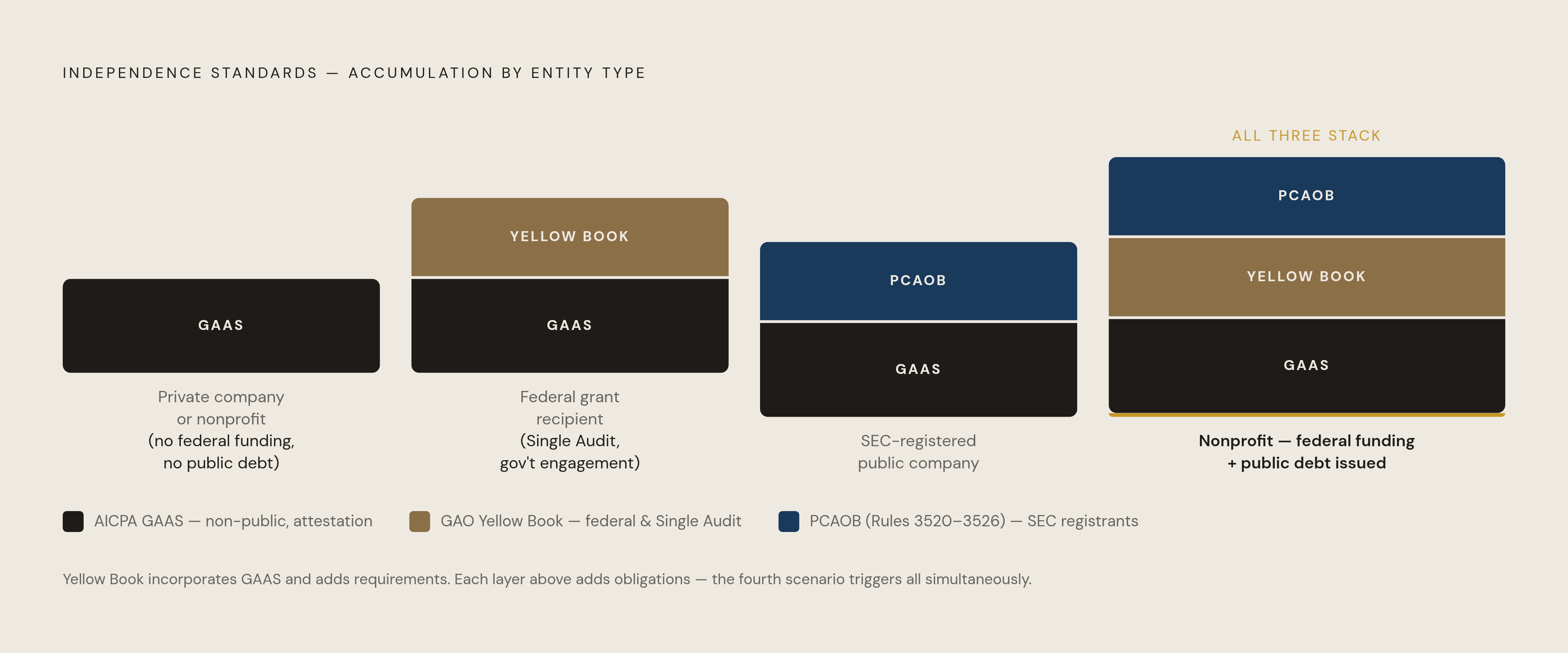
Three bodies of standards govern auditor independence, and they do not apply uniformly across all engagements. Understanding which framework applies to a given audit is itself a compliance step, not a preliminary one.
The AICPA's Generally Accepted Auditing Standards, administered through the Auditing Standards Board and grounded in the AICPA Code of Professional Conduct, govern audits of non-public entities: private companies, nonprofits, and most attestation engagements outside the securities markets. The PCAOB's standards, including Rule 3520 and its companion rules, govern audits of public companies registered with the SEC. These rules layer on top of existing professional ethics obligations rather than replacing them. The GAO's Government Auditing Standards, commonly called the Yellow Book, govern audits of federal grant recipients, Single Audits conducted under Uniform Guidance, and most government-related engagements. For financial audits, the Yellow Book incorporates GAAS and then adds requirements of its own.
The practical implication of this tiered structure is not merely academic. A firm auditing a mid-sized nonprofit that receives federal funding faces all three layers simultaneously. GAAS applies because the entity is non-public. The Yellow Book applies because federal funds are involved. And if the entity issues public debt, PCAOB rules may enter the picture as well. Firms that treat the standards as interchangeable, or that default to the most familiar one, expose themselves to compliance gaps they may not discover until inspection.
The Yellow Book also situates independence obligations inside a broader accountability architecture. Its requirements, including 80 hours of CPE every two years, quality control systems, peer review, and reporting on internal controls and compliance, signal that independence is not a freestanding rule. It is one component of an auditor's comprehensive responsibility to the public.
The Specific Prohibitions GAAS Imposes on Financial Interests, Fees, and Management Roles
Under ET §1.200.001 of the AICPA Code, four categories of relationship or arrangement are flatly prohibited for auditors of non-public entities. These are not judgment calls subject to the conceptual framework; they are bright lines.
First, auditors may not hold a direct financial interest in an audit client. No stock, no ownership stake, no comparable instrument. Second, auditors may not hold a material indirect financial interest, a category that extends to financial relationships held through close family members or certain investment vehicles. Third, auditors may not assume management responsibilities for a client, a prohibition that reaches further than it might initially appear. Overseeing client employees, directing operations, or making decisions that properly belong to client management all implicate this rule, even when the conduct arises in the context of what looks like a consulting engagement. Fourth, auditors may not accept contingent fees, meaning compensation tied to the outcome of the audit or to client performance metrics.
For auditors of public companies, the PCAOB adds specificity. Rule 3521 prohibits contingent fees. Rule 3522 restricts certain tax transactions. Rule 3523 addresses tax services provided to persons in financial reporting oversight roles, a category that includes CFOs and audit committee members. Rule 3526 requires auditors to communicate with the audit committee about independence matters before accepting an engagement and at least annually thereafter.
The management functions prohibition deserves more attention than it typically receives. The GAO makes explicit in the Yellow Book what the AICPA Code implies: even limited consulting work can threaten independence if it slides into management decision-making. I have seen this happen in practice, often inadvertently, when a firm's advisory team provides operational recommendations that client management adopts without meaningful independent evaluation. At the point where the client is functionally relying on the auditor's judgment to run the business, the auditor is no longer independent of the business. One might argue that the line between advice and management is obvious in practice — but is it? The enforcement record suggests otherwise.
How the AICPA's Conceptual Framework Handles Threats That Don't Fit a Bright-Line Rule
The prohibitions described above cover a great deal of territory, but they cannot anticipate every situation that arises in a profession that is constantly expanding its service offerings and operating in increasingly complex environments. The AICPA Code's Conceptual Framework for Independence fills this gap with a risk-based approach: when no specific rule directly addresses a situation, the practitioner identifies the relevant threat category and then evaluates whether available safeguards reduce that threat to an acceptable level.
Five threat categories are recognized. The self-interest threat arises when the auditor has a financial or other personal interest that could inappropriately influence judgment. The self-review threat arises when the auditor is effectively evaluating their own prior work, a common scenario when non-audit services have been provided to the same client. The advocacy threat arises when the auditor promotes a client's position to the point where objectivity is compromised, a risk that surfaces most acutely in litigation support and valuation work. The familiarity threat reflects the well-documented tendency of long-standing relationships to erode professional skepticism over time; GAAS addresses this directly through mandatory partner rotation and second-partner reviews on high-risk engagements. The intimidation threat arises when client pressure, actual or implied, shapes the auditor's conclusions.
The framework's value is real. It gives practitioners a structured method for reasoning through situations that the codified rules did not anticipate, which is increasingly important as both service offerings and firm structures grow more complex. Its limitation is equally real. The framework depends on the auditor's candid self-assessment of their own objectivity, which is precisely the dimension most vulnerable to rationalization. Independence in fact and independence in appearance diverge most dangerously when an auditor believes they are objective but external circumstances suggest otherwise, and the framework, by design, does not provide an external check on that belief. That raises an important question: if the framework relies on self-assessment, what organizational structures exist to catch the cases where that self-assessment is wrong?
Where Non-Audit Services Create the Most Common Independence Problems
The self-review threat is at its sharpest when a firm provides services that generate the financial information it then audits. Bookkeeping, tax preparation, valuation, IT consulting, internal audit outsourcing, executive search: each of these services, when provided to an audit client, requires a careful independence analysis before the engagement begins and ongoing monitoring throughout.
The analytical question is consistent across service types. Does this engagement place the auditor in a management role? Does it create a financial interest in the client's outcomes? Would a reasonable and informed observer conclude that the auditor's judgment has been compromised by the scope of services provided?
PCAOB inspection data makes clear that firms are not consistently asking these questions in time. A PCAOB Spotlight report from September 2024 identified prohibited non-audit services as a recurring inspection finding across multiple cycles. The specific failures were instructive: firms had not obtained audit committee pre-approval for non-audit services; auditors had not adequately communicated the scope of those services before the engagement commenced; individual auditors had failed to disclose financial interests in audit clients. These are not novel failures. They are the same failures appearing in successive inspection cycles, which suggests a systemic problem rather than isolated lapses. Why exactly does this happen? The answer, in most cases, is that pre-approval and disclosure are treated as administrative steps rather than substantive safeguards — and that distinction in treatment produces a distinction in outcomes.
Pre-approval by the audit committee is not a procedural formality. Both GAAS and PCAOB rules treat it as a substantive safeguard, and the distinction matters. A formality can be satisfied with a signature. A substantive safeguard requires the audit committee to understand what it is approving and why the service is consistent with the auditor's independence obligations.
The 2024 revision to the Yellow Book, effective for financial audits beginning on or after December 15, 2025, reflects a similar tightening. The revised standards expand guidance on non-audit services specifically, a signal from the GAO that this area warrants heightened attention in government-related engagements.
What PCAOB Enforcement Patterns Reveal About Where Firms Are Actually Falling Short
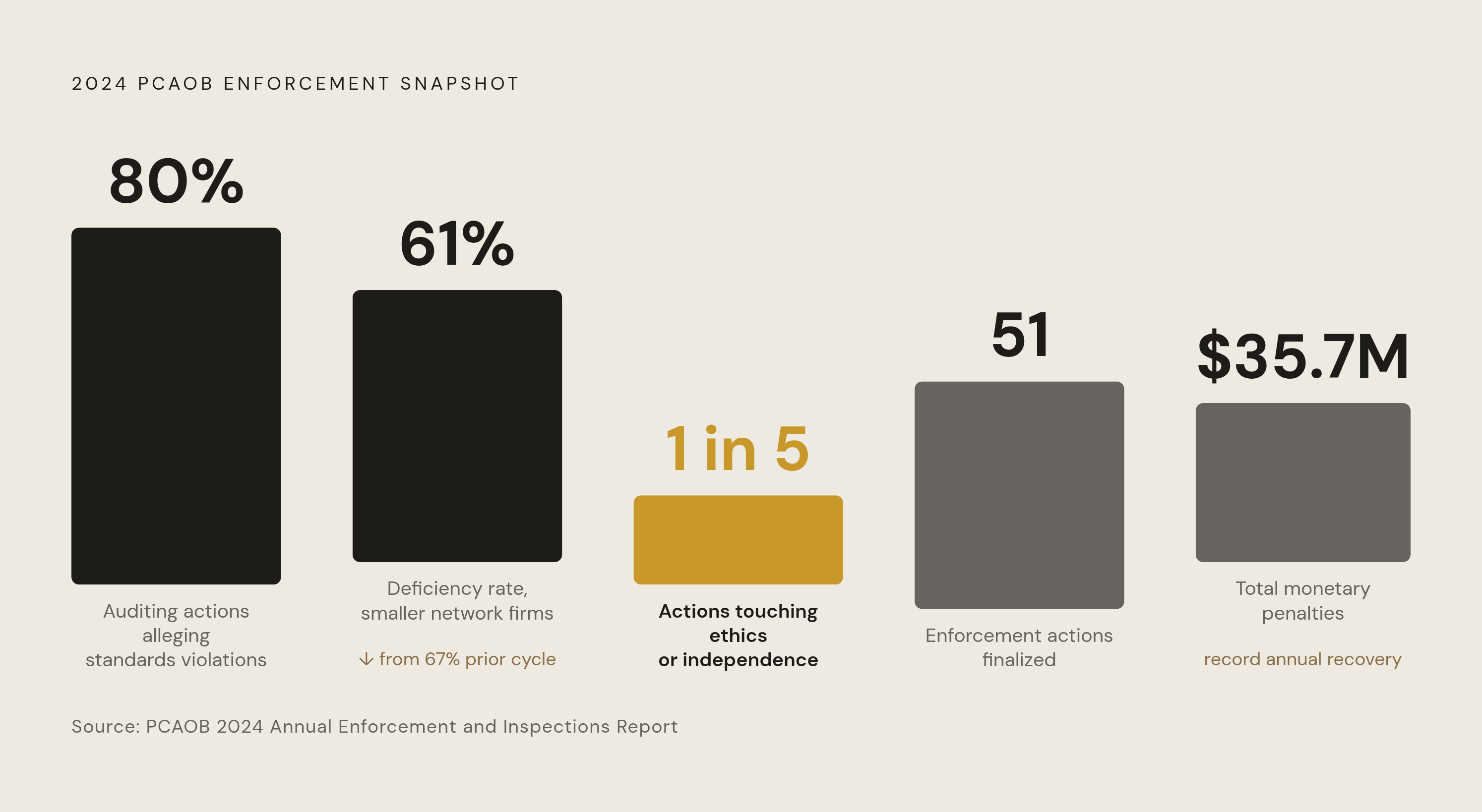
The enforcement data from 2024 is worth sitting with. The PCAOB finalized 51 enforcement actions in that year, resulting in $35.7 million in total monetary penalties, a record for annual monetary recoveries. Among the 2024 auditing actions, 80% alleged violations of auditing standards, and one in five also alleged violations of ethics and independence or quality control standards.
Smaller, non-affiliated network firms inspected on a triennial basis showed deficiency rates of 61% in the most recent inspection cycle, down from 67% in the prior cycle. Deficiencies clustered around audit evidence, internal control over financial reporting, and revenue testing. But the independence and quality management failures running alongside these audit deficiencies tell a related story: firms that struggle with audit execution tend to struggle with the organizational infrastructure that supports independence as well.
The pattern in the deficiencies is worth naming directly. Failures concentrate around three areas: audit committee pre-approval processes, firm-level quality control systems for independence monitoring, and individual-level disclosure failures. These are not three separate problems. They are the same problem manifesting at different levels of the organization. When a firm's quality management system does not treat independence as a core ongoing obligation, pre-approval processes become perfunctory and individual auditors stop internalizing the disclosure requirements.
The PCAOB's 2023 addition of Part I.C to its inspection reports, a dedicated section for independence noncompliance, reflects a deliberate regulatory signal. Deficiencies that were previously embedded in broader quality management findings are now surfaced and reported separately. That visibility change is not cosmetic. It is designed to make independence failures harder for firm leadership to compartmentalize or overlook.
The Safeguards GAAS Expects Firms to Have in Place, and What Quality Management Standards Now Require
Safeguards operate at two levels: the profession level, encompassing licensing requirements, peer review, and the standards themselves, and the firm level, where policies, monitoring systems, and engagement-level controls translate abstract requirements into operational practice.
Firm-level safeguards that bear directly on independence include written independence policies covering financial interests, prohibited services, and pre-approval procedures; annual independence confirmations from all covered persons; partner rotation protocols addressing the familiarity threat; second-partner or engagement quality reviews for higher-risk engagements; and formal audit committee communication procedures for any non-audit services provided to an attest client.
SAS No. 146, the AICPA's updated quality management standard, raises the bar on all of these. Effective for periods beginning on or after December 15, 2025, with the first system evaluation required by December 15, 2026, SAS 146 expands the quality management components from six to eight, places greater emphasis on risk assessment and emerging technologies, and treats strict adherence to independence not as a separate checklist item but as a foundational condition of audit quality itself.
The engagement partner's role is more explicitly defined under SAS 146 than it was under the prior standard. Partners are responsible for ensuring that all team members understand the independence requirements applicable to the engagement and that any threat identified during fieldwork is addressed promptly. This is a meaningful shift. Independence compliance moves from being a firm-wide function administered by a general counsel or ethics partner to being an engagement-level accountability assigned to the person closest to the work. Firm leadership's job, under this framework, is to make engagement partners capable of meeting that responsibility, not to substitute for it. It is also worth considering what this shift demands culturally, not just structurally: a partner who owns independence accountability at the engagement level must also feel empowered to raise concerns without institutional pressure to resolve them quietly.
How AI Tools in Audit Workflows Interact with Independence Obligations
AI adoption in audit practice is accelerating. Thomson Reuters survey data indicates that among firms already using or planning to use generative AI, 44% report using it daily or more frequently, with an additional 29% using it weekly. The capabilities now reaching audit workflows include compliance analysis, general ledger reconciliation, real-time anomaly detection, and draft adjustment generation, tasks that previously required sustained human attention across many hours of engagement time.
The reputational dimension of this shift is real. BDO's 2025 survey found that 81% of finance leaders report greater trust in audit and advisory firms using advanced technologies. Efficiency and credibility appear to move together, at least in client perception.
But what if that credibility is built on a process that quietly introduces a self-review threat the firm has not yet identified? The independence question that AI introduces is less widely discussed. When an AI system performs a function, whether reconciliation, control testing, or report generation, and the same firm then audits the outputs that system produced or influenced, does that create a self-review threat? The answer under current standards is: it depends, and the analysis requires the same conceptual framework that governs any other non-audit service. GAAS does not yet contain an AI-specific independence standard. Practitioners can draw on AU-C 315's risk assessment requirements alongside COSO's 2024 guidance on generative AI and the IIA's updated AI auditing framework, but the application requires judgment in the absence of bright-line rules.
The governance considerations are substantial. Model documentation, data lineage and integrity verification, bias and accuracy testing, change management over model versions, and human review of AI-generated outputs used in financial reporting are all areas where the auditor's professional judgment must remain visible and documented. The self-review threat is most acute when automation generates outputs the same firm then relies on in forming an audit opinion, with no documented human evaluation of the system's work product.
Firms that treat AI as a set-and-forget solution court exactly this failure. The defensible approach pairs automation with documented human oversight at each stage where AI output influences an audit conclusion, preserving the auditor's role as the source of professional judgment rather than its successor.
How Alternative Practice Structures and PE Investment Affect Independence Obligations
Financial acquirers now account for more than half of accounting services merger and acquisition activity, with deal volume growing sharply in recent years. The preferred vehicle is the alternative practice structure, which separates the licensed CPA firm, the entity authorized to perform attest work, from a non-attest business entity in which outside capital invests. The design is intentional: it attempts to maintain compliance with professional standards while enabling access to private equity resources.
The independence challenge the alternative practice structure introduces is structural rather than incidental. If investors in the non-attest entity hold financial interests that are closely affiliated with the CPA firm's operations, regulators must evaluate whether those interests impair the licensed firm's independence with respect to its audit clients. The analysis turns on the nature of the affiliation, the degree of shared economic interest, and whether a reasonable and informed observer would conclude that the investor's financial stake creates pressure on the CPA firm's professional judgments.
The AICPA has proposed significant changes to the ethics rules governing outside investment in accounting firms. The specifics of those proposed rules are evolving, which means firm leaders pursuing or evaluating outside capital need to monitor these developments actively, not after a transaction closes. The cost of a retroactive analysis is considerably higher than the cost of diligence conducted in advance.
The core compliance principle does not change regardless of ownership structure. The licensed CPA firm must maintain independence in both fact and appearance for every attest engagement it performs. No arrangement with an affiliated non-attest entity, however carefully structured, creates an exemption from that obligation. Independence travels with the license, not with the capital.
Firms evaluating alternative practice structure arrangements should treat a full independence analysis as a required element of deal diligence, not an afterthought. The question is not only whether the proposed structure complies with current rules, but whether it would withstand scrutiny under rules that are actively being revised.
What Firm Leaders Should Take from This as an Operational Matter
Independence is a leadership responsibility before it becomes a compliance function. The standards are detailed and the enforcement data is concrete, but neither translates into operational practice without firm leaders who understand what they are asking of their teams and why.
Three areas warrant the most direct leadership attention. Quality management systems are the first. SAS 146 assigns engagement-level independence accountability to the engagement partner, but engagement partners can only meet that accountability if the firm has built the systems, the training, and the culture that make it possible. The standard puts responsibility at the engagement level; leadership determines whether that responsibility is supportable.
Non-audit service decisions are the second. Every decision to offer a service to an existing audit client is simultaneously a business development choice and a compliance decision. In firms where those conversations happen in separate rooms, independence failures are a foreseeable outcome. The people approving new service engagements need to be asking the same question the ethics partner will ask later: does this create a self-review threat, a management functions problem, or a reasonable appearance of conflict?
Technology and ownership decisions are the third. AI adoption introduces independence questions that require proactive analysis, not reactive compliance after the tools are embedded in the workflow. PE investment and alternative practice structure arrangements require independence analysis as part of transaction diligence, not as a post-close reconciliation. In both cases, the cost of getting ahead of the question is far lower than the cost of addressing a deficiency after an inspection or an enforcement action.
The 2024 enforcement data, $35.7 million in PCAOB penalties, with one in five actions involving ethics and independence violations, reflects what happens when independence is treated as a background condition rather than an active obligation. These are not tail risks for firms operating at scale. They are the predictable consequence of quality management gaps that accumulate across engagement cycles.
The firms that navigate independence requirements effectively are not necessarily the ones with the most elaborate compliance infrastructure. They tend to be the ones where independence is understood, from the managing partner through every staff auditor on the engagement, as the condition that makes the audit worth conducting in the first place. That understanding is what GAAS ultimately requires: not the mere absence of prohibited relationships, but a demonstrable commitment to the objectivity that gives audited financial statements their authority.