Audit Risk Model Components
Auditors control detection risk when they cannot reduce inherent or control risk.

Most audit failures are not failures of effort. They are failures of risk reasoning, and specifically, failures to use the audit risk model the way it was actually designed to be used. After years of sitting in planning meetings, reviewing workpapers, and watching PCAOB inspection findings cycle through the same problem areas year after year, that is the conclusion I keep returning to. The textbook version of the model is elegant: three components, one formula, a tidy target of 5% audit risk. The fieldwork version is messier, more consequential, and far more interesting. But what if the model itself is being applied correctly on paper, yet still producing deficient audits? That question is worth holding onto.
The model's core premise is clear about its own limitations. Auditors cannot eliminate risk. Every audit, however rigorous, carries some residual probability of issuing an unqualified opinion on a materially misstated set of financial statements. What the model provides is a framework for managing that probability across three components: inherent risk, control risk, and detection risk. The formula expressing this relationship, AR = IR × CR × DR, is not a precision instrument. Standards are explicit that it is not intended to capture every factor influencing individual risk components. Its value lies in structuring the auditor's judgment, not replacing it.
The conventional target, an overall audit risk of approximately 5%, represents a 95% confidence threshold. Reaching that target is not a matter of applying the formula mechanically; it requires accurate assessment of two components the auditor cannot control, and deliberate management of the one component they can. That asymmetry is the conceptual engine driving everything that follows.
Inherent Risk: What It Captures and What Shapes It
Inherent risk is the susceptibility of an account balance or assertion to material misstatement, assessed entirely apart from any controls. This is not risk that management has introduced through negligence or malfeasance. It is risk baked into the nature of the business, the industry, and the transactions themselves.
Assessing it accurately requires the auditor to understand several intersecting factors. The client's industry and business environment set the baseline: a construction company recognizing revenue on long-term contracts faces categorically different inherent risk than a retailer recording point-of-sale transactions. The nature of the client's accounting methods and estimates matters enormously, particularly in areas where judgment is discretionary and verifiable benchmarks are scarce. Management incentive structures, including pressure to meet earnings targets, the terms of debt covenants, and executive compensation tied to reported metrics, can elevate the risk of intentional misstatement in ways that are often underweighted in planning. And the intrinsic complexity of specific transactions, derivatives, business combinations, multi-element arrangements, creates conditions where misstatement is more likely regardless of intent.
High-inherent-risk accounts tend to cluster in predictable places: revenue recognition, goodwill, intangible assets, inventory. These are judgment-intensive areas with fewer bright-line accounting rules, which means both the risk of honest error and the opportunity for manipulation are elevated. PCAOB inspectors flagged these exact categories as recurring deficiency areas in their July 2023 Spotlight on common audit deficiencies, a finding that should not surprise anyone who has spent meaningful time in an audit room.
The critical constraint on inherent risk is that auditors cannot reduce it. They can recognize it, respond to it, and document their reasoning about it; they cannot make a complex estimate simpler by wishing it so. This makes accurate IR assessment the linchpin of a defensible audit. An auditor who understates inherent risk in a high-risk account does not eliminate the risk; they simply fail to respond to it appropriately. Why exactly does this happen so consistently, even among experienced teams? The answer likely lies less in ignorance of the model and more in the comfort that familiarity breeds.
Control Risk: How Internal Controls Enter the Model
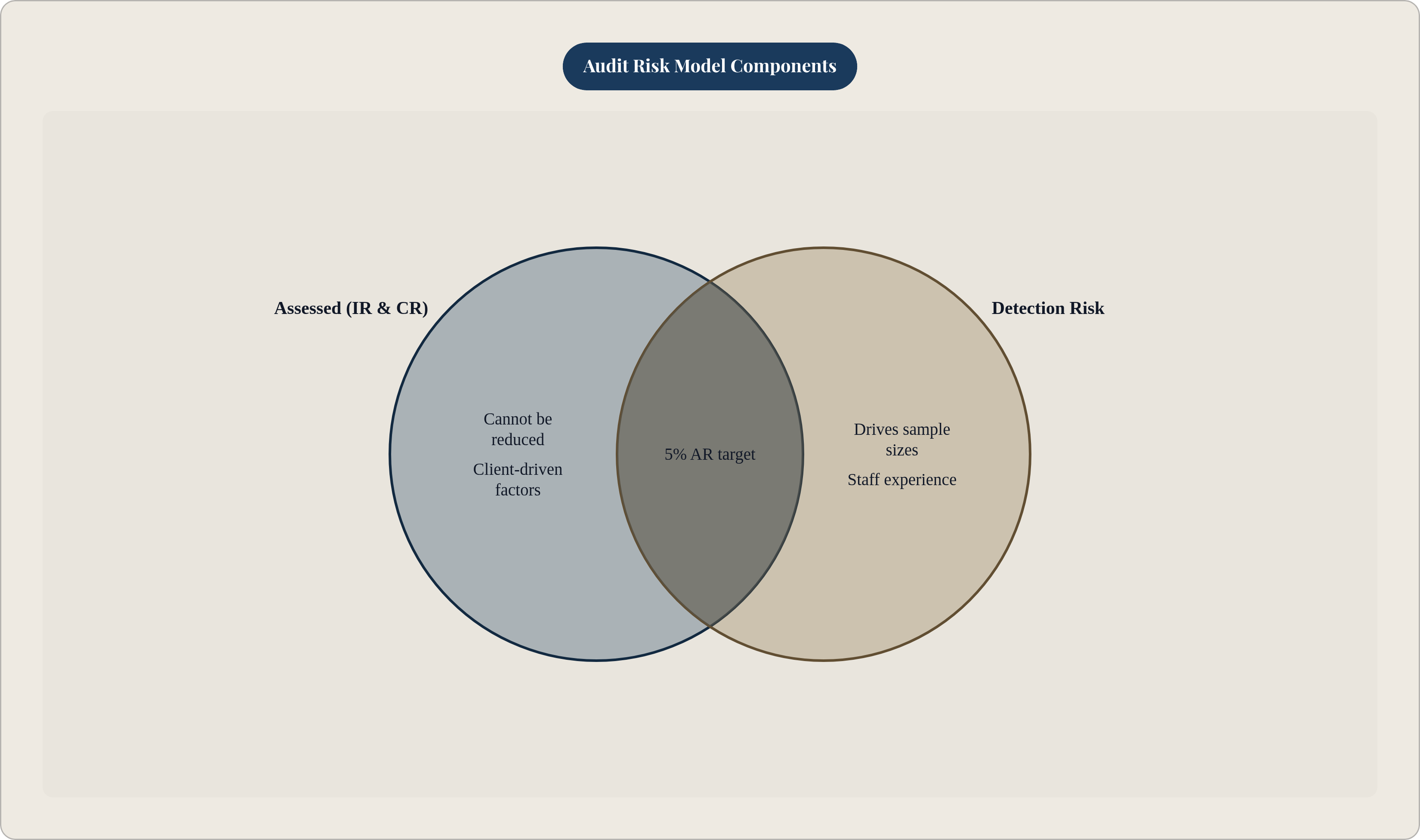
Control risk is the probability that a material misstatement existing in an assertion will not be prevented or detected on a timely basis by the entity's internal controls. Unlike inherent risk, it is partly within the client's influence. Strong, well-designed controls operating effectively can suppress it substantially. Weak, absent, or untested controls leave it at its maximum.
The auditor's choice at this stage is consequential and binary in its practical effect. If the team elects to test the operating effectiveness of controls and those controls prove effective, control risk can be assessed below maximum. If the team does not test controls, whether for resource reasons or because the initial assessment suggests controls are weak, standards require control risk to be set at maximum. There is no middle ground in the documentation.
The practical consequence of setting CR at maximum is that the risk of material misstatement collapses into inherent risk. Every dollar of risk identified in the inherent risk assessment is treated as wholly unmitigated. In a high-inherent-risk area, that is an aggressive posture, and it demands a correspondingly aggressive substantive response.
It is also worth considering how control risk functions as a multiplier on inherent risk rather than an independent variable. A high-IR account with tested, effective controls leaves the auditor in a defensible position; a high-IR account with untested controls is the scenario that most strains detection risk, the only lever remaining.
Detection Risk: The One Component the Auditor Can Actually Control
Detection risk is the probability that the auditor's own procedures will fail to detect a material misstatement that exists. The distinction between assessment and management is the key conceptual divide in the entire model. Inherent risk and control risk are assessed based on evidence about the client and its environment. Detection risk is managed: it is the auditor's response variable, adjusted to hold overall audit risk at the target level.
The inverse relationship between assessed risk of material misstatement and allowable detection risk is straightforward in principle and demanding in practice. When both IR and CR are high, the product of those two components is large, and DR must be correspondingly small to keep the overall product at or below 5%. Working through the arithmetic with illustrative figures embedded in audit standards, an inherent risk at maximum and a control risk assessed at 70% implies a required detection risk of roughly 7% to achieve a 5% overall audit risk target. That is a stringent requirement, and it translates directly into the design of the substantive program.
Auditors reduce detection risk by pulling several interdependent levers: expanding sample sizes, deploying more experienced personnel in high-risk areas, adding substantive procedures including both analytical procedures and tests of detail, and using data analytics to examine full populations rather than relying on samples. Each of these choices carries a cost, which is precisely why accurate IR and CR assessment matters so much upstream. Overstating RMM in a low-risk area drives unnecessary expenditure; understating it in a high-risk area produces deficiencies.
Sampling risk is worth addressing as a distinct concept here, because it is often conflated with detection risk broadly. Sampling risk is the possibility that a sample drawn from a population will not be representative, meaning misstatements present in the full population may be absent from the sample, or vice versa. It is a subset of detection risk, and it varies inversely with sample size. Larger samples reduce sampling risk but do not eliminate it; detection risk itself cannot be driven to zero. The model makes the irreducible residual explicit, which is one of its underappreciated contributions to intellectual honesty about what audits can actually guarantee.
How the Three Components Interact When the Formula Is Applied
In practice, auditors fix their target audit risk before fieldwork begins, typically at 5%, and then assess IR and CR based on planning procedures and accumulated evidence. Detection risk is the derived variable: the maximum level at which the substantive program can operate if the team intends to hold overall audit risk at target.
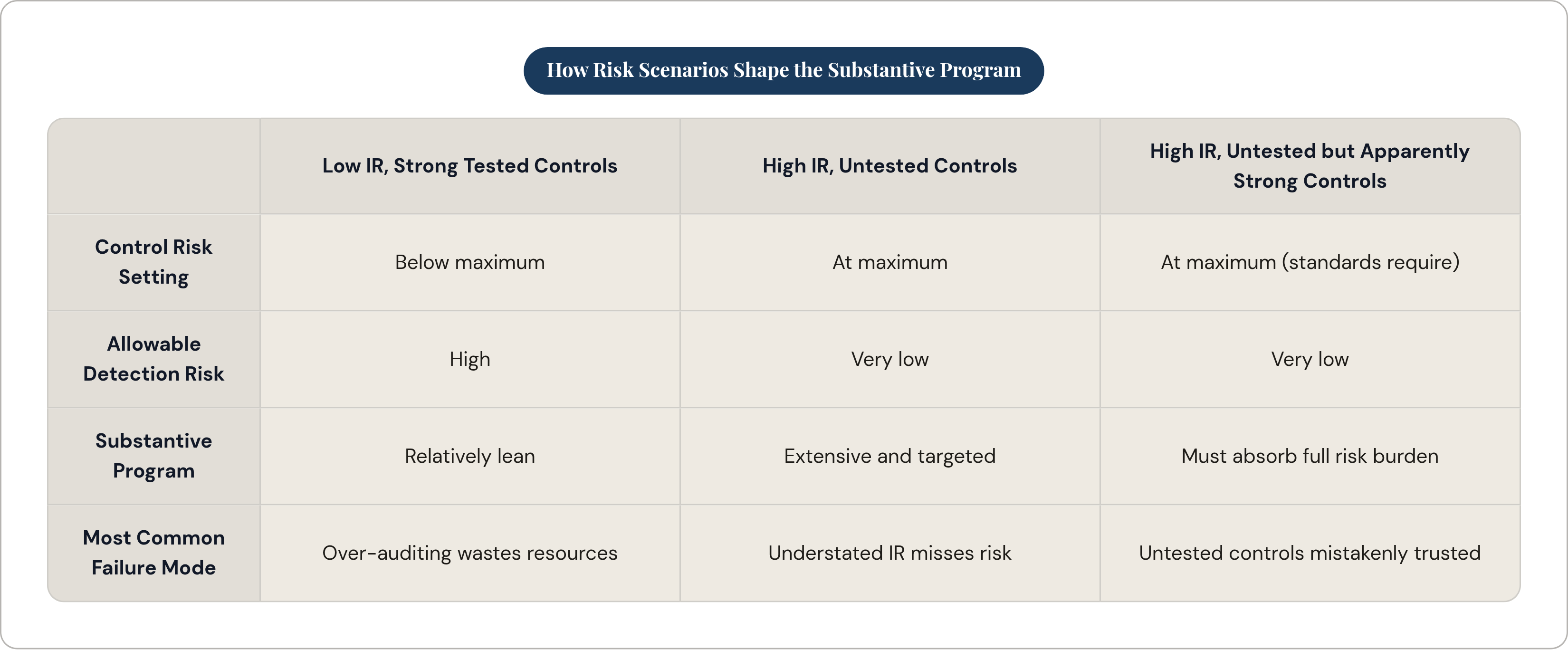
The logic plays out differently across risk scenarios, and tracing those differences clarifies why the formula is useful as a planning instrument even when it is not treated as a precise calculation. In an area with low inherent risk and strong, tested controls, CR falls below maximum and DR can be set high, meaning the substantive program can be relatively lean. In an area with high inherent risk and untested controls, CR stays at maximum, DR must be very low, and the substantive program must be correspondingly extensive. The scenario most frequently mishandled in practice is the third: high inherent risk with controls that appear strong but have not been tested. In that case, regardless of how effective those controls might actually be, standards require CR at maximum, and DR must absorb the full burden of risk mitigation.
A practical implication that does not receive adequate attention in planning discussions is the cost of error in both directions. Over-assessing IR in a low-risk area is not a conservative, defensible choice; it is a misallocation of audit resources, consuming hours that could more productively be directed elsewhere. Under-assessing IR in a high-risk area creates the conditions for undetected deficiencies. Both errors are costly, in opposite directions, and the model's value as a planning tool depends on getting the assessments as accurate as the available evidence permits.
What SAS 145 Changed About How the Model Is Applied
Statement on Auditing Standards No. 145, effective for financial statement periods ending on or after December 15, 2023, does not alter the foundational structure of the audit risk model. What it does is clarify and enhance the rigor with which its components are assessed and documented, with particular emphasis on inherent risk.
The most operationally significant change is the mandatory separate assessment requirement. Previous guidance permitted auditors to develop a combined estimate of the risk of material misstatement, blending IR and CR into a single judgment. SAS 145 prohibits this. Each component must be assessed independently, documented separately, and if controls are not tested, the standard explicitly requires CR at maximum and RMM equal to IR. There is no longer any path to a blended assessment that softens the documentation burden of a control-heavy RMM estimate.
SAS 145 also introduces the concept of the inherent risk spectrum, which is new conceptual territory. Auditors are now required to consider both the likelihood and the magnitude of a potential misstatement at the assertion level, positioning their assessment on a spectrum rather than selecting from a discrete set of categories. Significant risks are defined under the standard as identified risks with inherent risk assessed near the upper end of that spectrum, a definition anchored exclusively in IR and independent of the auditor's planned response. This reframing matters because it separates what is risky from what the auditor intends to do about it, a distinction that prior practice sometimes blurred.
The stand-back provision introduces a sequencing requirement that is new in explicit form: auditors must prioritize significant classes of transactions, account balances, and disclosures before addressing other material amounts. And the revised definition of a relevant assertion, now requiring an identified risk of material misstatement rather than the previous "reasonable risk" threshold, narrows which assertions demand full assessment-level scrutiny.
One underappreciated operational benefit of the standard is the relief it provides in low-risk areas. Where IR is assessed as low and documented as such, the resulting lower RMM legitimizes smaller sample sizes in those areas, freeing engagement hours for redeployment toward higher-risk assertions. This is efficiency through accuracy, not efficiency through corner-cutting.
Where Audits Most Commonly Break Down Under the Model
PCAOB inspection data released in March 2025 reported an aggregate Part I.A deficiency rate of 39% in 2024, down from 46% in 2023. Progress is real, but more than one in three inspected audits still carried a deficiency. For the eight non-Global Network Firm firms inspected annually, the 2024 deficiency rate was 52%, essentially unchanged from 53% the year prior. Whatever is improving at the largest firms has not yet reached mid-tier and smaller practices at comparable scale.
The most common deficiency identified in 2024 was failure to sufficiently understand the client's accounting procedures or policies. That raises an important question: if the audit risk model requires accurate IR assessment as its first and most foundational step, and the most common deficiency is inadequate understanding of the very factors that drive IR, are firms treating the model as a genuine diagnostic tool or as a documentation exercise completed after the real decisions have already been made? The recurring PCAOB problem areas, revenue recognition, accounts influenced by business combinations, inventory, goodwill and intangibles, equity transactions, are precisely the high-inherent-risk, judgment-intensive accounts where the model demands the most rigorous planning.
What the inspection data suggests, when read alongside the deficiency type, is that breakdowns cluster not where controls are absent but where auditors underestimate the risk in the first place. An auditor who has walked through the revenue recognition cycle for the same client twelve times has a well-documented tendency toward familiarity bias, a softening of skepticism that SAS 145 explicitly calls out. The standard requires professional skepticism even in areas auditors believe they understand well, precisely because comfort with a process is not evidence of its integrity.
The implication is uncomfortable but worth sitting with: the model works when auditors use it as a genuine diagnostic tool. It fails when it becomes a documentation exercise, populated after the substantive program has already been designed.
Applying the Model as a Resource Allocation Tool, Not Just a Documentation Requirement
The model's most practical function in a well-run audit is telling the team where to invest time and where to exercise restraint. High-DR areas, those where RMM is low, justify leaner procedures. Low-DR areas, where IR is high and controls are untested or ineffective, require the engagement's heaviest substantive investment. This is resource allocation logic, and it improves both efficiency and quality simultaneously when the underlying risk assessments are accurate.
SAS 145's data-driven orientation suggests that firms applying the standard seriously should expect to rely more heavily on analytics-based risk assessment and less on uniform tests of detail distributed across all material accounts. The standard's emphasis on understanding transactions and identifying risks with precision is more compatible with targeted, evidence-driven procedures than with the blunt instrument of standardized sample sizes applied regardless of risk level.
Staffing follows directly from DR management. Detection risk is not only a function of how many items are tested; it reflects who is doing the testing and how capable they are of recognizing what a misstatement would look like in that specific context. Assigning less experienced staff to an area carrying a low allowable DR is a structural risk, not a budgetary decision. The engagement partner who treats high-risk areas as training opportunities is, in effect, setting DR higher than their documentation reflects.
The feedback loop that accurate ARM application creates is worth tracing explicitly. Accurate IR assessment leads to an appropriate CR determination, which produces a calibrated DR target, which drives a right-sized substantive program. Reduced over-auditing in low-risk areas frees hours for high-risk areas. The documentation requirements SAS 145 imposes on this process are not administrative overhead; they are a quality control mechanism, creating an auditable trail of the team's risk reasoning rather than merely its conclusions.
The model's limits deserve acknowledgment. It structures judgment; it cannot substitute for it. Skepticism, industry knowledge, and a genuine understanding of why a particular management team might be motivated to misstate a particular account are irreducibly human inputs. No formula produces those. What the audit risk model does, at its best, is give experienced auditors a coherent framework for translating judgment into defensible decisions about where to look, how hard, and with how much evidence. But how does this affect our original promise? If the model's value depends entirely on the quality of human judgment feeding into it, then improving audit outcomes is less a technical problem than a behavioral one, and one the inspection data answers, at least partially, every year.