Going Concern Disclosures in Audit Reports
Auditors must independently verify management's going concern analysis and disclosure.

Financial statements rest on a foundational premise: the entity will continue operating for the foreseeable future. When that premise holds, assets are valued as productive, liabilities are classified by contractual terms, and the financial picture reflects a going enterprise. When it breaks, those same judgments may need to be revisited entirely. This is not a technicality; it is the structural logic underlying every number on the page.
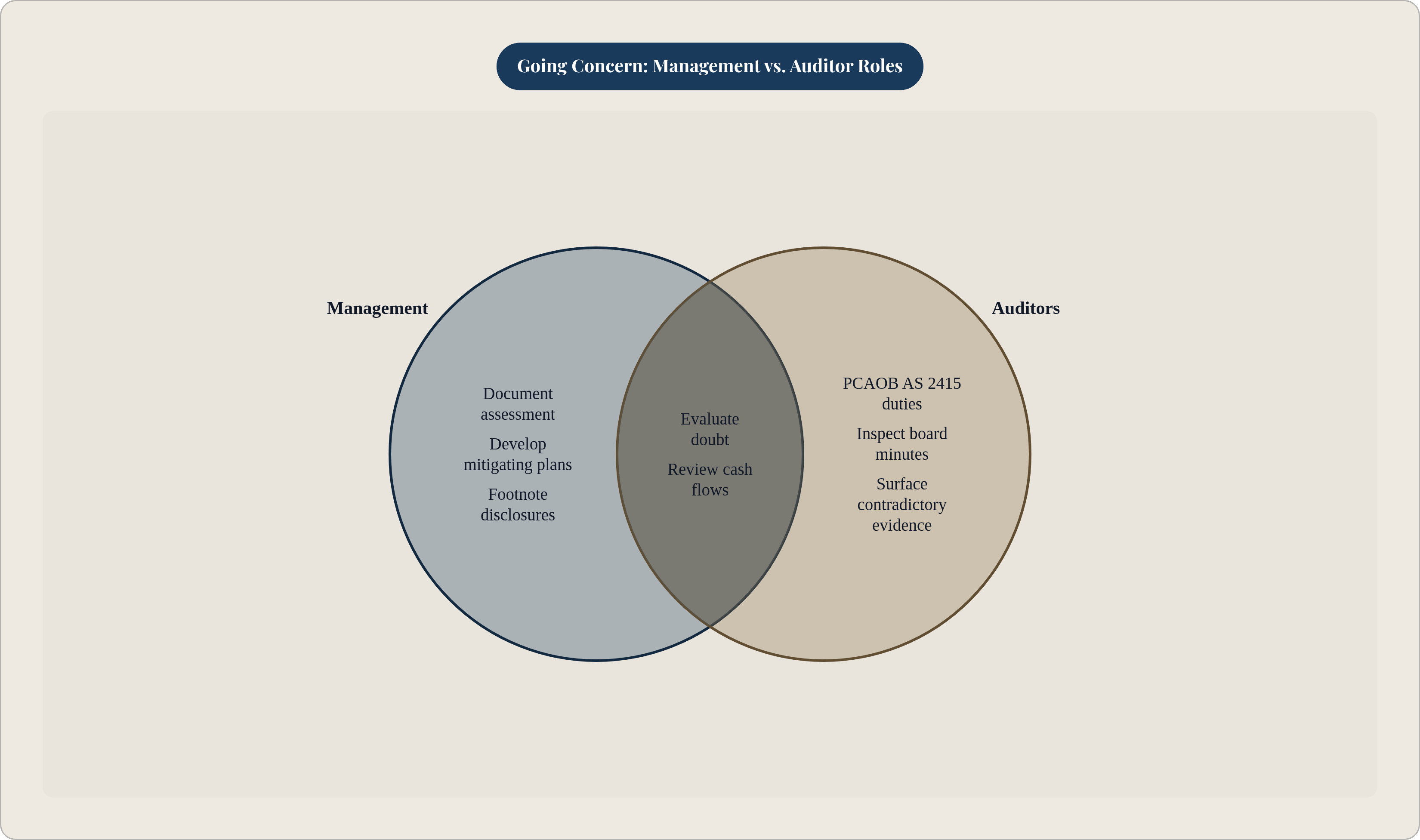
After ASU 2014-15, auditors no longer carry primary responsibility for the going concern assessment; management does. The auditor's role is to test management's evaluation independently, examining whether the analysis was thorough, whether the identified conditions are complete, and whether any disclosed mitigating plans are feasible, specific, and within management's control. That sequence clarifies accountability without eliminating disagreement when conditions fall in a gray zone. The one-year look-ahead window runs from the date financial statements are issued or available to be issued, a distinction that forecloses holding statements until liquidity improves and releasing them with the problematic conditions already behind the curtain.
What are the auditor's responsibilities after ASU 2014-15 shifted primary assessment duties to management, and how does the one-year look-ahead window work under U.S. GAAP? Management must now evaluate, document, and where necessary disclose. Auditors then test that evaluation independently. The sequence clarifies accountability, even if it does not resolve the tension between the two parties when conditions sit in the gray zone.
The look-ahead window under U.S. GAAP is one year from the date financial statements are issued, or available to be issued. That second clause was deliberate: it forecloses holding statements until liquidity improves, then releasing them with the problematic conditions conveniently behind the curtain. The clock starts when statements are ready.
The conditions that raise substantial doubt fall into two broad categories. Financial indicators are the familiar ones: recurring operating losses, working capital deficiencies, negative operating cash flows, adverse key ratios. But non-financial and operational indicators carry equal weight. Covenant defaults, denial of ordinary trade credit, arrearages in dividends, noncompliance with statutory capital requirements, the scramble for unconventional financing. I have seen balance sheets that looked passable right up until the moment a supplier stopped extending credit; by the time that showed up in the ratios, the assessment was already overdue.
Management's evaluation has two steps. First, assess whether substantial doubt exists in the aggregate, considering all relevant conditions together. Individual conditions that appear manageable in isolation can collectively indicate real risk, and a checklist mentality will miss that. Second, if substantial doubt is identified, determine whether planned mitigating actions are sufficient to alleviate it, and whether those plans are feasible, specific, and within management's control. That second step is where most of the real argument happens.
Disclosure is triggered only when substantial doubt is raised. The assessment itself, however, is required every reporting period regardless of whether conditions look dire. Every entity, every year, owes at least a thorough pass through the analysis.
How auditors independently evaluate management's assessment
Under PCAOB AS 2415, the auditor's obligation is not to review management's paperwork and assess its tidiness. It is to independently evaluate whether substantial doubt has been correctly identified, whether management's mitigating plans are feasible, and whether the overall assessment is reasonable. That requires the auditor's own evidence, gathered through the auditor's own procedures.
That evidence typically includes cash flow projections, debt covenants, financing commitments, subsequent events, and board minutes. But the quality of that evidence varies considerably. A signed refinancing commitment and a letter of intent both land in the same folder. They are not the same thing, and the auditor's job is to make that distinction explicit and document why it matters. I have sat in rooms where management presented both as roughly equivalent signs of progress. They are not.
Testing mitigating plans requires asking uncomfortable questions: Are the identified actions actually within management's control, or do they depend on third-party decisions management cannot compel? Is the timeline realistic within the look-ahead window? Are the underlying assumptions conservative, or do they represent the most optimistic scenario management could construct without being obviously wrong?
The 2024 revision to ISA 570 formalizes what experienced auditors have understood for years: confirmation bias is a hazard in this work. Management presents its analysis with understandable, sometimes strategic, optimism. The auditor who evaluates only evidence that corroborates that view is not conducting an independent assessment. The revised standard requires designing procedures that surface contradictory evidence. The requirement is new; the principle is not.
It is also worth considering what this means for non-financial risks, now formally in scope under the revised international standard: customer concentration, supply chain instability, technological obsolescence. These conditions do not reliably show up in financial ratio analysis until they have already done significant damage. An entity can have an acceptable income statement and a fragile business.
How the conclusions translate into audit report language
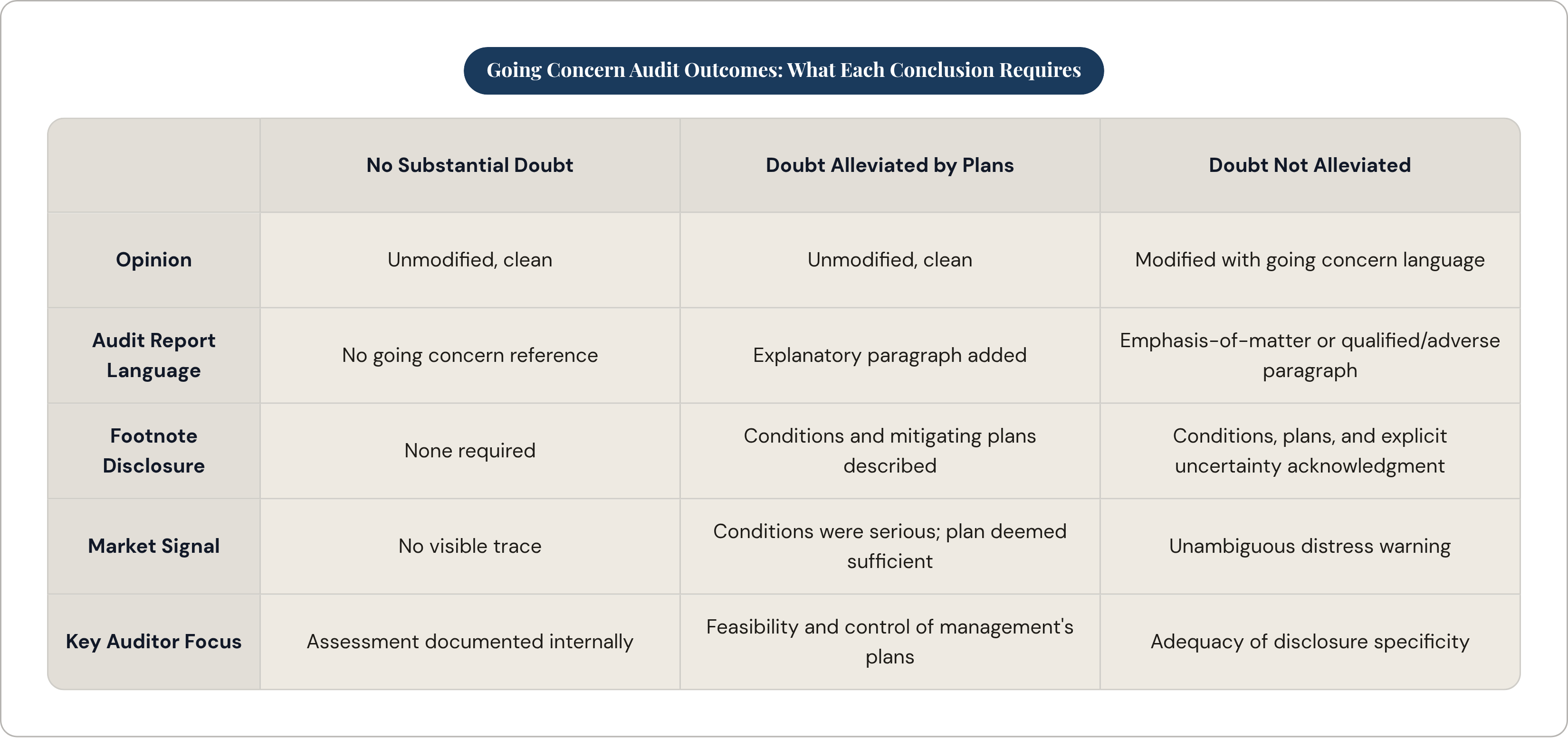
There are three possible outcomes, each with distinct implications.
When no substantial doubt is found, no going concern language appears in the report. The assessment happened, was documented, and leaves no visible trace in the opinion. For most audits, this is where things end.
When substantial doubt exists but management's plans adequately mitigate it, an explanatory paragraph is added but the opinion itself is not modified. Conditions were serious enough to raise doubt; management has a credible plan; the auditor assessed the plan as sufficient. The disclosure is in the footnotes, the opinion stays clean. This distinction matters enormously to clients, and explaining it clearly before they see the draft report is part of the auditor's job. Clients who learn it for the first time in fieldwork tend to conflate explanatory paragraph with modified opinion, and that confusion is avoidable.
When substantial doubt exists and is not adequately alleviated, the opinion is modified with going concern language. Depending on the framework, this takes the form of an emphasis-of-matter or a qualified or adverse paragraph. The signal to the market is unambiguous.
The accompanying footnote disclosure must describe the conditions that raised doubt, the plans management intends to pursue, and, if doubt is not fully alleviated, an explicit acknowledgment that material uncertainty remains. Adequacy of that disclosure is itself an audit judgment. A footnote that gestures at conditions in general terms without specifics about the plans or their feasibility may be technically present and practically useless.
Babcock & Wilcox Enterprises' 2024 annual filing illustrates what precision looks like. The company disclosed substantial doubt arising from uncertainty over its ability to refinance specific credit facilities before specific maturity dates. Specific facilities, specific deadlines: that level of granularity gives investors a concrete basis for evaluating the risk rather than a vague statement that conditions are challenging.
How common going concern opinions actually are (and what conditions drive the count up)
Going concern opinions are more common than most people outside auditing expect. According to Audit Analytics' twenty-year review, roughly one in four public companies received a going concern opinion in fiscal year 2022. That figure is not an anomaly; it reflects the breadth of conditions that can trigger the evaluation and the range of companies that operate near the margins of the relevant financial indicators. But what if that number is itself a signal worth interrogating — not just of corporate distress, but of whether the assessment is being applied consistently across engagements?
The count is cyclical and macro-sensitive. Opinions peaked during the 2008 financial crisis and have risen again as bankruptcies increased through 2024, a trend documented alongside broader concerns about audit rigor in the Netherlands Authority for the Financial Markets' 2025 exploratory study. When credit tightens, covenant defaults rise. When revenues compress, working capital deficiencies follow. The connection is direct, and the audit community does not get to pretend otherwise when the cycle turns.
The PCAOB's 2025 inspection priorities flagged specific sectors for heightened going concern scrutiny: financial services, real estate, and information technology, alongside companies affected by supply chain disruption and M&A activity. For firms with significant practices in those sectors, going concern is not an edge case managed by a small group of distressed-company specialists. It surfaces across engagement teams with varying levels of experience, which creates its own quality risk.
The rising bankruptcy environment makes sound going concern judgment more consequential, for investors relying on audited financials and for audit firms managing their own professional liability. These two things are related; firms sometimes need the reminder.
Why the going concern opinion can accelerate the very distress it reports
Here is the uncomfortable structural problem. A going concern opinion is designed to warn stakeholders. The warning itself can tighten credit, unsettle customers and suppliers, and trigger covenant defaults that are contractually tied to audit opinion language, worsening precisely the conditions the auditor was evaluating. The disclosure does not merely report risk; it can amplify it. At what point does transparency become a destabilizing force?
Companies understand this. The resistance to a going concern opinion is often not irrational. It reflects a realistic assessment of the economic consequences of disclosure, not merely the reputational ones. Management's mitigating plans, when presented to auditors, carry the weight of that awareness. The plans may be credible. They may also be presented with a degree of strategic optimism that exceeds what the underlying evidence supports.
The standard's structure acknowledges this tension, whether or not the drafters would use that word. The look-ahead window, the mitigating-plans step, the two-tiered outcome between an explanatory paragraph and a modified opinion: these features give management a legitimate path to avoid a modified opinion when plans are real and feasible. That is appropriate. It is also the precise point where auditor skepticism matters most, because the path can be constructed from optimistic projections rather than credible commitments. That raises an important question: how does an auditor distinguish between a plan that is feasible and one that has been engineered to clear the bar?
The AFM's 2025 exploratory study frames insufficient going concern auditing as a public interest failure, not merely a technical deficiency. When investors absorb losses from corporate failures that more rigorous going concern work might have surfaced earlier, the failure extends beyond the company. The standard-setters have responded to this tension by expanding auditor responsibility and strengthening transparency requirements. Both the PCAOB's ongoing AS 2415 research project and ISA 570's 2024 overhaul reflect that logic, and neither emerged from a vacuum.
What the ISA 570 revision changes for auditors and their clients starting in 2026
ISA 570 (Revised 2024) takes effect for audits of financial statements for periods beginning on or after December 15, 2026. It is the most substantial overhaul of the international going concern standard since the 2016 revision, and the changes are structural.
Report structure and transparency
All going concern commentary must now be consolidated into a single dedicated section of the audit report. Previously, references could be scattered across different opinion paragraphs, leaving readers to piece together the auditor's overall conclusion. The consolidation addresses a real readability problem that practitioners have complained about for years.
More significantly, every audit report must now explicitly address going concern, even when no material uncertainty is found. A clean report that is silent on the question and a clean report that explicitly confirms no material uncertainty was identified now carry different information content. That distinction is not subtle; it changes what a clean report actually communicates.
For listed entities, close-call situations must appear in a separate report section. When substantial doubt was identified but ultimately resolved, that fact must be disclosed rather than being absorbed into Key Audit Matters or left undisclosed entirely. This is a meaningful increase in transparency for precisely the situations where the auditor's judgment was most heavily tested.
Minimum assessment period
If management's evaluation covers less than twelve months from the date of approval, auditors must require management to extend it. The previous standard permitted abbreviated assessments in certain circumstances. Some engagements exploited that gap, whether intentionally or through comfortable inattention.
Definitions and scope
A new formal definition of "material uncertainty" clarifies a threshold that previously varied in interpretation across engagements and jurisdictions. Non-financial risks, including customer concentration, supply chain fragility, and technological disruption, are now explicitly in scope. The explicit prohibition on confirmation bias requires auditors to design procedures that surface contradictory evidence rather than validate management's conclusions.
Practical implications
For audit teams, the revised standard means more documentation, earlier in the engagement. Going concern cannot be treated as a late-stage wrap-up procedure. The conditions that warrant assessment are present at the start of most engagements. The investor-facing rationale for these reforms is stated explicitly in the standard-setters' communications: major corporate collapses where auditors issued clean reports shortly before failure prompted the overhaul. This is a response to demonstrated failure, not a precautionary refinement.
Where the U.S. standard stands (and what the PCAOB's quality infrastructure changes mean for going concern work)
PCAOB AS 2415 is under active research; no revised standard has been finalized. U.S. auditors are not yet subject to the ISA 570 changes. The direction of travel, however, is not ambiguous. Investor feedback about the effectiveness of going concern reporting has directly prompted the PCAOB's standard-setting research, and the inspection priorities reveal where the Board believes practice is weakest.
A parallel quality infrastructure change affects going concern work independently of the AS 2415 revision. QC 1000, the PCAOB's new quality control standard, becomes effective December 15, 2026, following a one-year delay to allow firms more implementation time. The standard requires proactive, risk-based quality control systems. The shift matters: the previous model was largely reactive, relying on after-the-fact inspection findings to surface weaknesses. QC 1000 requires firms to identify engagement types with elevated quality risk and have documented controls in place before inspectors arrive.
Going concern assessments in distressed-company audits are a textbook example of elevated quality risk under that framework. Judgment intensity is high, documentation requirements are demanding, and the consequences of deficient work are significant. Firms that have not explicitly identified going concern as an area requiring enhanced controls in their QC 1000 implementation will likely encounter that observation during inspections. That is not speculation; it is pattern recognition.
RSM's publicly disclosed 47.1% deficiency rate in its 2023 PCAOB inspection led the firm to establish an independent audit quality advisory board, illustrating that judgment-intensive areas, including going concern, are where inspection findings concentrate. The rate is a firm-specific data point, but the pattern it reflects is not unique to RSM.
The PCAOB's 2025 inspection selections explicitly prioritized audits with heightened going concern risk in financial services, real estate, and IT. Firms with significant practices in those sectors should treat that as a concrete signal.
What firm leaders and their clients should do when conditions might warrant a disclosure
Timing is the first thing. Going concern should not arrive as a year-end surprise. Auditors who raise the issue for the first time during fieldwork, when the look-ahead window is nearly exhausted and mitigating options are narrowing, have already handled it poorly. The relevant conditions are visible earlier in most cases; the question is whether anyone is paying attention.
Management's assessment is substantive work. A signed refinancing commitment is evidence. A letter of intent expressing interest in future discussions is not the same thing, and presenting them as roughly equivalent will not survive auditor scrutiny. Management should pressure-test its own plans before presenting them: Are the proposed actions within our control? Are the assumptions underlying these projections conservative, or are they the best case we could construct without being called out? Is the timeline realistic? The auditor will ask all of this. Anticipating those questions with documentation is more credible than answering them under scrutiny during fieldwork.
The distinction between the two-tier outcomes deserves explicit client communication, and it should happen before the draft report is on the table. An explanatory paragraph without an opinion modification signals that conditions were serious, that management has a plan, and that the auditor assessed the plan as sufficient. It is not automatically a crisis signal. Conflating it with a modified opinion causes clients to either overreact to the former or underestimate the latter, sometimes both within the same engagement.
Disclosure quality matters under the revised standards even when doubt is ultimately alleviated. Footnote language that describes conditions in general terms, names plans without specifics, or omits the timeline and feasibility basis for management's conclusions is itself an audit finding. Management should write disclosures that are specific about what the conditions are, what the plans entail, and what uncertainty remains. Boilerplate language that satisfies the checkbox without informing the reader will draw scrutiny it could have avoided.
For audit firms, going concern engagements are documentation-intensive and judgment-intensive in ways that other audit areas simply are not. Gathering contemporaneous evidence, documenting the evaluation of mitigating plans with the specificity the standard requires, maintaining documentation that holds up under inspection: the administrative burden is real, and it belongs at the front of the engagement, not wedged into the closing days. Treating going concern as a low-effort wrap-up procedure is where inspection findings originate. Experience makes that observation feel less like a principle and more like a pattern.