Risk Assessment Procedures in Audit Planning
Auditors often check the audit risk formula without using it as an integrated decision system.

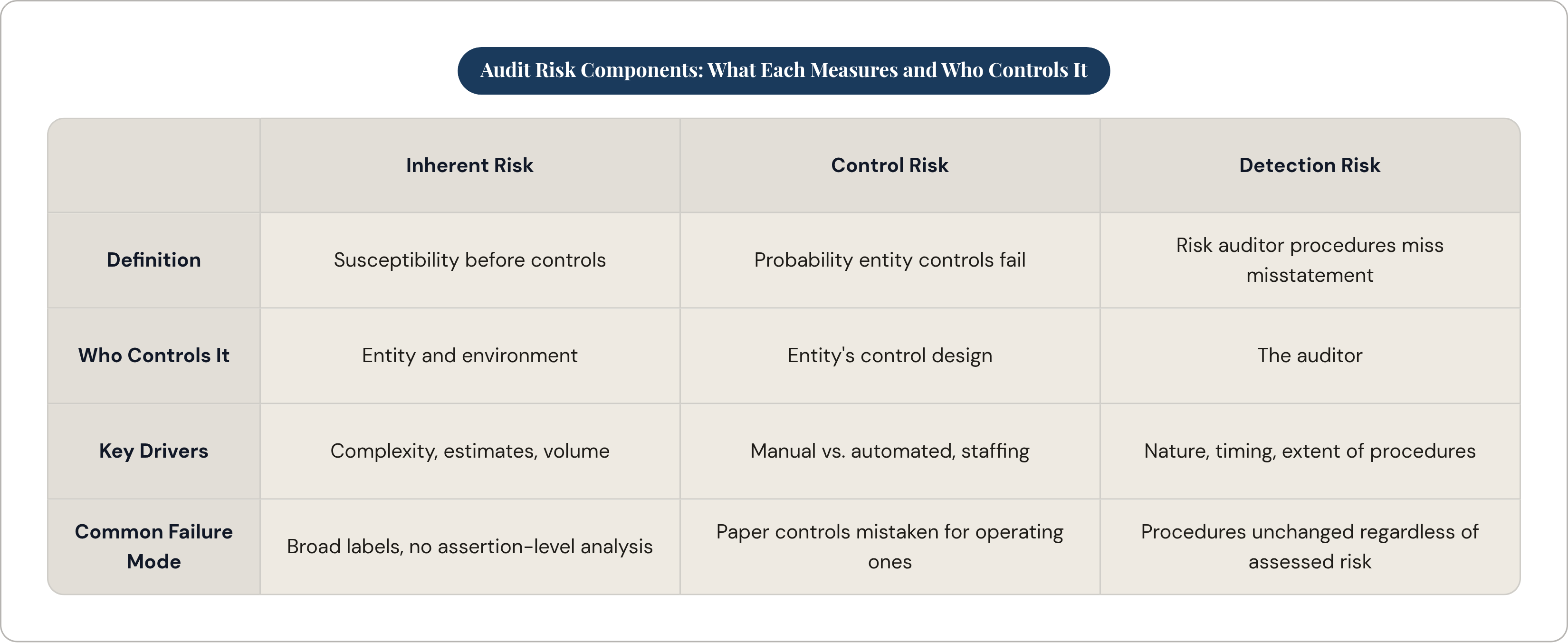
Audit risk equals inherent risk multiplied by control risk multiplied by detection risk. Most auditors can recite this. The recitation, though, may be precisely the problem.
These three components are not independent scores to be assigned in sequence. They are interdependent levers, and treating them otherwise produces documentation rather than analysis.
Inherent risk reflects susceptibility to misstatement before controls enter the picture. The drivers are well understood: complexity, subjectivity, transaction volume, significant estimates. A large portfolio of variable-rate instruments carries higher inherent risk for valuation than a simple cash account. Nobody disputes this in the abstract. In practice, though, inherent risk assessments routinely collapse into broad labels applied at the account level without interrogating the assertion-level exposure underneath. "High," "moderate," "low," floated without analytical support. That collapse is where precision gets quietly abandoned.
Control risk is the probability that the entity's own controls fail to prevent or detect a material misstatement. A control that exists on paper but runs through an overwhelmed staff accountant at every quarter-close is not operating at the same risk level as a system-enforced three-way match, regardless of how both are labeled in the workpapers. Manual controls carry more variability than well-configured automated ones. By their nature, they always will.
Detection risk is the one component the auditor actually controls, which is what makes it consequential. If inherent and control risk are assessed as high, detection risk must be driven correspondingly lower: more extensive procedures, better targeted, timed closer to year-end. The auditor cannot alter the inherent susceptibility of a complex estimate, and may not be able to rely on controls that are weak or untested. Adjusting the nature, timing, and extent of procedures is the available lever, and it has to be used deliberately.
Where full-population testing remains impractical, sampling risk deserves explicit treatment alongside these three. Testing a sample rather than the complete population leaves a residual risk that untested items contain misstatements that go undetected. High inherent or control risk assessed alongside high sampling risk should logically push toward larger sample sizes or alternative approaches. Whether it does in practice is a different question.
But what if an auditor assesses inherent risk as high, control risk as moderate, and then designs procedures at roughly the same rigor applied last year? That auditor has not used the model. The components are a system. Treating them as three separate checkboxes defeats the point of the framework entirely.
Understanding the entity and its environment as the starting point
Before any risks can be meaningfully identified, the auditor needs a working model of the entity: what it does, how it generates revenue, what pressures it operates under, how it is governed. This foundation shapes every judgment that follows. It is not background reading to skim before fieldwork begins, and the difference between teams that treat it seriously and those that do not becomes visible quickly in the quality of what gets identified downstream.
The areas to cover are well-specified in the standards. Industry and external environment: sector norms, competitive dynamics, regulatory requirements specific to the client's industry, which are materially more complex for a healthcare entity or registered broker-dealer than for a straightforward manufacturing company. Nature of the entity: organizational structure, ownership, governance arrangements, business model, the revenue streams driving financial performance. Accounting policies: whether the policies the entity has adopted are appropriate for its transactions, and whether estimates are developed through a reasonable process.
Objectives, strategies, and related business risks require more judgment than the other categories. Management's strategic priorities create financial reporting exposures in ways that are not immediately visible. A company pursuing aggressive revenue growth through channel partners faces different completeness and occurrence risks on revenue than one with a direct sales model. A business under covenant pressure has different incentives around debt classification than one with ample liquidity. Understanding what management is trying to accomplish financially gives you a materially different vantage point than reading the prior-year financial statements alone.
Internal controls must be understood at the entity level, not only at the transaction level. PCAOB AS 2201 addresses this for integrated audits, but the principle applies broadly: the control environment, management's risk assessment processes, information and communication systems, and monitoring activities all shape the reliability of financial reporting. An entity with a skeptical audit committee and an engaged internal audit function operates in a meaningfully different environment than one where management's tone around controls is, at best, casual.
The sources for building this understanding are varied and practical. Inquiry of management, those charged with governance, and operational personnel with direct knowledge of high-risk processes. Preliminary analytical procedures, ratio and trend analysis, to surface anomalies before fieldwork begins. These analytics are risk identification tools at this stage, not substantive tests; the distinction matters for how findings get interpreted and documented. Observation of operations, review of significant contracts, board minutes, regulatory correspondence, and prior-period workpapers round out the picture.
An auditor with a solid working model of how the entity actually functions will identify risks that a checklist-driven approach misses. Checklists are built from generic risk categories, not from this client's specific circumstances. The quality of this understanding determines the quality of everything that follows.
Using prior audit information without letting it anchor the assessment
Continuity across engagements is valuable. Per PCAOB AS 2110, auditors may limit the nature, timing, or extent of risk assessment procedures by relying on prior-period information. The standard's condition is critical: the auditor must evaluate whether that prior information remains relevant and reliable in the current period. That evaluation is frequently cursory, and the gap between what the standard requires and what actually happens is where a significant amount of risk-assessment quality disappears.
Several conditions consistently erode prior-period relevance. Personnel changes in key financial reporting or control roles matter because controls are not abstract; they run through specific people. A new controller, turnover in accounts receivable, a change in internal audit leadership each warrant fresh scrutiny of the procedures and judgments that person owned. Significant system implementations or ERP migrations change the automated control environment in ways that can render prior assessments entirely obsolete. Mergers, acquisitions, restructurings, and new business lines introduce transactions, estimates, and disclosure requirements the prior-period risk matrix simply did not contemplate. Prior-period deficiencies that were not fully remediated are active risks, not closed files.
The anchoring problem is structural rather than a matter of individual discipline. Teams under time pressure gravitate toward rolling forward last year's risk matrix because it is efficient in the short term, and the consequences of an under-updated assessment are not immediately visible. A team defaulting to prior-period conclusions without reassessment is effectively auditing the prior period: applying yesterday's risk picture to today's engagement.
The discipline that counteracts this is documentation with a specific constraint. For each area where the prior-period assessment is carried forward, the auditor must explicitly state why that assessment remains valid, rather than assuming continuity. Writing out the rationale forces a real evaluation. If the rationale cannot be articulated, the rollforward is not defensible, and what appears to be a documented risk assessment is actually a documented assumption.
Change velocity is the most reliable signal that prior-period reliance deserves heightened scrutiny. M&A activity, system implementations, and regulatory shifts all compress the half-life of prior-year knowledge. That raises an important question: is the team asking whether something has changed, or whether it has actually looked closely enough to find out? On most active engagements, something always has changed. The question is whether the team has actually looked.
Identifying and prioritizing risks of material misstatement across assertions
Risk identification is assertion-level work. The auditor is not assessing whether an account is "risky" in the aggregate; the work is locating where, within specific balances, transaction classes, or disclosures, misstatements could occur and survive undetected. The assertions provide the organizing structure: existence and occurrence, completeness, valuation and accuracy, rights and obligations, presentation and disclosure.
Each assertion carries its own risk profile for a given account. Revenue recognition on a long-term service contract may be low risk for completeness but high risk for accuracy and cutoff, depending on contract terms and the entity's estimating process. Inventory may be high risk for existence at a company with significant cycle count failures and low risk for valuation if products are fungible and market prices are readily observable. Collapsing these into a single account-level rating loses information that will quietly shape the audit response in the wrong direction before anyone realizes it has been lost.
Significant risks deserve separate treatment. These are risks that, due to their nature, require substantive procedures regardless of how the control assessment comes out. Fraud risk qualifies. Related-party transactions generally qualify. Estimates with high subjectivity, including certain fair value measurements, contingent liabilities, and revenue recognition under complex contract arrangements, frequently qualify. The significance designation carries real procedural consequences, and I have watched the rationalization happen more than once: the significant risk designation quietly pulled back to reduce workload, documented in language too vague to challenge, never looking defensible in hindsight.
Revenue recognition and complex contract arrangements are structurally among the highest-risk areas across entity types, for reasons independent of any particular client. The five-step model under ASC 606 creates multiple judgment points, each a potential source of misstatement: identifying performance obligations, allocating transaction price, recognizing revenue as obligations are satisfied. The risk of misapplication rises in arrangements that are novel, complex, or structured in ways management finds financially favorable. That last condition warrants genuine skepticism, not merely a notation in the workpapers.
Cybersecurity and third-party access increasingly surface as significant risks in IT-dependent environments. Third-party access to financial data, the reliability of data transferred between systems, the integrity of information flowing into account balances and disclosures: these are financial reporting risks with direct assertion-level implications, not a side matter for the IT specialists to resolve separately.
Prioritization in practice is a multi-factor judgment: inherent risk level, control maturity, change velocity, regulatory exposure, prior audit findings. High-risk areas warrant annual or continuous attention. Stable, low-risk areas with well-functioning controls can reasonably cycle on a longer cadence. The coverage decision should be driven by the risk map, not by the contours of last year's audit program.
PCAOB inspection data released in March 2025 reported an aggregate deficiency rate of 39% in 2024, down from 46% in 2023, with risk-based execution cited as a contributing factor. Directional progress is real. A 39% deficiency rate is also a reminder of how much ground remains.
Documenting the risk assessment in a way that holds up to scrutiny
Documentation is a compliance requirement. Under IIA Standard 9.4, effective January 9, 2025, the risk assessment must be documented and refreshed at least annually. For external auditors working under PCAOB or AICPA standards, the obligations are similarly substantive, and inspection findings in this area are not treated charitably.
What the documentation must capture is specific. The risks identified and the rationale for their assessed level: not a label, but a stated basis. The information sources consulted: inquiries made, analytics run, documents inspected, observations performed. The evaluation of prior-period information for continued relevance. Which risks were designated as significant and why. Most critically, the linkage between assessed risks and planned procedures. A risk assessment that ends without connecting to the audit response is a planning document, not a governing one.
IIA Standard 9.5 adds a coordination obligation: chief audit executives must work with second-line and external assurance providers to surface coverage gaps. Documentation supports this coordination by making the internal audit risk map legible to other assurance functions. A risk map that only the engagement team can interpret is not serving its full purpose.
PCAOB amendments to AS 1105 and AS 2301 clarify that technology-assisted analysis must be evaluated and documented to demonstrate sufficient appropriate evidence. An auditor cannot point to a model's output as evidence without demonstrating that the output was evaluated and that it supports the conclusion reached. QC 1000 extends this to firm-level obligations: engagement documentation, however created, must meet all professional and legal requirements.
The documentation gaps that recur in practice are consistent enough to name. Risk ratings without stated rationale, where a label floats without explanation. Missing linkage between assessed risks and the planned response, where the risk assessment and the audit program are parallel documents with no demonstrated connection. Failure to update documentation when conditions change mid-engagement, so the planning memo reflects a risk picture that was overtaken by events weeks before fieldwork closed. Each of these is a documentation deficiency. Collectively, they suggest the risk assessment did not actually govern the engagement, which is the more important failure.
Designing the audit response to match the risk profile
The audit response is a set of calibrated choices across three dimensions: nature, timing, and extent. What type of procedure is performed and at what level of precision. When it is performed, interim versus year-end, and whether continuous monitoring supplements point-in-time testing. How much work, including sample sizes, coverage thresholds, and whether full-population or sampling-based approaches are used.
To understand why this works, we must first look at how risk levels interact with response design. High inherent risk combined with low control maturity requires expanding the nature and extent of substantive procedures and generally moving timing closer to year-end to reduce roll-forward risk. High inherent risk with strong controls justifies a different approach: test those controls rigorously before placing reliance on them, and retain the capacity to expand if they do not hold. Lower-risk areas with stable histories and well-functioning controls can reasonably support more efficient procedures on longer cycles. A flat response across all risk levels is no response at all; it simply means the model was never actually used.
For significant risks, the standard is unambiguous: substantive procedures are required regardless of the control assessment. Tests of controls cannot substitute for substantive work on a significant risk.
The audit response is also where resource allocation decisions get made in practice. Staffing levels, scheduling, and specialist involvement all flow from the risk map. Per PCAOB AS 2110, this is where the overall audit strategy is finalized. An engagement that has done thorough, assertion-level risk identification will have a natural basis for deploying a valuation specialist on complex estimates, assigning senior staff to high-risk areas, and scheduling interim procedures where the risk of undetected misstatement rises the further the period-end recedes.
The quality gap between engagements becomes most visible precisely here. A team that has worked through the risk picture at the assertion level will make different decisions about where to spend time than one working from a prior-year template, filling in blanks, and calling it planning.
Where AI and data analytics are changing how risk assessment gets done
AICPA AU-C 500 explicitly recognizes that audit procedures may be performed using automated tools and techniques, including data analytics, AI, machine learning, and robotic process automation. That standards-level acknowledgment carries an obligation: the auditor who uses these tools is responsible for evaluating their outputs, not just receiving them.
The changes AI is producing are not uniform across the process. Anomaly detection across full transaction populations is perhaps the most practically significant shift. Rather than defining a search manually and applying it to a sample, the auditor can flag outliers across the entire population for human review. The coverage improvement is real, and the risk of sampling error on transaction-level testing is materially reduced. Predictive risk scoring that incorporates historical patterns, industry data, and entity-specific signals can support the prioritization judgment without replacing it. A model can weight factors that a human reviewer might underweight under time pressure; the auditor still carries the obligation to evaluate whether the output is coherent with the underlying facts.
Document analysis via natural language processing is changing how much ground an auditor can cover in the planning phase. AI can extract key terms from lease agreements, debt covenants, and revenue contracts, including the performance obligation structures relevant under ASC 606, at a speed and consistency that would have been impractical through manual review alone. Auditors can develop a more complete picture of the entity's contractual exposure early in the engagement. That used to require either significant senior time or accepting gaps in coverage, and most teams quietly accepted the gaps.
A 2026 systematic review of peer-reviewed research found that machine learning-based anomaly detection, NLP-driven document analysis, and robotic process automation now appear across planning, risk assessment, control testing, and substantive procedures. The BDO 2025 survey found that 81% of finance leaders report greater trust in audit and advisory firms using advanced technologies, and 48% believe AI-driven audit innovation leads to enhanced accuracy and error reduction.
It is also worth considering what none of this displaces. PCAOB amendments to AS 1105 and AS 2301 are explicit: an AI output that has not been evaluated by a qualified professional is not sufficient appropriate audit evidence, regardless of how sophisticated the underlying model is. The governance requirements for AI use in audit are real: approval workflows, audit trails for model outputs, access controls, continuous monitoring of model reliability. Agentic systems, capable of adapting across workflow steps rather than executing fixed scripts, represent the next development in this space. The binding constraint remains what it has always been: qualified professionals must retain review and approval authority over all conclusions, not because professional standards compel it in the abstract, but because professional opinion requires a professional to own it.
Treating risk assessment as a living input rather than a planning artifact
PCAOB AS 2101 is explicit on a point that practice sometimes obscures: planning is a continual and iterative process running through the completion of the audit. The risk assessment that exists at engagement kickoff is a starting hypothesis. On complex engagements, it rarely survives contact with fieldwork unchanged, nor should it.
Conditions that require revisiting the risk assessment arise regularly. An unexpected reconciling item that cannot be explained. An unusual journal entry pattern. A variance in an analytical that contradicts management's explanation. Any of these can shift the inherent or control risk picture for an area initially assessed as routine. Management disclosures of new transactions, disputes, or errors during the engagement warrant reassessment of the affected areas. Changes in the client's operating environment, whether a significant customer loss, a regulatory action, or a banking covenant trigger, are relevant to the risk profile of the financial statements being audited. Evidence that controls previously assessed as effective are not operating as expected forecloses the reliance the audit plan anticipated. The harder question is whether the team has a mechanism for surfacing and acting on that evidence before fieldwork closes, or whether the response gets deferred until the pressure to wrap up has already distorted judgment.
The teams I have seen handle this well share a specific habit, and it is less about methodology than about discipline. They documented the risk assessment clearly at planning. They revisit it when conditions change. They can trace every significant procedure back to a specific risk, and when the risk picture shifts, the procedure shifts with it. Not at the end of fieldwork. As the evidence emerges.
Risk assessment results also extend beyond the engagement boundary. Audit risk assessments serve as a foundation for internal control planning, incident response, and strategic decision-making. IIA Standard 9.5's coordination requirement reflects this: the risk map is a shared input across the assurance ecosystem, and its value compounds when it is legible and current across functions rather than siloed within a single engagement team's workpapers.
The 39% aggregate PCAOB deficiency rate in 2024 reflects real directional progress from 46% the prior year. It also reflects that a substantial share of inspected engagements still carry meaningful gaps, and those gaps cluster around the same recurring failures: incomplete assertion-level analysis, anchored prior-period rollforwards, risk assessments that never connected to the audit response. One might argue these are simply resource problems, that teams would do better work with more time. But none of these are conceptually difficult problems. They are failures of discipline, and discipline is harder to sustain than any methodology.