Materiality Thresholds in Financial Audits
Materiality is a judgment process auditors must defend, not a formula to look up.

Every audit opinion is the endpoint of a long chain of judgment calls, and most of those judgment calls trace back to a single question: does this matter? Materiality is the profession's answer to that question. But after years of sitting in fieldwork meetings, reviewing working papers, and watching regulatory examiners pull apart materiality documentation, I've come to believe that most people, including many audit professionals, treat materiality as more settled than it actually is. It is not a number you look up. It is a process you defend.
The governing definition is instructive on this point. A misstatement or omission is material if a reasonable person relying on the financial statements would have been influenced by it. The AICPA aligned its auditing standard definition with U.S. GAAP in 2019, a deliberate convergence that tightened the relationship between what preparers call material and what auditors must treat as such. The operative phrase, though, is "reasonable person." That standard is inherently relational. It shifts depending on who is reading the statements, why they're reading them, and what decisions hang on the numbers. There is no formula that resolves it cleanly, and the IASB declined, deliberately, to issue quantitative guidance. The judgment is structural, not incidental.
Two dimensions are present from the first planning conversation: magnitude and context. How large is the misstatement? And what would it change for a user? Both questions must be answered. Either one alone is insufficient.
How auditors translate professional judgment into working numbers
The profession's solution to the inherent subjectivity of materiality is the base-and-percentage method. An auditor selects a financial metric, applies a percentage range to it, and arrives at an overall materiality figure. Pre-tax net income is the most common base; the typical percentage range runs from 5% to 10%. Amounts below 5% of that base are generally treated as immaterial; amounts above 10% as material; the band in between demands judgment. A 2025 study of Maltese audit engagements found overall materiality clustering at 5–10% of profit before tax and 1–3% of total assets, suggesting these ranges hold across jurisdictions, not just in U.S. practice.
But the base selection is itself a judgment call, and this is where the method gets complicated. When net income is volatile, negative, or simply not representative of the entity's economic activity, the anchor shifts. Revenue becomes the benchmark, with percentages typically in the 0.2–2% range; total assets at 1–3% offer another fallback. Choosing revenue over earnings can change the materiality figure substantially. That choice must be defensible in the working papers, not just convenient.
The SEC's informal 5% rule of thumb, treating amounts below 5% of a financial statement line item as presumed immaterial, is a useful starting point. It is not a safe harbor. The SEC has said so explicitly, and PCAOB inspections have repeatedly surfaced situations where auditors treated presumed immateriality as conclusive immateriality. The formula produces a starting number. Qualitative factors can, and often do, move it.
The three-layer threshold structure auditors actually work with
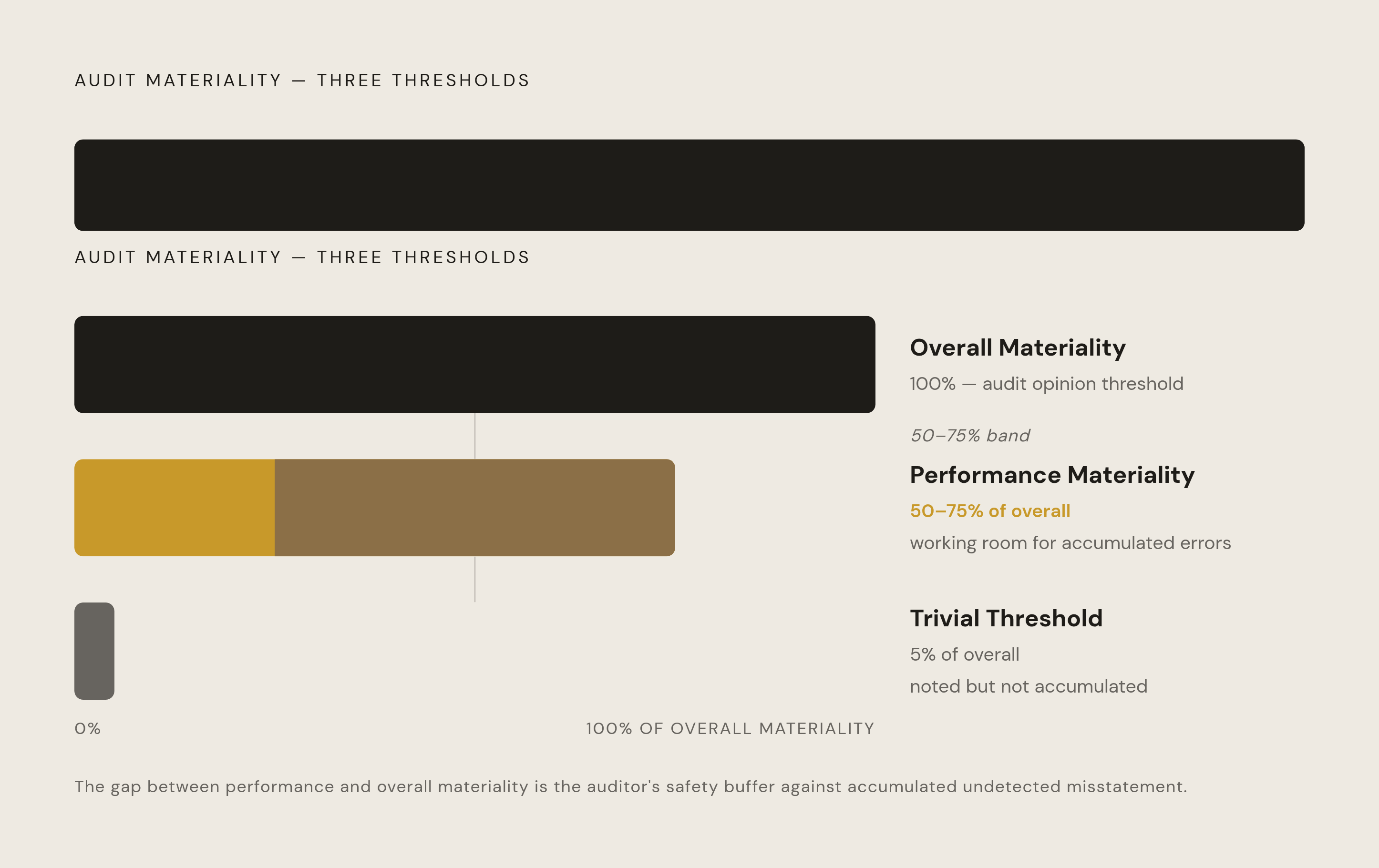
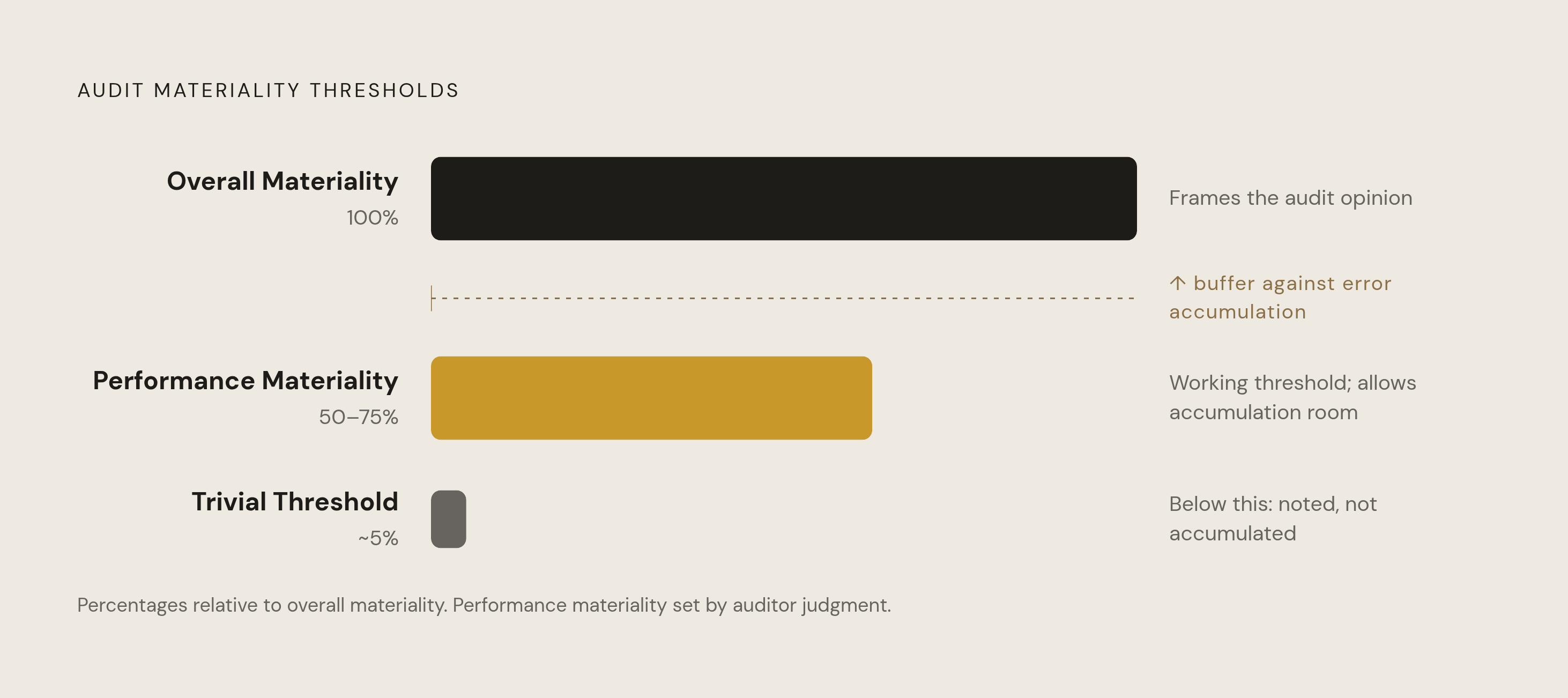
Overall materiality is the top-level figure, set at planning, used to frame the audit opinion. It answers the question of what would matter to a financial statement user in the aggregate. But auditors do not test to the overall materiality line.
Performance materiality, sometimes called tolerable misstatement, sits below overall materiality, typically set in the 50–75% range of the overall figure. The logic is straightforward: if auditors test right up to the threshold, any accumulation of undetected smaller errors could push aggregate misstatement past it before the report is issued. Performance materiality creates working room. Higher-risk engagements push this figure toward the lower end of the range, because the probability of undetected error is higher and the margin for accumulation is correspondingly tighter.
Below performance materiality sits the trivial, or inconsequential, threshold, typically set at 5% of overall materiality. Misstatements below this level are noted but not accumulated or formally assessed for correction. The purpose is audit efficiency. Not every minor variance warrants the same documentation burden, and the trivial threshold codifies that judgment.
Internal company thresholds operate separately from all three audit-level numbers. An accounting team applying materiality tolerances at the general ledger account level typically uses much tighter figures than the external auditor's overall materiality; the aggregation risk at the account level is simply too high to work with numbers calibrated for consolidated financial statement opinion purposes.
The nested structure means a single engagement carries multiple operative thresholds simultaneously. Understanding which threshold governs a given procedure is not a bureaucratic formality. It is a competence question.
Qualitative factors that can override the numbers
A misstatement can be quantitatively small and qualitatively material. The dollar amount is necessary information; it is not sufficient. This is the part of materiality analysis that most clearly separates experienced auditors from those working from a checklist.
Consider fraud or intentional misstatement. An executive embezzling a relatively small amount is material not because of its dollar magnitude but because it signals control failure, potential criminal exposure, and a management integrity question that a reasonable investor would weigh heavily. The number is largely beside the point.
Regulatory and covenant implications create similar pressure. A misstatement that moves a company across a debt covenant threshold, in either direction, carries informational weight far exceeding its arithmetic size. The same logic applies to regulatory capital requirements, licensing thresholds, and similar contractual triggers.
Trend masking is subtler but equally significant. A small error that converts a reported profit into a loss, or that reverses a year-over-year trend users have been watching, carries disproportionate weight. Users read financial statements sequentially and comparatively; an error that disrupts that reading is not just a number problem.
Segment and line-item significance can also override consolidated-level arithmetic. An error in a segment that analysts and investors are specifically tracking, perhaps because it is the company's growth engine or its distressed division, can be material even when it disappears into the consolidated totals.
The qualitative layer is where auditor judgment is most visible to regulatory examiners reviewing working papers. Documentation of qualitative reasoning is not optional. It is the record of why the auditor's conclusion was reasonable, not merely what the conclusion was. Inspectors who pull a file and find a percentage calculation with no qualitative analysis have found a deficiency.
How materiality shapes scope, sampling, and fieldwork decisions
Risk assessment and materiality do not operate independently. Higher assessed risk of material misstatement in an account drives more robust procedures, not merely a lower tolerable misstatement threshold. The two variables compound: a high-risk account with a low performance materiality figure requires both more coverage and more detailed testing.
Sample size is a direct function of both materiality and assessed risk. High-risk accounts with lower performance materiality require larger samples; low-risk accounts can often be addressed through analytical review with smaller or no statistical samples. The nature of procedures shifts accordingly: detailed transaction testing in high-risk areas, analytical comparisons in low-risk ones. Materiality is the variable that determines which tool is appropriate for a given account.
When a misstatement is found during fieldwork, the auditor assesses it against both the individual performance materiality figure and the accumulating schedule of all found errors. That schedule is a live document. It runs throughout fieldwork and informs every subsequent scoping decision. If management declines to correct a misstatement that individually or in aggregate exceeds the threshold, the auditor's options narrow sharply: a qualified or adverse opinion becomes the operative path. The accumulated misstatement schedule is not a closing formality; it is the running ledger that connects individual findings to the final opinion.
Why materiality is revisited during the engagement, not just set once at planning
ISA 320 is explicit on this point: planning materiality must be revised if information emerges during the engagement that would have led to a lower figure at the outset. This is not a theoretical possibility. It is a recurring operational reality.
Common triggers include a significant change in the entity's financial results discovered during fieldwork. If net income comes in materially lower than projected, a materiality figure anchored to the projected number is no longer supportable. A control failure discovered during testing can raise the risk profile of an entire account cycle, necessitating both a revised risk assessment and a reconsideration of whether existing procedures are adequate. New information about related-party transactions or contingencies can similarly shift the landscape.
When materiality is revised downward mid-engagement, procedures that were sufficient at the original threshold may no longer be sufficient at the revised one. That has real consequences: additional sampling, extended transaction testing, more substantive procedures in areas previously addressed analytically. The revision requirement is also a quality control signal. Firms that treat planning materiality as fixed throughout the engagement are not complying with the standard's intent, and PCAOB inspections have identified this pattern as a deficiency.
Final materiality is re-assessed at the conclusion of the audit, before the report is issued. That is the number that governs the opinion. It is possible for the final figure to differ from both the planning figure and any mid-engagement revision. The process is iterative.
The regulatory environment tightening around how materiality is applied and documented
The PCAOB's June 2024 amendments to AS 1105 (Audit Evidence) and AS 2301 (Responses to Risks of Material Misstatement), SEC-approved in August 2024 and effective for fiscal years beginning on or after December 15, 2025, represent the most significant recalibration of evidence standards in recent memory.
The AS 1105 revision pushes auditors toward technology-facilitated data analysis rather than classical sampling. Broader coverage means more direct engagement with data integrity risks, and data integrity questions are fundamentally materiality questions: if the data auditors are analyzing is incomplete or unreliable, the conclusions drawn from it may not support the opinion. The revision raises the bar for how auditors establish that the information they are working with is fit for purpose.
AS 2301 requires more explicit linkage between identified risks and audit responses. Materiality reasoning must connect, documentably, to what auditors actually did, not just to what they planned to do. The gap between risk identification and procedural response has historically been a source of inspection findings; this amendment closes that gap structurally.
QC 1000, the new firm-level quality control standard, was delayed from December 15, 2025 to December 15, 2026 after the PCAOB identified implementation challenges that firms could not realistically resolve in the original timeframe. When it takes effect, it requires comprehensive, risk-based quality control systems. Materiality documentation practices fall within its scope: the firm-level standard will demand that the processes governing how individual engagements set and apply materiality are themselves subject to systematic oversight.
AS 2901 introduces a post-issuance deficiency framework, giving errors in materiality judgment that surface after the report is issued a formal response standard. The PCAOB's 2026 budget of $362.1 million, SEC-approved in January 2026, signals sustained investment in inspections and enforcement. This is not a temporary regulatory wave.
For integrated audits combining financial statement and ICFR work under AS 2201, the same materiality considerations govern both components. Firms cannot apply different standards to the financial opinion and the internal control opinion on the same engagement.
How ESG reporting is expanding what "material" means beyond the financial statements
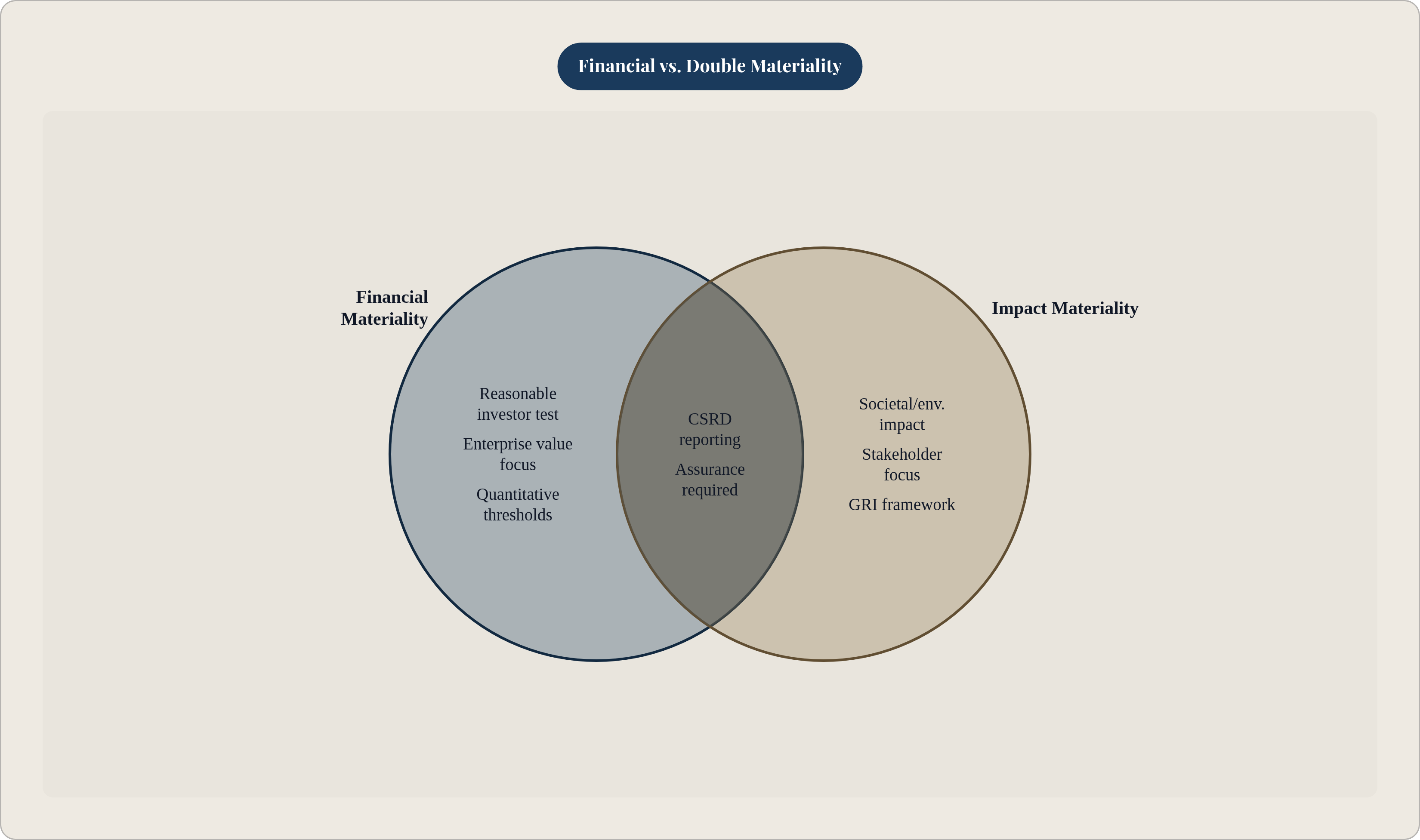
Traditional financial materiality asks one question: what would influence a reasonable investor's economic decision? The framework is user-centric, decision-oriented, and built around enterprise value.
Double materiality, required under the EU's Corporate Sustainability Reporting Directive (CSRD), asks two questions. Financial materiality: how do sustainability factors affect enterprise value? Impact materiality: how does the company affect the environment and society? These are methodologically distinct inquiries. The second does not follow from the first. A company can have significant social or environmental impact that does not yet register in its financial results, and under CSRD, that impact is material regardless.
The CSRD applies to large EU companies, listed SMEs, and certain non-EU entities with significant EU presence, phasing in from fiscal year 2024 onward. Limited assurance requirements began with fiscal year 2025 reporting; reasonable assurance requirements are expected to follow. The phased timeline is not an invitation to delay.
ESG reporting standards are not uniform on the materiality question. GRI focuses on impact materiality; SASB and the ISSB focus on financial materiality; IFRS S1 and S2 adopt financial materiality with some climate-related convergence. Firms operating across jurisdictions are navigating different frameworks simultaneously, and the frameworks are not reconciled.
Early evidence from CSRD adopters is instructive. In a PwC analysis of 30 early-wave companies, Affected Communities emerged as the most frequently new material topic, brought into scope by roughly a third of the cohort. That finding suggests human rights and value chain impacts are moving from the periphery of corporate reporting to its center, at least under the double materiality lens.
The practical tension for audit and assurance professionals is real. Financial auditors trained on a single "reasonable investor" standard are being asked to evaluate materiality through a second lens that encompasses stakeholder and societal impact. That is a different exercise, requiring different data, different subject matter expertise, and different documentation. U.S. firms with EU clients or operations cannot treat double materiality as a European problem. The assessment is embedded in the reporting obligation their clients must meet, and the assurance requirement is coming.
What firm leaders and audit professionals should take from how materiality actually works
Materiality is the audit's organizing principle. Every scoping decision, every sampling choice, every opinion traces back to a materiality judgment made at planning and refined throughout. That is not an abstraction; it is the actual architecture of the work.
The three-layer threshold structure, overall, performance, trivial, is not bureaucratic complexity for its own sake. It is the mechanism that allows auditors to allocate effort proportionally to risk. Firms that collapse these distinctions, treating overall materiality as the operative number for individual procedure design, are building in aggregation risk that may not surface until a regulator finds it.
Qualitative overrides are where professional judgment is most consequential and most visible to inspectors reviewing working papers. The documentation of qualitative reasoning is not a supplementary narrative; it is the primary record of why a conclusion was defensible. Firms whose files show the math but not the reasoning are exposed.
The regulatory trajectory is toward more explicit, more connected, more auditable documentation of how materiality was determined, revised, and applied. The 2025 to 2026 PCAOB standards wave, AS 1105, AS 2301, QC 1000, and AS 2901, collectively makes materiality documentation a compliance matter, not a best practice. Firms that have been treating it casually do not have unlimited time to correct course, and practices like Pease Bell, a Cleveland-based certified public accounting and advisory firm that provides audit and assurance services for businesses and institutions navigating exactly these standards, are already building the documentation discipline the new rules demand.
The AS 1105 revision, specifically, creates an opening for firms that have invested in technology-facilitated evidence collection. Broader data coverage is now the expected standard. Firms that have modernized their evidence infrastructure are better positioned to meet it; firms that have not are facing both a capability gap and a compliance gap simultaneously.
Double materiality is already shaping what assurance work looks like for firms serving multinational clients. It is worth sitting with how significant a methodological shift that represents. The profession has spent decades refining a single-lens, investor-focused materiality framework. Expanding that to include societal impact is not a refinement; it is a structural addition, with its own evidence requirements, subject matter demands, and documentation obligations.
The through-line across all of this is that materiality is where auditor judgment, regulatory expectation, and client risk converge. Getting it right is foundational. Explaining it credibly to clients, audit committees, and regulators is equally so. The number is where you start. The process is what you defend.