Compliance Audit Scope and Objectives Under Government Auditing Standards
Compliance scope in GAGAS audits extends beyond financials to laws, regulations, and federal awards.

The Yellow Book's nine chapters divide into two functional layers. The first five are cross-cutting: foundation, general requirements, ethics and independence, competence, and the quality management framework that the 2024 revision restructured substantially. These apply regardless of engagement type. Chapters 6 through 9 are engagement-specific, with Chapter 6 covering financial audit standards as the primary home for compliance-related fieldwork and reporting obligations. Chapter 7 addresses attestation engagements. Chapters 8 and 9 cover performance audit fieldwork and reporting, respectively.
The structural point practitioners most often miss is that compliance requirements are not siloed in a single chapter. I have watched experienced auditors read Chapter 6 in isolation and come away with a coherent but incomplete picture of what is actually required of them. It is an understandable mistake: the chapter is dense, the engagement-specific detail is urgent, and the foundational chapters can feel like preface. They are not. Competence, independence, and quality management are active constraints on how fieldwork is conducted. They belong in scope-setting conversations, not in the table of contents.
Compliance requirements within the Yellow Book can be financial or nonfinancial, and that distinction shapes how auditors define objectives from the outset. The 2024 revision explicitly recognizes two categories of audit objectives bearing directly on scope-setting: entity objectives, meaning what the auditee is attempting to accomplish under applicable law, regulation, and strategic mandate; and prospective analysis objectives, involving conclusions about future events or possible actions. The governing standard is stated plainly: auditing coverage must be broad enough to fulfill the reasonable needs of potential users of the audit report. Everything else flows from that.
The Scope of a GAGAS Compliance Audit and What It Requires Auditors to Examine
Scope in a GAGAS compliance audit refers to the boundaries of what the auditor must examine, and those boundaries are defined by engagement type, applicable law, and the informational needs of report users. For financial audits with a compliance dimension, auditors must assess whether financial statements are presented fairly under recognized accounting standards, evaluate internal controls over financial reporting, and test compliance with laws and regulations that have a direct and material effect on the financial statements.
That last requirement is where GAGAS diverges most visibly from a standard AICPA financial audit. An audit conducted solely under AICPA standards addresses compliance incidentally, to the extent it affects financial statement presentation. GAGAS layers in controls and compliance testing as explicit, independent obligations. Some practitioners describe this as a difference of emphasis. The reporting consequences suggest otherwise; the difference is categorical, not tonal.
The 2024 Yellow Book is explicit on a point that practitioners sometimes treat as implied: auditors must clearly understand the audit objectives, the scope of work, and the reporting requirements before beginning fieldwork. This is a stated standard. Scope ambiguity at engagement outset is a standards violation, not a documentation gap, and the distinction matters when peer review findings are being written.
GAGAS does not incorporate the AICPA Code of Professional Conduct by reference, though it acknowledges that CPAs may operate under both frameworks simultaneously. For issuer engagements, auditors may also apply PCAOB standards alongside GAGAS. Coexistence of multiple applicable frameworks is routine in practice, and it requires deliberate coordination rather than the passive assumption that one framework covers what another leaves open.
When the auditor issues a GAGAS audit report, the compliance statement is required only when the auditor has followed all unconditional and applicable presumptively mandatory requirements. Where departures exist, the auditor must document the justification and demonstrate that the requirements' objectives were achieved through other means. The threshold is substantive.
Where the Single Audit Extends and Sharpens GAGAS Compliance Objectives for Federal Award Recipients
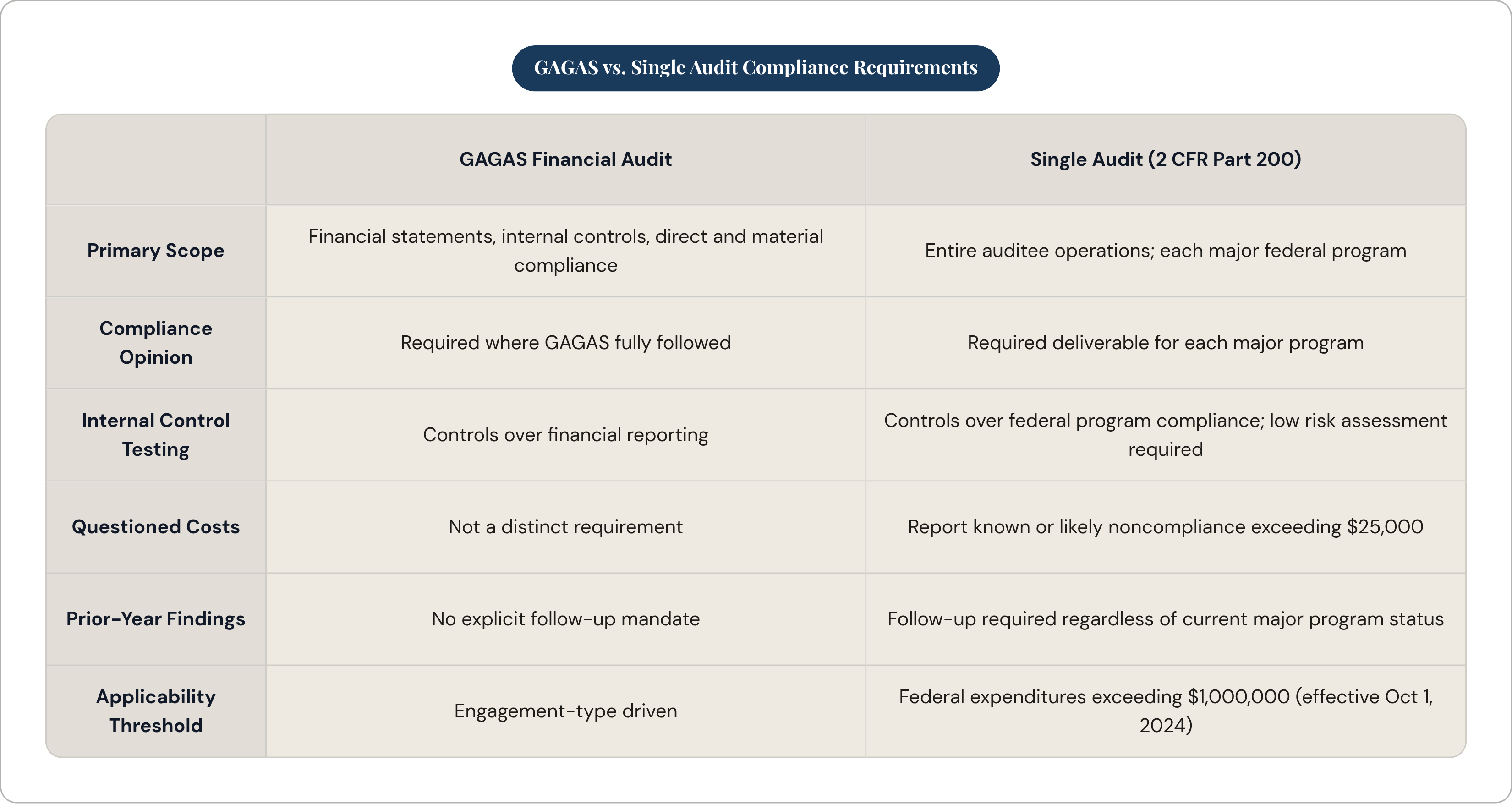
The Single Audit is the mechanism through which GAGAS compliance objectives are operationalized for federal award recipients. Governed by 2 CFR Part 200, the Uniform Guidance, and conducted under GAGAS, the two frameworks are not parallel; they are nested. The Uniform Guidance sets program-specific requirements; GAGAS fieldwork and reporting standards govern how those requirements are tested and reported.
Effective October 1, 2024, the threshold for Single Audit applicability rose to $1,000,000 in federal award expenditures during a fiscal year, up from $750,000. Firms with clients near that boundary need to revisit scope conversations early, before fieldwork planning begins. A client who previously required a Single Audit may no longer meet the threshold, which changes the engagement structure entirely, and that conversation tends to go better when it happens before budgets are finalized rather than after.
The scope of a Single Audit is intentionally expansive: it must cover the entire operations of the auditee, or, at the auditee's option, a series of audits covering each department, agency, or organizational unit that expended or administered federal awards, with each treated as a distinct non-federal entity. For major programs, the auditor must determine whether the auditee complied with federal statutes, regulations, and the terms and conditions of federal awards that may have a direct and material effect on each major program. Compliance testing must include tests of transactions or other audit procedures sufficient to support an opinion on compliance. That opinion is a required deliverable, not a summary observation.
Internal control over compliance receives parallel treatment. The auditor must obtain sufficient understanding of the auditee's internal control over federal programs to plan the audit to support a low assessed level of control risk of noncompliance for major programs. Where controls appear likely to be ineffective, the auditor must report a significant deficiency or material weakness, assess control risk at maximum, and evaluate whether additional compliance testing is warranted. The guidance draws on both the Comptroller General's Standards for Internal Control in the Federal Government and the COSO Internal Control-Integrated Framework. Practitioners need working fluency in both.
Two additional requirements distinguish the Single Audit from a Yellow Book financial audit without a federal program dimension. First, auditors must report known or likely noncompliant spending exceeding $25,000 for a major program as questioned costs, covering amounts that violate federal rules, lack required documentation, or appear unreasonable given program purposes. Second, auditors must follow up on prior-year findings regardless of whether the relevant program qualifies as a major program in the current year. Prior findings do not expire because a program's classification changed. Clients rarely understand that second point without explanation, and the consequences of misaligned scope assumptions are not trivial.
What the 2024 Yellow Book Changed About How Compliance Audit Quality Is Managed
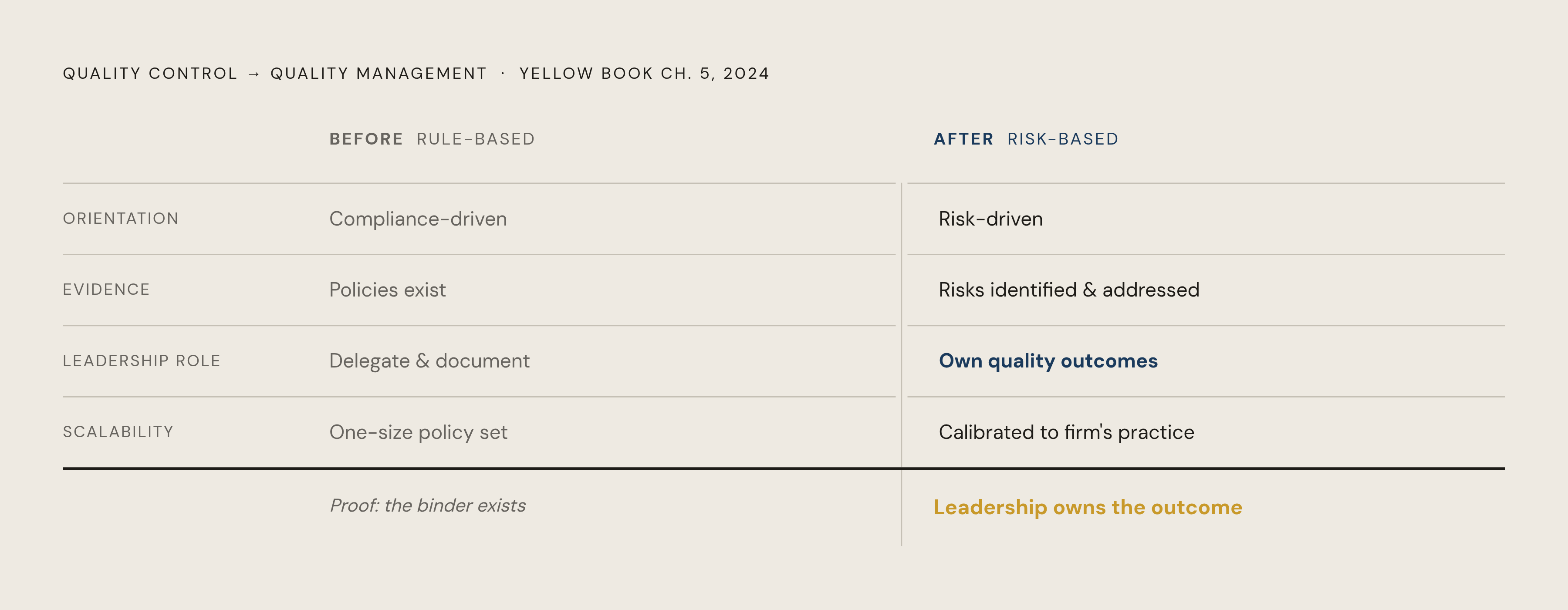
The most structurally significant change in the 2024 revision is not in Chapter 6. It is in Chapter 5, which was rewritten entirely to replace the prior quality control framework with a quality management framework. This is worth sitting with for a moment, because the terminology shift understates what actually changed.
Quality control was largely rule-based: maintain policies, document procedures, conduct reviews. The evidence of compliance was essentially the existence of the policies. Quality management, as the 2024 standards frame it, requires proactive, risk-based oversight of engagement quality, with explicit accountability at the leadership level. Chapter 5 now requires that an audit organization's leadership take ownership of quality outcomes, not merely oversee the existence of policies. The organization must identify where quality risks exist in its specific practice and design responses calibrated to those risks. A firm's existing quality control infrastructure may be robust, and that still does not make the transition straightforward, because the underlying cognitive model has changed, not just the procedures.
Scalability provisions are built into the framework. The nature, extent, and formality of a quality management system varies based on firm size, number of offices, geographic dispersion, personnel expertise, engagement complexity, and cost-benefit considerations. Scalability does not mean the requirements are optional; it means the form of compliance can vary while the substance cannot.
The 2024 revision permits, but does not mandate, engagement quality reviews for GAGAS engagements, representing a meaningful departure from prior practice, where the engagement quality review model was more prescriptive.
Updated competence requirements now include targeted continuing professional education hours in cybersecurity, data analytics, and fraud detection. These are components of what the standards define as GAGAS competence, not elective additions to a CPE portfolio. That signal about where compliance risk is heading should inform how firms think about staffing and training pipelines, not just current-year CPE tracking.
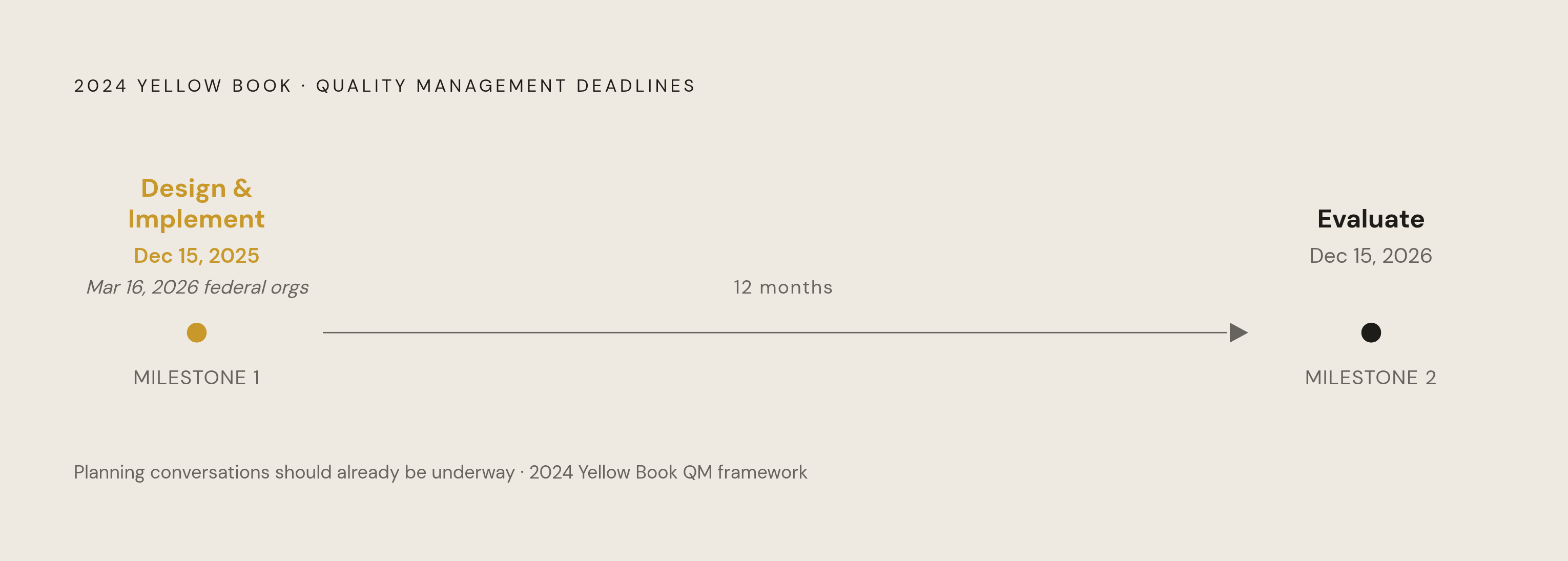
Peer review remains mandatory: every audit organization performing GAGAS engagements must undergo an external peer review at least once every three years. Implementation creates two distinct milestones. Quality management systems must be designed and implemented by December 15, 2025 (or March 16, 2026 for qualifying federal organizations). Evaluation of those systems must be completed by December 15, 2026.
How the 2025 AICPA Guide Translates the Updated Standards into Audit Practice
The 2025 edition of the AICPA's Government Auditing Standards and Single Audits guide was updated to reflect both the 2024 Yellow Book revisions and the updated Uniform Guidance. For CPA firms performing government and Single Audit work, this is the primary professional reference. Its updates are not optional reading for firms that want to remain technically current.
The 2025 edition sharpens guidance in areas where practitioner judgment has historically varied most. Identifying risks of material noncompliance is now framed as a structured risk-identification process rather than a matter of auditor intuition applied to program facts. Understanding the auditee's system of internal control receives more precise treatment, with the guide distinguishing between components assessed at the entity-wide level and those evaluated at the major program level. That distinction has direct implications for how fieldwork is scoped and documented.
Sampling methodology in Uniform Guidance compliance audits receives specific attention, which is overdue. Persistent variation across practitioners in this area has been a source of peer review findings for years, and the updated guide attempts to provide a more disciplined framework for sampling decisions. Anyone who has sat through a peer review exit conference knows the conversations that arise when sampling rationale is underdocumented. The guide also addresses how auditors should evaluate the sufficiency and appropriateness of audit evidence and how identified instances of noncompliance affect the compliance opinion.
One operational deadline embedded in the Single Audit framework warrants explicit tracking: the reporting package must be submitted to the federal clearinghouse by the earlier of 30 days after the auditor's reports are received or 9 months after the end of the audit period. Hard deadline, federal oversight attached.
Why the Compliance Audit Workload Is Arriving at a Moment of Acute Staffing Pressure
The technical demands of the 2024 Yellow Book are arriving against a workforce backdrop that is, by any reasonable measure, unfavorable. Bureau of Labor Statistics data shows that more than 300,000 professionals left the accounting and auditing field between 2020 and the mid-2020s, a decline exceeding 17%. BLS simultaneously projects substantial annual job openings driven by retirements and career changes, alongside employment growth through 2033. Supply and demand are moving in opposite directions.
Government and compliance audit work is particularly exposed. GAGAS engagements require specialized continuing education, peer review readiness, and the kind of judgment-intensive fieldwork that develops over years, not quarters. They are not entry-level assignments, which means the staffing problem is not simply a volume problem; it is a depth problem. The 2024 revision's updated CPE requirements in cybersecurity, data analytics, and fraud detection raise the competence bar further, adding to what already-stretched staff must maintain. Firms that have historically relied on rotating junior staff through government engagements as a training ground will find that model harder to sustain when baseline competence requirements are higher and senior oversight capacity is thinner.
CFO Pulse Survey data from 2024 indicates that a large majority of financial leaders reported difficulty finding qualified accounting talent, a figure that has grown substantially since 2022. A significant share of currently practicing public accounting CPAs are projected to reach retirement age within the next fifteen years. Meeting the 2024 Yellow Book's compliance audit scope and objectives is not only a technical challenge; it is a capacity challenge, and the two compound each other in ways that are difficult to plan around when you are also managing a shrinking bench of experienced government auditors. If a firm's most experienced GAGAS practitioners are already stretched thin, who absorbs the added competence requirements the 2024 revision imposes? That is not a rhetorical question. It is a resource planning question with no clean answer.
What Firm Leaders Performing Government Audit Work Need to Do Now
The December 15, 2025 effective date is close enough that planning conversations should already be underway. Firms waiting to assess readiness are spending time they do not have.
Three priorities stand out before the effective date. First, map current quality control procedures against the new quality management requirements. The shift from quality control to quality management is substantive: gaps in documentation, monitoring, and leadership accountability are the most common failure points in this kind of framework transition, and they tend to surface in peer review rather than internal review. Second, assess staff CPE compliance against the updated requirements. Cybersecurity, data analytics, and fraud detection hours are components of GAGAS competence and need to appear in CPE plans as scheduled commitments, not aspirational line items. Third, review active Single Audit engagements against the revised $1,000,000 threshold. That conversation belongs in the engagement planning phase, before budgets and engagement letters are finalized.
Firms approaching the 2024 Yellow Book as primarily a documentation update will be underprepared. The quality management shift, the updated competence requirements, and the enhanced Single Audit guidance collectively change how compliance audit work must be planned and supervised. The talent shortage amplifies the stakes considerably: staff capable of performing government audit work are already stretched, and absorbing new requirements without deliberate workflow changes creates audit quality risk. In a GAGAS context, audit quality risk carries regulatory consequences, including peer review findings and potential loss of authorization to perform federal award audits.
Government auditing has always demanded more than its private-sector counterpart. That gap has widened, and the more pressing question is not whether firms have read the updated standards, but whether they have the organizational capacity to actually execute against them.