Audit Opinion Types and Their Meanings
Auditors use materiality and pervasiveness to decide between five opinion types.

PCAOB Auditing Standard 3105 frames the entire opinion decision around two categories of reservation: a departure from generally accepted accounting principles, or a limitation on the scope of the audit. These are structurally different problems, and they lead to different branches of the decision tree. But before the auditor reaches the branch, the same two questions apply regardless of which reservation type is present.
First: is the issue material? An issue is material if it is significant enough to influence the decisions of a reasonable financial statement user. That is the governing standard, not the auditor's instinct about whether management will be upset, and not the size of the number in absolute terms.
Second: is the issue pervasive? This is the variable that gets underweighted most consistently, in my observation. An issue is pervasive when it affects so many accounts or disclosures that the financial statements as a whole cannot be relied upon, or when it relates to items that represent a substantial proportion of the statements or are fundamental to users' understanding. Pervasiveness is not simply a function of magnitude; it is a function of reach.
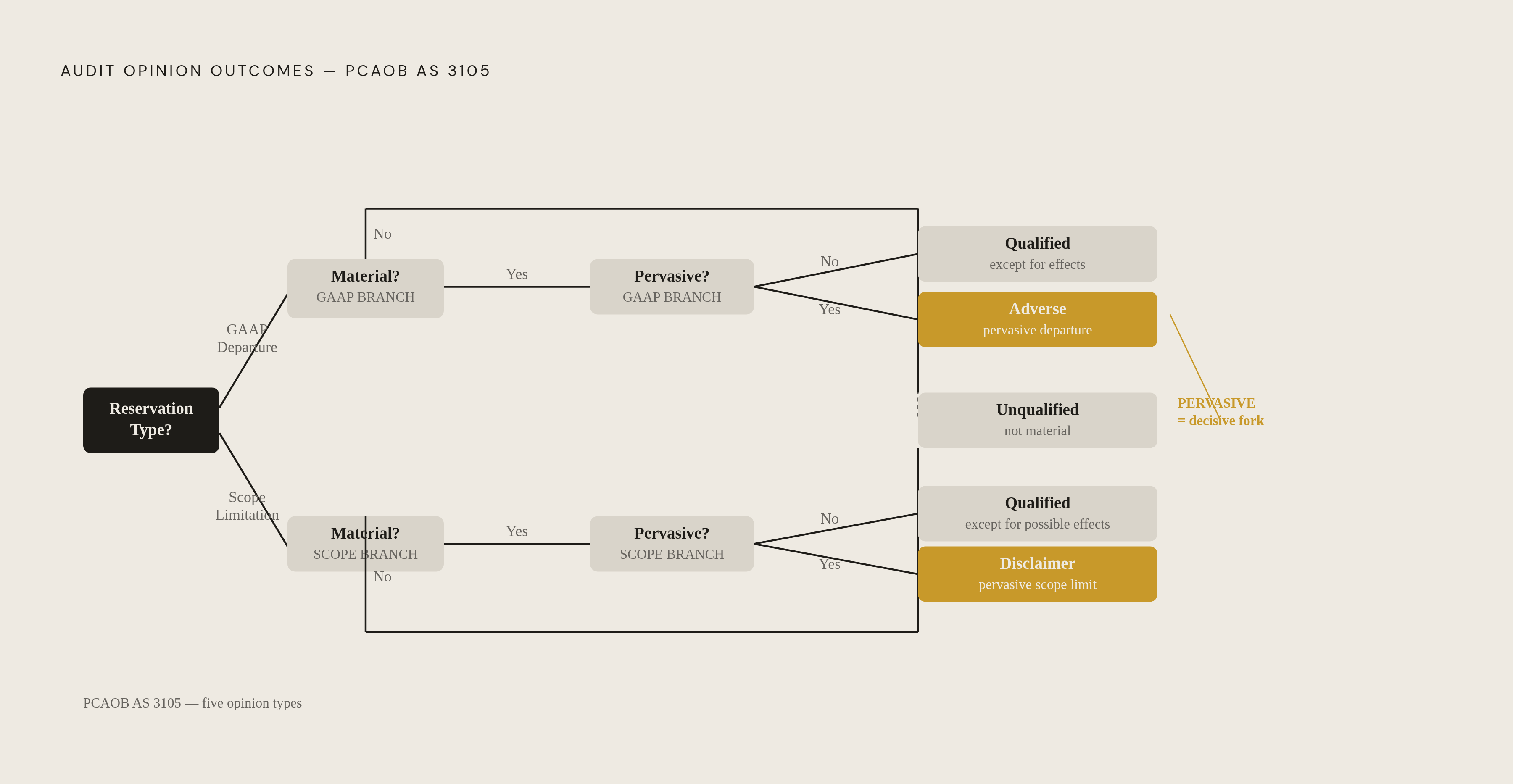
These two variables, combined with the type of reservation, produce a decision grid. No material reservation produces an unqualified opinion. A material GAAP departure that is not pervasive produces a qualified opinion. A material GAAP departure that is pervasive produces an adverse. A scope limitation whose potential impact is not pervasive produces a qualified opinion. A scope limitation whose potential impact is pervasive produces a disclaimer.
The terminology shifts by framework. "Unqualified" is the PCAOB term; "unmodified" is the IAASB equivalent. The label changes; the logic does not.
What the grid provides, practically, is a defense against the gravitational pull of deadline pressure and client pressure — two forces that, in my experience, are rarely absent from any engagement where a modified opinion is under consideration. When both questions are answered methodically and documented, the resulting opinion is professionally defensible. When they are compressed or skipped, the firm's exposure grows accordingly, and the paper trail that was supposed to support the judgment call does not exist.
The Unqualified Opinion: What It Actually Certifies and What It Assumes
An unqualified opinion states that the financial statements present fairly, in all material respects, the financial position, results of operations, and cash flows of the entity in conformity with the applicable reporting framework. That is a precise claim, and the precision is not incidental.
What it certifies: the auditor obtained sufficient appropriate evidence, applied professional judgment, and found no material misstatements. It also implicitly affirms that management maintained internal controls adequate to support the representations made in the statements. A clean opinion is a verdict on the numbers and an assessment of the processes that produced them.
What it does not certify matters equally. An unqualified opinion is not a guarantee of perfect accuracy, not an assertion that fraud is absent, and not a prediction about future performance. It is a professionally bounded conclusion: no material misstatements were found, based on procedures designed and executed in accordance with applicable auditing standards. That boundary becomes important when a client later claims their auditor "missed" something that fell below the materiality threshold or outside the scope of planned procedures, a conversation that happens more often than it should.
For public companies, a clean opinion keeps the Form 10-K compliant and avoids the heightened regulatory attention a modified opinion invites. For private companies, it satisfies lender covenants and preserves the borrowing relationship.
One nuance worth flagging: even an unqualified opinion on a public company engagement now requires disclosure of critical audit matters, the most difficult, complex, or subjective issues encountered during the engagement. A clean opinion with substantive CAM disclosures is still a clean opinion; the opinion paragraph itself is unmodified. But a reader who understands the framework will pay close attention to what the CAM section reveals, because it is effectively a window into the judgment calls the team had to make on the way to that clean conclusion. The opinion says everything is fine; the CAMs say here is where fine was hardest to establish.
The Qualified Opinion: A Bounded Reservation, Not a Blanket Indictment
The standard language of a qualified opinion reads: "except for the effects of the matter described in the Basis for Qualified Opinion section, the financial statements present fairly in all material respects." That "except for" construction is doing precise professional and legal work. It is not boilerplate.
It tells the reader exactly which portion of the statements carries the reservation. It signals, with equal force, that everything outside that reservation can be relied upon. A qualified opinion is not a statement that the financial statements are unreliable; it is a statement that one identified, contained problem exists within otherwise fairly presented statements.
PCAOB AS 3105 requires the auditor to disclose all substantive reasons for the qualification in one or more paragraphs immediately preceding the opinion paragraph. The qualification must be explained, not merely signaled. A reader who works through the explanatory paragraphs will know the nature of the issue, why it meets the materiality threshold, and why the auditor concluded it was not pervasive enough to warrant an adverse.
The qualified opinion has two distinct triggers. The first is a material GAAP departure isolated in its impact: a specific account is misstated, a disclosure is incomplete, an accounting policy is incorrect, but the problem does not contaminate the statements as a whole. The second is a scope limitation whose potential impact, while material, is contained: the auditor could not perform a required procedure for a specific account or class of transactions, but the rest of the audit was conducted without restriction.
Both triggers produce the same opinion form, though the "except for" language differs slightly. A GAAP departure produces "except for the effects of the matter." A scope limitation produces "except for the possible effects of the matter," because the auditor is acknowledging uncertainty about what full procedures might have revealed, rather than confirming a finding.
Private company clients deserve particular attention here. A lender relying on audited financials for covenant compliance may interpret a qualified opinion as a technical default, regardless of whether the underlying issue actually affects debt service capacity. This is a function of how loan agreements are drafted, not a judgment the auditor makes. But it means the conversation about a potential qualification should happen well before the opinion is issued. I have seen situations where a client's first substantive discussion with their lender about a qualification came after the report was already finalized, which left no room to negotiate the covenant interpretation and put the company in a worse position than the accounting issue itself warranted.
The most common misread of the qualified opinion is treating it as a precursor to something worse. It is not a precursor; it is a distinct, professionally defensible conclusion appropriate to a specific set of facts. Issuers who understand the framework can communicate it to their stakeholders accurately, rather than letting the "modified" label carry more weight than the underlying issue deserves.
The Adverse Opinion: What It Takes to Reach This Conclusion and What Follows
An adverse opinion is an affirmative statement of failure. PCAOB AS 3105 defines it as a conclusion that the financial statements do not present fairly the financial position, results of operations, or cash flows in conformity with GAAP. The auditor is not expressing a reservation about part of the statements; they are concluding that the statements as a whole are unreliable.
The variable that separates adverse from qualified is pervasiveness. The misstatement is not isolated; it reaches broadly enough across accounts, disclosures, or fundamental line items that a reasonable user cannot rely on the statements for any purpose requiring an accurate picture of the entity's financial position.
Common triggers include the absence of supporting documentation at scale, significant errors or omissions across multiple accounts, fraud or noncompliance with material financial consequences, and preparation of the statements under an incorrect accounting basis. Consider a company in a going-concern situation that prepares its financials on a historical cost basis rather than a liquidation basis. If the entity is, in substance, winding down, the applicable measurement framework is wrong, and potentially most of the balance sheet reflects valuations built on an inapplicable premise. The breadth of that error, touching the majority of reported assets, meets the pervasiveness threshold.
The stakeholder consequences cascade quickly. Investors and creditors are placed on notice that the statements cannot support decisions about the entity's financial position or results. For public companies, an adverse opinion on a Form 10-K triggers regulatory scrutiny. Lender covenants are typically tripped. Institutional investors, depending on their investment policy statements, may be required to liquidate positions.
Adverse opinions on large public company filings are rare, and not incidentally so. The cascading consequences create powerful incentives to resolve material pervasive issues before the opinion is issued. By the time an adverse opinion is actually issued on a significant engagement, it usually means resolution was not achievable, not that the issue arrived late or was overlooked. The conversations between management, counsel, the audit committee, and the engagement team typically begin long before fieldwork closes.
For firm staff, the weight of the consequence does not make the adverse opinion the wrong conclusion when the evidence supports it. It makes the rigorous application of the materiality and pervasiveness analysis more important, not less.
The Disclaimer of Opinion: When the Auditor Cannot Conclude at All
A disclaimer of opinion occupies a structurally distinct position in the framework, and that distinction is frequently collapsed in practice. A disclaimer is not a harsher version of an adverse opinion. It is a categorically different kind of statement.
An adverse opinion reflects completed audit work that produced a conclusion: the statements are wrong. A disclaimer reflects incomplete audit work that produced no conclusion at all. The auditor is not saying the financial statements are incorrect; they are saying they cannot form a professional view on whether the statements are correct or not. The difference is between "this is false" and "I cannot tell you whether this is true."
That distinction matters practically. A disclaimer does not necessarily mean the financial statements are misstated. It means no qualified professional has verified them. Some readers find that uncertainty more troubling than an adverse opinion, which at least reflects a completed engagement. Others conflate the two entirely, which is an understandable error if you encounter them infrequently, but an avoidable one if you understand the framework.
A disclaimer can only arise from a scope limitation. This is a hard rule, not a judgment call. GAAP departures, no matter how severe or pervasive, do not produce disclaimers; they produce adverse opinions. The branch that leads to a disclaimer is defined entirely by the auditor's inability to obtain sufficient appropriate evidence.
Common triggers include management-imposed restrictions on audit procedures, inability to access financial records, destruction or unavailability of key documentation, and significant going-concern uncertainties that prevent required procedures from being performed. In each case, the gap in the evidentiary record is large enough that any conclusion drawn from available evidence would not be professionally supportable.
One additional judgment that belongs alongside the disclaimer decision: when a scope limitation is sufficiently pervasive, withdrawal from the engagement may be the more professionally appropriate response. Firms that treat the disclaimer decision and the withdrawal decision as unrelated considerations are missing the relationship between them. The question of whether to issue a disclaimer or withdraw from the engagement should be deliberate, not a default.
Reading the Decision Tree as a Single Framework Rather Than Four Separate Definitions
The grid, stated plainly: no material reservation produces an unqualified opinion; a material GAAP departure that is not pervasive produces a qualified opinion with "except for" language; a material GAAP departure that is pervasive produces an adverse; a scope limitation that is not pervasive produces a qualified opinion with "except for the possible effects" language; a scope limitation that is pervasive produces a disclaimer.
The framework is not a checklist that executes automatically. It requires professional judgment at both the materiality step and the pervasiveness step, which is why two experienced auditors examining the same facts can sometimes reach different conclusions about where a given situation falls. The framework structures the judgment; it does not replace it. I have been in rooms where that disagreement was genuine and neither side was obviously wrong, which is worth acknowledging for anyone who assumes these determinations are mechanical.
For audit staff applying the framework in the field, the sequence matters. Start with the nature of the issue: GAAP departure or scope limitation. That determines which branch you are on before any other analysis begins. Then assess materiality. If the issue does not rise to a level that would influence a reasonable user's decisions, the analysis ends and you stay on the clean opinion path. If it clears materiality, assess pervasiveness. That determination produces your output.
For readers of audit reports, the explanatory paragraphs preceding the opinion paragraph in any modified report are not formalities. They are the auditor's disclosure of exactly which branch of the tree was followed and why. A reader who knows the framework can decode that disclosure rather than simply reacting to the label in the opinion paragraph itself, which is, in my view, the more useful skill.
One structural pressure on the profession deserves mention here. The auditing workforce has contracted meaningfully, with a significant portion of experienced practitioners having exited in recent years. More opinion-level judgments are consequently falling to less experienced staff, often under time pressure that does not accommodate extended deliberation. A clear, internalized decision framework becomes more valuable under those conditions. Firms that build systematic review processes around the materiality and pervasiveness questions, rather than relying on senior judgment applied intuitively at engagement close, reduce the risk of inconsistent calls made under deadline.
AI-assisted audit workflows can flag potential scope limitations and GAAP departures earlier in an engagement, giving teams more runway to resolve issues before the opinion decision arrives. But the framework, two questions applied in sequence, remains the quality checkpoint that any such tooling supports. Technology can surface anomalies; it cannot assess whether those anomalies are pervasive in the sense that professional standards require. That determination belongs to the auditor, and it is where the framework earns its keep.