Audit Readiness for Private Companies
GAAP compliance alone won't satisfy auditors—you need documented processes and reconciled accounts.

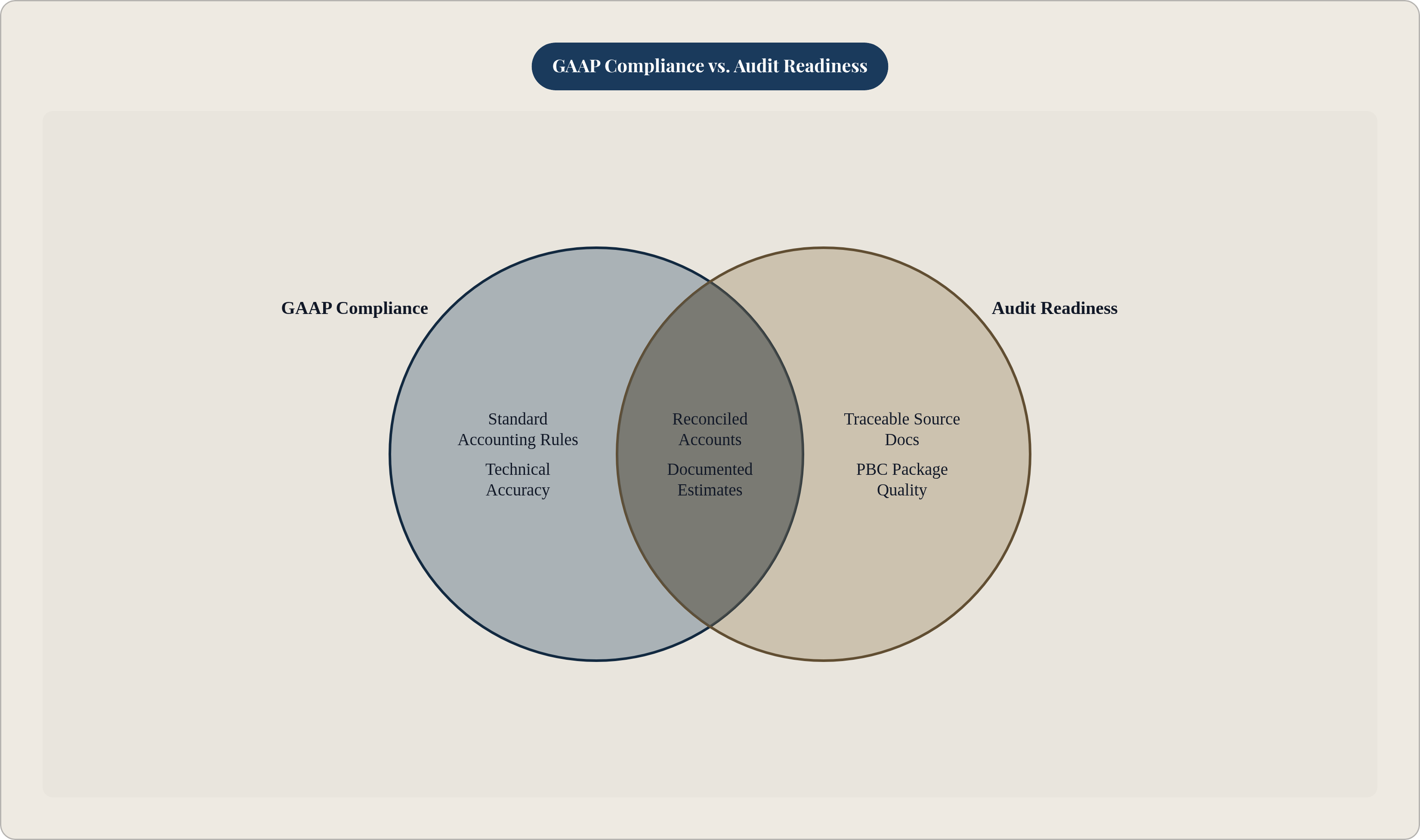
Audit readiness is a phrase that gets used loosely, and the looseness is expensive. Having financial statements available is not audit readiness. Having financial statements supported by reconciled accounts, documented accounting estimates, organized source documentation, and the internal processes that produced all of it consistently: that is audit readiness. The distinction sounds minor until an auditor arrives and starts testing it.
But what if a company believes it has done enough simply by staying compliant with GAAP? An auditor's objective is to form an independent opinion, and forming that opinion requires evidence. The auditor is not simply reviewing a balance sheet; the auditor is testing whether the numbers on that balance sheet are supportable, whether the controls that generated them are reliable, and whether the documentation trail is traceable. A company can be technically compliant with GAAP and still be operationally unprepared for serious scrutiny. Conflating compliance with readiness is one of the more expensive assumptions a finance team can make, and it surfaces most often in companies that have never been through a demanding audit before.
Readiness in practice comes down to three things. Financial statement accuracy: accounts are reconciled, estimates are documented, transactions are recorded in the correct period. Organized documentation: every significant balance has supporting schedules that are accessible, complete, and traceable to source transactions without requiring a search. Aligned internal processes: the controls and workflows that produced the numbers function consistently and can be demonstrated to function.
Most private companies are staffed for operations, not for audit support. Those two modes of work require fundamentally different disciplines, and that gap tends to surface at the worst possible moment.
The technical accounting areas that expose companies most often
Complexity accumulates in predictable places, and documentation falls short in the same ones, with enough regularity that experienced practitioners stop being surprised by it.
Revenue recognition under ASC 606 remains a persistent source of findings, particularly for companies with complex contract structures, variable consideration, or milestone-based arrangements. The standard requires judgment, and judgment requires documentation. Companies that have grown into new revenue models without updating their accounting policies to reflect that complexity are the ones most frequently caught mid-audit with positions they cannot support.
Lease accounting under ASC 842 continues to surface issues at companies that have not fully inventoried their lease portfolios. The standard applies to arrangements that may not be labeled as leases in the underlying contracts, and incomplete identification of the lease population is a straightforward way to produce a material gap that no one noticed was forming.
R&D cost capitalization requires documentation of what qualifies, how the threshold was determined, and how that determination was applied consistently across periods. R&D-intensive companies that treat this as a routine calculation rather than a documented accounting policy create exposure that often goes unrecognized until fieldwork begins. Reconstructing contemporaneous rationale at that point is not really possible.
Foreign entity consolidation requires written support for functional currency determinations. Missing documentation there slows an audit significantly, not because the underlying conclusion is necessarily wrong, but because there is no contemporaneous record to test against.
Nonroutine and complex transactions represent the highest concentration of risk. M&A activity, restructurings, and business combinations account for the majority of material weakness disclosures, a pattern consistent across recent audit data. A transaction-heavy year concentrates technical complexity in precisely the areas auditors examine most closely. That these two conditions so often arrive simultaneously is rarely coincidental; it reflects companies that build deal capacity before they build documentation infrastructure.
How internal controls failures become visible and costly
Controls and outputs are not the same thing, and auditors do not treat them as equivalent. A company can present clean financial statements and still have deficient controls. A deficiency that creates a reasonable possibility of material misstatement, even without an actual misstatement having occurred, meets the definition of a material weakness under ICFR standards. The absence of an error does not immunize a company from a material weakness finding; the standard is about possibility, not actuality.
Three control fundamentals draw consistent scrutiny: segregation of duties, so that no single person controls a complete financial transaction cycle; independent review and approval of journal entries and financial activities, as a substantive check rather than a rubber stamp; and regular reconciliations with defined variance thresholds and documented follow-up, meaning discrepancies are resolved systematically rather than whenever someone has time.
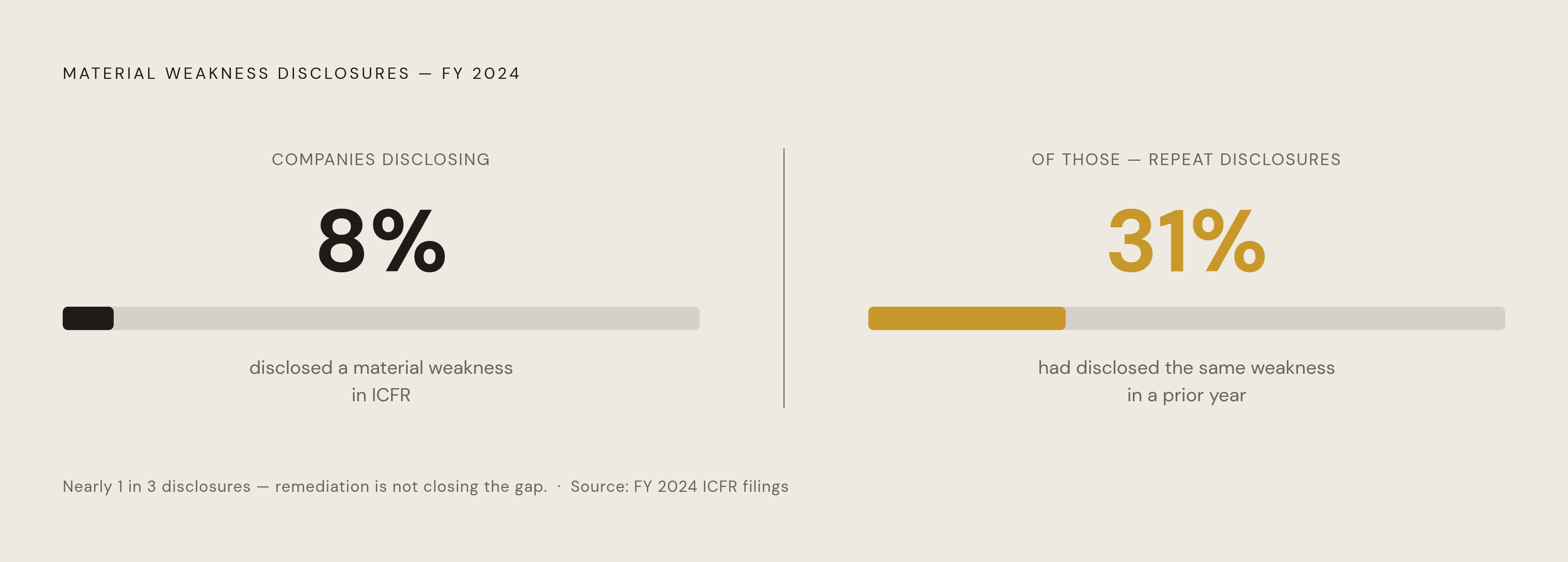
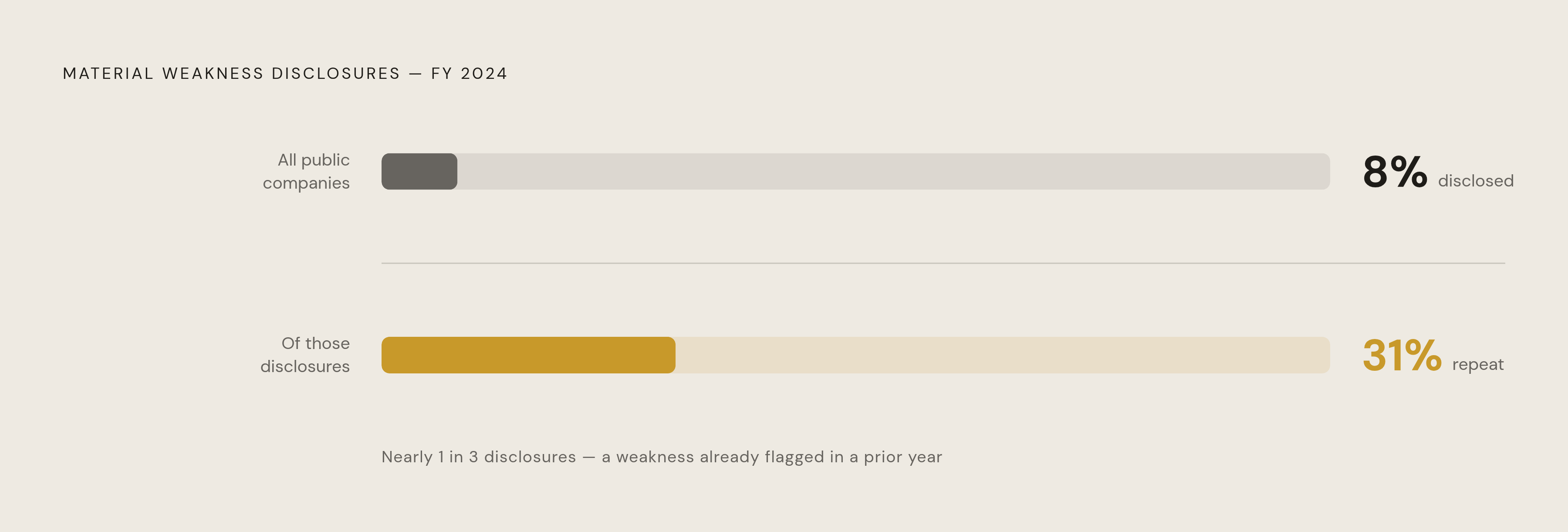
The scale of ICFR failure is not negligible. In fiscal year 2024, 8% of companies disclosed material weaknesses, and 31% of those disclosures involved issues that had appeared in prior years. Nearly one in three companies disclosing a material weakness had already disclosed one before. Remediation plans are being written; what is happening far less consistently is the underlying discipline holding after the auditor leaves. That raises an important question: if the same weaknesses keep resurfacing, are companies actually fixing the root cause, or simply documenting a response?
The consequences extend well beyond the audit itself. Material weaknesses appear in filings and are visible to lenders, investors, and counterparties. They increase audit fees, consume significant management time, and in some cases delay financial statement filings entirely. Advance Auto Parts disclosed that turnover in key accounting positions created a material weakness that delayed a quarterly filing, a clear illustration of how personnel instability and control failure compound each other. The common root causes are predictable: inadequate documentation and accounting policies, insufficient technical expertise in key roles, IT and access control gaps, poor segregation of duties in lean finance teams.
Two recurring audit deficiencies that companies keep underestimating
Two patterns appear with enough regularity in private company audits to treat as structural rather than situational.
The first involves controls with a review element. Auditors consistently find that client review procedures and their supporting evidence are inadequate, particularly for complex estimates like goodwill impairment or business combination valuations. The problem is almost never that the reviews did not happen. It is that they were undocumented in any way that gives an auditor confidence the review was substantive rather than perfunctory. A manager signing off on a spreadsheet is not documentation showing what was reviewed, what questions were raised, or what conclusions were reached. Most companies learn this distinction during fieldwork, which is precisely when it is too late to reconstruct a credible record.
The second involves IT and system-generated data. Reports extracted from ERP or financial systems are not automatically reliable for audit purposes, and auditors expect evidence that the completeness and accuracy of those reports has been validated. This is where automation creates a false sense of security. A process that feels automated feels trustworthy, but without validation controls, finance teams can rely on inaccurate system outputs without ever recognizing the problem. For companies modernizing their technology stacks, the risk is particularly acute: adding new systems without building validation controls into the workflow creates new audit exposure even as it solves operational problems.
Both patterns trace back to the same failure: confusing the existence of a process with documented evidence that it operated as designed.
What year-end preparation looks like when it is done well
Year-end is not the beginning of audit readiness. It is where readiness either holds or fractures under pressure. Companies that experience the most disruptive audit seasons are, more often than not, the ones treating the auditor's arrival as the signal to start preparing.
Companies that manage year-end well have already done most of the work before fieldwork begins. Account reconciliations are completed and reviewed before auditors arrive. Supporting schedules for every significant balance are tied out, organized, and accessible before the first PBC request lands. Accruals and estimates carry documented rationale, not just a number and a reference to prior year. Prior-year audit adjustments have been reviewed, with clear evidence that previously identified issues are resolved in the current year's records. Related-party transactions are identified and disclosed. Debt covenant compliance is documented.
The prepared-by-client list, the PBC package, is the auditor's first meaningful signal of how ready a company actually is. Disorganized or incomplete responses extend timelines, increase fees, and raise implicit questions about control quality that can shape the auditor's entire approach to the engagement. Companies that treat PBC preparation as an ongoing discipline rather than a deadline response consistently compress audit cycles and reduce exposure.
It is also worth considering the value of formalizing an internal pre-audit review: walking through the auditor's likely areas of focus before they arrive surfaces issues while there is still time to address them. This is a diagnostic for the company's own benefit.
The talent shortage inside private companies and how it creates audit risk
Audit readiness is not a purely technical problem. For many private companies, it is a staffing problem, and the current environment is making it considerably worse.
The accounting and auditing workforce has contracted significantly since 2020, with a substantial share of experienced professionals exiting the field. A 2025 survey found that organizations were carrying an average of five open finance or accounting positions, up from two the prior year, and half reported that filling those roles takes sixty days or more. Finance teams are structurally understaffed, and that is a direct input into how controls operate, not a talent pipeline abstraction.
When key accounting roles turn over or go unfilled, the institutional knowledge behind reconciliation procedures, documentation standards, and control processes leaves with the people who held them. The Advance Auto Parts situation is not an outlier. Pre-IPO companies face this in amplified form: most do not have an internal audit function, and implementing the controls infrastructure that SOX compliance requires takes a year or more under the best conditions. Beginning that process without experienced personnel in place is one of the most reliable ways to underestimate what readiness actually demands.
There is also a concentration risk that does not always register until it becomes a problem. When process knowledge lives in one or two people, the departure of either creates an immediate gap. Documentation can bridge some of that, but only what was written down. It cannot capture the judgment calls that never made it onto paper. The implication is not that private companies need to hire on a headcount-per-control basis. It is that audit infrastructure needs to be designed with talent continuity in mind, including the scenario where the people who understand how a process actually works are no longer there next quarter.
Where AI fits into building and maintaining audit-ready processes
AI's most credible contribution to audit readiness is in the high-volume, repetitive work that forms the foundation auditors test: reconciliations, transaction matching, data validation, anomaly flagging. A 2025 Intuit QuickBooks survey of 700 accountants found that 81% reported AI boosts productivity and 86% said it reduces mental load. The value is not replacement of judgment; it is recovery of capacity that can then be directed toward work that actually requires judgment.
Agentic AI systems, those capable of initiating tasks, monitoring conditions, and coordinating across platforms, have practical application in continuous control monitoring. Flagging variance exceptions, routing items for review, maintaining documentation trails automatically: these are functions where this class of technology is already being deployed. The connection to the IT and system-generated data deficiency is direct. AI can help build the validation controls that give auditors confidence in system outputs, but only if those controls are designed deliberately rather than assumed to exist because something automated is running.
But how does this affect our original promise of a more audit-ready organization? The more important distinction is between accelerating a process and creating an auditable one. AI can surface, flag, and compile. Qualified professionals still review, approve, and apply judgment, particularly for the complex estimates and nonroutine transactions that represent the highest concentration of audit risk. AI does not resolve documentation discipline problems, does not supply the reasoning behind a goodwill impairment determination, and cannot transform a running process into one an auditor can test. Mistaking efficiency for auditability is its own category of exposure.
Why audit readiness is a permanent state, not an annual project
The recurring material weakness data makes the argument plainly. If 31% of companies disclosing a material weakness in fiscal year 2024 had disclosed one before, then the conventional response, identify the problem, remediate it, move forward, is not working at a structural level. One-time fixes do not produce permanent infrastructure.
Every trigger that demands audit readiness can arrive on short notice, on a timeline set by someone other than the company: a lender's credit review, an investor's request, an M&A inquiry, a government program's audit requirement. None of these wait for the company to be ready. The company that is perpetually prepared holds a structural advantage over the one that begins when the trigger fires, and that advantage compounds over time in audit fees, cycle length, and the absence of findings that would otherwise appear in public filings.
A permanent-readiness posture requires controls that operate continuously, documentation habits embedded in daily workflow rather than assembled in response to a request, regular internal review cycles that test whether controls are functioning rather than whether they exist on paper, and a plan for talent continuity that does not leave audit capacity concentrated in individuals whose departure would create an immediate gap.
The financial infrastructure built for audit readiness is also the infrastructure that supports operational decision-making. Clean records, reconciled accounts, documented estimates, functioning controls: these are not audit artifacts. They are preconditions for managing a company well. Companies that have actually lived through a serious audit, one that found things, tend to understand this in a way that is difficult to convey to those who haven't. The discipline that survives scrutiny is the same discipline that makes the numbers trustworthy for internal purposes. That is not a coincidence of virtue. It is a feature of how good financial infrastructure works.