Cost Report Preparation for Skilled Nursing Facilities
Cost reports now shape industrywide Medicare rates, not just individual facility reimbursement.

Prior to the Balanced Budget Act of 1997, Medicare reimbursed SNFs on a reasonable cost basis: spend it on covered services, within limits, and largely recover it. The prospective payment system, effective for cost reporting periods beginning on or after July 1, 1998, ended that arrangement. Under PPS, CMS sets a per-diem rate in advance, calibrated by case mix and geography, bundling routine, ancillary, and capital-related costs into a single payment. Whatever the spread is between what care actually costs and what the rate provides, the facility carries it.
But what if the cost report's real purpose is not what most facilities assume it to be? This is where facilities tend to misread their own cost reports. The document no longer drives individual reimbursement directly. What it drives is the empirical base CMS uses to calibrate future rates. The FY 2025 PPS update was 4.2%, approximately $1.4 billion in aggregate; the proposed FY 2026 update is 2.8%. Both figures derive from cost report data filed across the sector. A poorly prepared filing does not only harm the facility that filed it; it introduces noise into the rate-setting mechanism, and that noise propagates outward, quietly, across years.
The Patient Driven Payment Model, introduced in 2019, compounded these stakes in ways that remain underappreciated in most compliance conversations. PDPM replaced RUG-IV, which had tied payment directly to therapy minutes delivered, with a system that compensates based on patient clinical characteristics across five components: physical therapy, occupational therapy, speech-language pathology, nursing, and non-therapy ancillary services. Under RUG-IV, misallocating therapy costs could at least theoretically correlate with payment anomalies detectable through billing reconciliation. Under PDPM, therapy volume no longer drives revenue directly. Misallocated contract therapy costs will not inflate claims. They will, however, continue distorting the cost data CMS uses to evaluate rate adequacy. The feedback loop persists; it is simply less visible from inside a single facility's billing department.
Patient-day accuracy did not become less important under PDPM. It became more consequential. Clinical classification across the five components must align with MDS data and billing records. When it does not, the discrepancy is simultaneously an audit trigger and a data quality problem that undermines the facility's own settlement calculation.
MedPAC reported that freestanding SNFs achieved a Medicare margin of 22% in 2023, the twenty-fourth consecutive year above 10% (MedPAC, March 2025 Report to Congress). That sustained margin suggests the payment system functions reasonably well for facilities operating and reporting with discipline. The cost report is the mechanism that makes that discipline visible, and the absence of it equally so.
The Structure of the CMS-2540 Cost Report: What Each Worksheet Covers and Why It Exists
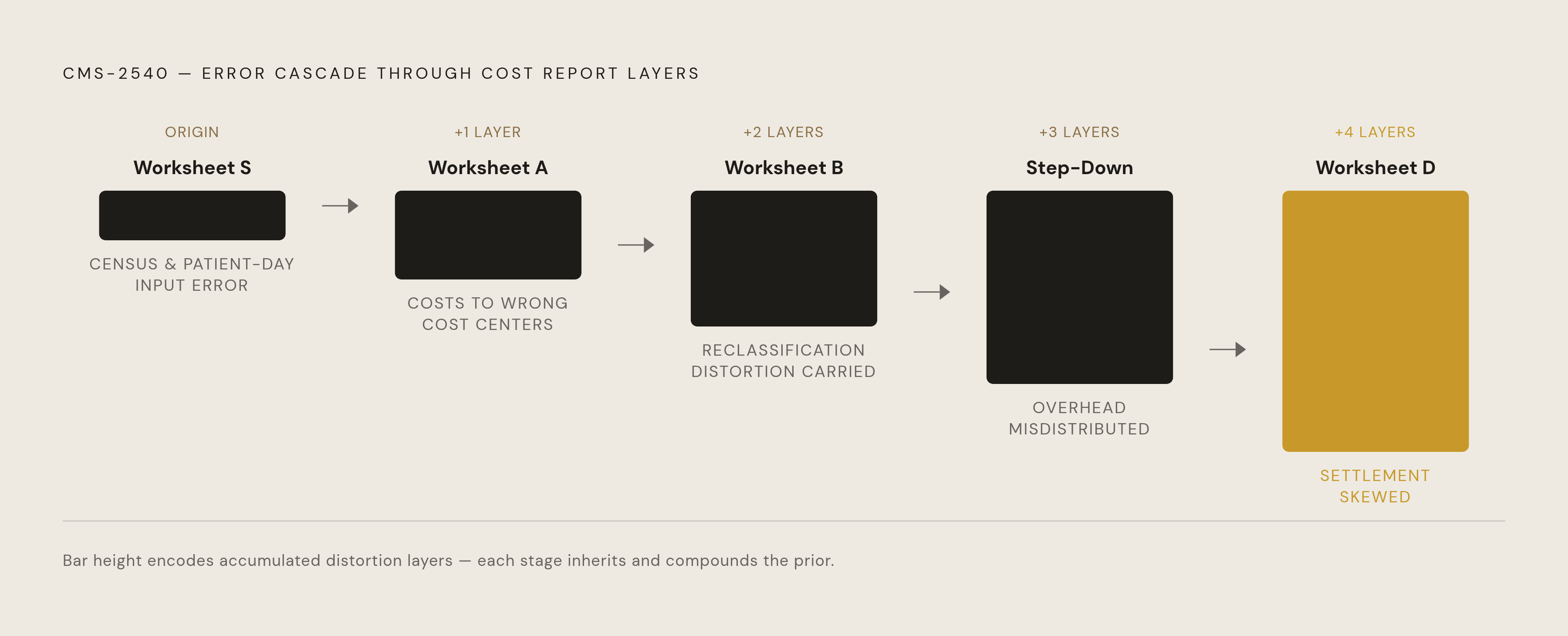
The CMS-2540 is organized as a series of worksheets, each capturing a distinct dimension of the facility's financial activity. The architecture matters for one practical reason: a mistake in an early worksheet does not stay there. It propagates forward through allocation layers into settlement.
Worksheet S contains the statistical foundation, census data, patient days by payer, bed counts, occupancy. Everything downstream depends on what lands here. Worksheet A is where all expense categories are initially posted to cost centers: labor, contract services, medical supplies, overhead, administrative expenses, all arriving from the trial balance. Worksheet B handles reclassification and adjustment, moving costs from how they were recorded in the general ledger to where they are functionally incurred under Medicare's cost center definitions.
These two steps, Worksheet A posting and Worksheet B reclassification, are where the cost report diverges most sharply from the general ledger. Anyone who approaches this work assuming cost reporting is essentially a reformat of the trial balance will hit the wall here, usually on a deadline.
Worksheet C develops cost-to-charge ratios used in ancillary department settlement. Worksheet D is where settlement occurs: after the step-down allocates overhead to direct care cost centers, Worksheet D calculates Medicare's share of costs for each center. Worksheet G presents the revenue and operating expense statement, including room and board and ancillary revenues by payer.
The step-down method deserves direct treatment because it is frequently described and rarely explained with useful precision. Overhead cost centers, administration, housekeeping, dietary, plant operations, do not generate Medicare revenue on their own. Their costs must reach the direct care cost centers through a prescribed allocation sequence. CMS specifies the order. Once a cost center has been closed, meaning its costs have been allocated out, it cannot receive allocations from cost centers closing later in the sequence. Allocate in the wrong order and the settlement math is wrong in ways that are not immediately obvious, and may not surface until the MAC reviews it.
Electronic submission occurs through the Electronic Cost Report format, filed with the facility's Medicare Administrative Contractor, not CMS directly.
Allowable Versus Non-Allowable Costs: The Line That Determines Reimbursable Expenses
Not every dollar a facility spends is reimbursable under Medicare. CMS applies a "reasonable and necessary" standard, and the boundary between allowable and non-allowable is not always legible from the general ledger, particularly where facilities carry complex ownership or management structures.
Allowable costs include direct patient care, nursing labor, therapy services whether provided by employees or contractors, and medical supplies. Routine services, room, board, dietary, housekeeping, laundry, are allowable. Administrative and general overhead allocated on a reasonable basis qualifies. Capital-related costs, including depreciation, qualifying lease costs, and interest on capital asset borrowing, are allowable under CMS's specific rules for each category.
Non-allowable costs must be identified and removed before settlement. Activities unrelated to patient care, gift shops, beauty salons, certain uncovered ancillary services, are excluded. Advertising and marketing expenses fall outside the allowable definition with narrow exceptions. Charitable and fundraising expenses are excluded.
Related-party transactions are where things get complicated, and they represent some of the most common MAC audit findings. Management fees, rent, or purchased services paid to affiliated entities must be tested against arm's-length pricing standards. Where the related-party cost exceeds what an independent transaction would have produced, the excess is disallowed. Facilities with management company agreements, affiliated real estate entities, or shared services arrangements with parent companies face this analysis across multiple lines of their trial balance. The documentation required to defend related-party costs is substantial, and reconstructing arm's-length comparables after an audit has opened is categorically harder than building the file in advance.
The practical implication is that the allowable/non-allowable distinction must be applied at the general ledger level before costs are posted to Worksheet A. Finding a non-allowable cost after the step-down has been run means rebuilding the allocation from that point forward. Recoverable, but expensive in ways that compound under time pressure.
Cost Allocation and the Step-Down: How Overhead Reaches Medicare's Share of Costs
The step-down is the methodological core of the cost report. Abstract preparation errors become concrete financial consequences here. To understand why this works, we must first look at how overhead costs are connected to direct care cost centers through allocation statistics.
Each overhead cost center is allocated to subsequent cost centers using a statistic reflecting how those overhead resources are consumed. Plant operations and housekeeping costs are typically allocated based on square footage. Dietary costs use meals served or full-time equivalents. Administrative and general costs are often allocated based on accumulated costs or direct charges. Employee benefits follow patient days or FTEs by department. These statistics reflect CMS's judgment about the primary driver of resource consumption in each cost center, codified in the cost report instructions.
Those statistics must be tracked throughout the year. After step-down, each direct care cost center carries its own costs plus its proportional share of overhead. Medicare's portion of routine care costs is then calculated based on Medicare patient days relative to total patient days. For ancillary services, cost-to-charge ratios apply.
Where facilities consistently lose ground in this process is the quality of their supporting statistics. Square footage figures estimated years ago and never revisited. Meal count records reconstructed from memory. FTE data pulled from payroll reports that do not match departmental definitions in the cost report instructions. Each introduces error, and small errors in allocation statistics compound across the step-down sequence because each subsequent allocation layer absorbs the distortion from the prior one. By the time you reach settlement, what started as a minor square footage miscalculation has touched every cost center downstream.
Capital cost centers warrant separate attention. Depreciation and interest are not folded into routine care costs. They carry separate worksheet treatment, separate allocation rules, and distinct settlement treatment. Treating capital as residual overhead is a preparation error that affects both reported costs and the settlement calculation, often pulling both in the same direction.
Patient Days, Census Data, and the Statistical Foundation the Entire Report Rests On
Patient days are the most pervasive statistic in the cost report. They drive routine cost allocation, settlement percentages, and occupancy-based metrics across multiple worksheets. When census data is wrong, almost everything derived from it is wrong, and the errors are often difficult to isolate after the fact.
Payer categories must be tracked precisely. Medicare Part A days, Medicare Advantage days, Medicaid fee-for-service days, Medicaid managed care days, and all other payer days are distinct categories with different implications for cost allocation and revenue reporting. They must reconcile to billing records. That reconciliation is the verification that Worksheet S reflects what the facility actually billed and received payment for.
The same census errors recur because the underlying operational situations that generate them recur. Medicare days counted during non-covered stays, periods following benefit exhaustion or custodial-only care, overstate Medicare utilization and distort settlement. Hold-bed days, where a bed is reserved for a temporarily absent resident, must be handled according to CMS rules that vary by state. Leave-of-absence days present a similar classification problem. For facilities with swing-bed designations, swing-bed days must be separated from SNF days because they carry distinct cost and payment treatment.
Under PDPM, the complexity increases further. Patient-level clinical classification data across the five component groups must align with census records and MDS data. A discrepancy between what the MDS shows, what was billed, and what appears in the cost report census implicates clinical documentation, billing integrity, and cost report accuracy simultaneously. Three separate compliance systems, producing data about the same patients. When they tell different stories, auditors notice, and reconciling the divergence after the fact is considerably more difficult than preventing it.
Worksheet S is where census data is formally entered, but accuracy there is entirely a function of reconciliation work done throughout the year. Retrospective census reconstruction at filing is the cost report equivalent of trying to rebuild a patient's clinical record from scattered notes after discharge: technically possible, practically unreliable, and a source of estimation risk that compounds across every downstream calculation.
Medicare Settlement: How the Cost Report Produces a Final Payment Reconciliation
Under PPS, SNFs receive interim per-diem payments throughout the year based on PDPM rates. The cost report does not generate a new per-diem. It settles cost-based items remaining outside the prospective rate structure and reconciles total Medicare costs against total Medicare payments received.
Capital costs, under specific circumstances, remain settled on a cost basis rather than being fully subsumed by the per-diem. Allowable Medicare bad debts, representing beneficiary cost-sharing amounts uncollected after the facility's normal collection process, are reimbursed at a partial rate through cost report settlement. The qualifying rules are specific: the debt must be demonstrably uncollectible, must represent legitimate cost-sharing liability for a Medicare beneficiary, and the facility must have pursued collection through a documented, standard process before writing it off. Bad debt log deficiencies are among the most commonly cited MAC audit findings, and they are among the most preventable with consistent month-by-month tracking.
The settlement calculation itself is straightforward in principle. The MAC compares total Medicare costs derived from the step-down to total Medicare payments received during the year. A credit balance means the facility received more than its costs support and owes a refund. A debit balance means CMS owes an additional payment. The direction and magnitude of that settlement depend entirely on the accuracy of everything upstream.
After filing, the MAC issues a Notice of Program Reimbursement. This process can take years, and in the interim, the filed cost report is the operative record. Errors persist until the facility files an amended report or the NPR process reaches final settlement. That raises an important question: should a facility that discovers a material error after filing amend proactively, or manage the risk through the NPR process? That decision has financial and compliance dimensions that are considerably easier to evaluate before filing than after.
Medicaid Cost Reporting: How State Requirements Layer on Top of the Medicare Filing
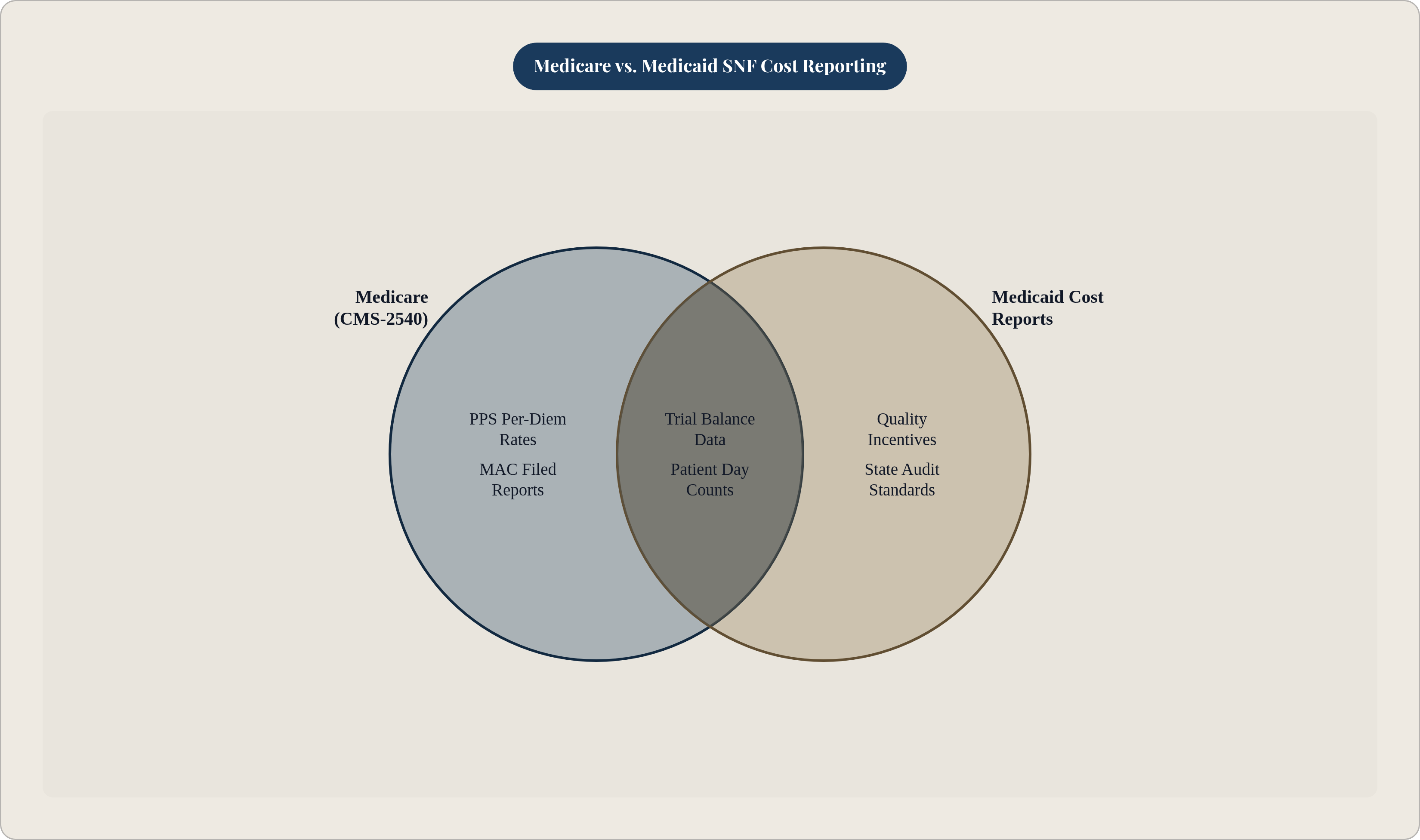
Most SNFs derive a substantial share of revenue from Medicaid. State Medicaid programs require their own annual cost reports, and these are distinct filings from the federal Medicare cost report. There is no single national Medicaid cost report form. Texas, North Carolina, Connecticut, Illinois, Massachusetts, and every other state with a Medicaid long-term care program maintains its own provider instructions, its own form, and its own audit standards.
The structural differences between state Medicaid cost reports and the CMS-2540 are meaningful in practice. Some states use per-resident-day rates derived from cost report data. Others use cost center structures similar to the federal report but with different definitions and allocation methods. Several states incorporate quality incentive components or acuity adjustments with no parallel in the federal filing. Fiscal year requirements and filing deadlines may differ from the Medicare cost report period.
The compounded risk arises where the two systems share a common data source. The trial balance and patient day data anchoring the Medicare cost report typically serve as the starting point for Medicaid cost reports as well. When those underlying data points are inconsistent between the two filings, both the MAC and the state Medicaid agency have audit rights. Concurrent federal and state audit exposure from inconsistent underlying data is a materially more difficult position than facing a single audit.
Multi-state operators face this complexity multiplied. Each state's Medicaid agency applies its own disallowance standards and its own audit methodology. A cost allowable under one state's Medicaid rules may not be allowable under another's, even when it is allowable under Medicare. Managing these differences at scale requires systematic tracking infrastructure built deliberately, not assembled at filing time from whatever is available.
The expanded payer reporting requirements in CMS-2540-24, which now require Medicare Advantage and Medicaid managed care days reported separately, will increasingly surface discrepancies between what federal and state reports show for the same facility in the same period. The separation is intentional on CMS's part. Whether facilities' tracking systems are granular enough to support it is an open question, and the answer varies considerably across the sector.
What the New CMS-2540-24 Form Requires That the Prior Form Did Not
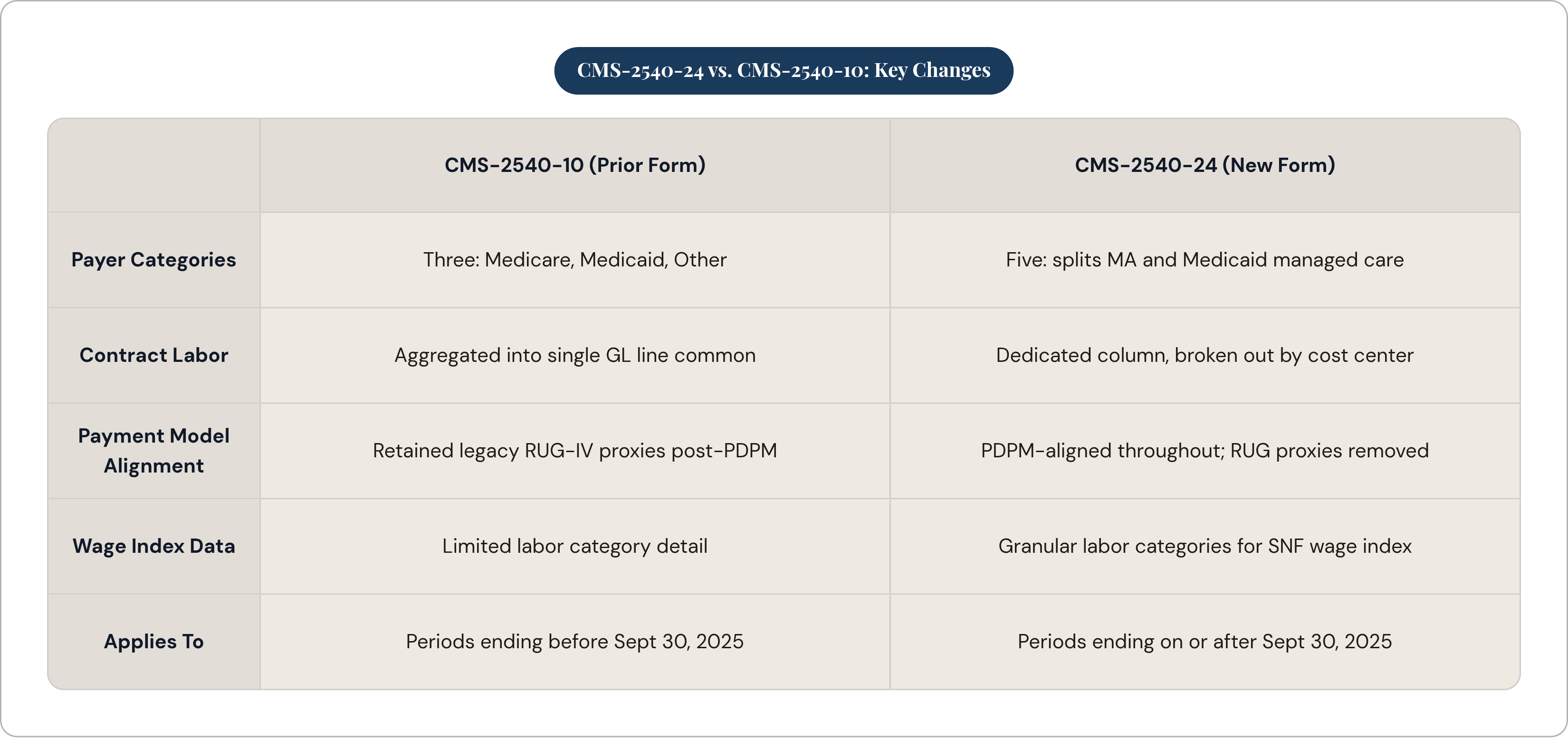
CMS-2540-24 is the first major revision to the SNF Medicare cost report in fifteen years, replacing CMS-2540-10. It applies to cost reporting periods ending on or after September 30, 2025. A one-time 60-day filing extension applies for periods ending March 1 through December 31, 2025. That extension is a grace period, not a signal that preparation can wait.
The most operationally significant change is the expansion of payer categories. The prior form used three: Medicare, Medicaid, and Other. CMS-2540-24 expands to five, splitting Medicare into traditional fee-for-service and Medicare Advantage, and splitting Medicaid into fee-for-service and managed care. Many billing systems were not built to produce that level of disaggregation as a reporting output. Facilities that have historically tracked "Medicare days" as a single bucket face a data architecture problem, not merely an additional column to populate.
Worksheet A now includes a dedicated column for contract labor costs, broken out across cost centers. Facilities that previously aggregated contract labor into a single general ledger line, which is common practice, must now reclassify those costs by the cost center where the contracted work actually occurred. For a facility carrying significant contract nursing, contract therapy, and contract dietary staffing, this is a substantial reclassification exercise. Done prospectively through 2025, it is manageable. Done retrospectively at filing, it becomes an estimation problem.
The new form eliminates legacy RUG-IV proxies that persisted in CMS-2540-10 even after PDPM's introduction, a vestige of the transition period that is now formally closed. PDPM-aligned data is required throughout. Additional cost center detail, including labor category granularity that feeds CMS's longer-term SNF wage index work, appears in sections with no equivalent in the prior form.
It is also worth considering what the real operational risk is here — and it is not late filing. It is arriving at the filing deadline with incomplete data: discovering at the point of preparation that the tracking infrastructure needed to populate the new form accurately was never built. A facility that reaches its fiscal year-end without having tracked Medicare Advantage days separately, without having coded contract labor by cost center, and without having reconciled census to billing monthly, faces a reconstruction problem. Estimation becomes unavoidable, and estimation under time pressure, in a document subject to MAC audit and NPR review, is where exposure accumulates. Pease Bell, a Cleveland-based certified public accounting firm that specializes in skilled nursing facility accounting and Medicare cost report work, is among the advisors that approach this preparation as a year-round discipline rather than a filing-season exercise.