Accounts Receivable Management in Skilled Nursing Facilities
Thin margins mean SNF survival depends on controlling cash timing, not cutting costs.

The numbers from recent industry reporting do not inspire comfort. CLA's 40th Annual SNF Cost Comparison and Industry Trends Report placed median operating margin at 1.8% in 2024, up from 0.6% five years earlier, but still an operating environment where a single percentage point of revenue disruption becomes a crisis rather than a rounding error. Plante Moran's data shows the sector crossed from a national net margin of -1.63% in 2023 to 0.19% in 2024. The industry, in aggregate, barely cleared breakeven last year. That raises an important question: if the margin is this thin, what is actually separating the facilities that survive from those that do not?
The distribution beneath that average is where the real story lives. Thirty-six percent of SNFs posted margins of -4.0% or worse in 2023, while 34% came in at 4% or better. The middle is thin. Most facilities are far closer to insolvency than their administrators would prefer to admit publicly, and the ones that survive tend to share a particular obsessiveness about cash timing that appears nowhere on any org chart.
Cost pressures are not softening. Nursing wages rose roughly 3% to 4% across categories between 2023 and 2024, and Medicaid reimbursement in most states is failing to keep pace. Occupancy recovery helps: median occupancy reached 83.3% in 2024, up from 80.7% the prior year. But higher census also means more claims volume, more payer touchpoints, and a proportionally larger AR portfolio managed by, in many cases, the same billing staff who were already stretched before the beds filled back up.
At margins this thin, an MA authorization that lapses, a Medicaid claim aging past 120 days without resolution, a denial category going untracked for two quarters: these are not administrative inconveniences. They are material hits to operating income. AR discipline is not a back-office concern; it is one of the few operational levers that actually separates facilities in the top third from those quietly running out of runway.
How Payer-Specific Payment Timelines Shape Cash Flow Planning
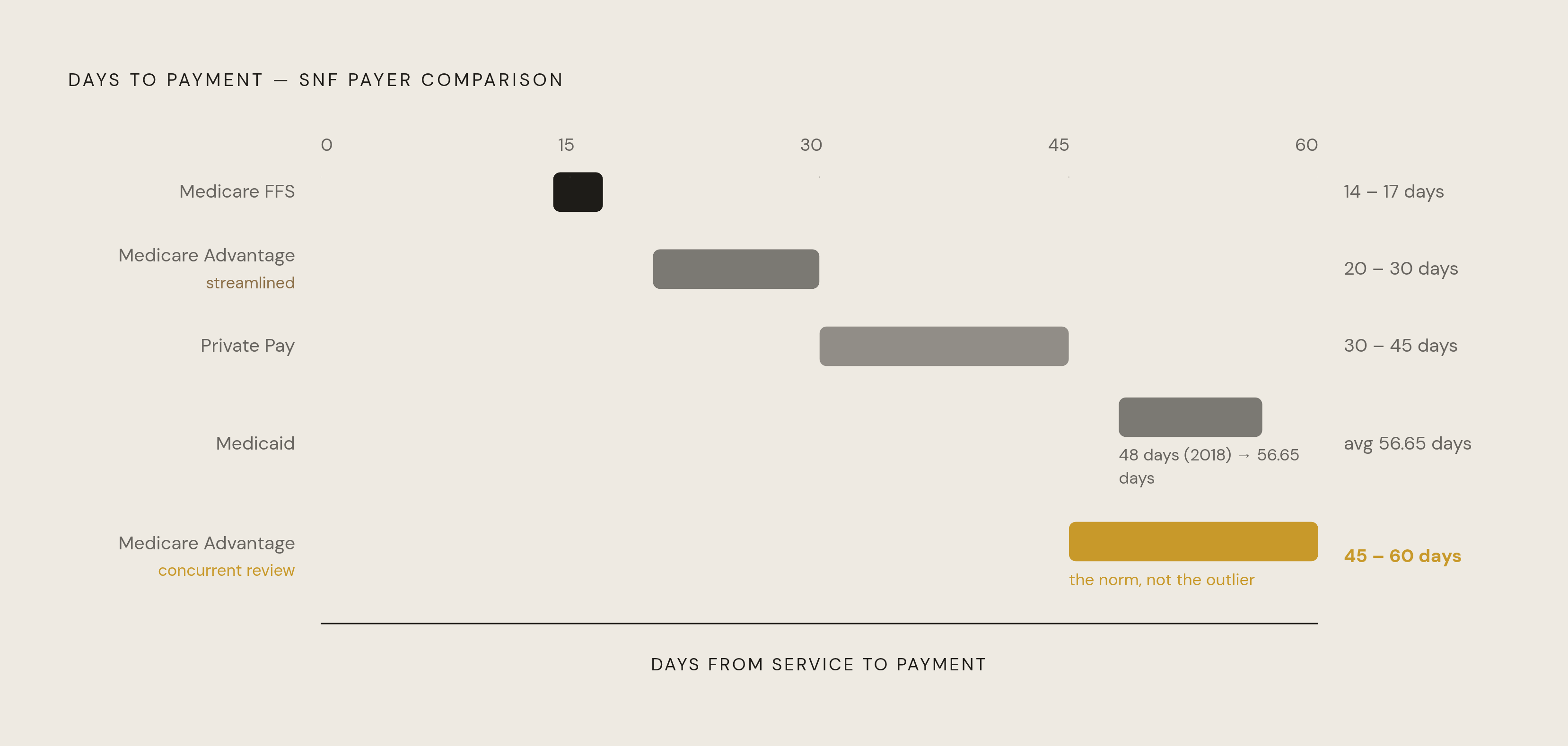
Medicare Part A fee-for-service remains the fastest-paying payer in the SNF context, with clean claims typically clearing in 14 to 17 days. The problem is that Medicare FFS represents a shrinking share of facility days, dropping from 10% in 2022 to 8% in 2023, so this reliable cash source is contracting precisely as cost pressures intensify.
Medicare Advantage fills some of that volume gap, but not with the same cash-flow profile. Plans with streamlined authorization and preferred-provider relationships can pay in 20 to 30 days on clean claims. Plans with complex concurrent review requirements routinely run 45 to 60 days even when nothing goes wrong clinically or administratively. MA enrollment reached 55.4% of Medicare beneficiaries nationally, and MA utilization in SNFs grew to 47.6% in 2024. The 45-to-60-day scenario is an outlier in name only; it is the norm.
Medicaid payment timing reflects both state-level administrative capacity and the complexity of eligibility processing. Maryland benchmark data, one of the more rigorously tracked state datasets in the industry, shows industry-average Medicaid collection at 56.65 days, up from 48.02 days in 2018, an increase of more than eight days over roughly five years. That same dataset shows Medicaid representing a large majority of receivables in the facilities tracked. When your dominant payer takes nearly two months to pay and constitutes nearly two-thirds of your receivables, your weighted average cash conversion looks nothing like what any summary dashboard implies. The finance team using that dashboard to make staffing and capital decisions is working from a fundamentally incomplete picture, and the consequences tend to surface at the worst possible moment.
Private pay carries its own timing dynamic. Monthly statement cycles mean the earliest possible payment arrives 30 days after statement date, assuming the family pays promptly on receipt. In practice, a 30-to-45-day target requires consistent follow-up for accounts that do not self-resolve, and those conversations are different in kind from a payer dispute workflow.
The practical implication for finance leadership is that aggregate Days AR Outstanding, while a useful directional metric, is an inadequate planning instrument in isolation. A payer-stratified cash flow projection, one that maps expected collections by payer segment against actual billing volume and known payment timelines, gives you something you can actually manage against. But what if the mental model used to build that projection is itself out of date? With approximately 10,000 to 11,000 people becoming Medicare-eligible each day and MA enrollment continuing to grow, the cash timing picture will grow more complex over the next decade. Operators who budget assuming Medicare FFS speed across their entire receivables portfolio will chronically underestimate both the timing and the management intensity of their cash conversion cycle. The problem, in my experience, is rarely analytical capacity; it is the persistence of a mental model built for a payer mix that no longer exists.
The Billing Workflow Foundations That Keep Claims Clean Before Submission
The industry benchmark for clean claim rate sits at a high threshold as of 2025, with best-performing organizations pushing toward 98%. Below a certain threshold, billing staff spend more time on rework than on proactive claim management, and the downstream effects compound across every aging bucket simultaneously. Upstream workflow discipline is not a quality-of-life improvement for billing departments; it is the primary cost-reduction mechanism in the revenue cycle, and most facilities have more room to improve here than anywhere else, without spending money on technology.
SNF-specific upstream failure points follow recognizable patterns. Admission eligibility goes unverified before or on the day of admission, particularly for Medicare Advantage plans with facility-tier requirements that determine whether the SNF is covered under the patient's benefit structure. The Medicare Part A three-day qualifying hospital stay, a foundational requirement for SNF coverage, gets confirmed after the facility bills rather than before, producing a denial that should have been avoided. MDS assessments, the Minimum Data Set documentation that drives payment rate calculations under PDPM, are submitted late or contain coding errors, corrupting the claim at its source before it leaves the building. Prior authorizations are obtained neither in advance nor renewed before expiration. Discharge dates and billing period end dates are misaligned between clinical documentation systems and billing platforms.
Each of these failures has a different root cause and a different owner, which is precisely why they persist.
The relationship between MDS accuracy and AR deserves particular attention because it is less intuitive than the others. Under PDPM, the patient's functional and clinical profile, captured in the MDS, determines the payment rate directly. A miscoded assessment does not merely create a clerical correction; it either underpays the facility for services rendered or generates a denial requiring appeal resources, clinical documentation retrieval, and rework time to resolve. The billing error and the clinical documentation error are the same error, though they almost never get treated that way organizationally. It is also worth considering what this means structurally: closer integration between clinical and billing teams does surface these errors earlier, and the data on facilities that have formalized that integration bears this out, even if the organizational resistance to changing the structure is real and persistent.
A pre-bill review checklist that verifies payer, authorization status, MDS lock date, and diagnosis coding before submission is the single highest-leverage upstream intervention available to most SNF billing operations. It is neither complicated nor expensive. What makes it difficult is the organizational accountability structure required to sustain it: who owns the claim at each handoff, from admissions through clinical to billing, must be explicitly defined. Claims that fall through handoffs are overrepresented in aged AR, and they tend to fall through the same unclaimed space between departments, repeatedly, until someone assigns ownership.
Integrated billing platforms that pull MDS data, census information, and payer parameters into a unified workflow reduce the manual reconciliation steps where upstream errors originate. Fragmented technology stacks, where clinical and billing systems do not communicate, require human intervention at exactly the points most likely to introduce error.
Reading AR Aging Buckets by Payer to Catch Problems Before They Become Write-Offs
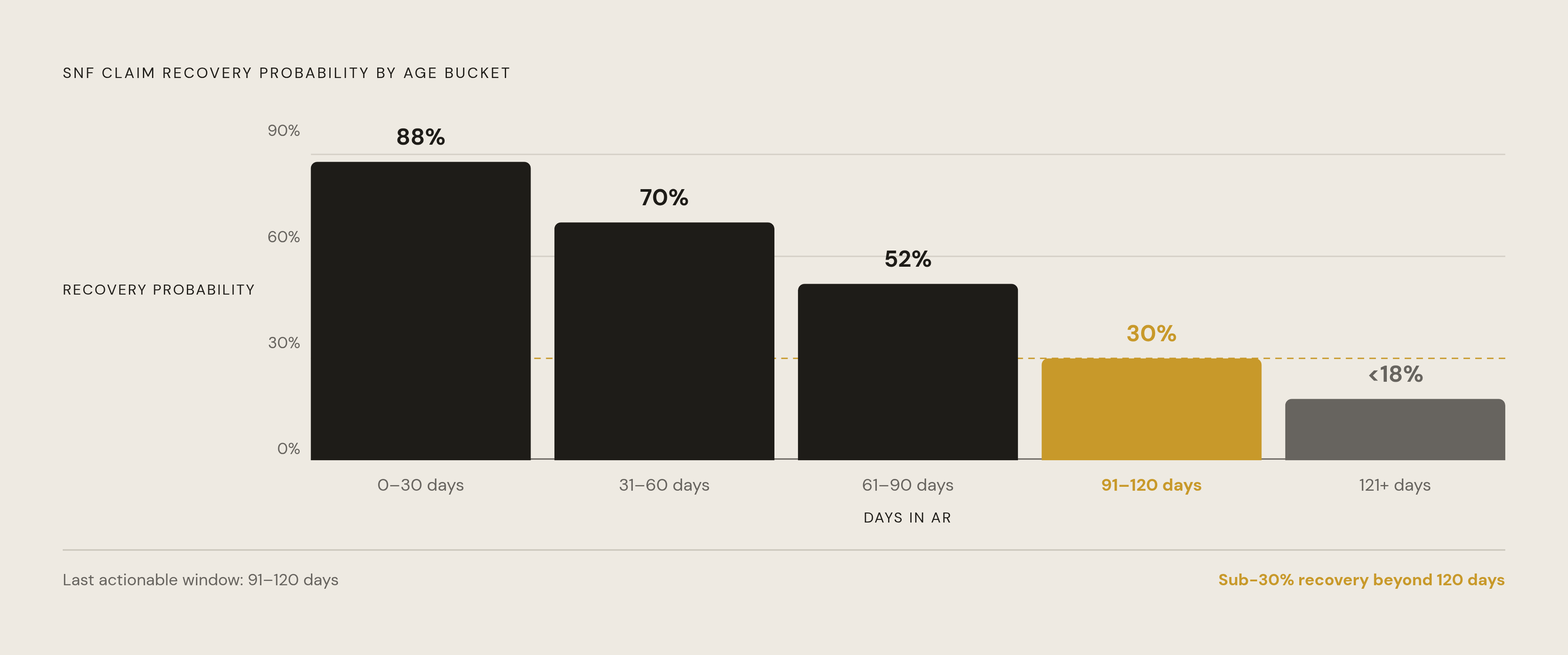
Standard aging buckets, 0 to 30, 31 to 60, 61 to 90, 91 to 120, and 121 or more days, are universal across healthcare billing environments. The SNF-specific discipline is running them by payer rather than in aggregate. An aging report showing 14% of total AR beyond 90 days tells you something is wrong. The same report stratified by payer tells you what is wrong, where the root cause lives, and which resolution path applies. These are not equivalent pieces of information, and treating them as such is how facilities end up surprised by write-offs they could have prevented.
The collectability curve grows steep as claims age. Industry data consistently shows that accounts beyond 120 days carry less than a 30% probability of collection, and the drop-off through the 61-to-90-day window to the 91-to-120-day window is substantial, not gradual. Time is the most finite resource in AR management, and its passage is not neutral: every day an account ages without active management, the probability of full recovery declines.
What aged AR looks like varies substantially by payer. A Medicare FFS claim sitting in the 61-days-or-older bucket is almost always a documentation or billing error, and it should be rare; when it appears, it warrants immediate attention, not routine follow-up. A Medicare Advantage account in the 45-to-60-day range is typically an authorization dispute or a plan-specific timely filing issue, requiring plan-specific escalation rather than a call to a general billing line. Medicaid accounts in the 90-plus-day bucket could represent a pending eligibility determination, a retroactive rate adjustment, or a state-specific billing hold, each with an entirely different resolution path requiring different documentation and different contacts. Private pay accounts beyond 60 days usually signal financial hardship, a disputed charge, or confusion about the billing cycle; the conversation required to resolve them is different in kind, not just degree, from a payer dispute.
A weekly aging review cadence, where the AR manager or business office manager examines each bucket stratified by payer, provides the rhythm necessary to catch movement before it becomes a write-off. Accounts migrating from 60 days toward 90 should trigger automatic escalation. Accounts already beyond 90 days require individual resolution plans, not batch follow-up letters.
One might argue that slower Medicaid AR is simply uncollectable AR and should be written off earlier to clear the books. The Maryland benchmark data complicates that assumption: bad debts as a percentage of total receivables declined even as Medicaid collection days lengthened over the same period. Slower Medicaid AR is not necessarily uncollectable AR. It rewards persistence and eligibility vigilance rather than premature write-off, a distinction that matters considerably at current margins.
Denial Management as a Standing Operational Function, Not an Exception Workflow
SNFs experience claim denial rates in roughly the 8% to 12% range. Across the broader healthcare sector, initial claim denials reached 11.8% in 2024, with best-in-class organizations targeting below 5% and top performers below 3%. Nearly 41% of healthcare providers reported more than 10% of their claims denied in 2024. SNFs, with their MA exposure and complex payer mix, are not positioned to outperform that trend without structural investment in denial management, and most facilities are investing nowhere near enough.
The denial categories that disproportionately affect SNFs are recognizable and largely preventable. Medical necessity denials from MA plans represent the highest-volume category: a plan's clinical reviewers apply the plan's criteria for continued-stay justification, which may diverge from CMS criteria, and concurrent documentation that fails to anticipate that divergence generates a denial that is difficult to appeal retroactively. Authorization denials reflect process failures, whether the authorization was never obtained, it expired, or the service fell outside its parameters. Timely filing denials result from staff turnover or system handoffs that allow filing windows to close. Coordination of benefits errors are particularly common with dual-eligible residents, where the Medicare and Medicaid sequencing must be precisely correct.
Tracking discipline is as important as the resolution workflow. Every denial should be logged by payer, denial code, and root cause, not simply worked and closed. If one MA plan generates a disproportionate share of medical necessity denials over two quarters, that pattern is simultaneously a billing problem, a clinical documentation problem, and a contract renegotiation data point. Treating it only as a billing problem forfeits two of the three available interventions.
Appeal protocols must be payer-specific. Medicare FFS redetermination follows specific regulatory timelines; missing a deadline forfeits the appeal entirely. MA plans have first-level internal appeal processes followed by escalation to an independent review entity; knowing each plan's pathway, including named escalation contacts, accelerates resolution compared to generic call-center escalation. Medicaid fair hearing processes vary by state in both timeline and documentation requirements. A generic appeal letter sent to the wrong address through the wrong process is not an appeal; it is lost revenue with the administrative appearance of having been worked.
The return-on-investment case for sustained denial management investment is direct at SNF margins. Recovered denied revenue flows to operating income without additional cost of delivery. Trilogy Health Services and American Healthcare REIT reported that proactive MA rate negotiations and a strategic focus on higher-acuity admissions drove meaningful Medicare rate growth, a reminder that favorable contract terms upstream reduce denial friction downstream. Denial management and contract management are connected levers, and organizations that treat them as separate functions leave value on the table.
Payer-Specific Collections Strategies for Medicaid, Medicare Advantage, and Private Pay
The same follow-up workflow applied uniformly across all payers produces mediocre results across all payers. Collections strategy must match payer behavior, not billing staff convenience.
Medicaid
Eligibility integrity is the primary lever in Medicaid collections. Medicaid eligibility lapses, particularly in states with annual redetermination cycles, create retroactive billing voids that are both difficult to resolve and largely preventable. Eligibility must be verified monthly, not only at admission. Residents in a pending Medicaid status, navigating a spend-down calculation or waiting for an application determination, should be tracked in a separate workflow with private-pay bridge billing applied where state rules permit.
Electronic claim submission through state Medicaid portals reduces payment delays compared to paper-based processing. States that accept 837I electronic claims consistently pay faster. Timely filing windows for Medicaid vary by state and can be as short as 90 days; staff who apply a single mental model across all state programs will eventually file late in at least one of them, and by then the window is closed.
The Maryland benchmark data reinforces a counterintuitive point: bad debt risk in Medicaid is comparatively low when eligibility is maintained, even as collection timelines extend. The appropriate response to lengthening Medicaid days is persistent follow-up and eligibility vigilance, not accelerated write-off.
Medicare Advantage
Concurrent authorization management is the most consequential lever in MA collections. Tracking authorization end dates before they expire, not after a denial arrives, requires a calendar-driven workflow that many SNF billing departments fail to operate with sufficient discipline. A single expired authorization on a high-acuity MA resident can represent a denial worth thousands of dollars that becomes nearly unrecoverable after the fact.
Building a plan-specific contract matrix, documenting each MA plan's authorization requirements, timely filing windows, preferred documentation formats, and appeal escalation contacts, converts institutional knowledge into an operational system that survives staff turnover. This document should be treated as a living record, updated with every contract renewal and every meaningful payer interaction that reveals new requirements. The discipline of maintaining it is not glamorous work, but the cost of neglecting it shows up directly in aged AR.
MA plans increasingly require concurrent clinical documentation aligned to their medical necessity criteria, which may differ from CMS criteria in meaningful ways. A clinician documenting to CMS standards while the plan reviews against different thresholds is a denial waiting to occur. Billing and clinical teams must be aligned on what each plan actually requires, not what CMS requires in the abstract, and that alignment does not happen by accident.
Tracking MA denial patterns by plan separately allows the billing team to identify which plans are generating disproportionate friction. That information belongs in contract renegotiation conversations, not only in denial worklists.
Private Pay
Financial counseling at admission is the most underutilized collections tool in private pay. Families who understand the billing cycle, their financial obligation, and the transition point from Medicare coverage to private pay responsibility before that transition happens are far less likely to generate aged receivables. The conversation is not a collections call; it is expectation-setting at the moment of highest receptivity. Most facilities do not have it, or have it inconsistently, and the downstream cost of that gap accumulates quietly in the 60-plus-day aging bucket. But how does this affect our original promise of reducing write-offs? A structured admission conversation, delivered consistently, that reduces private pay aging beyond 60 days even modestly, is worth real money at current margins.
Written financial agreements at admission, specifying billing dates, payment expectations, and late payment protocols, create a documented basis for subsequent follow-up that verbal understandings lack. Medicare benefit exhaustion notices, provided with adequate advance notice of the 100-day benefit limit and skilled level-of-care termination timelines, eliminate the payment gap that results when families are surprised by the change in financial responsibility.
Accounts that do not respond within 30 days of statement should receive a follow-up communication. Accounts that reach 60 days without resolution warrant a financial counselor conversation, not another letter. Payment arrangements for large outstanding balances are preferable to allowing accounts to age toward the 90-day write-off threshold. A structured arrangement generates cash; an aged account generally does not.
The Staffing and Organizational Structure Behind High-Performing AR Teams
SNF billing is a specialist function. Staff must simultaneously understand PDPM and MDS mechanics, payer-specific authorization logic for multiple MA plans, state Medicaid rules that change with regulatory updates, and procedural requirements for appeals across multiple payer tiers. Generalist billing staff, the kind that perform adequately in a physician practice or a simpler payer environment, are a structural liability in this setting. That is not always apparent until the aged AR report makes it undeniable.
The most common organizational failure is distributed accountability. Billing responsibility falls across the administrator, the director of nursing, and a part-time billing clerk, with no single individual owning AR outcomes as an explicit performance accountability. In that structure, everyone is nominally responsible for billing and no one is actually responsible for AR performance. The predictable result is a denial rate nobody can explain and an aging report that surprises everyone quarterly.
High-performing operations center AR accountability in a dedicated AR manager or business office manager who owns Days AR Outstanding, denial rate, and clean claim rate as defined performance metrics with regular reporting cadence to administration. Below that manager, payer-specific follow-up responsibilities are assigned explicitly rather than distributed generally. Someone owns the MA authorization calendar. Someone owns the Medicaid eligibility verification cycle. Someone owns the private pay statement and follow-up workflow. When a claim ages into a problem bucket, the question of who owns it has an answer before the problem is discovered, not after.
The staffing investment required to build this structure is meaningful, but the alternative is not a lower-cost option. Facilities operating with inadequate billing infrastructure do not save money on billing staff; they lose it in unrecovered denials, aged Medicaid receivables, and write-offs that a more disciplined organization would have prevented. At a median operating margin of 1.8%, the cost of structural AR underperformance is not a budget variance. It is the difference between a facility that is viable and one that is not.