Related Party Transactions in SNF Financial Statements

ASC 850 defines a related party as any party that controls, or can significantly influence, the management or operating policies of the reporting entity to the extent that the entity may be prevented from fully pursuing its own interests. The definition is intentionally broad. It captures majority owners, entities with significant influence short of control, and arrangements where no money changes hands at all: interest-free loans, administrative services provided without charge, rent-free use of space. The trigger is influence over economic decisions, not the exchange of funds.
Influence exercised two holding-company layers removed from the SNF itself still qualifies. That structural distance is precisely where compliance blind spots accumulate, because the people preparing the cost report often have no visibility into the full ownership stack above them. I have sat in rooms with cost-report preparers who did not know who owned the management company writing their paychecks.
The Medicare framework operates through 42 CFR § 413.17(b), which defines a related organization as one associated with the provider "to a significant extent" through common association, affiliation, or control, whether the SNF controls the other entity or is controlled by it. The regulatory language deliberately parallels the GAAP concept, but the governing logic differs: the regulation is keyed to cost-report allowability, not disclosure alone.
In practice, both definitions sweep broadly. Management companies, real estate holding entities, staffing agencies, therapy companies, and captive insurance arrangements under common ownership fall within each framework's scope. A party can qualify as related under one framework and be treated differently under the other, which raises a question that trip up even experienced auditors: if a transaction satisfies one framework's requirements but not the other's, does the engagement actually hold? Both frameworks must be addressed independently, or the analysis is incomplete.
The Scale of Related Party Flows in the SNF Industry
The numbers reframe what might otherwise seem like an edge-case problem. For Medicare cost-reporting periods covering fiscal years 2015 through 2020, SNFs reported $160.4 billion in Medicare payments and directed $65.4 billion of that total to related parties, according to the Department of Health and Human Services Office of Inspector General. In 2015 alone, nursing homes funneled $11 billion through affiliated entities. When dollar flows at that scale appear year after year, the question of whether this represents a compliance gap or a deliberate design choice becomes harder to avoid.
Chain-level figures show how concentrated this exposure can become. Life Care Centers of America, operating over 200 nursing homes and 25,000 beds, paid $386,449,502.71 to related parties in 2018 alone, totaling $1.25 billion across 2018 through 2020, per OIG findings. Pruitt Health, with nearly 90 nursing facilities across four states, paid its related parties nearly $88.5 million more than the actual costs those entities reported over the same three-year period. These are not rounding errors. They represent a systematic pattern of intercompany pricing that exceeds recoverable cost, covering only the transactions regulators have managed to examine.
Regional data confirms the pattern below the national level. Michigan nursing homes paid nearly $1.2 billion to related party companies across 2021 through 2023. Consumer Voice research has found that nearly 75% of nursing homes engage in related party transactions, making this a structural feature of the industry rather than an anomaly.
The dollar exposure in any single SNF engagement is rarely trivial, and the aggregate picture suggests systemic underreporting, not isolated error.
The Four Transaction Types Where Related Party Exposure Concentrates
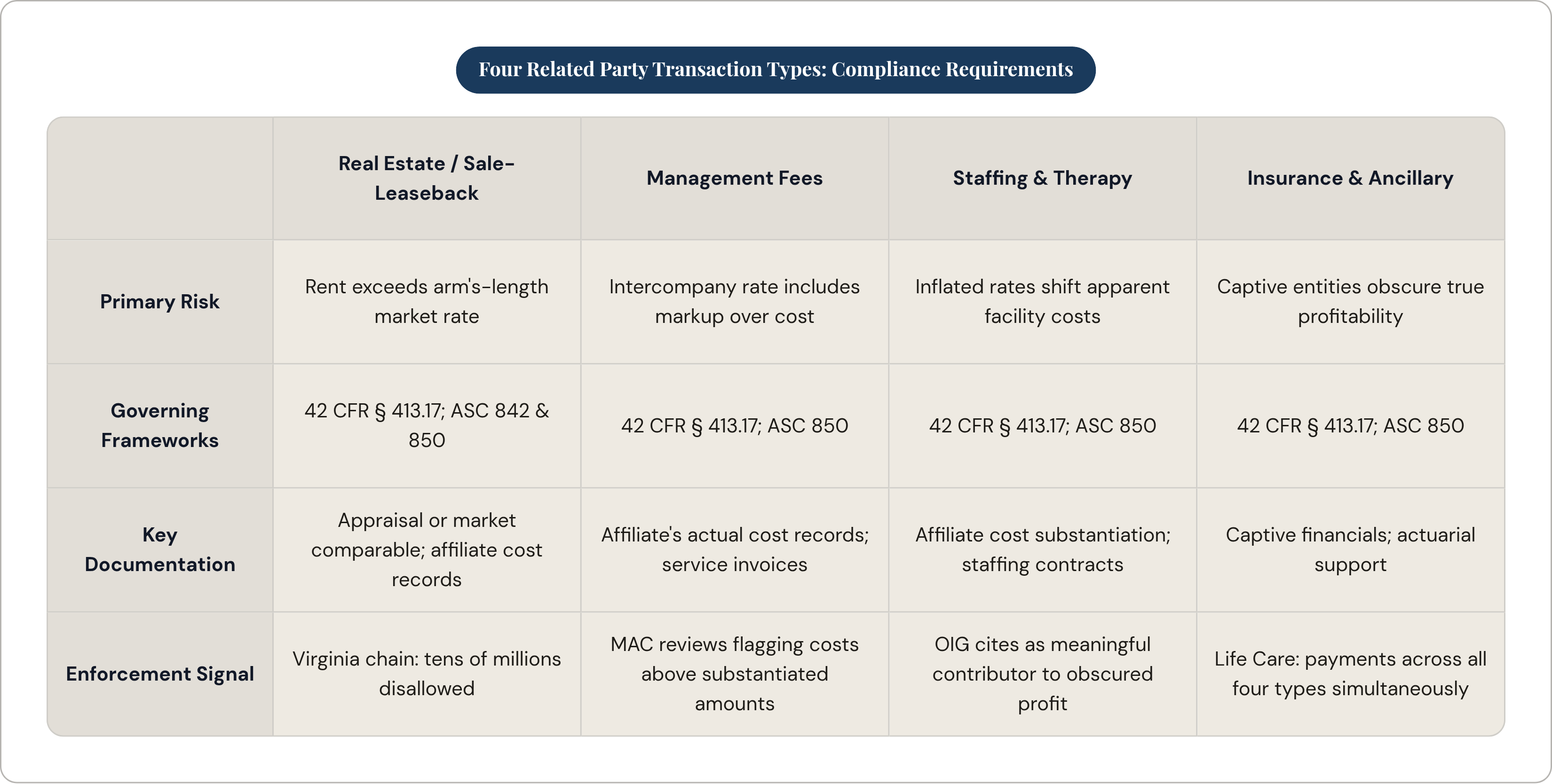
Across the industry, related party risk concentrates in four transaction categories. Each has distinct mechanics, distinct documentation requirements, and distinct consequences for the cost report.
Real Estate and Sale-Leaseback Arrangements
A common structure involves a facility selling its building and land to a commonly owned entity or real estate investment trust, then leasing it back at rates that may exceed what a third-party landlord would charge. A desk review of 37 facilities in a Virginia chain identified tens of millions of dollars in disallowed, unsubstantiated, and reportedly inflated expenses, with investigators specifically flagging unusually high related-party rent as a primary finding. When the landlord is an affiliate, the rent is not at arm's length, and 42 CFR § 413.17 limits recoverable cost accordingly.
These arrangements carry a dual compliance burden that advisors frequently underweight: ASC 842 governs measurement and classification of the lease itself, while ASC 850 disclosure requirements run concurrently. Both must be satisfied, and satisfying one does not touch the other.
Management Fees
SNFs routinely pay affiliated management companies for IT, consulting, or administrative services at rates that may exceed what those companies actually incurred. The issue is not whether these arrangements exist; it is whether the intercompany rate reflects actual cost rather than a markup. MAC desk review findings consistently surface facilities paying parent-owned management companies amounts exceeding substantiated costs, with CMS requiring cost-report adjustments for the difference.
Staffing and Therapy Companies
Contracting with an affiliated staffing agency or therapy provider at inflated rates effectively shifts apparent costs out of the facility and into a related entity that reports lower expenses. OIG-cited research estimates that nursing facilities obscured substantial portions of their profitability through payments to related parties, with real estate and management fees as primary vehicles but staffing and therapy arrangements contributing meaningfully to the total.
Insurance and Other Ancillary Arrangements
Self-owned captive insurance entities, purchasing cooperatives, and ancillary businesses round out the typical structure. Life Care's cost reports, as reviewed by OIG, showed simultaneous payments to self-owned management, staffing, insurance, and therapy companies, illustrating how a single chain can span all four categories within a single reporting period.
The working principle across all four types: the auditor's question is whether the structure is disclosed and whether the cost reported reflects the related party's actual cost, rather than the marked-up intercompany charge.
How 42 CFR § 413.17 Sets the Cost Ceiling and What It Requires in Practice
The regulation's core rule is straightforward: related-party costs may be included in allowable Medicare costs only at the lower of the related organization's actual cost or the market price for comparable services, facilities, or supplies purchased elsewhere. By removing the ability to profit on intercompany transactions, the rule eliminates, at least in theory, any incentive for owners to inflate costs through affiliated entities.
What "actual cost" requires in practice is more demanding than clients tend to appreciate. The SNF cannot simply book the invoice from its affiliate and call it documented. It must obtain and be able to produce records of what the affiliated entity actually spent to deliver the service or lease the property. If the affiliate's cost is unavailable or undocumented, the allowable amount defaults to fair market value, which requires its own substantiation: typically a formal appraisal or market comparable analysis. Documentation gaps do not simply create an uncomfortable conversation with a reviewer; they collapse the allowable cost ceiling to a figure the facility may have never independently established.
The regulation includes an exception provision at 42 CFR § 413.17(d): providers can request relief from the cost-ceiling rule if they demonstrate the transaction meets an arm's-length standard. OIG's December 2024 report found that Medicare Administrative Contractors were not consistently reviewing or documenting these exception requests, creating a gap that both providers and auditors have, in some cases, exploited through inattention rather than intent.
The practical implication for the cost-report auditor is a two-part test on every related party line item: first, is the relationship properly disclosed; second, is the reported cost the lower of actual cost or market price, with documentation sufficient to survive MAC review.
What GAAP Requires Under ASC 850 and Where It Diverges From the Cost-Report Framework
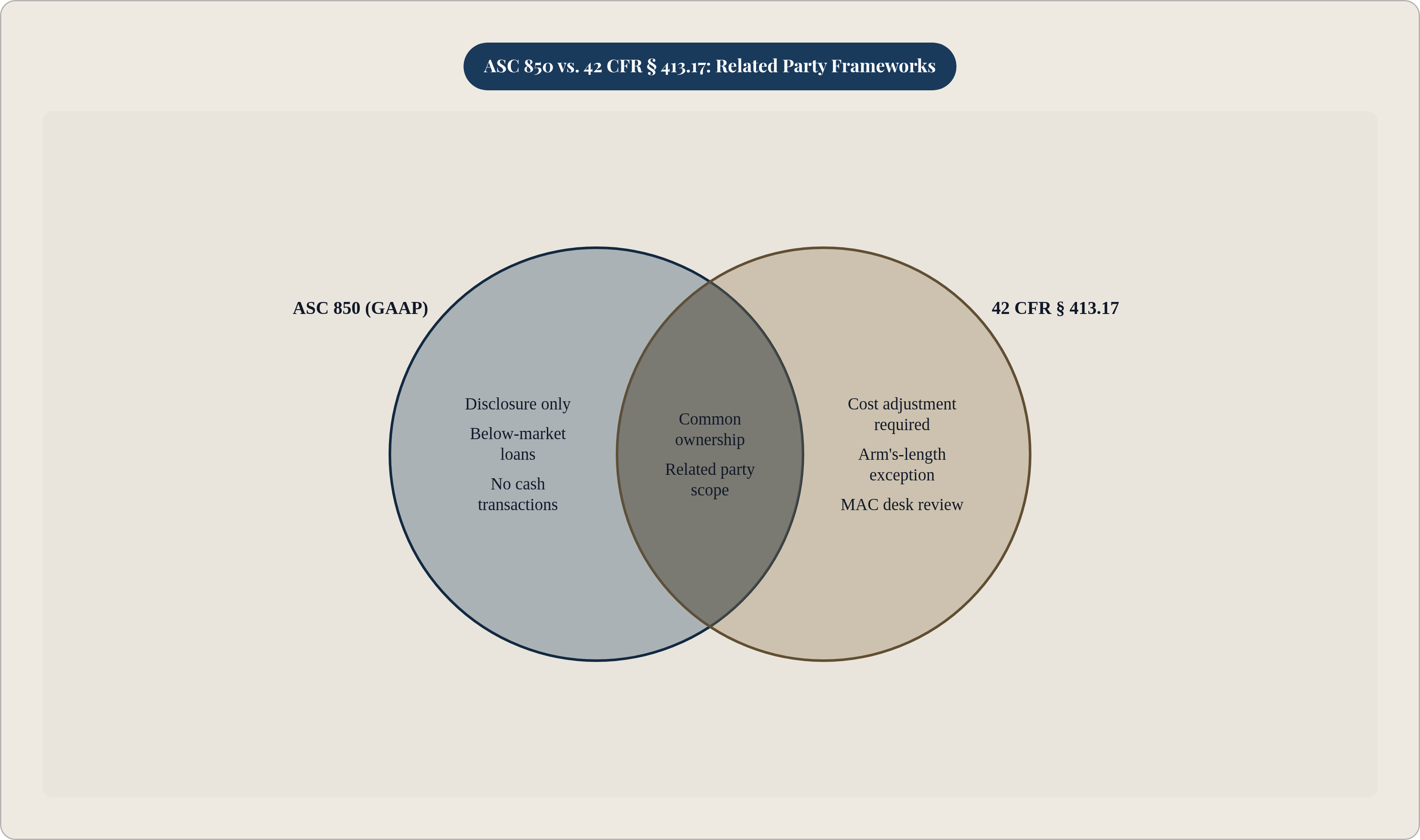
ASC 850 requires that financial statements disclose material related-party transactions, including the nature of the relationship, a description of the transaction, the dollar amounts involved, and any amounts due to or from related parties at period end. The standard also reaches transactions where no cash changes hands: below-market loans, administrative services provided without charge, and use of facilities at nominal or zero cost all require disclosure.
The critical divergence from the Medicare framework is this: ASC 850 requires disclosure, not adjustment. Financial statements do not need to restate related-party transactions to fair value; they need to describe them with sufficient specificity that a reader can assess their economic significance. That is the opposite of 42 CFR § 413.17, which mandates cost adjustment as a condition of Medicare reimbursement, independent of how the transaction is described in the financial statements.
A facility can satisfy GAAP disclosure requirements in full while simultaneously misreporting costs on its Medicare cost report. That gap is not theoretical. On more than one engagement, I have watched the financial statements carry clean disclosures that any reasonable auditor would approve while the cost report contained related-party line items with no supporting documentation for actual cost, the two documents prepared by different teams who had compared notes. Neither team thought they were doing anything wrong, which is part of what made it so difficult to unwind.
When related party arrangements involve leased property, the measurement and classification layer of ASC 842 applies, but ASC 850 disclosure obligations run in parallel. Both must be satisfied, and neither satisfies the other.
A clean audit opinion on SNF financial statements does not imply Medicare cost-reporting compliance. The two frameworks address different questions and must be tested separately. Conflating them creates client exposure that neither the auditor nor the facility may recognize until a MAC audit or OIG review surfaces it.
Where the OIG Found Compliance Failing and What Its December 2024 Report Means for Auditors
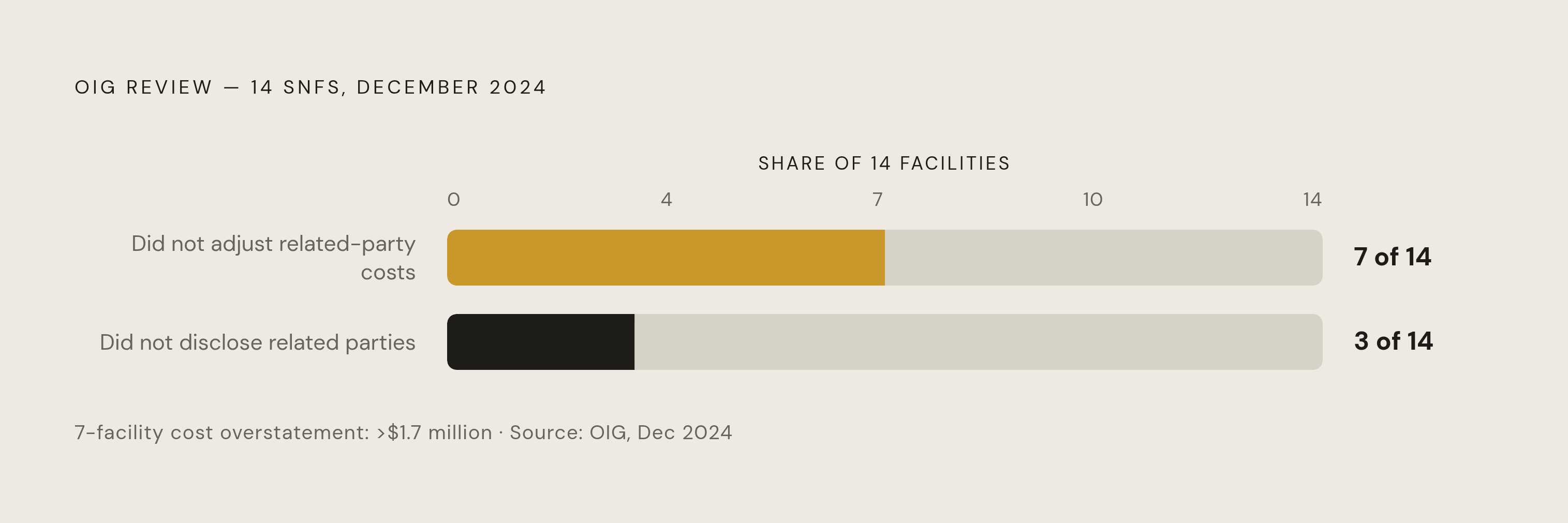
OIG's December 2024 report reviewed a nonstatistical sample of 14 SNFs. Three did not properly disclose one or more related parties on their Medicare cost reports. Seven did not properly adjust related-party costs to Medicare-allowable levels, overstating costs by more than $1.7 million across the sample. Given the sample's limited size relative to the industry, that figure likely understates the systemic problem.
The systemic gap OIG identified was not confined to facility-level failures. MACs were failing to include related party disclosure or cost adjustment in their normal desk review or audit activities. CMS had not provided sufficient guidance on how to determine allowable related-party costs. The enforcement infrastructure designed to catch these errors was not operating as intended.
OIG issued three recommendations. First, require MACs to review related-party reporting as part of normal desk reviews; CMS did not concur. Second, develop guidance for SNFs on determining allowable related-party costs; CMS concurred. Third, provide guidance to reeducate MACs on reviewing exception requests under 42 CFR § 413.17(d); CMS concurred.
CMS's non-concurrence on the first recommendation deserves more attention than it typically receives. MAC-level review of related party costs remains inconsistent, which means SNFs are accumulating retrospective audit risk rather than being corrected in real time. Despite regulations in place for decades, neither MACs nor any other federal entity was systematically reviewing SNF compliance with related party requirements before this report. Clients who have relied on enforcement inattention as a practical shield are now operating under a materially different risk profile, whether or not their day-to-day operations have changed.
The Tunneling Concept and How the November 2024 OIG Compliance Guidance Reframes the Risk
OIG's November 2024 Nursing Facility Industry Segment-Specific Compliance Program Guidance, the first industry-specific compliance guidance published since the updated general guidance in November 2023, introduces a concept that changes the legal texture of related party review: tunneling. The term refers to the misrepresentation or concealment of profitability through payments to related parties, typically ancillary businesses, that enriches owners while directing fewer resources toward resident care.
Prior enforcement framing treated inflated related party payments primarily as accounting errors, problems of measurement and disclosure subject to cost-report adjustment. The ICPG characterizes them as a mechanism by which owners extract value at the expense of patients and Medicare. That recharacterization matters enormously.
One might argue that the underlying facts haven't changed, that only the label applied to them has shifted. But this is where the analysis gets uncomfortable. Once the operative question shifts from measurement accuracy to intentional concealment, False Claims Act analysis enters the picture rather than simply a cost-report settlement. Intent, not just inaccuracy, becomes the governing inquiry. The same set of facts that once resolved through a cost-report adjustment can now support FCA liability. That is not a subtle doctrinal distinction; it changes the exposure profile for clients who have assumed these matters are reconcilable through amended filings.
For advisory work, the implications are concrete. Compliance questions that were once technical, whether the cost is properly adjusted, whether the relationship is disclosed, now carry potential FCA exposure when the misstatement is characterized as intentional. Ownership transparency, specifically who controls the related entities and whether those relationships appear on the cost report, becomes a compliance priority rather than a disclosure formality. Private equity-owned facilities, which often carry layered related party structures inherited through acquisition, require particular scrutiny under this framework.
The Expanded Disclosure Obligations Under CMS-855A, Effective January 2024
A final rule effective January 16, 2024, implementing Section 6101 of the Affordable Care Act, significantly expands the ownership and managerial control disclosures required of SNFs enrolling in or recertifying for Medicare. The rule creates a new disclosure category, "Additional Disclosable Parties" (ADPs), covering entities that provide certain services to or exercise certain controls over the SNF, with disclosures due on the CMS-855A SNF Attachment and a compliance deadline phased through 2025.
ADP categories are broad and will surface many previously undisclosed related party relationships. They include entities exercising financial control, such as those with authority to approve expenditures or monitor finances; entities providing financial services, including accounting, financial audits, and asset management; cash management services; clinical consulting; and entities developing policies and procedures. Management companies, real estate holding entities, and financial services affiliates that have historically operated in the background of SNF ownership structures are now squarely within the disclosure mandate.
The rule also finalizes definitions of private equity company and real estate investment trust for Medicare enrollment purposes, directly targeting the ownership structures most closely associated with sale-leaseback arrangements and management fee extraction.
The enforcement consequence of non-compliance is not a cost-report adjustment. SNFs that fail to provide required ADP disclosures may face denial or revocation of Medicare enrollment. For a facility where Medicare represents the dominant payer, that is an existential consequence, not a technical deficiency.
Clients who engaged private equity partners or executed sale-leaseback transactions before 2024 need to audit their CMS-855A disclosures against the new ADP categories before the compliance deadlines resolve fully. Many have not done so, and the gap between what they believe is disclosed and what the rule now requires is often wider than anyone on the facility side has measured.
What a Defensible Related Party Compliance Posture Looks Like for SNF Clients
The starting point is relationship mapping, and it should precede any cost-report or financial statement work. Document every entity under common ownership or control that transacts with the SNF: management companies, landlords, staffing agencies, therapy providers, insurers, ancillary businesses. This is not a one-time exercise. It requires updating when ownership changes, when new services are sourced from affiliates, and when private equity transactions restructure the entity stack.
Once the map exists, apply both frameworks to every identified relationship, sequentially. Under ASC 850: is the transaction material, and is it disclosed with sufficient specificity, including dollar amounts, the nature of the relationship, and any balances outstanding at period end? Under 42 CFR § 413.17: is the cost reported the lower of the related organization's actual cost or fair market value, and is there documentation sufficient to substantiate whichever figure is used?
Audit the CMS-855A against the ADP categories established by the January 2024 final rule. For any relationship that involves a lease, apply both ASC 842 and ASC 850 and document both independently. For any transaction that could be characterized as involving management control or financial oversight, evaluate whether it triggers ADP disclosure obligations.
The clients at greatest risk are not necessarily those with the most complex structures. They are the ones whose structures have not been reviewed through the lens of the tunneling framework, the December 2024 OIG findings, and the expanded CMS-855A requirements. These developments arrived within months of each other and collectively describe a compliance environment that has moved faster than most SNF programs have adapted. The retrospective exposure sitting on some of these balance sheets has not been quantified. That is the more pressing problem, and it is the one least likely to surface until someone outside the facility starts asking questions.