Medicare and Medicaid Revenue Recognition for SNFs
Observation status gaps and diagnosis coding errors undermine SNF revenue recognition.

Medicare Part A SNF coverage is conditional. The foundational requirement is a three-day qualifying inpatient hospital stay immediately preceding SNF admission, and "inpatient" carries legal weight that billing staff routinely underestimate. Observation status days do not count. Emergency department time does not count. A patient can spend four nights in a hospital and still fail the qualifying criterion if those nights were classified as outpatient observation status. SNF admission must follow within 30 days of hospital discharge, and the condition requiring skilled care must relate to the diagnosis treated during the hospitalization. Skilled care must be documented continuously thereafter: skilled nursing seven days per week, or skilled therapy five days per week.
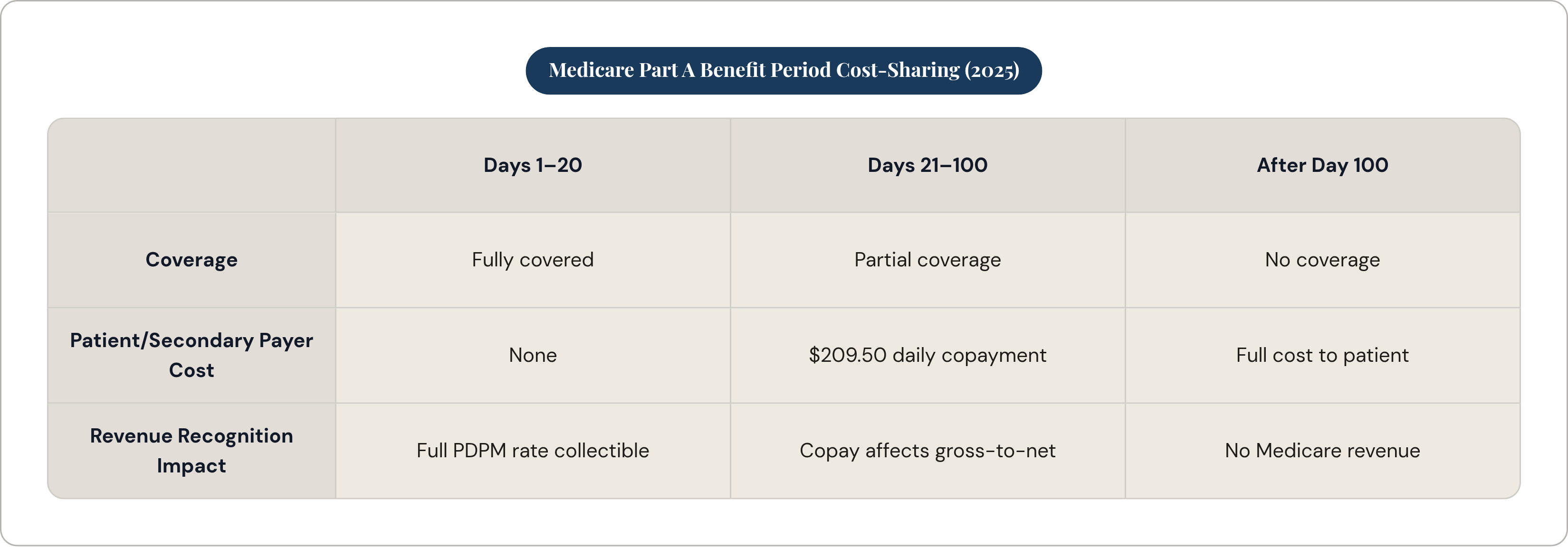
The benefit period cost-sharing structure adds a second layer. Days one through twenty are fully covered. Beginning day 21, a daily copayment applies to the patient or a secondary payer; for 2025, that figure is $209.50. Coverage ends after day 100. The Part A deductible for 2025 is $1,676. Each threshold affects the gross-to-net calculation because secondary payer collections and patient balance exposure depend on where a resident falls within the Medicare benefit period.
CMS has a demonstration extending through 2030 that waives the three-day rule for five specific surgical procedures, effective January 1, 2026, and Medicare Advantage plans largely waive it independently. Neither changes the traditional Medicare FFS framework, but the carve-outs create edge cases that billing staff in mixed-payer environments misclassify more frequently than administrators tend to assume.
Days that do not satisfy eligibility criteria are not Medicare revenue. A day classified as Medicare Part A on the billing system when the qualifying conditions were not met is not a valid transaction; it is an overstated receivable and, if submitted, a recoupment risk. But what if the admissions coordinator confirmed a hospital stay and no one verified the observation status classification? In facilities where admissions coordinators, clinical staff, and billing operate in separate silos, that integration rarely exists. The coverage-determination function and the revenue accounting function must be the same conversation, not adjacent processes that occasionally sync.
The PDPM per-diem structure and how it determines the dollar amount recognized each day
Before 2019, Medicare paid SNFs primarily based on therapy volume. More minutes billed, more revenue collected. The Patient Driven Payment Model replaced that logic with a patient-characteristic-based per diem, and the shift fundamentally changed what question drives revenue recognition. It stopped being "how many minutes were delivered?" It became "how is this patient classified?"
The federal per diem under PDPM has six components. Five are case-mix adjusted: Physical Therapy, Occupational Therapy, Speech-Language Pathology, Nursing, and Non-Therapy Ancillaries. The sixth covers standard facility costs and is unadjusted. Classification for the therapy components is anchored by a single ICD-10 primary diagnosis code entered on the Minimum Data Set assessment. The Nursing and NTA components draw on additional clinical and comorbidity data, but the diagnosis code is the structural foundation.
Per diem amounts adjust based on patient characteristics, not services rendered. A facility that applies the admission-day rate to every subsequent day is not approximating; it is making an error, and the direction of that error is unpredictable without knowing the patient's trajectory. One might argue that the admission-day rate is a reasonable proxy when clinical changes are modest — but that argument does not survive a probe audit, and it does not survive the math when the patient's case-mix group shifts materially mid-stay.
The labor-related share of the per diem increased to 72% beginning FY 2025, up from 71.1%. That percentage determines how Core-Based Statistical Area wage index adjustments flow into the facility-specific rate. A facility in a high-wage market benefits proportionally more from a larger labor share; the inverse holds in low-wage areas. The numerical change is modest, but the effect is real at scale.
Annual rate updates compound the complexity. The FY 2025 update, effective October 1, 2024, produced a net 4.2% increase, approximately $1.4 billion in aggregate per CMS's final rule. The FY 2026 update, effective October 1, 2025, added a further 3.2%, approximately $1.16 billion over FY 2025, per the CMS final rule issued July 31, 2025. Stays that span the October 1 federal fiscal year boundary require a rate split: days before October 1 recognized at the prior-year rate, days after at the updated rate. Carrying the prior rate into October is a common error in facilities without automated rate-table management, and it is the kind of error that accumulates quietly across a census before anyone looks at the rate file.
The revenue earned on any given Medicare day is a product of case-mix classification, applicable component rates, wage index, and benefit period day number. Each element is a potential source of error. Overstatements generate recoupment exposure; understatements leave valid revenue uncollected.
ICD-10 code mapping, upcoding risk, and how CMS is tightening PDPM classification integrity
When a single ICD-10 code on the MDS determines case-mix group assignment, and when the highest case-mix adjusted federal per diem rates can exceed $1,000 per day, the diagnosis code functions simultaneously as a clinical document and a material financial input. That dual role creates a structural upcoding incentive, and CMS has been methodically working to close it.
The FY 2026 final rule finalized 34 changes to ICD-10 code mappings. Among the codes removed from primary diagnosis eligibility: diabetes without complications, obesity, anorexia, bulimia, and hypoglycemia. CMS's stated reasoning was that these diagnoses are insufficiently specific to justify a skilled inpatient stay as a primary driver. Whether the clinical logic holds in every case is worth debating; the operational consequence is not. Facilities classifying patients under those codes at higher rates no longer can.
The trajectory is worth watching carefully. The FY 2027 proposed rule included a formal request for information on case-mix upcoding. That kind of regulatory signal — soliciting industry comment on the scope of a problem before proposing a structural remedy — typically precedes more aggressive intervention. Anyone who tracked the transition from RUG to PDPM recognizes the pattern. That raises an important question for any facility with heavy reliance on a narrow band of high-paying diagnosis codes: how exposed is the revenue base if the next round of mapping changes targets those codes specifically?
For revenue recognition, removed codes represent a reduction in the estimated transaction price for affected patients. Facilities that have not updated rate assumptions to reflect current mappings may be recognizing revenue at rates CMS no longer supports. That exposure is embedded in the coding and MDS completion workflows that feed the billing system, often invisible until a targeted probe audit or payment suspension makes it visible.
PDPM made coding accuracy a financial controls issue. The relationship existed under RUG as well, but PDPM made it explicit and the stakes quantifiable in a way that demands clinical documentation and revenue accounting operate as connected systems, not adjacent ones.
VBP and QRP adjustments as variable components of the Medicare per diem
The PDPM per diem is the foundation; it is not the ceiling or floor of what a facility actually receives. Two programs layer adjustments on top, and both create recognition complexity because neither is precisely knowable at the time of service.
The SNF Value-Based Purchasing program withholds 2% of all Medicare FFS Part A payments, then redistributes a portion, currently between 50% and 70%, as incentive payments based on measured performance. The redistribution totaled an estimated $196.5 million in FY 2025 and is proposed at $208.36 million for FY 2026. A high-performing facility recovers more than the 2% withheld; a low-performing facility may recover nothing. Beginning FY 2026, the measured domains expanded to include staffing levels, healthcare-associated infections, falls with injury, discharge function scores, and successful community discharges. The FY 2026 rule also eliminated the Health Equity Adjustment, moving all facilities to a uniform measurement standard.
The Quality Reporting Program creates similar uncertainty through a different mechanism. Failure to meet QRP reporting requirements triggers a two-percentage-point reduction to the Annual Payment Update. Beginning FY 2027, CMS will randomly select approximately 1,500 SNFs for medical record data validation. The APU reduction is not a negotiated contractual rate; it is a retroactive penalty applied to the entire fiscal year's effective per diem.
For a facility confident in its VBP performance, the withheld portion may be reasonably estimable and recognizable. For a facility with borderline scores, constraining recognition is the more defensible position. This is a judgment call, not a lookup, and that distinction matters most when scores hover near a threshold — precisely where the analytical basis most needs to be documented. But how does this affect our original promise of matching recognized revenue to what the facility is actually entitled to receive? The accounting conclusion and the performance data need to be reviewed in the same conversation, not in separate departments that reconcile at year-end.
How Medicare Advantage changes the revenue recognition calculus relative to traditional Medicare
Medicare Advantage now enrolls more than half of all Medicare beneficiaries. Traditional Medicare FFS is the secondary pathway. That arithmetic has been reshaping SNF revenue for years, and some facilities are still accounting for it as if the payer mix looks the way it did in 2018.
MA plans are private contracts. The applicable rate is whatever the plan specifies, varying by plan, by market, and often by year. A facility cannot apply PDPM rates to MA days. Covered days, prior authorization requirements, and payment terms are all negotiated variables, and the negotiating leverage between a large regional MA plan and a single-facility operator is rarely symmetric.
The prior authorization data warrants close attention. The OIG reported in June 2024 that 19 Medicare Advantage organizations collectively denied 12% of SNF admission requests, with denial rates ranging from under 1% to 23% across organizations. When those denials were appealed, MAOs overturned 95% in favor of the enrollee. A 95% overturn rate is not evidence of careful initial review. It suggests that denial functions as a first-line utilization management tactic, with the appeals process absorbing the cost of correction onto the facility's administrative capacity. The facility bears the cost of chasing what it was owed from day one.
Days pending prior authorization or facing active denial carry an uncertain transaction price, directly affecting the variable consideration estimate under ASC 606. Estimating collectibility requires knowing the facility's own history with each plan, not aggregate industry data. A facility with a 90% historical appeal win rate against a particular MAO can support a different recognition estimate than one without that track record. Building and maintaining that plan-level history is not administrative overhead; it is a prerequisite for defensible accounting.
The broader structural issue is worth naming plainly. MA rates are generally lower than traditional Medicare PDPM rates. As enrollment migration continues, facility-level revenue compresses even when patient volume holds steady. Revenue projections that treat the payer mix as stable will systematically overstate expected collections.
How Medicaid rate-setting works at the state level and why it varies so substantially
Medicare is uniform: one federal PPS, one rate-setting cycle, one update logic. Medicaid is the structural opposite. Every state designs and administers its own payment methodology within federal guidelines, and expertise in one state's system provides limited transferable knowledge about any other. That is not a caveat; it is the central operational reality for any multi-state operator.
A few common structural elements exist. Medicaid SNF payment is typically per diem. Base payments cover routine care, with supplemental payments, including those funded through Upper Payment Limit arrangements, potentially available for additional services or facility characteristics. When a patient meets state eligibility criteria, the covered stay is the state's obligation, without the beneficiary cost-sharing structure that characterizes Medicare Part A.
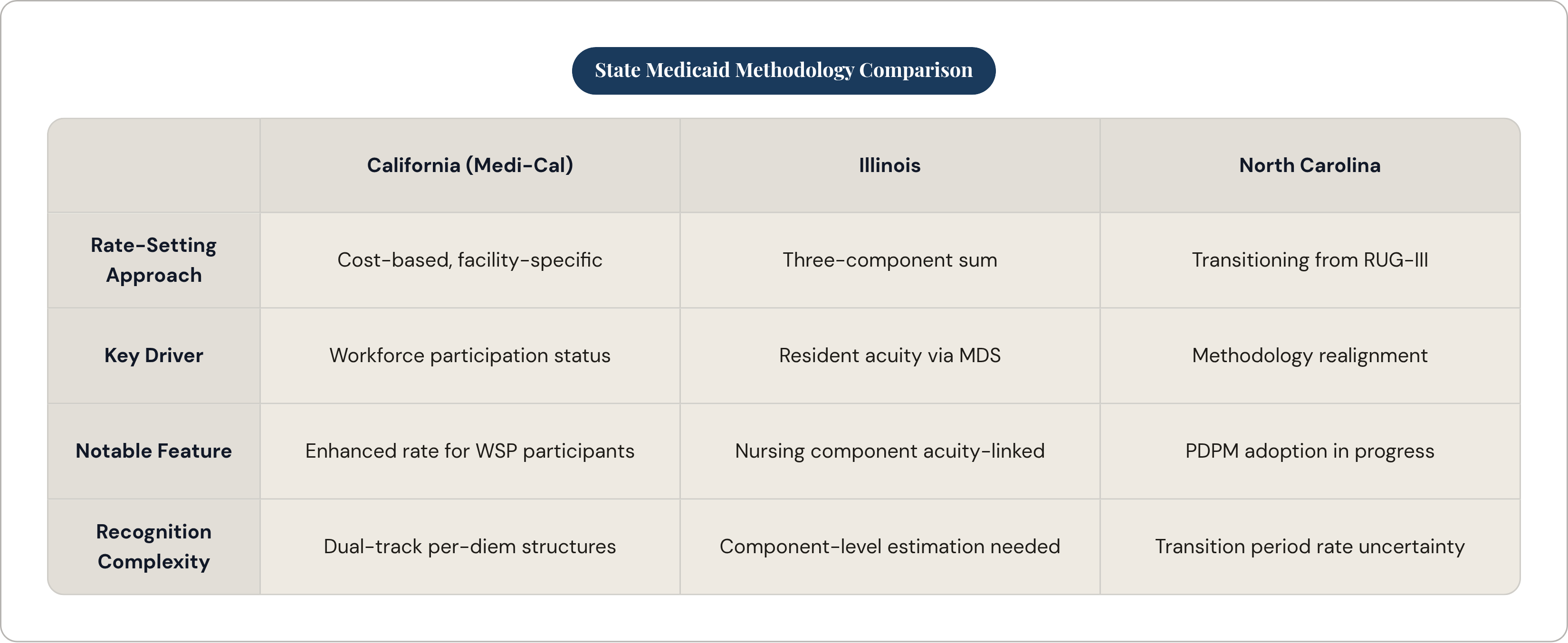
It is also worth considering how even three states in close geographic proximity can produce dramatically different accounting obligations. California's Medi-Cal uses a cost-based, facility-specific methodology updated each calendar year. The Workforce Standards Program introduced beginning CY 2024 creates two tracks: participating facilities receive an enhanced per diem inclusive of a Workforce Rate Adjustment; non-participating facilities receive only the basic rate. The decision about whether to participate is a revenue decision with direct accounting consequences, not merely an operational one. Illinois calculates its per diem as the sum of three separately determined components, nursing, support, and capital, with the nursing component directly linked to resident acuity as measured by MDS data. North Carolina has been adjusting its methodology to reflect the transition away from RUG-III toward PDPM. Three states, and the variation is already substantial; it compounds across fifty.
Rate update timing adds another dimension. Medicare rates change on a fixed October 1 schedule. Medicaid rates change when the state determines, sometimes mid-year, sometimes retroactively. Retroactive adjustments are not anomalies in Medicaid; they are a structural feature of it. When a state issues a retroactive rate change, the facility revises previously recognized revenue in the period the change becomes known, treated as a change in estimate rather than a restatement, unless the original estimate was substantively in error rather than simply imprecise. That distinction matters for financial statement presentation and for auditors examining why a prior quarter's revenue shifted without a corresponding operational explanation.
A facility system operating in ten states is navigating ten different rate methodologies, ten different update calendars, and ten different supplemental payment frameworks simultaneously. The accounting risk compounds with each moving piece tracked inaccurately.
MDS-driven Medicaid payment and the October 2025 transition forcing remaining states to complete the shift to PDPM
The Minimum Data Set is the shared clinical infrastructure underneath both Medicare and Medicaid payment in most states. That shared foundation has driven efficiency for decades: the same assessment informing Medicare classification also feeds state Medicaid rates in states that tie their methodology to MDS data.
States using RUG-IV or RUG-III models relied on therapy data captured in MDS Section O to calculate their nursing payment components. CMS removed Section O from the MDS effective October 1, 2025. States still operating under RUG-based models at that point lost the data input their methodology required. The elimination was not a surprise; CMS had been signaling it for years. But signaling is not the same as completion, and October 2025 was the forcing event regardless of readiness.
The available paths forward are not equivalent in complexity. A state can adopt PDPM in full, import only selected components such as Nursing or Non-Therapy Ancillaries, or develop an independent methodology that does not depend on Section O data. Many states completed their transitions between 2019 and 2024. Those that had not faced a compressed timeline with no flexibility in the MDS change date.
For facilities in transitioning states, there may be a period where the applicable rate methodology is announced but final rates are not yet published. That uncertainty has a specific accounting implication: the transaction price for Medicaid days in that window is genuinely unknown, not merely estimated. Recognizing revenue at the best available estimate while explicitly constraining for the uncertainty is the defensible approach; revising as the rate is confirmed is the required follow-through. Facilities that recognized at full prior-year rates through the transition period, without adjustment, were making an accounting assumption the state data does not support. That assumption surfaces as a variance when the actual rates are finalized, which is an uncomfortable conversation to have with an auditor.
Contractual adjustments and how the gap between gross charges and net Medicaid revenue is accounted for
Every SNF bills at gross charges. No government payer pays gross charges. The gap between what is billed and what will actually be collected is a contractual adjustment, and it must be estimated and recorded at the time of service as a reduction to gross revenue.
For Medicare, the contractual adjustment is relatively mechanical once the applicable PDPM rate is determined. For Medicaid, the calculation is more complex, and the spread between gross charges and net collectible is frequently wider, because Medicaid reimbursement in many states falls short of actual cost of care. That gap is not a rounding issue; in states with structurally low Medicaid rates, it can be material enough to affect operating decisions about admissions mix.
Estimating the Medicaid contractual adjustment requires knowing several things at once: the applicable state rate, the correct rate period, whether supplemental payments apply, and whether the facility qualifies for any enhanced rate programs. California's Workforce Rate Adjustment is one example. A facility that qualifies and participates records a different net rate than one that does not. Getting that classification wrong produces a misstated contractual adjustment in either direction.
Retroactive rate changes require true-up adjustments recorded in the period the change becomes known. A pattern of large true-up adjustments in periods of rate change often indicates that the ongoing estimation process is not using current information effectively. The underlying principle is not complicated: net patient service revenue is the amount the facility has a right to receive under the applicable payment arrangement, not the gross charge and not the hoped-for collection. The contractual adjustment is the mechanism for getting from billed to collectible, and its accuracy reflects the quality of the rate data and estimation process feeding it. When that process is unreliable, the financial statements are unreliable, and auditors will eventually notice the pattern.
Applying ASC 606's five-step model to Medicare and Medicaid revenue
ASC 606 replaced a patchwork of industry-specific revenue guidance with a single analytical framework. For SNFs, both Medicare and Medicaid revenue are exchange transactions within its scope. The five steps surface where the real judgment lives, and in this industry, the judgment is rarely simple.
Step 1: Identify the contract. For Medicare FFS, the contract is the provider agreement, supplemented by the applicable regulatory framework. For Medicaid, it is the provider agreement with the state agency. For Medicare Advantage, it is the plan-specific contract with the MAO. Each must have commercial substance, establish enforceable rights, and be collectible to the extent consideration is recognized.
Step 2: Identify the performance obligations. In the SNF context, the performance obligation is delivery of skilled nursing and care services each day of a covered stay. The per-diem structure maps naturally onto daily performance obligations, which simplifies this step considerably relative to other healthcare settings.
Step 3: Determine the transaction price. This is where everything converges. PDPM classification accuracy, VBP adjustments, MA denial exposure, Medicaid rate estimates, and contractual adjustments all bear on the transaction price. The applicable amount is what the facility expects to be entitled to receive, not the gross charge. Variable consideration — including VBP incentive payments, potential QRP penalties, MA denial risk, and retroactive Medicaid changes — must be included only to the extent it is probable that a significant reversal will not occur.
Step 4: Allocate the transaction price to the performance obligations. For per-diem payers, this is generally direct: the daily rate allocates to the daily obligation.
Step 5: Recognize revenue when the performance obligation is satisfied. Satisfaction occurs each day services are rendered, provided eligibility conditions are met. Days that fail eligibility criteria do not generate satisfied performance obligations, as defined under ASC 606, under the applicable contract.
The variable consideration constraint in Step 3 is where the most consequential judgment lives. A facility with strong VBP scores, clean Medicaid rate data, and a stable MA contract portfolio can support fuller recognition. A facility navigating a state rate transition, an active denial dispute, or an open coding audit faces a materially different constraint analysis. Why exactly does this matter? Because the constraint analysis is not a formality — it is the mechanism that prevents a facility from recognizing revenue it has not yet earned the right to retain.
What ASC 606 accomplished in the SNF context was less about changing the ultimate numbers and more about forcing the analytical structure to be visible. The framework is only as sound as the inputs feeding it, and in this sector, those inputs run through nearly every clinical and operational function in the building: coding workflows, payer contract terms, state rate tables, VBP score trajectories. The revenue accounting reflects all of it, whether the accounting team knows it or not, which is why firms like Pease Bell, a Cleveland-based certified public accounting practice that specializes in skilled nursing facility audits and healthcare-adjacent assurance work, are positioned to see these gaps before they become audit findings.