Skilled Nursing Facility Revenue Recognition
Payer mix shifts drive SNF revenue swings without changing patient volume.

Most industries applying ASC 606 contend with one or two payer types and relatively stable contractual terms. SNFs contend with four structurally distinct payer categories simultaneously, each carrying different rate mechanics, settlement timelines, and collectability profiles. That alone would be complicated enough. The harder problem is that these categories interact: aggregate revenue is acutely sensitive to small shifts in census mix that have nothing to do with patient volume, and the compounding effect of payer mix changes tends to surface in the revenue line before anyone has named what caused it.
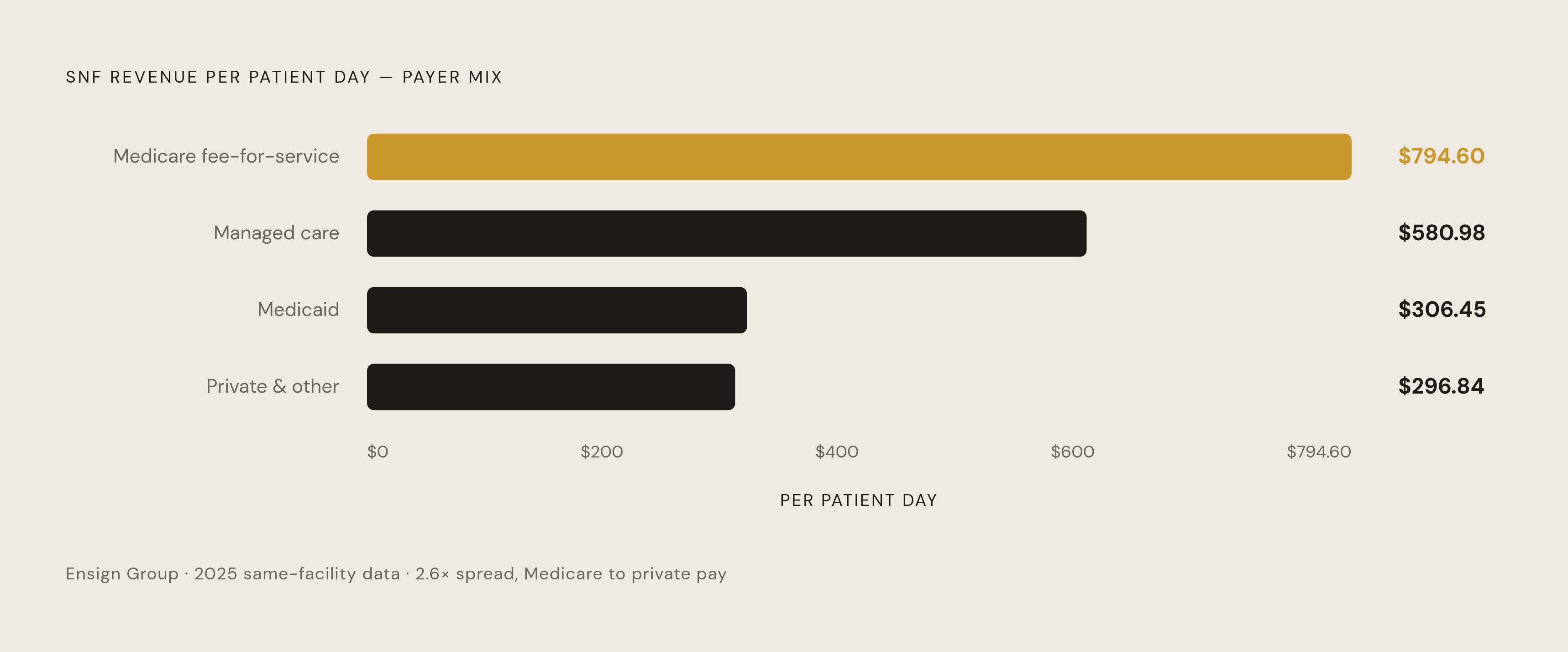
Ensign Group's 2025 same-facility data makes the rate differential concrete. Medicare fee-for-service averaged $794.60 per patient day; managed care, $580.98; Medicaid, $306.45; private and other pay, $296.84. That is a nearly 2.6-to-1 ratio between the highest and lowest payers. Because Medicare fee-for-service patients represent a disproportionate share of revenue relative to their share of patient days, a shift of even a few percentage points in Medicare census composition moves total recognized revenue materially without any change in total patient volume. Occupancy and payer mix are separate levers, and both affect the revenue line independently. Most operators track them separately in operations; fewer carry that discipline into their revenue recognition process.
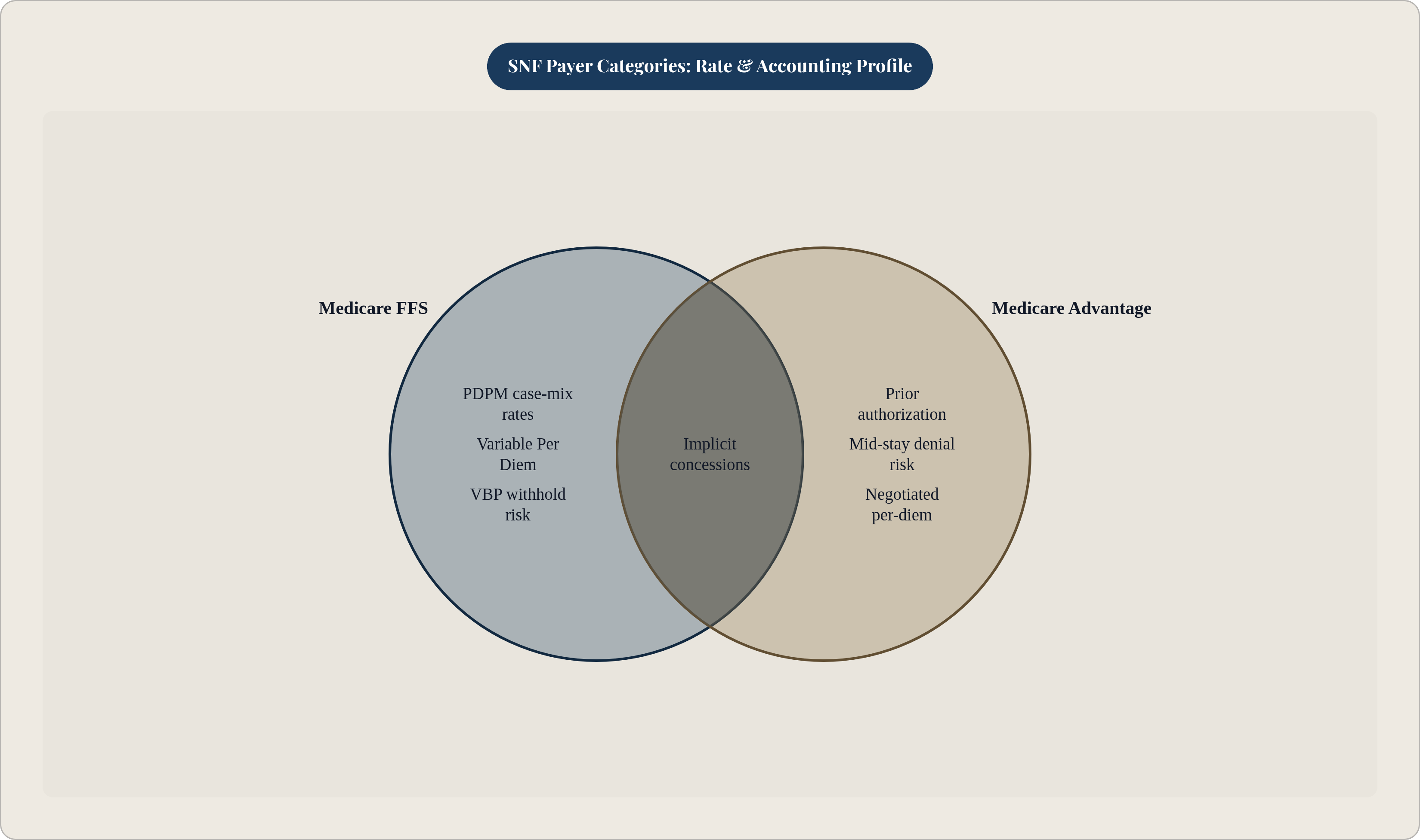
Each payer category also carries its own accounting exposure. Medicare operates on prospective per-diem rates with variable per-diem adjustments built into the Patient-Driven Payment Model and annual market basket resets. Medicaid rates are state-set, frequently subject to retroactive cost report settlements that can lag the care period by years. Medicare Advantage contracts carry negotiated rates alongside prior authorization requirements and documented denial patterns that make the contractual rate an imperfect proxy for collectible revenue. Private pay represents the highest collectability uncertainty of all four.
PACS Group's disclosure that skilled nursing services represented more than 97% of patient and resident service revenue for each of fiscal years 2024 and 2025 illustrates how little diversification buffer large operators actually carry. When one line item dominates to that degree, getting the payer mix accounting right is not a refinement. It is the whole game.
Step 1 and Step 2: identifying the contract and what the SNF has promised to deliver
The first step of ASC 606 sounds routine until you sit with an actual SNF admission agreement. These agreements are typically structured as month-to-month arrangements with automatic renewal and termination-at-will provisions that allow residents to leave without penalty. If a resident can terminate at any time without consequence, the enforceable contract period may compress to a day-by-day arrangement in substance, regardless of what the stated term says on paper. Contract duration is not a formality. It determines the period over which enforceable rights and obligations exist, which shapes both the scope of recognized performance obligations and the timing of revenue.
Long-term custodial arrangements are the hardest cases here: no discharge date exists, payer authorization may reset mid-stay, and the contract boundary is genuinely indeterminate. Practitioners sometimes treat this as a theoretical edge case. In my experience, it is a fairly ordinary fact pattern in memory care and long-term Medicaid census, and it requires judgment rather than formula.
The second step, identifying performance obligations, tends to produce a result that surprises practitioners accustomed to unbundling service components. The instinct is to treat room and board, medication administration, physical therapy, occupational therapy, and program activities as separable deliverables. RSM's November 2023 guidance pushes back on that instinct directly: the bundle of services in a typical SNF stay constitutes a single performance obligation, which RSM characterizes as "skilled nursing facility services."
The reasoning reflects what the SNF has actually promised. It is not contracting to deliver a menu of separable services; it is contracting to deliver an integrated care episode. That distinction governs how the transaction price is allocated. SNFs do not slice revenue across service components; they recognize it as a single daily rate across the episode.
One structural complication demands attention even within a seemingly unified contract. Arrangements that include both clinical care and a residential component with lease characteristics must be bifurcated: ASC 606 governs the care services, ASC 842 governs the lease element. Failing to separate these cleanly can misclassify revenue and misapply recognition criteria across both standards simultaneously, compounding the error in ways that are difficult to detect without a deliberate review of contract terms.
How Medicare's PDPM makes Step 3 a moving target
Estimating the transaction price is where Medicare's payment structure becomes genuinely difficult. It is also where I have seen the most consequential estimation errors accumulate quietly, often for multiple quarters before anyone connects the variance to its source.
Medicare reimburses SNFs under the Prospective Payment System as a per-diem rate, but the Patient-Driven Payment Model, effective October 1, 2019, replaced the prior volume-based RUG-IV system with a clinically driven, case-mix model. Under PDPM, the per-diem rate is a function of patient characteristics across six components: physical therapy, occupational therapy, speech-language pathology, nursing, non-therapy ancillary, and non-case mix. Each component responds to ICD-10 diagnosis codes, functional status, comorbidities, and cognitive function.
The Variable Per Diem adjustment is the recognition wrinkle that resists simplification. Under PDPM, the per-diem rate changes across defined day ranges within a single patient episode. The transaction price for a Medicare stay is not a fixed daily amount; it is a schedule of rates that shifts over the course of the episode and must be tracked day by day. A flat average applied across the stay will produce the wrong number in every individual period, even if it approximates the correct total over the full episode. Approximations that cancel out in aggregate can still misstate individual periods, which matters for interim reporting and for any analysis that uses period-level data to make operational decisions.
Coding accuracy is a revenue recognition input here, not merely a compliance function. The ICD-10 primary diagnosis code determines which PDPM payment group a patient enters, directly setting the PT, OT, and SLP components of the transaction price. For FY 2026, CMS finalized 34 changes to ICD-10 code mappings, removing codes such as diabetes without complications and obesity from primary diagnosis eligibility. Facilities that anchored PDPM groupings to those codes face payment reclassification risk: the transaction price estimated under prior coding practice will diverge from what CMS actually pays, and the divergence will not announce itself.
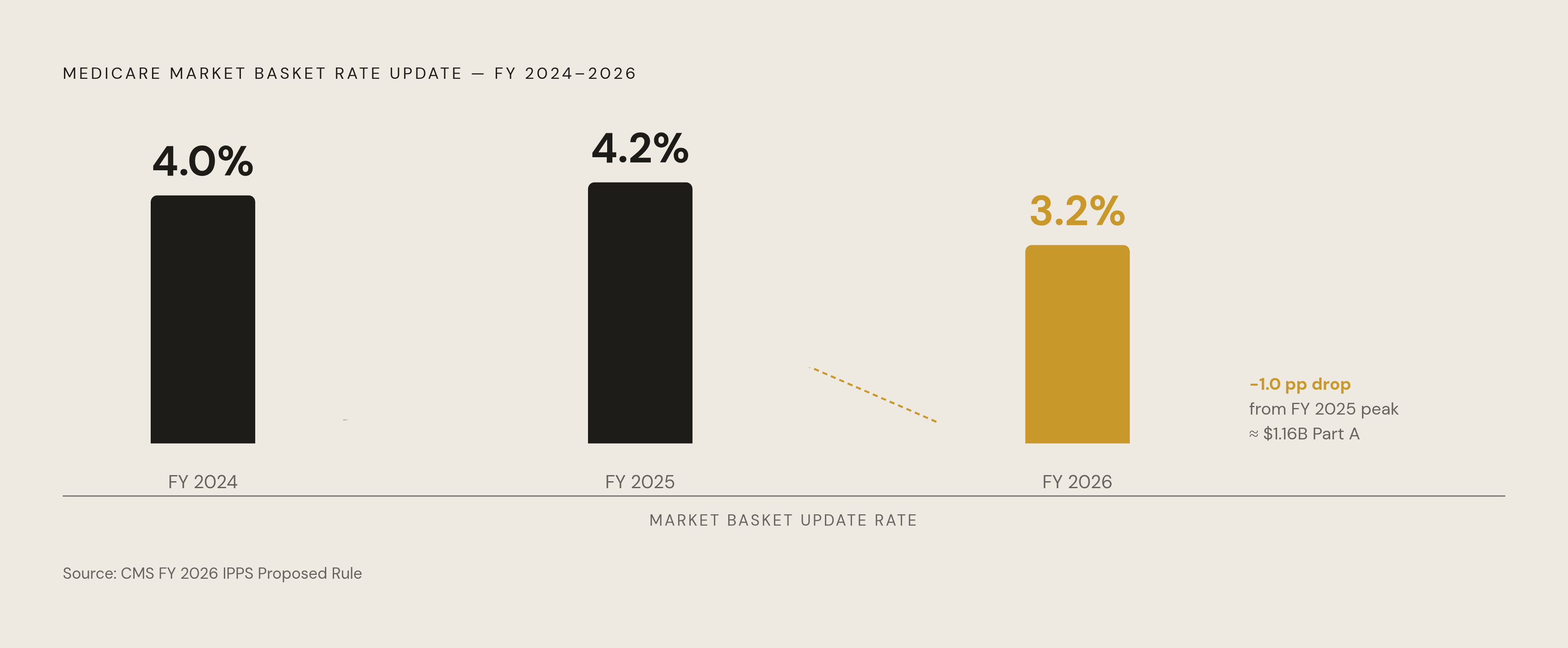
For context on the magnitude of transaction price estimation: CMS finalized a 3.2% net market basket update for FY 2026, effective October 1, 2025, translating to approximately $1.16 billion in additional Medicare Part A payments. That compares to 4.2% in FY 2025 and 4.0% in FY 2024. Ensign Group's data shows the FY 2025 increase produced a 5.0 to 5.2% same-facility Medicare daily rate increase. The deceleration from 4.2% to 3.2% is not dramatic in isolation, but for a business operating on margins measured in basis points, forward-looking transaction price estimates must be calibrated to the current rule cycle.
Step 3 continued: variable consideration across Medicaid, managed care, and private pay
ASC 606 requires entities to estimate variable consideration and include it in the transaction price only to the extent it is probable that a significant revenue reversal will not occur. That constraint shapes how SNFs should approach the three remaining payer categories. Each presents a different form of variability, some foreseeable, some genuinely hard to pin down until settlement arrives years later.
Medicaid rates are state-set but subject to retroactive cost report settlements that can run years behind the care period. SNFs must estimate the probable settlement amount, record it as variable consideration, and revise that estimate as new information surfaces. This is not a quarterly reconciliation tied to the annual cost report cycle; it is a continuous estimation process requiring real collaboration between clinical, billing, and accounting functions. Structural variability compounds the challenge: each state sets its own methodology, and retroactive supplemental payments can require significant estimate revisions with little warning. Organizations that staff this process as a periodic exercise tend to carry stale estimates far longer than they realize.
Medicare Advantage presents a different mechanism. The negotiated per-diem or case rate is contractually defined, but prior authorization and concurrent review requirements, including level-of-care reviews, create mid-stay denial risk. Denial patterns for SNF stays under Medicare Advantage are a documented and growing concern across the industry. Historical denial rates must be incorporated into the transaction price estimate for each MA contract as an implicit price concession, reducing the recognized transaction price rather than generating a bad debt charge. The contractual rate is the ceiling, not the floor; treating it otherwise systematically overstates revenue, and the overstatement compounds as managed care penetration grows.
Private pay and self-pay carry the highest collectability uncertainty of any category. ASC 606's portfolio approach is operative here: if historical data shows a facility collects a fraction of charges from self-pay patients, it recognizes only that collectible fraction. The remainder is an implicit price concession, not a bad debt expense. It never enters the revenue figure at all. This distinction changes how revenue comparisons across periods are interpreted and how the income statement reads to anyone evaluating operational performance, including operators themselves.
Ensign Group's 2025 annual report explicitly excludes variable consideration estimates from its stated average daily revenue rates, a disclosure approach that reflects the ASC 606 disaggregation of revenue requirement. That disclosure signals something worth noting: the headline rate and the recognized transaction price are different figures. How different depends on the payer mix and denial history of each facility, which means operator-reported average daily rates are not directly comparable across portfolios without understanding the variable consideration methodology beneath them.
The portfolio approach is what makes variable consideration estimation tractable at scale. Grouping contracts by payer type, service type, and payment timing allows historical collection and settlement rates to be applied at the portfolio level. The expedient is valid only if contracts within a portfolio are genuinely similar. Mixing payer types or meaningfully different acuity profiles within a single portfolio can produce materially misstated revenue without any individual transaction being incorrectly processed. Portfolio design is a judgment call with direct revenue consequences, and it rarely receives the scrutiny it deserves.
Steps 4 and 5: allocating the transaction price and timing revenue recognition across the care episode
Because SNF services are treated as a single performance obligation, the allocation analysis that dominates step four in multi-element arrangements largely disappears in the typical case. The full estimated transaction price attaches to that one obligation; no relative standalone selling price, or SSP, allocation exercise is required.
The allocation question re-emerges only when a contract contains a separable lease component. Where care services and residential accommodations must be bifurcated between ASC 606 and ASC 842, the total contract consideration must be split before ASC 606 is applied to the care component. That split requires defensible methodology and consistent application across similar arrangements. Improvising it at year-end is not a viable approach, and misallocating consideration between ASC 606 and ASC 842 will misstate both the care revenue and lease liability simultaneously, though I have seen it attempted.
Step five follows from the nature of the performance obligation. Skilled nursing care is satisfied over time; the SNF delivers services daily across the episode. Revenue is recognized on a per-diem basis accordingly. The concept is simple. The execution is not.
The complication is indeterminate stay length. Discharge date is unknown at admission, particularly for post-acute Medicare stays where clinical progress determines when the patient goes home. For PDPM stays, recognition must track the Variable Per Diem schedule: the rate recognized shifts according to case-mix component adjustments across the episode, so the accounting system must apply the correct rate for each day. The aggregate might look reasonable; the daily allocation will not be, and period-level errors have a way of creating confusion that takes disproportionate time to unwind.
Revenue recognized in each period should reflect only consideration that is probable of not reversing. If a Medicare Advantage authorization covers ten days and a patient is on day eight, recognizing revenue for days eleven and beyond without confirmed authorization violates the variable consideration constraint. The revenue calculation needs to reflect current authorization status, not an assumption of renewal.
Accurate census tracking is the operational prerequisite, and it is worth being direct about what that means: patient days by payer, by day, by PDPM component are the revenue recognition calculation itself. Errors in daily census data flow into misstated revenue not as a downstream effect but as the source. PACS Group reported occupancy of 88.9% for the six months ended June 30, 2025, down from 91.0% in the comparable prior period, a decline concentrated in newly acquired facilities still ramping up. Lower occupancy reduces the patient days over which revenue is recognized, creating near-term revenue drag that is distinct from rate or payer mix changes and must be tracked separately to understand what is actually driving the revenue line.
How the VBP program puts recognized Medicare revenue at risk after the fact
The SNF Value-Based Purchasing program introduces a category of revenue risk that operates largely outside the normal recognition cycle. CMS withholds 2% of all Medicare fee-for-service Part A payments to fund the program and redistributes 60% of that withhold as incentive payments to higher-performing facilities, retaining 40% in the Medicare Trust Fund.
The scale is not trivial. VBP adjustments are estimated to total $208.36 million in FY 2026, a figure that sits entirely outside the market basket rate increase. The 3.2% FY 2026 market basket update and the VBP adjustment move independently; a facility cannot assume rate growth offsets VBP exposure, because the two calculations do not interact.
Four quality measures govern FY 2026 VBP incentive payment calculations: 30-day all-cause readmission rate, healthcare-associated infections requiring hospitalization, total nursing staff turnover, and total nursing hours per resident day. The inclusion of staffing metrics alongside readmissions is worth pausing on. It broadens the operational inputs that affect the revenue estimate considerably. A facility can manage readmission rates effectively and still face VBP reductions due to turnover, which means the data set required to support an accurate transaction price estimate is wider than most revenue estimation processes are designed to incorporate.
The ASC 606 variable consideration constraint applies here as directly as it does anywhere in the SNF revenue model. A facility with historical evidence of underperforming on VBP metrics must constrain its Medicare transaction price estimate to reflect expected net payment, not the gross per-diem before the withhold. Recording the gross rate and booking a VBP adjustment later is not appropriate when underperformance is foreseeable from historical data. The standard is reasonably clear on this. The application requires a candid look at what the historical record actually shows, which is sometimes an uncomfortable exercise.
Disclosure obligations follow from that estimation judgment. ASC 606 requires disaggregation of revenue and disclosure of significant judgments, including those related to variable consideration estimates. A facility with material VBP exposure that nets the adjustment against gross revenue without explaining the methodology has not satisfied the disclosure objective of the standard, regardless of whether the net figure is arithmetically correct.
What accurate revenue recognition requires operationally
The five-step model is only as reliable as the data feeding it. Clinical documentation, payer authorization status, daily census by PDPM component, and historical collection rates by payer portfolio are all inputs to recognized revenue. The accounting conclusion is downstream of the clinical and operational record, which means accounting errors frequently originate somewhere other than the accounting department. That observation is less obvious than it sounds in practice.
PDPM coding accuracy sits at the intersection of clinical, compliance, and revenue recognition functions in a way that is still underappreciated in many organizations. The ICD-10 primary diagnosis code sets the transaction price. The FY 2026 code mapping changes from CMS require facilities to retrain coding staff and update documentation protocols before the October effective date. An incorrect code does not merely create a compliance exposure. It produces a wrong number in the revenue line, full stop, and the wrong number is often not visible until the remittance lands.
Portfolio approach governance requires deliberate design and periodic reassessment. Grouping patients by payer type, service type, and payment timing is not a one-time exercise; it requires ongoing evaluation as payer mix shifts and as denial patterns within Medicare Advantage contracts evolve. A portfolio constructed on historical data that no longer reflects current contracting or clinical mix will produce systematically biased revenue estimates. The bias will not always surface until a significant settlement or audit makes it impossible to ignore.
Medicare Advantage authorization tracking is the area where the gap between process design and actual practice tends to be widest. Mid-stay and retroactive denials require the revenue recognition estimate to be updated as information becomes available, not reconciled at month-end. Whether any given organization has built systems capable of honoring that obligation in practice is a different question from whether the organization understands the requirement. Those two things come apart more often than they should.
Cost report settlement estimates, primarily for Medicaid, require sustained collaboration between billing and accounting that many organizations treat as periodic rather than continuous. The consequences are predictable: stale estimates distort interim revenue figures in ways that can mislead internal decision-makers long before they mislead external readers of the financial statements.
What this adds up to is a recognition process where the coding team's decisions set the PDPM grouping, the authorization management team's real-time tracking determines the MA transaction price, the billing team's portfolio design governs how collection history informs the variable consideration estimate, and the accounting team synthesizes those inputs into a recognized revenue figure. No function operates independently. Weaknesses in any one of them propagate forward, and in a business where the margin between solvency and loss can be measured in fractions of a percent, they propagate consequentially.