SNF Chart of Accounts Best Practices
Redesigning your chart of accounts now avoids costly rework when CMS-2540-24 takes effect.

The stakes attached to a SNF chart of accounts are not abstract. When CMS finalized a 4.2% net increase in Medicare Part A payments for fiscal year 2025, adding $1.4 billion in SNF reimbursements, the question of how much of that increase any individual facility actually captures came down, in meaningful part, to whether its general ledger was built to support an accurate cost report. That is a concrete financial outcome tied to an accounting architecture decision most finance leaders made years ago and haven't revisited since.
The premise worth establishing at the outset: a SNF chart of accounts is not, in the first instance, a management accounting tool. It is a compliance and reimbursement instrument. The cost report drives Medicare settlement, shapes audit outcomes, and feeds the data that regulators use to set future rates. A COA that is designed around departmental reporting convenience, or around the preferences of a legacy EHR vendor, and then reverse-engineered into a cost report at year-end, creates both friction and leakage. The internal reporting follows from the compliance architecture, not the other way around. Facilities that haven't internalized this distinction tend to spend more on cost report preparation and recover less reimbursement than those that have.
The arrival of CMS-2540-24, effective for reporting periods ending on or after September 30, 2025, makes this architecture question urgent in a way it hasn't been since the prior form was issued roughly fifteen years ago.
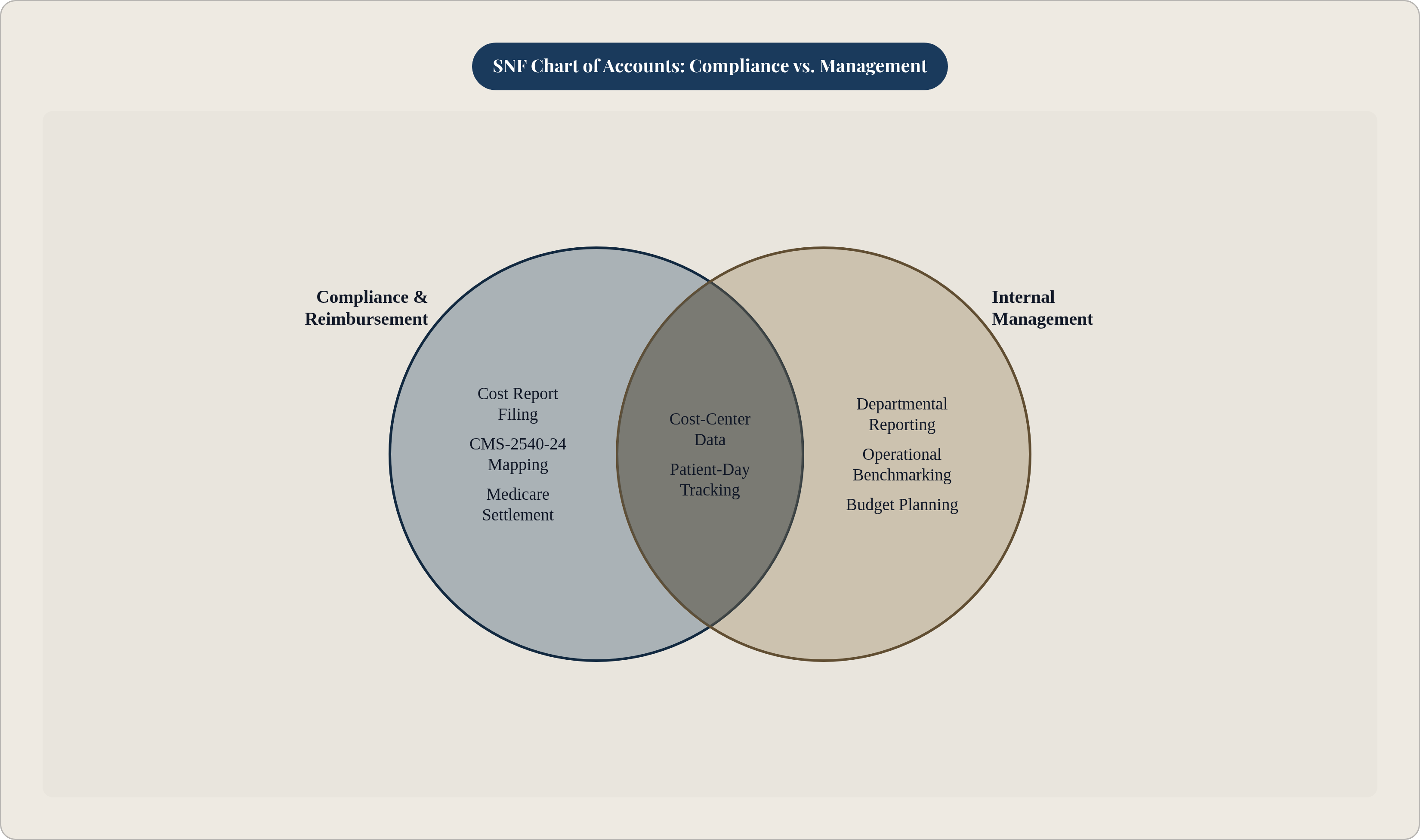
How CMS Cost-Center Logic Translates into a Working GL Structure
CMS cost-center logic is not complicated in principle; the difficulty is in the discipline of execution. Every major cost center that appears on Worksheet A of the cost report needs a corresponding home in the GL, populated throughout the year with actual transactions, not reconstructed at filing time from spreadsheet allocations.
The core cost centers every SNF COA must accommodate include nursing, therapy services (with PT, OT, and speech-language pathology tracked separately), dietary, housekeeping and laundry, plant operations, administration and general, and capital-related costs covering depreciation, lease, and interest. Each of these needs both a cost dimension and a statistics dimension. The cost side captures labor, supplies, and contract expenses. The statistics side captures patient days by payer and hours by position. Both dimensions must live in the same chart. Statistics accounts are not optional supplemental tracking; they feed Worksheet S and the reimbursement calculations that flow from it.
Since the introduction of PDPM in 2019, the shift away from therapy-volume-based reimbursement toward patient condition and care complexity has made precise therapy cost allocation more consequential, not less. Under the volume model, coding a therapy supply to nursing was an inconvenience. Under PDPM, it distorts the per-patient cost picture that drives both internal decision-making and external scrutiny.
The practical design principle I've returned to across many cost report cycles: accounts should be granular enough to produce Worksheet A line items directly, without manual reclassification at year-end. Reclassification is permitted, but it should be the exception. Facilities that reclassify large dollar amounts draw reviewer attention because it signals that the GL wasn't designed to match the form, which raises the question of what else doesn't match.
What CMS-2540-24 Actually Adds to the Tracking Burden
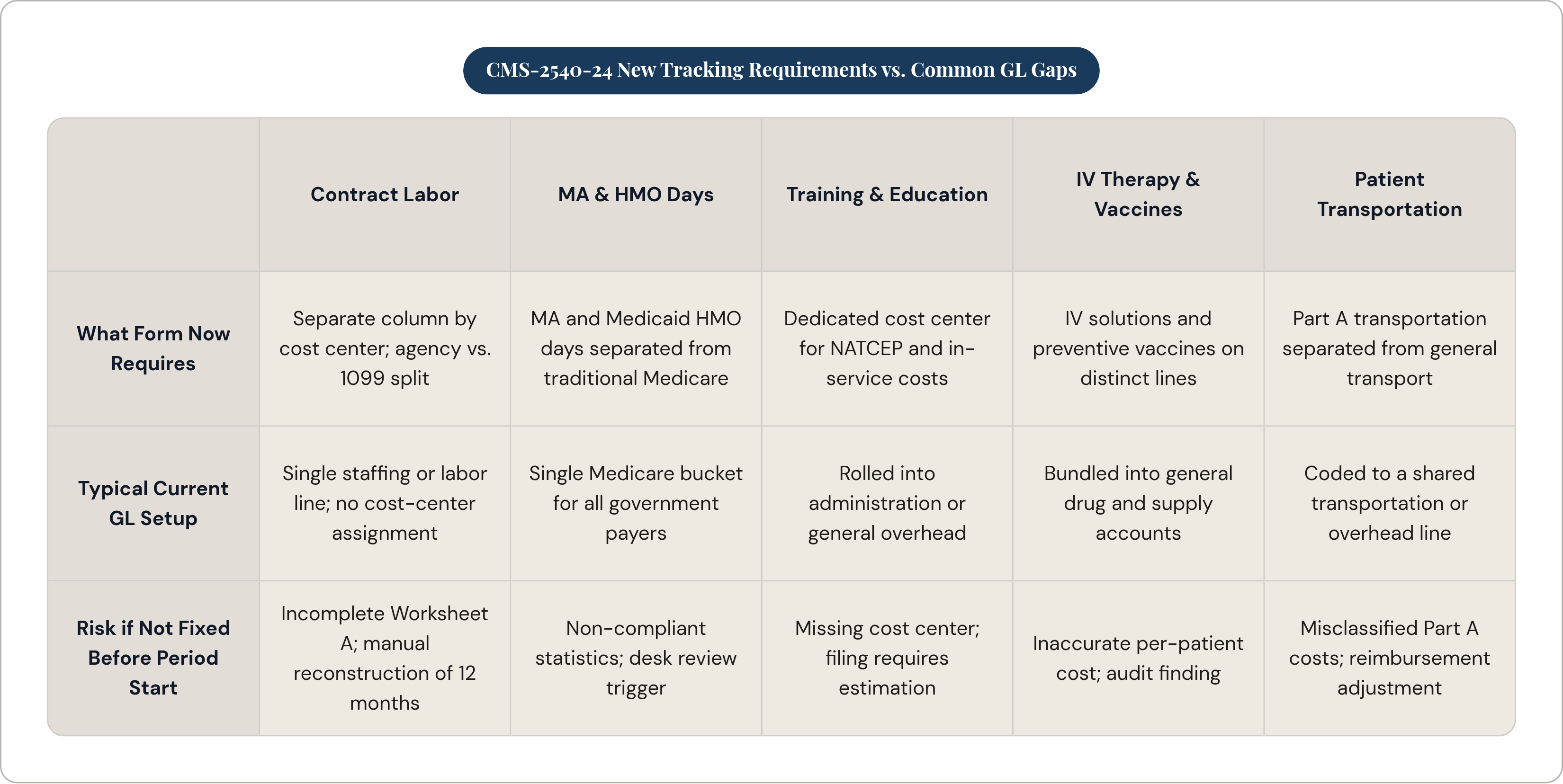
The new form is not a cosmetic update. Several of its structural changes require GL-level modifications that cannot be addressed retrospectively.
Contract labor now has its own column across Worksheet A cost centers, including amounts paid to 1099 vendors. A payroll system that aggregates agency invoices into a single overhead line cannot produce the position-level detail the form requires. Training and in-service education becomes its own cost center, capturing NATCEP costs and facility-required in-service labor and related expenses. Patient transportation under Medicare Part A must be tracked separately from general transportation costs. IV therapy costs are split from general drug and supply lines, with IV solutions reported separately and preventive vaccines assigned their own cost center. Medicare Advantage and Medicaid HMO days must now be separated from traditional Medicare statistics, a distinction that was previously optional and is now required.
The timing problem here is real and worth naming plainly. These are year-round tracking requirements. A facility that begins separating contract labor in October for a September fiscal year-end will have nine months of aggregated data that cannot be disaggregated cleanly. The new columns on Worksheet A will be incomplete, or they will be estimated, and estimates on a federal cost report are a different kind of problem than accurate data that happens to be unflattering.
Facilities with significant agency staffing exposure, active Medicare Advantage census, and multi-service ancillary lines face the most acute remediation burden, and they also face it on the shortest timeline.
The Contract Labor Gap Most SNF General Ledgers Have Right Now
Contract labor is the single clearest illustration of where the new form demands what current systems often cannot deliver. I've reviewed enough GL structures across SNF portfolios to say with confidence that the modal setup is: agency invoices coded to a staffing line or a general labor line, with no cost-center assignment, and no distinction between agency (W-2 equivalent) and 1099 vendor labor.
What the form now requires is separate reporting of contract labor expenses by cost center, with a further distinction between direct care agency labor and 1099 vendor labor, and contract labor hours for direct care positions. Producing that from a single aggregated account requires someone to manually reconstruct twelve months of agency invoices by cost center, which is both expensive and imprecise.
What needs to change at the GL level is structural. Each cost center needs a contract labor sub-account or dimension that runs parallel to the employed-wages account for that center. AP and payroll workflows need to capture cost-center assignment on each agency invoice at the time of payment. 1099 vendor invoices need to be flagged distinctly from agency staffing at the point of coding.
Inaccurate separation of contract and employed labor distorts per-patient cost calculations, which is among the explicit error types CMS reviewers flag. The correction, when it comes at audit, is not just a paperwork adjustment; it is a reimbursement adjustment.
The Medicare Advantage day separation issue belongs in this discussion as well. Facilities with growing MA census should be tagging MA days and associated ancillary costs separately in the GL now. The logic is the same: building the tracking structure retroactively is possible in theory and unreliable in practice.
Related-Party Transactions as a COA-Level Control Problem
Many SNFs operate within ownership structures that include affiliated management companies, real estate holding entities, or staffing agencies under common ownership. These arrangements are legitimate. They are also heavily scrutinized, because the incentive to inflate costs through related-party billing is structurally present and well-documented in CMS audit literature.
The governing rule is clear: costs reported for related-party transactions must reflect the actual cost to the related party, not the marked-up amount charged to the SNF. A facility that reports the invoiced amount from an affiliated entity, rather than the underlying cost to that entity, is overclaiming reimbursement, and it will be adjusted.
Consider a 120-bed SNF contracting with a common-parent management company for IT and consulting services at $600,000 annually; if that company can substantiate only $450,000 in actual costs, CMS requires a $150,000 downward adjustment to the cost report. That is a direct reimbursement reduction and an audit finding, not merely a documentation deficiency.
The COA design implication is practical: related-party vendor payments should be coded to dedicated accounts, or tagged with a related-party flag, so they can be isolated, documented, and adjusted without manual reconstruction when a MAC desk review begins. California's SB 650, effective 2023, now requires SNFs to file consolidated financial reports covering related entities with 5% or greater ownership interest. Whether or not that model spreads nationally, it reflects a transparency direction that facility-level COA design should anticipate.
The COA cannot prevent a related-party adjustment. It can make the documentation trail defensible, or it can make the exposure invisible until a reviewer creates it.
Patient-Day Tracking and Why Reconciliation Failures Draw the Most Audit Attention
Patient-day totals must reconcile exactly between the cost report, census logs, and payer records. Discrepancies are among the most common triggers for MAC desk reviews and additional documentation requests, and they are among the most preventable.
The CMS-2540-24 requirement to separate Medicare Advantage and Medicaid HMO days from traditional Medicare statistics makes this more demanding. A facility with a mixed payer census needs distinct day accounts by payer category. A single Medicare bucket is no longer adequate as a GL design.
The common failure mode I've seen repeatedly: census data lives in the EHR or ADT system, and the COA's statistical accounts are populated manually, via a month-end journal entry that introduces rounding errors or timing mismatches. The ADT system says several thousand Medicare days for the quarter; the GL shows a slightly different total. The difference is three days, which sounds trivial, but on a cost report, any discrepancy between the filing and the supporting documentation is a finding. The auditor doesn't weight findings by materiality in the first pass; they identify them.
Best practice is to automate the feed from the ADT or EHR to the GL's statistical accounts and to reconcile patient days monthly rather than annually. The monthly reconciliation cadence is not bureaucratic excess; it means errors are caught when the originating records are still accessible and when correction is routine rather than forensic.
Under PDPM, patient-day accuracy interacts with clinical classification in ways that extend beyond current-year settlement. Misclassified days or incomplete records can distort CMS analysis and affect future reimbursement, compounding the cost of an error that started in the ADT feed. The downstream claim denial literature reflects a related pattern: a meaningful share of SNF claims are denied on first submission, and a portion of those denials trace to payer-classification errors that originate upstream in the GL, not in the billing function.
Using the CMS HCRIS Dataset to Benchmark Cost-Center Performance
CMS publishes the SNF Cost Report public use file through HCRIS, with facility-level cost and charge data by cost center, utilization data, and Medicare settlement data organized by CMS Certification Number. This dataset is underused by SNF finance teams, partly because accessing it requires some technical facility, and partly because a COA that doesn't align with CMS cost-center logic can't be mapped to it cleanly.
A COA built around cost-center logic maps directly to HCRIS. A COA that deviates requires manual crosswalks that introduce the kind of error that makes the resulting analysis unreliable. The architecture question and the benchmarking question are the same question.
The practical application is real. A 150-bed Midwest rehabilitation SNF that reviewed three years of its own cost report data against peer facilities, using HCRIS as the reference, identified therapy costs running above peer norms at the cost-center level. Tracing the variance to staffing schedule inefficiencies, they reduced overtime by 20% without compromising care quality. That analysis required no consultant and no proprietary software; it required a COA that produced cost-center data clean enough to compare.
At a policy level, researchers using multi-year HCRIS data have found that rural SNFs are consistently reimbursed at rates materially below reported costs, which is the kind of finding that supports Medicaid rate advocacy in state legislative settings. That analysis works only if facility-level cost-center data is clean enough to aggregate. A fragmented or internally inconsistent COA contributes to the degradation of that data at the population level, which is an argument for COA discipline that extends beyond any single facility's reimbursement interests.
The cost report is the most granular financial dataset most SNFs produce. A well-designed COA makes it useful for internal decision-making throughout the year. A poorly designed one makes it a compliance burden and nothing more.
The Structural Errors That Make Cost Reports Audit-Vulnerable
Most cost report audit vulnerabilities are COA problems in disguise. They originate in chart design or coding discipline, not in the cost report preparation process. Fixing them at filing time is possible, but it is expensive and incomplete, because a reconstructed allocation is always more defensible in theory than in a reviewer's hands.
Misallocation of therapy costs, specifically, combining PT, OT, or speech therapy with nursing or administration, distorts true per-patient costs under PDPM and obscures whether therapy spending is appropriate relative to patient acuity. The signal it sends to a reviewer is that the facility either doesn't understand the cost-center structure or doesn't want the data disaggregated.
Failure to separate contract labor from employed wages produces inaccurate per-patient cost calculations and, under CMS-2540-24, will result in an incomplete Worksheet A that requires reconstruction at precisely the moment when reconstruction is most difficult.
Incomplete patient-day reconciliation, as discussed, is the most common trigger for desk review. Any gap between cost report days and census documentation is a finding waiting to be made.
Capital and lease omissions, errors in depreciation schedules or lease accounting, affect rate-setting and the capital cost portion of Medicare reimbursement in ways that compound over multiple cost report years.
Related-party cost inflation is the most likely source of a required cost report adjustment and repayment demand. The documentation expectation is explicit; the exposure for facilities that don't meet it is direct and measurable.
Late submission carries a consequence that dwarfs any preparation cost: CMS can suspend Medicare payments until the cost report is accepted. For a facility operating on typical SNF margins, a payment suspension measured in weeks is a genuine financial crisis.
A Readiness Checklist for CMS-2540-24 and Ongoing COA Hygiene
Before the September 30, 2025 reporting period begins, the audit of current GL accounts against all Worksheet A line items in CMS-2540-24 is the starting point. The gaps will cluster around contract labor, training and in-service education, Patient Transportation Part A, IV therapy, and preventive vaccines. Identifying them now, rather than in the fourth quarter of 2025, determines whether remediation is systematic or reactive.
Sub-accounts or cost-center dimensions for contract labor, distinguishing agency from 1099 labor, need to be established under each applicable cost center, at minimum nursing, therapy, and dietary. The AP workflow that governs vendor invoice coding needs to enforce cost-center assignment at the time of payment.
Medicare Advantage and Medicaid HMO statistical day accounts need to be separated from traditional Medicare accounts in the GL, not at year-end, but for every admission going forward. The related-party vendor accounts need documentation flags and current cost substantiation files before a reviewer asks for them.
The ADT-to-GL patient-day feed needs to be validated and set to a monthly reconciliation cadence. If the feed is manual, the automation investment is likely to pay for itself in the first cost report cycle it covers.
For ongoing COA discipline: treat the CMS cost-center structure as the master reference for any GL restructuring or system migration. Run a mid-year cost report trial to surface misallocations before year-end rather than during preparation. Benchmark cost-center results against HCRIS peer data annually. Monitor MAC audit focus areas; CMS audit activity in 2025 reflects heightened scrutiny of MDS accuracy and diagnosis coding alignment alongside cost report detail, and facilities that treat those functions as separate from the COA conversation will be surprised when the findings connect them.
For accounting and finance teams supporting multiple SNF facilities, the COA architecture question scales directly. Fragmented or inconsistent charts across a portfolio make cost report preparation a recurring fire drill rather than a managed process. A standardized COA architecture aligned to CMS cost-center logic, applied consistently across facilities, is the lowest-cost audit defense available. It makes every line of the cost report traceable to a GL account without reconstruction, which is the standard a reviewer applies and the standard the facility should hold itself to before the reviewer arrives.