Medicare and Medicaid Cost Report Preparation
Medicare suspends all future payments if your cost report misses the five-month deadline.

The standard deadline is five months after the close of the provider's fiscal year. A December 31 fiscal year end means a May 31 filing deadline, no exceptions. A hospital that billed minimally, or not at all, faces identical documentation requirements and the same certification obligations as a full-volume operation. New clients almost never anticipate this, and frankly, it is one of those things that surprises you the first few times before you accept it as a permanent feature of the work.
Non-compliance carries a concrete, immediate consequence: Medicare suspends all future payments until an accurate report is accepted. For any provider dependent on Medicare revenue, that is a direct cash flow threat with no built-in grace period.
A 30-day extension exists, but it requires a written request submitted before the original deadline, directed to the relevant MAC rather than to CMS centrally. Valid grounds include audit delays, documented staffing disruptions, and natural disasters. The MAC must approve it. Preparers who treat extension requests as routine formalities tend to discover, under deadline pressure, that their MAC has a different read on the situation entirely.
CMS's preferred submission channel is the Medicare Cost Report e-Filing portal, MCReF, which provides immediate submission confirmation, real-time feedback on potential issues, and secure handling of protected health information. Hard-copy submission remains technically permissible, though firms still routing paper filings are choosing friction that serves no one.
One timeline reality that costs firms and their clients real money: even after a timely filing, final settlement for hospital cost reports regularly extends across a multi-year window. The financial exposure from errors does not close when the filing is submitted. It persists until settlement is complete, which means a preparation mistake made in February can surface as a cash flow problem two or three years later, long after the preparer has moved on to the next cycle. But how does this affect the firm's responsibility to the client? Whether preparation practices actually account for that exposure window is, in most shops, a different question entirely.
How to Organize the Data-Gathering Phase Before a Worksheet Is Touched
Every downstream calculation is only as reliable as the source data feeding it. Cost reporting enforces this more harshly than most disciplines because the worksheets are interdependent. A miscategorized expense on Worksheet A does not stay on Worksheet A; it propagates through the step-down and into settlement figures. Poor organization in data gathering creates compounding errors, not isolated ones.
Financial records to have in hand before a single worksheet is opened: a working trial balance reconciled to audited financial statements, general ledger detail by cost center, payroll records with benefit expense allocations broken out, and depreciation schedules for all depreciable assets. These should be complete and reconciled to each other before reporting software is launched. Assembling them in parallel with worksheet completion is a reliable way to guarantee mid-preparation disruption.
Statistical and utilization data require equal discipline. Patient days, visits, and encounter counts must be captured by payer and service line. Medicare and Medicaid patient day counts, including SSI days for DSH calculations, must be separately documented. Occupational mix survey data, where applicable, feeds Worksheet S-3. FTE counts by job classification matter for both wage index and GME calculations.
Contracts and agreements tend to be the last category firms think to gather and the first to generate audit issues. Medicare and Medicaid provider agreements, related-party transaction documentation, approved GME program listings for teaching hospitals, the prior-year cost report, and any open MAC correspondence should all be in hand before preparation begins. The firms that skip this step are the ones calling outside counsel during desk review.
Identifying allowable versus unallowable costs belongs in this phase, not mid-preparation. Catching excluded costs early prevents them from entering the step-down process and corrupting figures downstream. Unwinding a miscategorized cost discovered halfway through the worksheets takes considerably more time than catching it beforehand, and the disruption tends to be felt across the entire engagement.
Completing the Core Worksheets: Trial Balance, Cost Allocation, and Statistical Data
Worksheet A is where the trial balance and expense summary are recorded. Every provider cost enters here, classified as either allowable or unallowable under Medicare principles. Common unallowable items include advertising, certain categories of executive compensation, charitable contributions, and penalties. Reclassifications made on Worksheet A carry through every subsequent worksheet, which is what makes errors here so costly to correct late in the process.
The Worksheet B series handles step-down cost allocation, distributing overhead and indirect costs from non-revenue-producing cost centers to revenue-producing ones. The sequence is prescribed by CMS. The order in which departments are closed affects final cost-per-unit figures in ways that can be material. Allocation statistics, including square footage, FTE counts, and meals served, must be documented and defensible. Misclassifying a cost center, or using an allocation statistic that cannot be supported with contemporaneous documentation, is among the most reliable MAC audit triggers. There is a particular kind of audit correspondence that traces back to a square footage figure someone pulled from memory rather than from a floor plan. It happens with some regularity.
The Worksheet S series captures statistical and supplemental data that underpins both revenue metrics and quality reporting. Worksheet S-3, Parts II and III, deserves specific attention: wage data reported there feeds future-year wage index calculations. The FY 2026 wage index draws on Worksheet S-3 filings included in the FY 2026 April 30, 2025 Wage Index Public Use Files. An error on a current-year S-3 does not merely affect current-year settlement; it shapes reimbursement across multiple fiscal years. That raises an important question: do most preparers fully reckon with that downstream reach while they are actually filling out the worksheet? The gap in awareness rarely becomes visible until a problem has already compounded.
The reimbursement levers embedded across these worksheets, wage index adjustments, DSH patient day percentages, rural and geographic add-ons, Medicare bad debt documentation, each respond to data entered earlier in the process. Getting the source data right before the worksheets are touched is not a preference. It is the mechanism by which accurate reimbursement is actually secured.
GME and DSH Calculations: Where the Largest Dollar Errors Occur in Hospital Cost Reports
Graduate Medical Education calculations apply only to teaching hospitals, but within that population they represent some of the largest dollar values in the entire cost report. Indirect Medical Education is calculated on Worksheet E-3; Direct GME on Worksheet E-4. Three inputs drive both calculations: resident FTE counts, approved program listings, and base-year cost data. Each has its own documentation requirements, and each has its own failure modes.
FTE counting errors are the most common source of GME miscalculation. Incorrect weighting for part-time residents, misattributed teaching time, residents counted under the wrong program: all of these reduce GME payments in ways that compound across fiscal years. Retroactive corrections are difficult. Once the MAC has settled a cost report, errors from prior years are hard to unwind, and the dollar consequences accumulate before the problem surfaces. A single FTE classification error can cost a teaching hospital considerably more than a year's worth of the preparer's fees, and that is before factoring in the multi-year compounding effect.
DSH calculations carry a different risk profile. Eligibility is determined by validating Medicaid patient day counts against state eligibility files and Medicare SSI day data. The process is tedious, detail-intensive, and each missed qualifying day directly reduces DSH payment eligibility. Reconciling two data sources that are not always synchronized is inherently manual and inherently fallible, and routine processes often fail to catch every discrepancy before it becomes a missed payment.
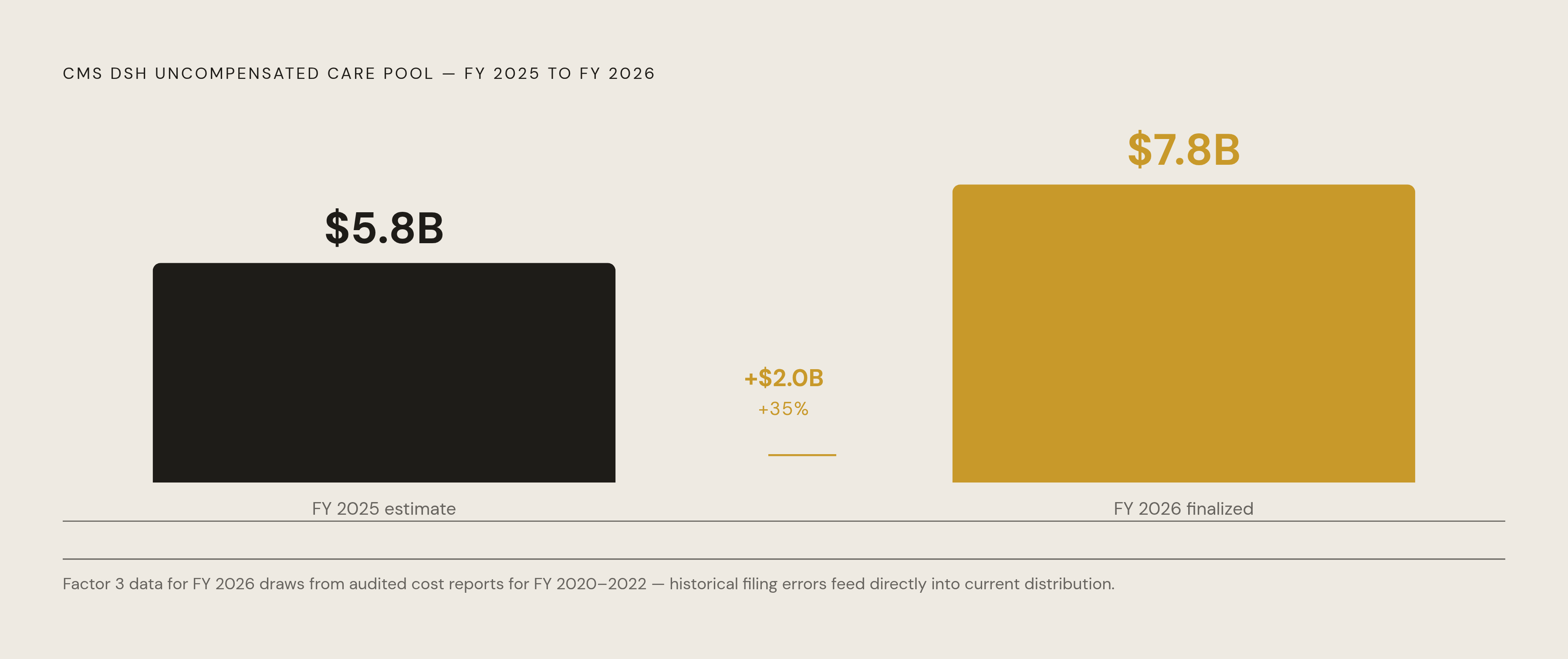
The regulatory stakes in FY 2026 make accuracy here more consequential than in recent cycles. CMS finalized a DSH Uncompensated Care Pool of $7.8 billion for FY 2026, an increase of approximately $2.0 billion from the FY 2025 estimate, roughly 35% higher. The pool is larger, which means the dollars at risk from DSH miscalculation are larger. Factor 3 data for FY 2026 draws from audited cost reports for FY 2020, FY 2021, and FY 2022, meaning historical errors in those reports affect current DSH distribution. Providers tend to assume that filed and settled cost reports are behind them. But what if that assumption is not always correct?
Between filing and final settlement, hospitals receive Medicare interim payments based on estimated cost report results. Providers that fail to monitor actual cost trends against interim rates can face large, unexpected cash flow adjustments at settlement. So, tracking interim rates is an ongoing service obligation, not a task that ends at submission.
FQHC Cost Report Requirements and the Outsized Effect of Cost Presentation on Medicaid Rates
Federally Qualified Health Centers file on Form CMS-224-14, not the hospital CMS-2552. Separate form, separate rules, separate MAC review process. The FQHC cost report must capture revenue, expense, and encounter data; GME adjustments where applicable; Medicare bad debt; and the administration of Medicare vaccines. The structure is less voluminous than the hospital form, but accurate cost presentation carries consequences that, in one specific respect, are more immediate.
For FQHCs, Medicaid cost reports are not merely compliance filings. They are the direct mechanism by which state agencies set prospective reimbursement rates. How costs are presented, categorized, and supported within the report determines the rate outcome, not simply whether the report was filed on time. A technically compliant filing that underrepresents allowable costs produces a lower rate, and that rate then governs reimbursement for subsequent periods. Unlike a hospital cost report error that might be corrected at settlement, an underperforming rate gets locked into the rate structure. The distinction matters enormously to the client, and it is not always explained before the filing goes in.
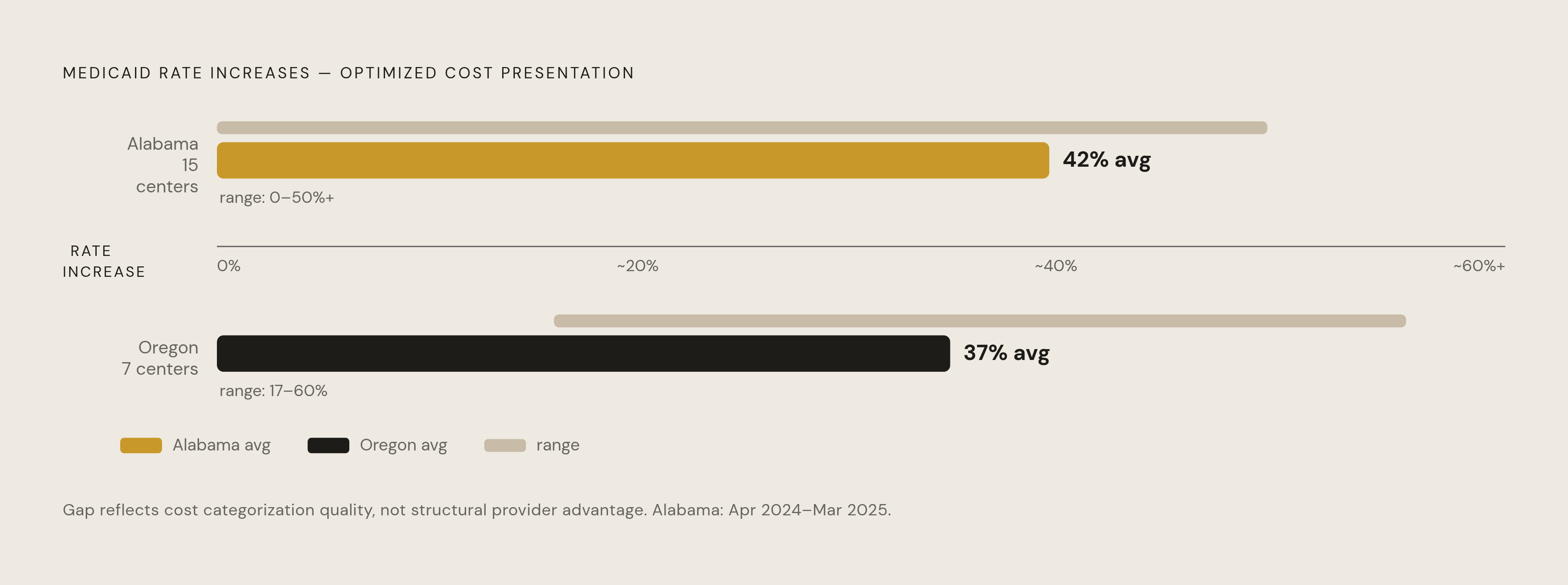
It is also worth considering what the gap between a compliant filing and a well-prepared one actually looks like in practice. Community Link Consulting's cost presentation approach produced an average Medicaid rate increase of 42% for 15 Alabama health centers between April 2024 and March 2025, with some centers exceeding 50%; the same methodology produced an average 37% rate increase for 7 Oregon health centers, with individual results ranging from 17% to 60%. These figures reflect what happens when cost categorization and presentation are treated as a technical discipline rather than a compliance obligation.
For accounting firms serving FQHC clients, this is the clearest available illustration of what specialist preparation actually delivers. The gap appears directly in the client's reimbursement figures, and it is attributable to the quality of the work rather than to any structural advantage the provider holds.
FY 2026 Regulatory Changes That Alter What Preparers Must Track This Cycle
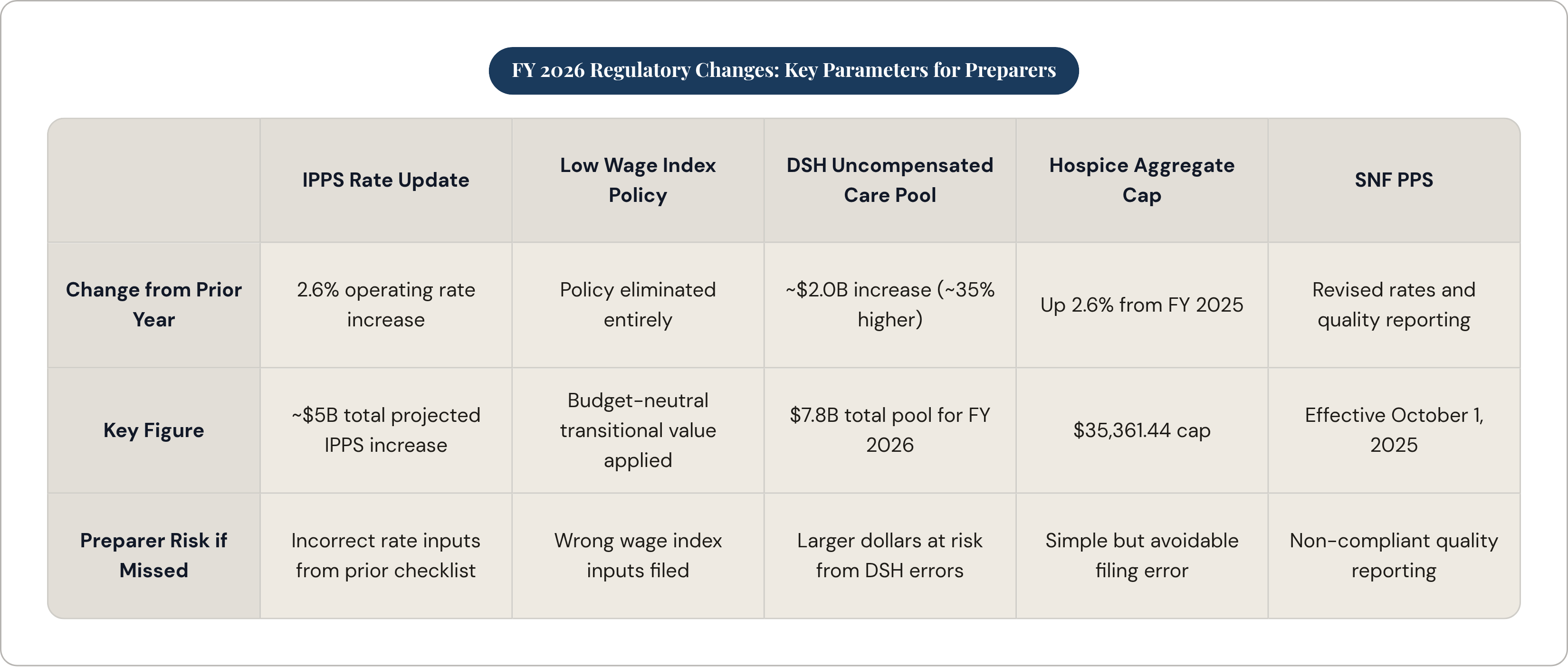
The IPPS Final Rule, effective October 1, 2025, brings a 2.6% increase in hospital operating payment rates, reflecting combined market basket and productivity adjustments. CMS projects total IPPS payments will increase by approximately $5 billion in FY 2026, including an estimated $2.0 billion increase in Medicare uncompensated care payments. MS-DRG weights have been recalibrated using cost-to-charge ratios derived from the March 31, 2025 quarterly HCRIS update, which means cost report accuracy from prior years feeds directly into the weights governing current-year payment. The feedback loop between historical filings and current reimbursement is tighter than many preparers account for.
The Low Wage Index policy has been discontinued. Following the D.C. Circuit Court's ruling in Bridgeport Hospital v. Becerra, the policy is eliminated, with a budget-neutral transitional value applied for previously eligible providers. Any preparation checklist carried over from last cycle without this update will produce incorrect wage index inputs. It is a straightforward error to make when regulatory review is treated as an annual skim rather than a structured process.
SNF PPS parameters for FY 2026 have been updated, with revised payment rates and quality reporting requirements effective October 1, 2025. The hospice aggregate cap is $35,361.44, up 2.6% from FY 2025's $34,465.34. Using the prior year's cap figure is a simple error and also a simple one to avoid, which makes it a particularly frustrating one to see in a filed report.
The broader pattern across successive CMS form revision cycles runs consistently toward more granular, data-intensive reporting. Each cycle adds detail rather than reducing it. Firms whose regulatory review is annual at best will consistently enter each cycle behind the changes, and that cumulative lag shows up in filed reports in ways that compound rather than cancel out.
MAC Submission, Common Rejection Triggers, and What to Expect After Filing
MCReF is the correct submission channel unless there is a specific documented reason to deviate. Real-time feedback, immediate confirmation, and secure PHI handling are practical advantages that reduce post-submission uncertainty. Firms filing by other means should be honest with themselves about whether those methods serve the client or simply preserve familiar habits.
Before submission, a structured review against known rejection and audit triggers is worth treating as a formal step in the preparation workflow, not a last-minute scan. The most common issues are consistent across MAC jurisdictions: mismatched totals between worksheets, unsupported allocation statistics in the step-down process, FTE counts inconsistent with payroll documentation, missing or incomplete supporting workpapers, improper exclusion of unallowable costs from Worksheet A, and DSH patient day counts unreconciled to state eligibility files. Each of these is detectable before submission if the review is systematic. However, the last-minute scan is precisely where they get missed.
After receipt, the MAC issues an acknowledgment and initiates desk review. Documentation requests follow in some cases, and response timelines are typically short. Missing a MAC documentation deadline creates avoidable consequences; it happens to firms that simply do not have a calendar system for post-filing correspondence, which is more common than it should be. Audits can be triggered by material discrepancies or by CMS's application of selection criteria to high-risk worksheets, the specific content of which CMS does not publish in granular detail.
Final settlement for hospital cost reports routinely extends across multiple years. Post-filing obligations include tracking interim payment rates against actual cost trends, responding promptly and completely to MAC information requests, and retaining all workpapers and source documentation in anticipation of audit. The financial exposure from filing errors does not close at submission, and CMS's increasingly data-intensive oversight posture makes documentation depth more consequential with each cycle.
What Accounting Firms Need to Build a Reliable Cost Report Practice
Building a cost report practice is not an extension of general healthcare accounting work. It is a specialized discipline with its own knowledge base, its own regulatory calendar, and its own client risk profile. The gap between conceptual familiarity and actual competence tends to become visible at the worst possible moment: during a MAC audit, with a client on the phone and workpapers that do not hold up.
The foundational requirement is staff who understand Medicare cost reporting principles at the worksheet level. Practitioners who can trace an error from a misclassified cost on Worksheet A through the step-down and into the settlement calculation, who understand why the sequence of the B-series allocation matters, who can read MAC correspondence and assess its implications without routing it to outside counsel as a first response. Knowing the form structure is table stakes. Knowing what goes wrong and why is the actual skill, and it takes longer to develop than firms typically plan for when they decide to enter this space.
Regulatory literacy must function as a recurring operational requirement. The FY 2026 changes described in this piece, the Low Wage Index policy elimination, the updated DSH pool, the IPPS rate recalibration, the revised hospice cap, the SNF PPS changes, illustrate the point: a single filing cycle can carry multiple substantive regulatory changes, any one of which produces incorrect inputs if the preparation checklist has been left unchanged from the prior year.
Software competency matters but is frequently overstated relative to the judgment it requires. Cost reporting platforms encode CMS form structures and perform calculations. However, they do not catch incorrect source data, misclassified cost centers, or unsupported allocation statistics. The platform is only as reliable as the practitioner operating it.
Client communication is an underappreciated component of a durable practice. Cost report preparation spans months, involves data requests from multiple departments within the provider organization, and produces results with ongoing financial management implications. Firms that communicate clearly about timelines, documentation requirements, and post-filing obligations retain clients and generate referrals. Instead of retaining clients, firms that treat the filing as a discrete transaction find out how thin that relationship is when something goes wrong and the client has no framework for understanding what happened or why.
One might argue that the FQHC rate-setting dynamic is the most instructive case for firms considering this space. The measurable gap between a compliant filing and an optimized one, documented in the Community Link Consulting results cited earlier, is the clearest available illustration of what genuine expertise delivers in a context where the client can actually see it in their reimbursement rate. After all, whether a cost report practice grows or stays flat often comes down to whether the firm has learned to make that distinction, and whether they can demonstrate it to a prospective client before someone else does.