Accounts Receivable Management in Long-Term Care
Medicaid pending and payer transitions drive aged receivables more than bad debt does.

Accounts receivable in long-term care runs on a payer mix most healthcare businesses never have to deal with: Medicare, Medicaid, managed care, and private pay, all under one roof, each with its own paperwork, timelines, and rules for what counts as a clean claim. That complexity is why collection timelines in this sector have stretched out over recent years, and it's why operators who build real process discipline into every stage of the revenue cycle end up collecting faster and carrying less financial risk than those who treat AR as something the billing office handles on its own.
Residents move between payers constantly. A resident admits on Medicare Part A, spends down assets, and converts to Medicaid, sometimes within the same quarter. Miss that transition, or catch it late, and you get retroactive denials that can erase weeks of reimbursement in one stroke. Then there's Medicaid pending, probably the single biggest driver of aged receivables in the industry: an application can sit with the state for six months, sometimes over a year, while the facility keeps feeding, bathing, and medicating a resident it hasn't been paid for. Ancillary charges, therapy minutes, cable, incontinence supplies, get missed when billing staff are underwater. And billing roles turn over often enough that the institutional knowledge of how a particular state's Medicaid office likes its paperwork walks out the door on a regular basis. None of this means the money isn't there to collect. It means the process to collect it needs more attention than most facilities give it.
What the numbers on LTC days in AR actually tell operators
Days in accounts receivable, DAR, is the metric that tells you how long a facility waits, on average, between delivering care and getting paid for it. Healthy LTC operators tend to run in the mid-to-upper forties; facilities with process gaps often sit well above that, and some run into the seventies or worse. That gap is the first thing worth sitting with, because a rising DAR feels like a warning sign about bad debt, but the two things are not the same measurement.
Here's the part that surprises people: even as collection timelines have stretched across the industry, bad debt as a share of total receivables has actually held steady or improved slightly. Read that again, because it cuts against the instinct to panic over a climbing DAR number. If the money were genuinely uncollectable, bad debt ratios would be climbing right alongside DAR. They're not, which tells you the real problem is speed, not collectability. Facilities that misread this distinction tend to over-reserve, writing off balances that Medicaid would eventually pay if someone just followed up on the application, and in doing so they understate what their receivables are actually worth on the balance sheet.
There's a second distortion worth naming. Some skilled nursing facilities let stale balances sit on the books long after any reasonable person would expect to collect them, and that inflates DAR artificially rather than reflecting a live billing problem. The allowance for doubtful accounts needs to be updated regularly, not treated as a once-a-year cleanup task, or the DAR figure stops meaning what people think it means.
Because Medicaid usually dominates the payer mix in LTC, a single blended DAR number is mostly telling you about Medicaid pending timing and not much else. An operator staring at one aggregate figure has no way to know whether the real bottleneck sits in Medicare interim billing, managed care authorization delays, or private-pay collections. Break DAR out by payer segment and the picture gets a lot more useful, and a lot more actionable.
How the revenue cycle breaks down in long-term care and where collections fail
The LTC revenue cycle starts before a resident ever moves in and doesn't finish until every payer involved in a stay, which might run for years, has settled every last component of it. That length is what makes the cycle so much more layered than what you see in a hospital or an outpatient clinic, and it's also where things quietly go wrong.
Problems start at intake. Incomplete payer verification means a facility discovers a coverage gap only after it has already delivered the care, which is the worst possible time to find out. Missed pre-authorizations, especially with managed care plans, are one of the most common reasons claims get denied outright.
Mid-cycle, the failures shift to execution. Under PDPM, Medicare Part A payment depends on accurate MDS, Minimum Data Set, coding across several clinical categories, so a coding error doesn't just create paperwork friction; it shows up directly as an underpayment or a denial. Ancillary charges for therapy, supplies, and amenities get missed or billed late when staff are pushing claims through manually and volume outpaces attention. And when a resident's payer status shifts mid-stay, particularly the Medicare-to-Medicaid transition mentioned earlier, that requires immediate rebilling action; wait even a couple of weeks and you're looking at retroactive denial exposure that's much harder to unwind.
Then there's what happens after the claim goes out the door. A claim that's submitted but not followed up on within thirty days starts aging quietly in the background, and by the time someone notices, timely filing deadlines may have already closed the door on collecting at all. Denial management in a lot of facilities is reactive: staff work denials one at a time as they land in the queue instead of running any structured analysis of why they're happening in the first place. And Medicaid pending balances occupy an odd space in all this, not denied, not approved, just waiting, which means they need their own tracking process outside the normal AR aging workflow or they get lost in the shuffle.
Claim denial rates across healthcare broadly have climbed in recent years, with a meaningful share of providers now reporting that more than one in ten claims gets denied on first submission. LTC feels that pressure more acutely than most sectors, simply because the documentation requirements are more demanding and there are more places for something to go wrong.
The payer-specific procedures that systematic AR management requires
Nothing about AR management works the same way across every payer type. Each one has its own timeline, its own documentation standard, its own claims format, its own appeal process, and treating them as interchangeable is where a lot of facilities lose ground. The foundation of a real AR system is a written policy, payer by payer, that spells out exactly what action gets taken and by whom at each thirty-day interval a balance stays outstanding.
For Medicare, the timely filing window generally runs a year from the date of service, but interim billing cycles come around often enough that they need active tracking, not a once-a-year glance. MDS accuracy is the other lever here, and it only works if billing and clinical staff are actually coordinating rather than working in separate silos that never talk to each other.
Medicaid needs its own separate tracking protocol for pending applications: who owns the follow-up call to the Department of Social Services, what happens if that call goes nowhere for sixty days, and how the pending balance gets reflected on the AR aging report. Retroactive eligibility approvals also need a trigger system, something that flags an approved application the moment it comes through so rebilling starts immediately instead of sitting for another few weeks.
Managed care contracts vary plan to plan, so authorization requirements, covered days, and covered services all need to be documented at the contract level and actually reflected in how billing staff process claims. Rate schedules need to stay current in the billing system too; an outdated rate table is a source of underpayment that's genuinely hard to catch without a regular reconciliation process built specifically to look for it.
Private pay is the one category fully within a facility's control, and it should be treated that way. Collection timelines and escalation steps belong in the admission agreement itself, spelled out and enforced the same way every time. Responsible party communication, statements, phone calls, payment plan offers, should follow a standard cadence rather than being left up to whatever a particular billing staffer feels like doing that week.
Monthly AR review as a management discipline, not a billing department routine
The aged accounts receivable report might be the single most consequential document a LTC operator produces, and in a lot of facilities, nobody above the billing supervisor ever looks at it. That's a gap worth closing. Best practice calls for management, not just billing staff, to sit down with the aged AR every month, walk through the history of every significant claim with the person handling it, and sign off on that review as documented proof the oversight actually happened.
What belongs in that review? Claims outstanding past sixty days, flagged by payer. Every Medicaid pending account, with current status and a realistic guess at when it resolves. Denied claims with denial reasons attached, plus whatever pattern is emerging across them. And any balance that's aged past a reasonable point of collection and needs to move into the allowance for doubtful accounts or get written off entirely.
That allowance has to reflect reality, not wishful thinking. A facility that understates it is reporting an inflated receivable balance, and that distortion doesn't stay contained to one line item; it throws off DAR, misleads lenders and investors reading the financials, and creates exposure the moment an auditor starts asking questions. Management sign-off matters here for a reason beyond internal accountability: it creates a paper trail that becomes relevant the moment an external audit, a lender review, or a regulatory examination comes knocking.
For facilities with HUD Section 232 financing, this isn't abstract. Owner draws are conditioned on annual audited financial statements that HUD reviews directly, which makes receivable accuracy a compliance requirement, not a nice-to-have.
Where automation and outsourcing genuinely improve AR performance — and what they don't fix
Automated claim scrubbing, eligibility verification, and denial tracking can cut AR days in a real way. Case evidence from assisted living operators shows meaningful reductions in collection timelines once end-to-end automation replaces a manual, paper-heavy billing process. That's worth taking seriously.
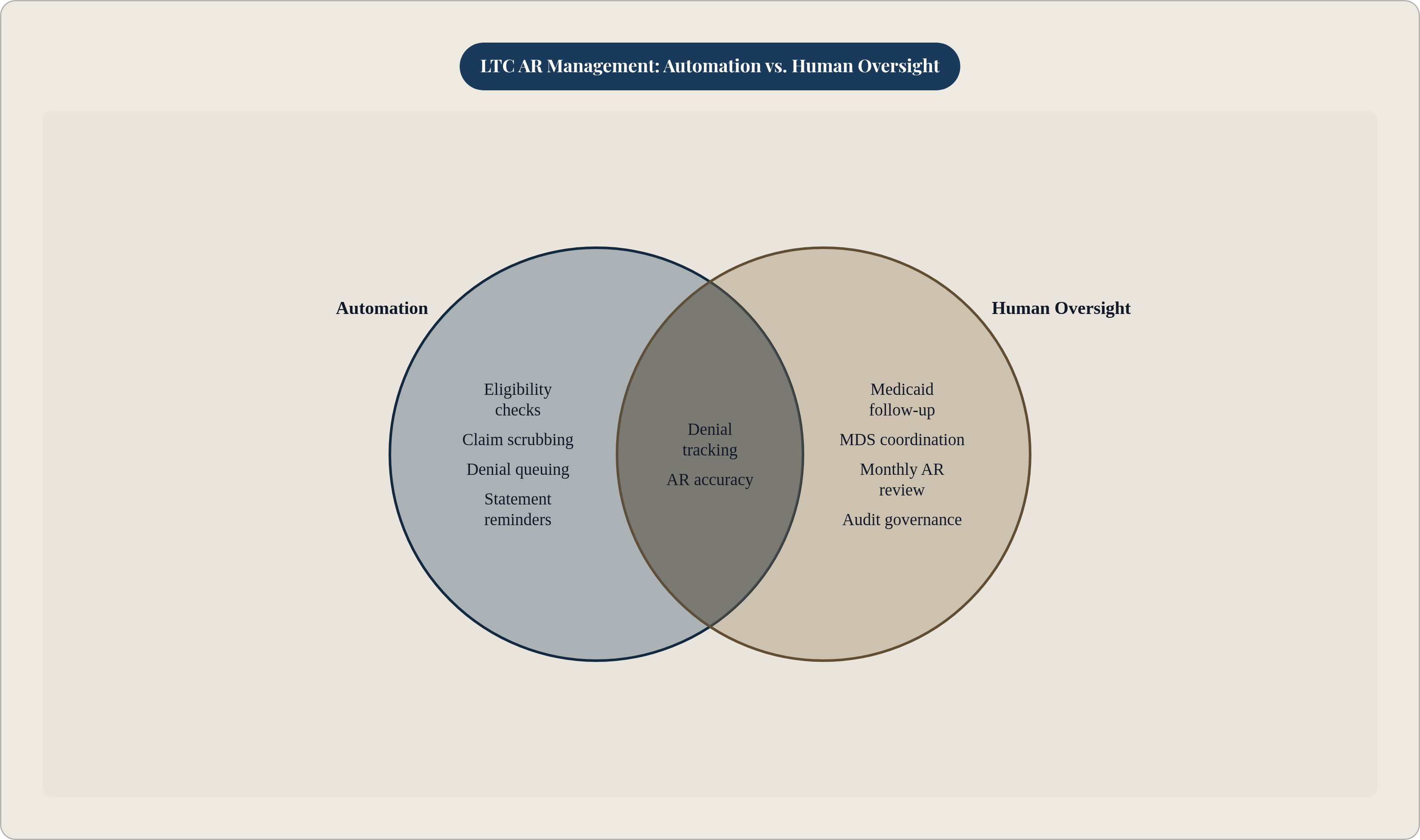
What automation does well is fairly specific. It catches eligibility changes at admission and at regular check-ins during a stay, before those changes turn into retroactive denials. It scrubs claims before they go out, flagging the documentation errors that commonly trigger a denial in the first place. It queues denials for resubmission systematically instead of letting them sit until someone remembers. And it handles statements and payment reminders for private-pay accounts without anyone having to manually track who's thirty, sixty, or ninety days out.
But what exactly doesn't automation touch? MDS coding accuracy is one: that's a clinical and billing coordination problem, and software can support the process but it can't substitute for a nurse and a biller actually talking to each other about a resident's condition. Medicaid pending follow-up is another; getting a caseworker at the Department of Social Services to move an application forward requires an actual human relationship, something no system replicates. And a dashboard, however well built, doesn't replace a CFO or administrator sitting down monthly and engaging with what the AR aging report is actually saying.
Outsourcing to a specialized LTC billing vendor can solve a labor shortage or fill an expertise gap that internal staff don't have. But the facility doesn't get to hand off responsibility along with the task; outsourced billing still needs internal oversight, someone checking data accuracy, someone owning the policy that governs how the vendor operates. The choice between in-house, outsourced, and hybrid billing should come down to whether the people doing the work actually understand LTC payer rules, not just which option costs less on paper.
How AR quality surfaces in a financial statement audit and what auditors look for
Accounts receivable is usually one of the largest assets on a skilled nursing facility's balance sheet, which means auditors spend real time on it, both for valuation and for collectability. The first thing an auditor checks is whether the allowance for doubtful accounts is reasonable. If a facility has been slow to write off balances it should have written off months ago, or if its reserve estimate looks thin against the aging, the reported AR balance is probably overstated, and that's exactly the kind of finding that turns into a bigger conversation.
Medicaid pending balances get particular scrutiny in this process. The auditor wants to know how long each one has been outstanding, what the realistic odds of approval look like, and whether a reserve makes sense for the ones that have drifted well past a normal processing window. Third-party liabilities matter here too, things like Medicaid rate settlements, retroactive payer adjustments, or findings from a payer audit, and those need to show up on both sides of the balance sheet at year-end, not just the receivable side.
Payer audit activity itself has picked up. State Medicaid Inspector General offices run claims audits, MDS audits, and payment integrity reviews on a regular basis, and any notice or draft finding still in process at year-end needs to be reflected in reserves and disclosures rather than left out because it isn't final yet.
The connection between audit quality and AR gets especially direct for HUD-financed facilities. HUD Section 232 borrowers have to submit annual audited financials, and HUD reviews those specifically for signs of financial distress, cash shortfalls, excessive draws, before it will sign off on owner distributions. A good audit catches these issues early enough for management to actually do something about them. An audit that treats AR as a box to check, without engaging seriously with aging methodology and reserve adequacy, misses exactly where the financial risk is sitting.
Building a durable AR management framework rather than chasing one-off fixes
None of this works as a single fix. Effective AR management in long-term care comes from several practices running at the same time, reinforcing each other, not from picking one initiative and hoping it solves everything.
The core pieces: written, payer-specific procedures with defined action steps at every thirty-day interval, not a vague general billing policy but something a biller can actually follow step by step. A Medicaid pending tracking system that lives separately from the main AR aging, with someone clearly responsible for it and a defined path for escalation when it stalls. Monthly management-level review of the AR, signed off as documented proof it happened. An allowance for doubtful accounts that gets revisited at every month-end close, not just dusted off when the auditors show up. Denial root-cause analysis run at least quarterly, looking for patterns by payer, by denial code, by the type of documentation that keeps tripping things up. And a clean protocol for mid-stay payer transitions, especially Medicare-to-Medicaid, with a trigger that sets rebilling in motion right away.
Governance carries as much weight as any of the process details. When a CFO or administrator actually signs off on that monthly AR review, it tells billing staff, auditors, and lenders alike that receivable management sits near the top of the priority list, not somewhere near the bottom. Facilities heading into a financial statement audit, a HUD compliance review, or a lender covenant test find that solid AR practices make those processes move faster and hurt less; it's the same underlying work, just done consistently across the year instead of crammed into a scramble before year-end.
For operators who want an outside read on whether their AR practices and financial reporting hold up, a specialized accounting firm with real skilled nursing experience, one that understands Medicaid pending dynamics, PDPM payment mechanics, and HUD compliance all at once, tends to surface gaps that an internal review just doesn't catch.