HUD 232 Loan Program Requirements Overview
Twenty beds minimum, state licensure, and proper mixed-use limits govern who qualifies.

The eligible universe is narrower than most borrowers expect. Licensed nursing homes, assisted living facilities, intermediate care facilities, and board and care homes qualify under Section 232. The minimum is 20 beds, and below that threshold the facility is categorically ineligible regardless of licensure status or financial performance.
Beyond bed count, HUD establishes an operational baseline. The facility must be state-licensed and regulated, provide three meals per day to residents, and maintain continuous protective oversight. Absent any one of those conditions, the project is out before underwriting begins.
The program accommodates some mixed-use complexity, though borrowers routinely overestimate how much. Independent living units may constitute up to 25% of total units without triggering disqualification, provided the remainder meets licensed-care requirements. Commercial space is permitted within limits: generally no more than 10% of gross floor area and 15% of gross income. Hair salons, medical offices, coffee shops, gift shops, non-resident parking. These are the uses HUD has recognized as appropriate. Commercial space appended primarily for income diversification is a different matter, and ORCF underwriters recognize the distinction as soon as they pull the rent roll.
Multi-site projects raise a specific structuring question. HUD's general preference is that both sites operate under the same license. Where state law prevents two different facility types from sharing a license, the combination may still qualify if the project constitutes a marketable real estate entity and permits convenient, efficient management. That determination is fact-specific. Sponsors who treat it as presumptive approval typically spend several weeks undoing ownership structures that should have been designed correctly at the outset.
The Distinct Loan Types Under Section 232 and What Separates Them
Section 232 is not a single product, and the underwriting errors that follow from treating it as one tend to surface late in the transaction, when correction carries the highest cost.
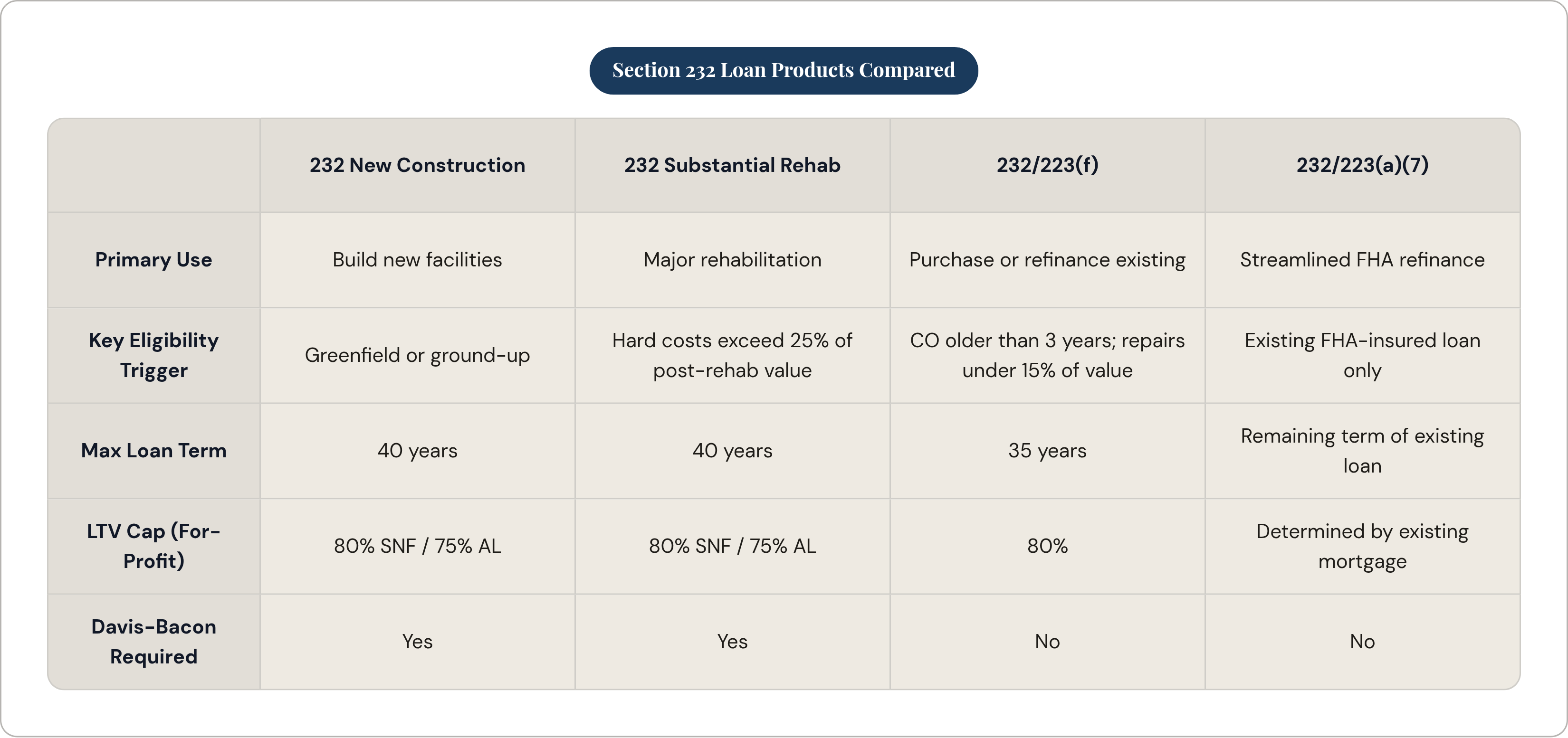
New construction loans carry an interest-only period through the construction phase plus two months, then convert to a fully amortizing 40-year loan. The substantial rehabilitation product applies when hard costs of repairs and replacements exceed 25% of post-rehabilitation market value. That threshold is what separates rehabilitation from refinance with incidental repairs. The two products carry different underwriting parameters, different timelines, and different Davis-Bacon Act obligations, and sponsors who discover this after already modeling the wrong product face an uncomfortable reset conversation with their lender.
The 232/223(f) product covers purchase and refinance of existing facilities and is the most commonly deployed in the market. Three conditions define its scope: the certificate of occupancy must be dated more than three years before application, with an exception for projects already carrying HUD-insured financing; repair scope cannot exceed 15% of as-repaired value; and the project cannot substantially replace 50% or more of two or more major building components, which HUD defines specifically as roof structures, wall and floor structures, foundations, plumbing, central HVAC, and electrical systems. A project that crosses any of those thresholds does not fail outright. It migrates product categories, with real implications for cost and schedule.
The 232/223(a)(7) streamlined refinance is available only for refinancing an existing FHA-insured loan, which makes it inaccessible to borrowers whose current debt sits outside the HUD system. The 232/241(a) supplemental loan adds financing on top of an existing insured mortgage. The Section 223(d) operating loss loan covers unforeseen operating deficits in a project's early years, most relevant during stabilization following construction. The Section 232(i) fire safety equipment loan is the most limited product in the suite: it finances the purchase and installation of fire safety equipment, primarily sprinkler systems meeting or exceeding CMS standards.
Each product exists to address a specific scenario. Using the wrong one does not produce a suboptimal outcome; it produces a failed application.
Loan Terms, LTV Limits, and the Financial Parameters That Size the Loan
The financial architecture of Section 232 is built around permanence. New construction and rehabilitation loans carry terms up to 40 years; existing property refinances without rehabilitation run up to 35 years; the minimum term across the program is 10 years. The interest rate is fixed at rate lock for the full loan term. Between 2020 and 2025, rates on new construction loans ranged from approximately 3.10% to 6.45%; on 232/223(f) refinance and purchase loans, from approximately 2.55% to 5.95% over a similar period. The spread within those ranges is wide enough that where a borrower lands on it can determine whether the project cash flows at all.
LTV limits are stratified by transaction type and facility type. New construction and substantial rehabilitation transactions are capped at 80% LTV for skilled nursing facilities and 75% for assisted living and board and care. On 223(f) purchase and refinance transactions, for-profit borrowers access 80% LTV; non-profit borrowers access 85%. Loan-to-cost on acquisition is 85% for for-profit sponsors and 90% for non-profits; refinance transactions may reach 100% loan-to-cost. These limits do not operate independently. The binding constraint is whichever of LTV, loan-to-cost, and debt service coverage ratio produces the smallest loan, and that interaction is reliably where deals land at a different number than sponsors initially modeled.
The minimum debt service coverage ratio is 1.45x, calculated as net cash flow divided by total annual debt service, including principal, interest, and mortgage insurance premium. The mortgage insurance premium, or MIP, is 1% upfront at closing and 0.65% annually. Required escrows cover taxes, insurance, replacement reserves, and MIP. Model these from the outset; they are not items to reconcile at the end.
Prepayment is prohibited during construction. Post-construction, lockout periods and penalty schedules are negotiable, though a 10-9-8-7-6-5-4-3-2-1-0 declining schedule is common. Lenders offering the most competitive fixed rates typically require 10-year call protection. Rate and flexibility are not independently negotiable variables, and borrowers who approach the conversation that way tend to learn that quickly.
The loan is non-recourse, but conditionally. The ORCF Healthcare Project Note is explicit: non-recourse carve-outs apply to intentional bad acts as defined in the Note. The document answers exactly what happens when a borrower reads "non-recourse" as unconditional. Reading it before closing, rather than after, remains the more productive sequence.
Borrower Eligibility: Entity Structure and Operator Experience
Both for-profit and non-profit entities may participate. The conditions that actually determine eligibility involve structure and track record.
The borrower entity must be a single-asset, special purpose entity, commonly referred to as an SPE. The property being financed must be the only asset of that entity; commingling with other assets or operations is disqualifying. This requirement exists to protect the insured collateral pool from unrelated liabilities, and HUD enforces it at the entity level, not merely through documentation representations.
Operating experience is required. The borrower must have a demonstrated track record of successfully operating one or more facilities of the same type being acquired, built, or refinanced. Both the structure of the deal and the experience of principals receive scrutiny. Hiring an experienced operator does not automatically satisfy the requirement, and sponsors who assume it does typically find out during underwriting review rather than before it.
Bankruptcy is a hard stop. FHA insurance is unavailable if the borrower, operator, principal, or affiliate is currently in bankruptcy, or has filed for or emerged from bankruptcy within five years of the lender's application. The five-year lookback applies to emergence, not filing. A principal who completed a bankruptcy proceeding three years prior may still fall inside the disqualification window at the time of application. Late-stage discoveries of this kind are avoidable; they require only that someone actually checks the lookback before the due diligence clock starts running.
On the lender side, parallel requirements apply. The lender must be FHA-approved and MAP-approved under the Multifamily Accelerated Processing program, and the lender's underwriter must hold the MAP-approved healthcare underwriter designation specifically. The pool of lenders qualified to underwrite these transactions is considerably smaller than the broader FHA lender community, and underwriting quality varies considerably within it.
State Licensing, Certificate of Need, and How Regulatory Approvals Interact with the HUD Process
ORCF will not issue insurance without documentation confirming full state approval. The interaction between that requirement and state regulatory frameworks routinely extends transaction timelines in ways borrowers fail to anticipate until they are already inside one.
Certificate of Need, or CON, requirements vary by state. Where state law mandates a CON before a healthcare facility is constructed or expanded, ORCF requires evidence of that approval before proceeding. Borrowers who treat state and federal approval processes as sequential, rather than parallel, can lose months at precisely the point in a transaction where carrying costs are highest and commitment windows are shortest.
Licenses are not merely regulatory credentials under the Section 232 structure. The license is pledged as security for the loan. Any change in bed authority, whether additions, deletions, or major improvements affecting licensed capacity, requires ORCF approval. Changes made without that approval constitute a violation of the HUD Regulatory Agreement, and the consequences extend well beyond administrative correction.
In CON states, a borrower acquiring a facility faces two parallel tracks: state licensure and CON approval on one side, HUD underwriting and processing on the other. Neither waits for the other. Managing both simultaneously, with counsel experienced in both regulatory regimes, is a structural necessity in those markets.
Third-Party Reports and Due Diligence Required at Application
The third-party package for a 232/223(f) application establishes the factual foundation HUD's underwriting depends on. Four items are universally required: a HUD-compliant appraisal, a Capital Needs Assessment (also referred to as a PCNA), a Phase I Environmental Site Assessment, and radon testing. A new PCNA is required every 10 years during the loan term, which makes it a recurring cost that belongs in operating projections from the beginning, not a one-time transaction line item to absorb and move past.
Seismic assessment requirements are location-dependent. Facilities in Seismic Zones 3 and 4, concentrated in parts of the western United States and certain southern areas, must include a seismic evaluation. Properties outside those zones do not. Geography determines applicability; transaction type does not.
The due diligence package extends to key principals. Credit and background review runs at the principal level alongside asset-level documentation. The underwriting scrutinizes who is behind the deal as rigorously as it scrutinizes the deal itself.
Insurance requirements carry specific numerical thresholds. Property coverage must extend to 90% of replacement cost. Deductibles are capped at $25,000 for properties with replacement values at or below $100 million; for properties above that threshold, the cap rises to $250,000 or 1% of property value, whichever is lower. Commercial General Liability minimums are $1 million per occurrence or $3 million per location, and umbrella coverage may be required for multi-facility owners.
Davis-Bacon prevailing wage compliance applies to new construction and substantial rehabilitation transactions. General contractors and all subcontractors must pay Department of Labor prevailing wages and submit weekly certified payroll reports. This requirement does not apply to 232/223(f) acquisition and refinance transactions, a distinction that affects both contractor engagement and overall project cost modeling in ways that compound quickly on larger projects.
How Applications Move Through LEAN Processing and What the Express Lane Actually Changes
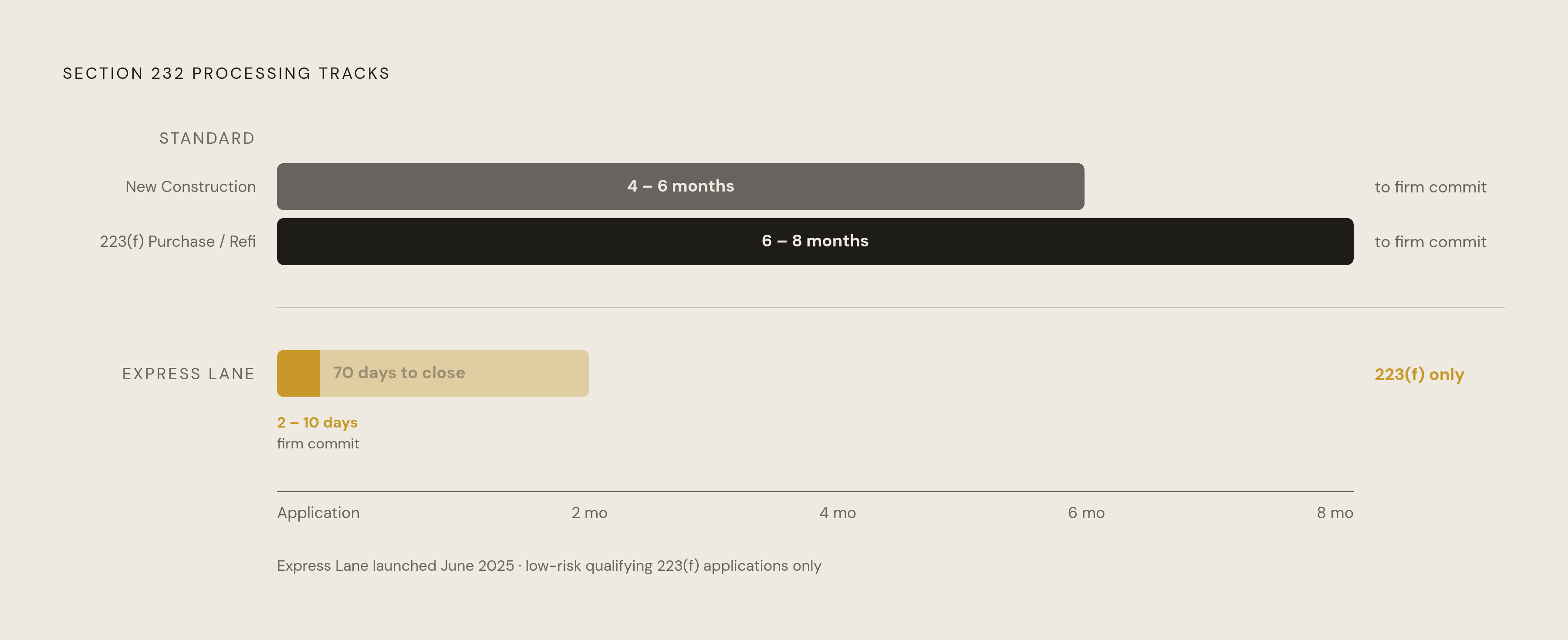
All FHA 232 loans process through the LEAN application system, designed to reduce redundancies relative to earlier HUD processing frameworks. Standard timelines under LEAN run approximately four to six months from application to firm commitment and closing for new construction, and six to eight months for 232/223(f) purchase and refinance transactions. Both ranges assume reasonable application complexity and, more critically, a complete submission.
The express lane, launched in June 2025, introduces a meaningful departure for qualifying 232/223(f) applications. Eligible applications meeting defined low-risk criteria receive queue priority. Firm commitments under the express lane have been issued within seven to ten days; some have cleared in as few as two days. Full transactions have closed in as few as 70 days from firm application to closing. Per reporting on FY 2025 activity, the express lane was identified as a key driver of FHA's healthcare lending volume during that period.
The compression is real, and it is available only to applications that arrive complete, accurate, and structurally consistent with low-risk criteria from the moment of submission. An incomplete application does not qualify. More precisely: a qualified application submitted incompletely forfeits the advantage entirely, which, in transactions where carrying costs and market windows are live variables, is a costly way to learn about a documentation gap that was always correctable before submission.