REAC Financial Assessment Scoring Explained
How HUD's REAC system uses financial ratios to flag housing providers at risk of failure.

HUD's Real Estate Assessment Center is a surveillance system, and its financial assessment component is the early-warning instrument at its core. Many affordable housing administrators treat financial reporting as a compliance ritual: submit the numbers, clear the deadline, move on. The reporting cycle is relentless, the forms are dense, and the consequences of imperfect scores can feel abstract until they aren't.
REAC sits at the center of HUD's effort to ensure that federally assisted housing remains safe, decent, and fiscally sound. It operates two parallel tracks: physical inspections and financial assessments. These tracks are related in purpose but entirely separate in methodology. REAC conducts approximately 20,000 property inspections per year. The financial filing universe is larger still: over 26,000 multifamily participants alone are required to submit annual electronic financial data. The scale of that data collection reflects something important. HUD cannot be everywhere. Financial scoring is how it extends oversight across a portfolio that no field office could personally monitor.
The financial score is not a report card. It is a risk signal. Understanding how that signal is built, what it measures, and what it triggers is, in my experience, one of the most undervalued competencies in housing operations.
How FASS-PH and FASS-FHA Divide the Universe of HUD-Assisted Properties
HUD administers financial assessment through two distinct subsystems, each designed for a different population of federally assisted entities.
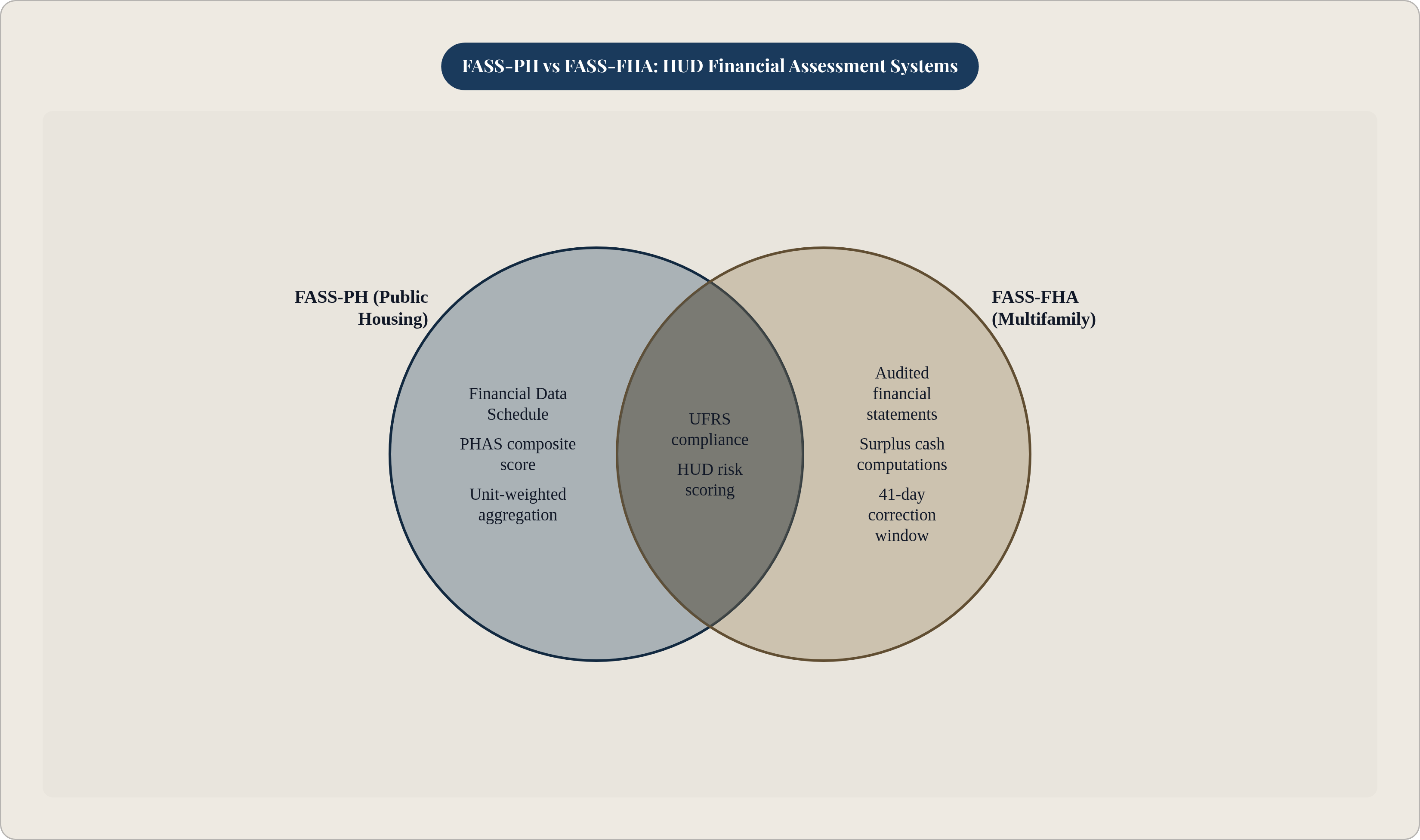
FASS-PH, the Financial Assessment Subsystem for Public Housing, receives electronic submissions from public housing agencies. PHAs submit their data through the Financial Data Schedule (FDS), a standardized reporting format prepared in accordance with Generally Accepted Accounting Principles, as required under HUD's Uniform Financial Reporting Standards rule at 24 CFR Part 5. The FDS is not a free-form document. It is a structured template that forces financial data into categories HUD can score and compare across agencies of vastly different sizes.
FASS-FHA, sometimes called FASSUB, serves a different population: multifamily rental properties and healthcare facilities carrying HUD-insured or HUD-held loans. Where FASS-PH receives a standardized schedule, FASSUB receives a more complex package: audited financial statements, supplemental schedules, surplus cash computations, footnotes, certifications, and internal control and compliance reports, all validated against HUD's Uniform Financial Reporting Standards (UFRS) format.
One practical distinction is worth noting carefully. Not every multifamily owner submits audited financials. Housing Notice H2013-23 permits profit-motivated and limited distribution owners receiving less than $500,000 in federal financial assistance to submit owner-certified financials rather than audited statements. This is not a loophole so much as a proportionality rule, but it creates a real difference in the evidentiary weight of submissions across the multifamily portfolio.
Both systems feed into downstream scores that determine a property's standing with HUD. The scoring machinery, however, differs significantly between them.
Where the Financial Condition Indicator Sits Within the Public Housing Scoring Framework
Public housing agencies are assessed under the Public Housing Assessment System, which produces a single composite score from four weighted indicators. Under 24 CFR § 902.9, physical condition carries 40 points, financial condition carries 25, management operations carries 25, and the Capital Fund program carries 10.
Financial condition is the second-largest component. That placement is deliberate. Physical condition dominates because safe, habitable housing is the mission's most immediate expression. But HUD's architects understood that a physically adequate property run on deteriorating finances is a deferred crisis, not a success. Twenty-five points reflects that judgment.
What is easy to miss is the floor embedded in the framework. A score below 60 percent of available points on the financial condition indicator, meaning below 15 of 25 points, constitutes a deficiency regardless of where the composite score lands. A PHA cannot subsidize weak financials with strong physical scores. Each indicator has an independent minimum. In practice, I have seen agencies focus obsessively on physical inspection preparation while allowing financial ratios to erode, only to discover that the deficiency designation arrives through the financial door, not the physical one.
The current weighting structure reflects the Interim PHAS Rule, effective March 25, 2011. A proposed rule published November 4, 2024 (Docket FR-6356-P-01) would remove the Capital Fund indicator entirely and redistribute its weight across remaining indicators, increasing financial condition's relative contribution. As of the January 3, 2025 comment deadline, that rule had not been finalized.
The Three Sub-Indicators That Build the 25-Point Financial Condition Score
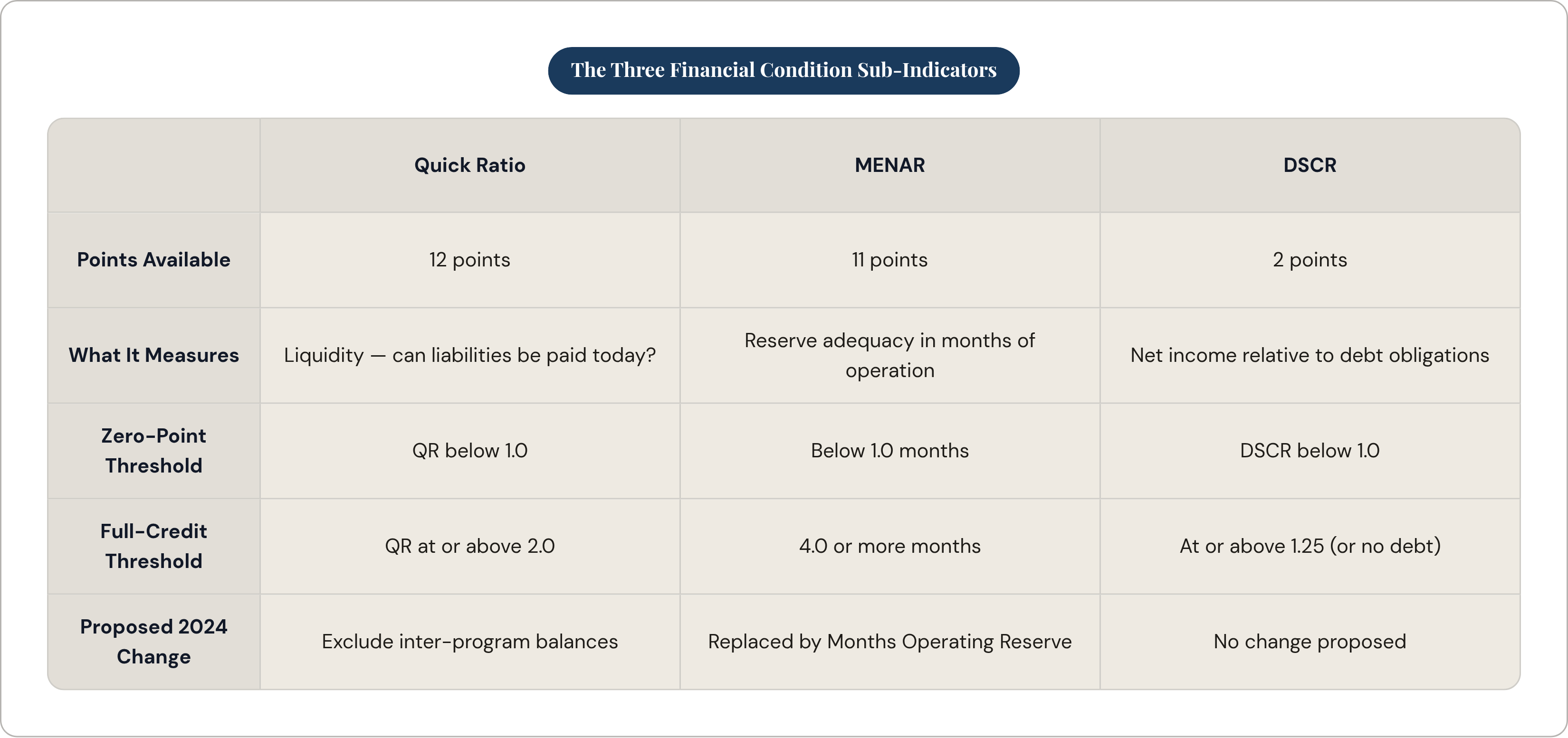
The financial condition indicator is not a holistic judgment. It is an arithmetic sum of three distinct sub-indicators, each measuring a different dimension of fiscal health. Understanding each one separately before considering how they interact is worth the time.
Quick Ratio
The Quick Ratio, a more conservative liquidity measure than the current ratio, carries up to 12 points, making it the dominant sub-indicator. It measures liquidity: adjusted unrestricted current assets divided by current liabilities. The question it asks is direct. If all current liabilities came due today, could this project pay them?
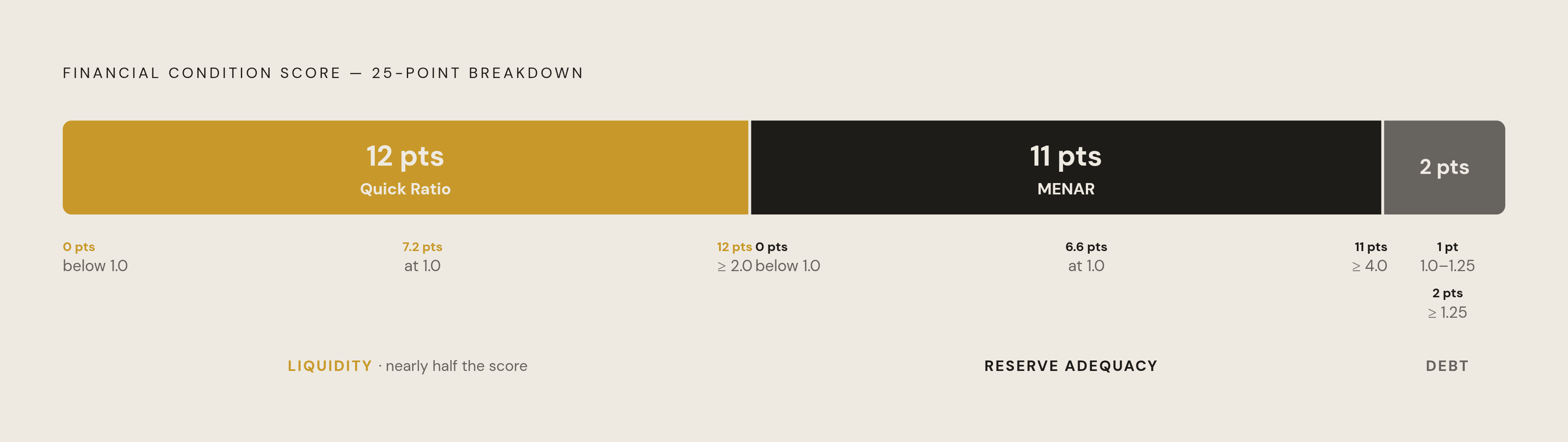
The scoring scale is not binary. A QR below 1.0 earns zero points. A QR of exactly 1.0 earns 7.2 points, reflecting HUD's recognition that bare adequacy is meaningfully different from insolvency. Between 1.0 and 2.0, points accrue proportionally. At or above 2.0, the project receives the full 12 points.
HUD's proposed 2024 revisions would clarify that inter-program balances between PHA projects and programs should be excluded from both quick assets and current liabilities. This is a technically significant correction. Under current practice, internal transfers between programs can inflate apparent liquidity without representing real cash available to the project. The proposed clarification would make the ratio a more accurate read of actual financial flexibility.
Months Expendable Net Assets Ratio
MENAR carries up to 11 points and addresses a different question: not whether a project can survive a crisis today, but whether it has sufficient unrestricted reserves to sustain operations over time. The ratio divides adjusted net available unrestricted resources by average monthly operating expenses, producing a result expressed in months.
A MENAR below 1.0 earns zero points, meaning a project with less than one month of operating reserves receives no credit at all. HUD treats one month of operating reserves as the minimum threshold for any credit at all. At exactly 1.0, a project earns 6.6 points. Between 1.0 and 4.0, points accumulate proportionally. At or above 4.0, the project earns the full 11 points.
The proposed 2024 rule would replace MENAR with a Months Operating Reserve sub-indicator. The conceptual intent is identical: reserve adequacy measured in months of operation. The calculation changes, however, to net current assets (current assets minus current liabilities) divided by average monthly operating expenses, rather than the gross unrestricted asset figure MENAR uses. The shift narrows the numerator, making it harder to inflate the ratio through assets that are technically unrestricted but practically encumbered.
Debt Service Coverage Ratio
DSCR carries only 2 points. It measures whether a project generates sufficient net operating income to service its debt obligations. A DSCR below 1.0 earns nothing. Between 1.0 and 1.25, the project earns 1 point. At or above 1.25, or in the absence of any debt, the project earns the full 2 points.
The low weighting is appropriate. Many public housing projects carry no debt, making the indicator inapplicable; those projects receive full points automatically. For leveraged developments, the DSCR matters more as a management signal than as a score driver. A project with a failing DSCR that also has liquidity and reserve problems is in serious trouble. A project with a strong QR and MENAR but a weak DSCR has a narrower, more tractable problem.
The three sub-indicators sum to exactly 25 points: 12 from the Quick Ratio, 11 from MENAR, 2 from DSCR. The design is intentional. Liquidity and reserve adequacy are weighted most heavily because they are the conditions HUD can do the least to remedy once they collapse.
How Individual Project Scores Are Aggregated into a PHA-Wide Financial Condition Score
PHAs typically operate multiple projects, each submitting its own FDS data. The sub-indicator ratios are calculated at the project level, not the agency level. Aggregation happens afterward.
Each project's financial condition score is multiplied by its unit count, producing a weighted value. The sum of all weighted values is then divided by the PHA's total unit count. The result is a unit-weighted average, a form of weighted mean that HUD applies consistently across its portfolio-level assessments. Larger projects pull the agency-wide score toward their own performance. A deteriorating score at a 400-unit development will move the needle far more than the same deterioration at a 40-unit development. This is not an accident of design. It reflects the reasonable premise that HUD's concern scales with the number of households at risk.
Scoring operates in two passes. An unaudited FDS submitted within two months of fiscal year-end generates an initial score. PHAS processes these filings nightly, meaning a PHA can see its preliminary FASS-PH score the following day. That immediacy matters: it allows agencies to identify problems before the audited submission crystallizes the score.
The audited FDS, due no later than nine months after fiscal year-end and marked "IPA Agree" by an Independent Public Accountant (IPA), generates a revised score that can move upward or downward from the initial figure. When unaudited and audited data conflict, HUD uses the audited data. The initial score is a placeholder; the audited score is the record.
Multifamily entities operate on a different timeline. They submit annual financial data within 90 days of calendar year-end, a fixed window anchored to the calendar rather than a fiscal year. The distinction in timelines reflects the structural differences between PHA fiscal year variation and the more standardized operating cycles of multifamily properties.
How Audit Quality and IPA Findings Affect the Score That Gets Recorded
Independent Public Accountants are not merely certifiers. HUD explicitly frames IPA firms as its first line of defense in assessing the financial condition of PHAs, Tribally Designated Housing Entities, and multifamily ownership entities. The audit's quality therefore has direct scoring consequences, not just reputational ones.
HUD's Quality Assurance Operations Division conducts quality control reviews of IPA firms to ensure that submitted financial information is reliable. When those reviews reveal problems, the consequences flow back to the PHA.
The deduction logic is structured around severity. If audit opinions on financial statements, major federal programs, or other required reports are anything other than unqualified, points may be deducted automatically. The most severe outcome short of referral is a Tier 1 finding, which triggers a 100 percent deduction of the financial condition indicator score. A PHA that entered the audit cycle with a solid 20-point financial score can exit it with zero. That is not a hypothetical. It has happened.
There is a proportionality rule embedded in the framework. If audit deficiencies have no effect on the financial components of public housing projects or the PHA's overall financial condition as it relates to PHAS, the score is not adjusted. The deduction applies where the deficiency is substantively relevant, not merely technical.
For multifamily FASSUB submissions, the correction mechanism works differently. If HUD identifies issues, including incomplete notes, material errors, or misstatements, the submission is archived rather than rejected outright. The owner receives 41 days to correct and resubmit. Failure to meet that deadline triggers referral to HUD's Departmental Enforcement Center, which can impose civil money penalties. The 41-day window is more forgiving than it sounds only if the owner takes it seriously immediately.
What the Composite PHAS Score Produces: Performance Designations and Their Practical Consequences
The composite PHAS score sorts PHAs into four performance designations: High Performer, Standard Performer, Substandard Performer, and Troubled Performer. The designations are not merely labels. They determine what happens next.
A score below 60 percent of available financial condition points, fewer than 15 of 25, constitutes a deficiency regardless of composite score. The deficiency designation is its own trigger, independent of the performance tier.
Substandard agencies that do not recover within 90 days of designation enter a collaborative remediation process: the PHA and the relevant HUD Field Office develop a Corrective Action Plan. This is, in practice, a managed relationship between a struggling agency and the federal government, with timelines, benchmarks, and external oversight. For Troubled agencies, the framework allows two years to improve the composite score to at least 60. That window is meaningful but finite.
Multifamily owners face a different set of consequences. A low REAC financial score can result in a HUD Flag, which may prevent the owner or management agent from being approved for future HUD programs. The score's implications, in other words, extend beyond the property being evaluated to the owner's entire development pipeline. For active developers, that flag is not a reputational inconvenience; it is a business constraint.
Late submissions carry their own penalties, assessed before any score-based designation is even applied. The financial scoring framework produces consequences at every stage: submission, audit, designation, and remediation.
Where the Financial Assessment Framework Is Heading Under HUD's Proposed 2024 Revisions
HUD's proposed rule, Docket FR-6356-P-01, published November 4, 2024, signals where the agency believes the current framework is inadequate. Reading a proposed rule as a diagnostic document is often as instructive as reading it as a regulatory text.
Several proposed changes bear directly on financial assessment. The Capital Fund indicator would be eliminated entirely, its 10 points redistributed across remaining indicators. Financial condition would carry more relative weight as a result. The MENAR sub-indicator would be replaced by the Months Operating Reserve sub-indicator, narrowing the reserve adequacy calculation in ways that reduce the ability to inflate the ratio through nominally unrestricted but practically constrained assets. The Quick Ratio calculation would be clarified to exclude inter-program balances, correcting a known tendency toward overstated liquidity. The proposed rule would also extend PHAS to Moving to Work expansion agencies, broadening the population subject to this scoring framework.
Perhaps most consequentially, the proposed revisions would allow HUD to intervene earlier, based on trending performance data rather than waiting for a designation threshold to be crossed. That shift, if finalized, would change the nature of HUD oversight from a periodic reckoning to something closer to continuous monitoring.
As of the January 3, 2025 comment deadline, the rule remained a proposal. Current scoring rules are in effect. Practitioners should confirm status before making operational decisions based on the proposed changes.
What the proposed revisions clarify, however, is the logic the current system has always embodied. Financial condition scoring is HUD's early-warning instrument. The proposed changes are calibration adjustments, designed to make that instrument more sensitive and more resistant to the kinds of accounting presentation choices that can make a financially stressed property look healthier than it is. The direction of travel is toward greater precision, not toward relaxation. That is worth understanding before the rule takes its final form.