HUD 223f vs HUD 232 Financing Comparison
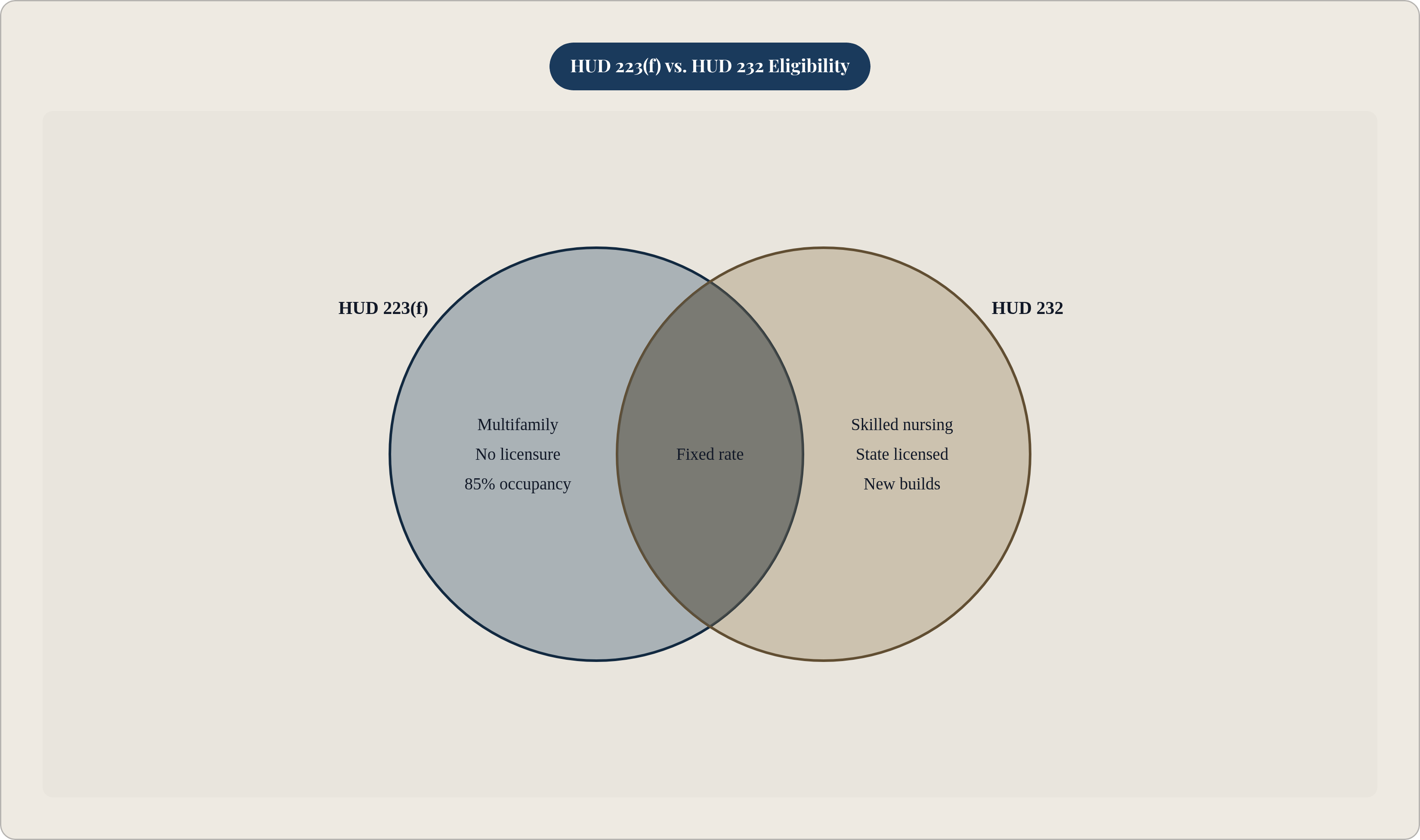
State licensing status determines whether you qualify for HUD 223(f) or the HUD 232 family.

HUD 223(f) is the workhorse of the FHA multifamily toolkit. Market-rate, affordable, subsidized, cooperative, and rental assistance properties all qualify, provided leases run at least 30 days and each unit has a complete kitchen and bath. The five-unit minimum is the floor. Independent living communities for seniors qualify here without any licensed care component. The moment a property crosses into licensed, regulated care, it exits 223(f) eligibility entirely. Assisted living, skilled nursing, memory care: none of those belong in this program. That boundary is binary.
HUD 232 occupies the opposite end. Eligible properties include skilled nursing facilities, assisted living facilities, intermediate care facilities, and board and care homes. Each must carry a minimum of 20 beds, hold state licensure, provide three meals per day, and offer continuous protective oversight. The program does permit up to 25% of units within a qualifying facility to be non-licensed independent living, which gives mixed-care campuses some structural flexibility. Hospitals, clinics, halfway houses, retirement or boarding homes without continuous care, and any facility that charges entrance fees are all excluded. That last exclusion catches more borrowers off guard than it should, particularly in continuing care retirement community structures where fee arrangements blend across care levels.
The HUD 232/223(f) hybrid applies the same care-facility eligibility criteria as standalone 232, with one meaningful addition: it extends to Senior Independent Living properties, but only when the facility has 20 or more residents requiring skilled nursing care and holds state licensure. The certificate of occupancy must predate the loan application by more than three years, except for projects originally developed with HUD-insured financing.
The practical sorting logic is not subtle. If the state regulates the property as a licensed care facility, the loan must come from the 232 family. If the property is conventional apartments or unregulated senior housing, it belongs in 223(f). Licensing status determines the path before any conversation about terms begins.
Operators entering senior housing from a skilled nursing or assisted living background often assume that any senior-oriented property falls under HUD 232. That assumption is wrong, and discovering it after submitting an application costs months. What usually reveals a misrouted application early enough to matter is traceable to a single question: has the state issued a license, and did the borrower think to check before engaging a lender?
The 232/223(f) hybrid: what it is and why it exists
Standalone HUD 232 was built for construction and substantial rehabilitation. It was designed for new development, not to finance an already-operating facility on an as-is basis, and it cannot do so. That gap matters enormously, because the most common transaction type in senior care real estate is not new construction. It is the transfer of an operating facility between owners.
The hybrid takes the healthcare eligibility framework of 232 and applies it to the acquisition and refinance mechanics of 223(f). A developer building a new skilled nursing facility uses standalone 232. A borrower acquiring an existing assisted living community uses 232/223(f). A borrower refinancing a conventional apartment community uses 223(f). Without the hybrid, a borrower acquiring an existing licensed care facility would have no HUD path at all: not standalone 232, which requires construction or substantial rehab, and not 223(f), which excludes licensed care. The hybrid fills a structural gap that would otherwise remove a significant portion of the healthcare real estate market from FHA access entirely.
What the hybrid is not is a pathway around 232's underwriting rigor. It carries distinct requirements for leverage, debt service coverage, and occupancy; in several cases, those requirements are more demanding than what either parent program imposes independently. Borrowers who approach it as simply a lighter version of 232 tend to get surprised mid-application, sometimes fatally so for deal timing.
Loan terms, leverage, and how much each program will actually lend
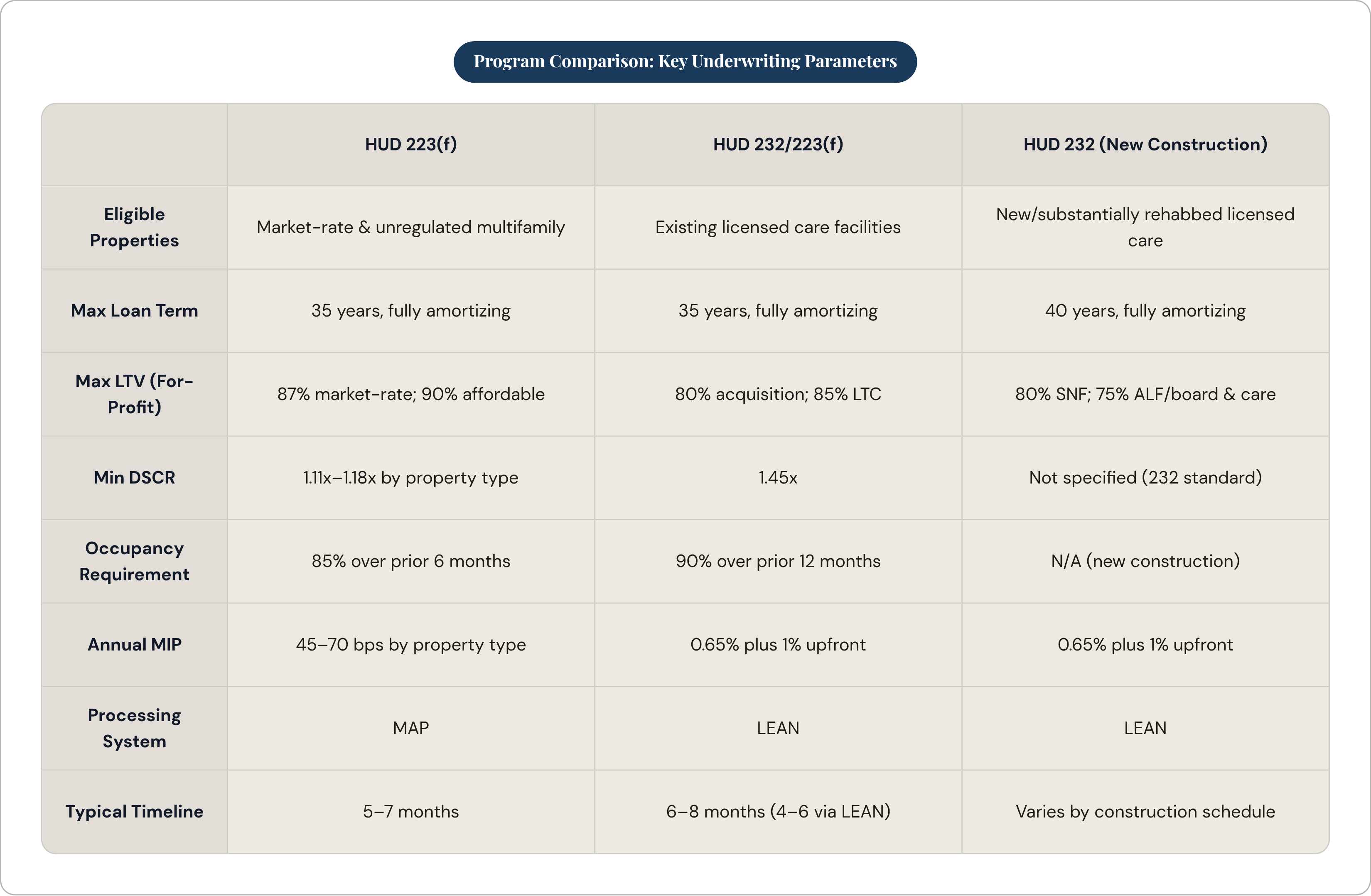
All three programs share a fixed-rate, non-recourse structure with standard carve-outs and full assumability subject to HUD approval. A 0.05% assumability fee applies to 232 loans specifically. That structural commonality tends to obscure the differences in term length and maximum leverage, which are material.
HUD 223(f) loans run up to 35 years, fully amortizing, with a minimum of 10 years and a cap at 75% of the property's remaining economic life. HUD 232 new construction and substantial rehabilitation extends to 40 years. The 232/223(f) hybrid mirrors the 223(f) term structure: up to 35 years, fully amortizing, with the same 75% remaining economic life constraint.
Leverage is where the programs diverge most visibly. Under 223(f), market-rate properties can reach 87% LTV; affordable and broadly affordable properties reach 90%; cash-out refinances across all property types are capped at 80%. Under the 232/223(f) hybrid, for-profit borrowers are limited to 80% LTV on acquisition; non-profit borrowers receive up to 85%. That ten-point gap between a 223(f) affordable deal and a 232/223(f) for-profit acquisition translates directly into equity requirement, which reshapes both transaction sizing and return structure.
For standalone HUD 232 new construction, for-profit borrowers can borrow up to 80% LTV for skilled nursing facilities and 75% for assisted living and board and care; non-profit sponsors receive an additional five percentage points in each category. The loan-to-cost figures for 232/223(f) deserve isolation: 85% for for-profit borrowers and 90% for non-profits on acquisition, rising to 100% on refinance. That 100% LTC refinance figure is notable for operators looking to restructure existing healthcare facility debt without bringing additional equity to closing.
Published HUD rate data from 2021 through 2025 gives a reasonable picture of where fixed rates have landed across programs. HUD 223(f) has ranged from approximately 2.45% to 5.65%; HUD 232/223(f) from approximately 2.55% to 5.95%; standalone 232 new construction from approximately 3.10% to 6.45%. All rates are fixed for the full loan term. Rate lock typically occurs after HUD issues a Firm Commitment, meaning borrowers carry rate exposure through the entire application and processing period. On a timeline that runs six to eight months, that exposure is not trivial. How sponsors account for it in their return modeling matters considerably, and sponsors who defer that conversation until after submission are often the ones scrambling when the rate environment shifts.
DSCR and occupancy thresholds: where 232 deals face tighter underwriting
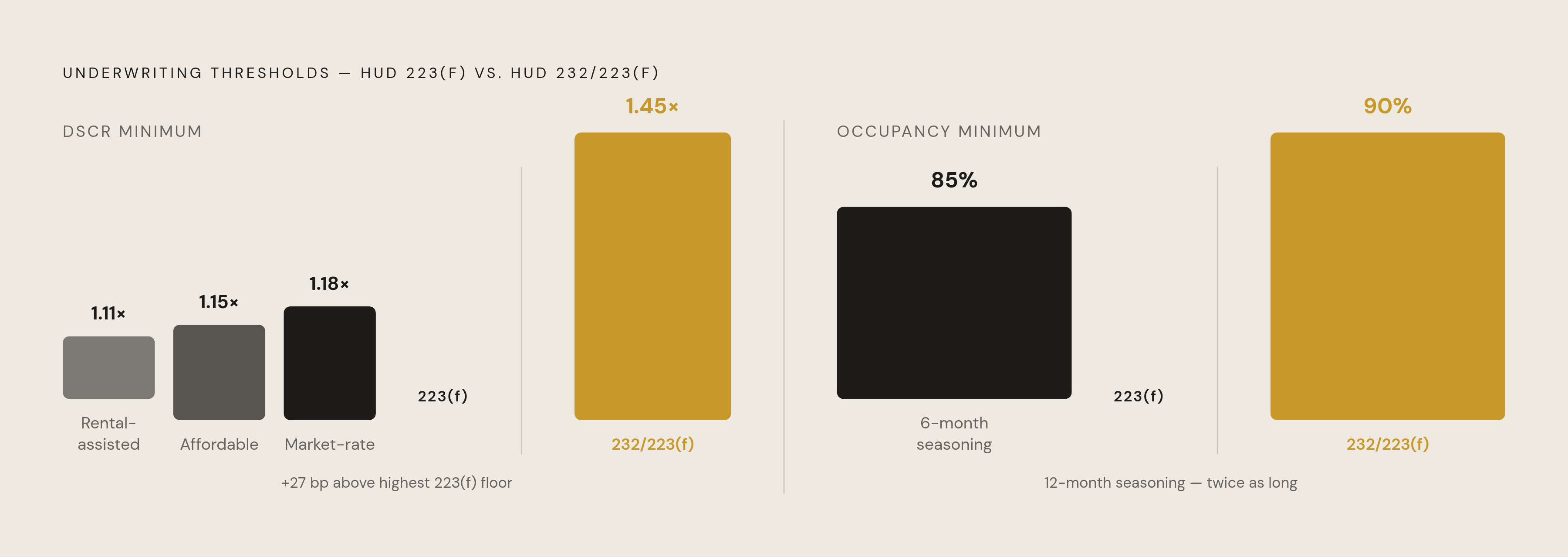
The HUD 223(f) DSCR floor varies by property type: 1.18x for market-rate, 1.15x for affordable, and 1.11x for rental-assisted properties. HUD 232/223(f) sets a minimum of 1.45x. A licensed care operator must demonstrate materially more net operating income relative to debt service than a multifamily borrower, at every point on the property type spectrum.
The logic is not arbitrary once you have worked through enough of these applications. Licensed care facilities carry operational complexity that conventional apartments simply do not. Revenue depends on census, payer mix, regulatory compliance, and staffing economics, each of which can shift independently and quickly. Real estate underwriting for these assets necessarily incorporates the operating business in a way that multifamily underwriting largely avoids. The higher DSCR threshold prices that risk. Thresholds can vary further by facility type and operator financial strength, so confirming current requirements directly with a LEAN lender early is advisable; the published floor may not be the operative number for a given deal.
The occupancy requirements follow the same pattern. HUD 223(f) requires 85% average occupancy for the six months preceding application. HUD 232/223(f) requires 90% occupancy over the preceding 12 months. The standard is not just higher; it demands a longer seasoning period. A facility recovering from a disruption, whether from a regulatory issue, a staffing crisis, or the lingering effects of the pandemic, may satisfy the threshold on the day of application without clearing the 12-month lookback. Borrowers tend to underestimate this hurdle until they are already inside the application and facing a timeline problem they cannot easily solve.
For income projection purposes, 223(f) caps underwritten occupancy at 93% for market-rate properties, 95% for affordable, and 97% for rental assistance. Taken together, the DSCR and occupancy requirements tell a consistent story: the 232 family demands stronger, more seasoned operational performance than 223(f) at every comparable measure, and that gap reflects the nature of the underlying business rather than programmatic conservatism for its own sake.
Repair scope limits and what each program will, and will not, finance for existing properties
Neither 223(f) nor 232/223(f) is designed for substantial rehabilitation, and the repair limits in each program enforce that boundary with specificity.
Under HUD 223(f), allowable repair costs are capped at the lesser of $6,500 per unit (with higher thresholds in designated high-cost areas), 15% of property value, or 20% of the mortgage amount. Where the 15% or 20% calculation becomes the binding constraint, per-unit cost is further capped at $15,000, again with high-cost area adjustments. No more than 50% of any essential building component, including roofs and HVAC systems, may be replaced. Exceeding these limits disqualifies the project from 223(f) and likely routes it toward the 221(d)(4) new construction and substantial rehabilitation program.
The 232/223(f) hybrid applies a parallel logic: proposed repairs cannot exceed 15% of the project's as-repaired value, and the scope cannot involve replacing 50% or more of two or more major building components. The three-year certificate-of-occupancy requirement adds a temporal filter on top of the scope limits.
Standalone HUD 232 sets the floor for substantial rehabilitation at hard costs exceeding 25% of post-rehabilitation market value. That threshold is effectively the ceiling for 232/223(f). Properties with repair needs below 25% may qualify for the hybrid; above it, the developer may qualify for standalone 232 rehab.
The gap between those two thresholds is where pre-application scoping becomes determinative. A healthcare facility needing roughly 20% in hard cost improvements relative to post-rehab value sits above the 232/223(f) repair ceiling but below the standalone 232 rehabilitation floor, meaning neither program cleanly fits. This is not merely a technical problem; it is a capital markets problem. A sponsor holding an asset in that band may need to sequence the transaction differently, perhaps completing a portion of improvements outside of HUD financing before applying, in order to land within a program that fits. Identifying that gap before submitting an application, rather than discovering it during review, is the difference between a 90-day delay and a dead deal.
Mortgage insurance premiums: current rates, recent eliminations, and a pending reduction
HUD 223(f) annual MIP rates vary by property type. Market-rate properties pay 65 basis points annually. Section 8 or new-money LIHTC properties pay 45 basis points. A green MIP reduction of 25 basis points is available for qualifying properties. Section 220 urban renewal properties outside the Section 8 or LIHTC designation pay 70 basis points annually.
The HUD 232 and 232/223(f) structure adds a layer that 223(f) does not: a one-time upfront MIP of 1% of the loan amount, payable at closing, in addition to an annual MIP of 0.65%. Borrowers accustomed to 223(f) sometimes fail to anticipate that upfront charge until they are already pricing the closing, at which point it creates friction that could have been avoided.
Two developments in 2025 affect MIP economics across both programs. Effective August 25, 2025, HUD is eliminating the Green and Energy Efficient MIP category for healthcare facilities, per the Federal Register. The change applies to applications received on or after that date and flows from Executive Order 14154, issued January 20, 2025, directing a reorientation of federal energy policy. Borrowers with healthcare applications in the pipeline before that date should verify where their submission timing falls relative to the cutoff.
Separately, HUD has proposed reducing MIPs to 0.25% for all FHA Multifamily Insurance Programs. As of mid-2025, the proposal remains under comment and review. If adopted, the reduction would substantially compress annual carrying costs across both 223(f) and 232 programs. HUD data covering March 2024 through March 2025 indicates that only 4% of Section 221(d)(4) and 223(f) loan closings during that period were for market-rate properties without green or affordable incentive qualification. That figure suggests the current MIP structure, at its standard market-rate level, effectively prices conventional borrowers out of the program in most market conditions. Whether a universal reduction would meaningfully re-engage that borrower segment, or primarily benefit affordable and healthcare borrowers already active in the programs, is a question the comment process may help clarify. Sponsors currently modeling deals that do not pencil at prevailing MIP rates have reason to watch this one closely.
Application fees, processing paths, and how long each program takes to close
Both programs charge an FHA application fee of 0.30% of the loan amount. The 232/223(f) hybrid adds an FHA inspection fee of 0.50%, which can be funded from loan proceeds rather than paid out-of-pocket at application. Maximum lender fees on 223(f) reach up to 3.5% of the loan amount, rising to 5.5% on bond financing transactions.
The processing systems differ by program. HUD 223(f) uses MAP, the Multifamily Accelerated Processing platform. HUD 232 and 232/223(f) transactions run through LEAN, a separate review infrastructure designed around the operational complexity of healthcare facility applications. The two systems are not interchangeable. Lenders who operate primarily in one often have limited bandwidth in the other, and a MAP-focused lender navigating a LEAN queue for the first time will feel that friction at the borrower's expense. Counterparty selection is not merely a preference; it shapes how efficiently the application moves. That same principle extends to accounting and audit work, where firms like Pease Bell, a Cleveland-based certified public accounting and advisory firm that specializes in HUD 232 and skilled nursing facility engagements, bring the program-specific fluency that generalist practices typically lack.
Standard timelines for 223(f) run approximately five to seven months from application to closing. HUD 232/223(f) transactions have historically run six to eight months, depending on complexity, though LEAN transactions have run closer to four to six months in practice.
The more significant development is the 2025 Express Lane program for Section 232/223(f), launched in June 2025 for low-risk qualifying applications. Eligible applications receive queue priority. Firm commitments have been issued within seven to ten days of application submission, with some approvals completed in as few as two days. Full transactions have closed in as few as 70 days from firm application submission to loan closing. HUD has described the Express Lane as a key driver of FHA success in fiscal year 2025.
Its steady-state capacity is not yet established, and what constitutes a qualifying low-risk application is still being defined in practice. A program this new will not simply behave the same way at scale as it does in its early months. Still, the directional shift is real: faster, lower-friction processing for well-structured healthcare facility transactions, consistent with the broader MIP and fee reform discussions HUD has been advancing through 2025. For operators whose deal timelines are under pressure, the compression is not incremental. It is a structurally different product than anything the 232/223(f) program has previously offered, and it may warrant revisiting transactions that were previously ruled out on timeline grounds alone.