PDPM Reimbursement and Its Accounting Implications

PDPM changed how skilled nursing facilities get paid, and it changed the accounting for that revenue just as much. Implemented in October 2019 to replace RUG-IV, the model shifted the reimbursement basis from therapy volume to patient clinical and functional characteristics. That sounds like a clinical story, but it's really a finance story: this piece walks through the six-component structure, the revenue recognition mechanics under ASC 606, the AR complications, and the audit risk that's grown up around all of it.
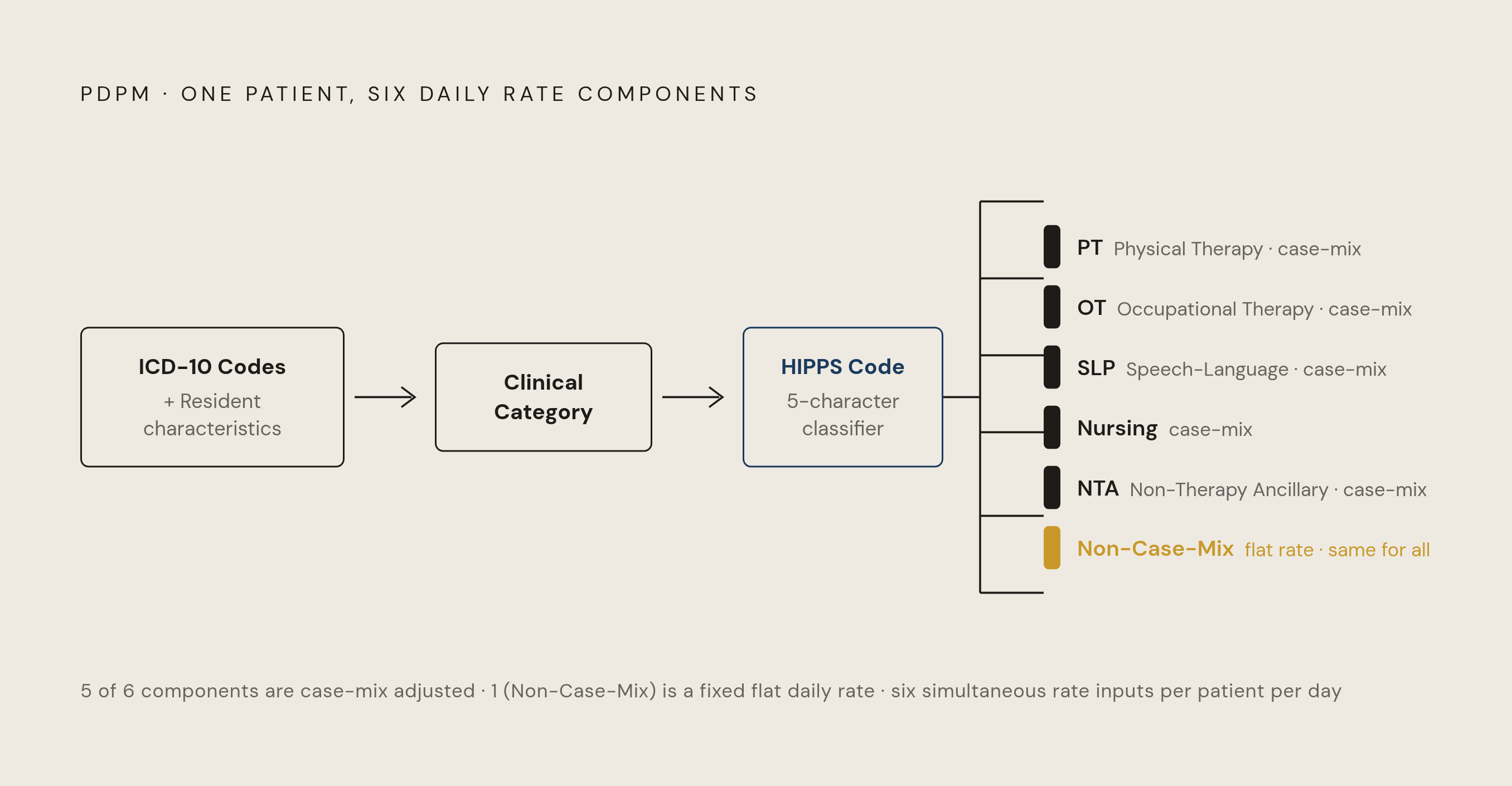
Start with the architecture, because the architecture is the point here, not the rate level. PDPM pays through six components per diem: five are case-mix adjusted (physical therapy, occupational therapy, speech-language pathology, nursing, and non-therapy ancillaries, or NTA), and one is a flat non-case-mix rate carried forward from the old RUG-IV system. Classification runs on a chain: ICD-10 diagnosis codes and resident characteristics determine a clinical category, the clinical category sets the HIPPS code, and the HIPPS code sets the rate. That's a direct line from clinical documentation to the dollar billed, and it means one resident generates six separate rate inputs every day, not one tidy number on a spreadsheet.
Medicaid is catching up to this same logic. States can adopt PDPM outright or pick components (Nursing only, or Nursing plus NTA, for example), and an October 1, 2025 deadline pushed the remaining holdouts to make the switch. Texas moved its NF providers from RUG-III to PDPM effective September 1, 2025. What that means on the ground: Medicaid AR, which finance teams once got away with treating under simpler assumptions, now runs through the same multi-component logic as Medicare. There's no more setting aside "the complicated payer" from "the simple one."
Current Medicare rate environment and what annual CMS updates mean for revenue projections
The FY 2025 final rule gave SNFs a net 4.2% payment increase, worth roughly $1.4 billion in additional Medicare Part A payments industry-wide. That figure breaks into pieces: a 3.0% market basket increase, a 1.7 percentage point forecast error adjustment, and a 0.5 percentage point productivity adjustment working against it. The same rule rebased the SNF market basket to a 2022 base year, a technical move that barely touches this year's number but will shape how every future update compounds from here on.
FY 2026 landed at a 3.2% increase, about $1.16 billion. Worth noting: the proposed figure earlier in the year had been 2.8%, built from a 3.0% market basket increase, a positive 0.6% forecast error adjustment, and a negative 0.8% productivity adjustment. The final number moved. That gap between proposed and final isn't a rounding error a finance team can shrug off; it's a real reminder that revenue projections need updating at each stage of rulemaking, not just once when the proposed rule drops.
Here's the timing wrinkle that trips people up. CMS rate changes take effect October 1, the start of the federal fiscal year, which lands mid-way through most SNFs' calendar-year reporting periods. Q4 revenue accruals have to reflect the new rate precisely from day one of the new fiscal year; carrying Q3 assumptions forward into October billing produces a real misstatement, not a trivial one. And because market basket weights differ by component, one blanket percentage across all six revenue lines won't hold up. Nursing might move differently than NTA. Finance teams have to work at the component level even for something as basic as a rate update.
How each of the six PDPM components behaves as an accounting line item
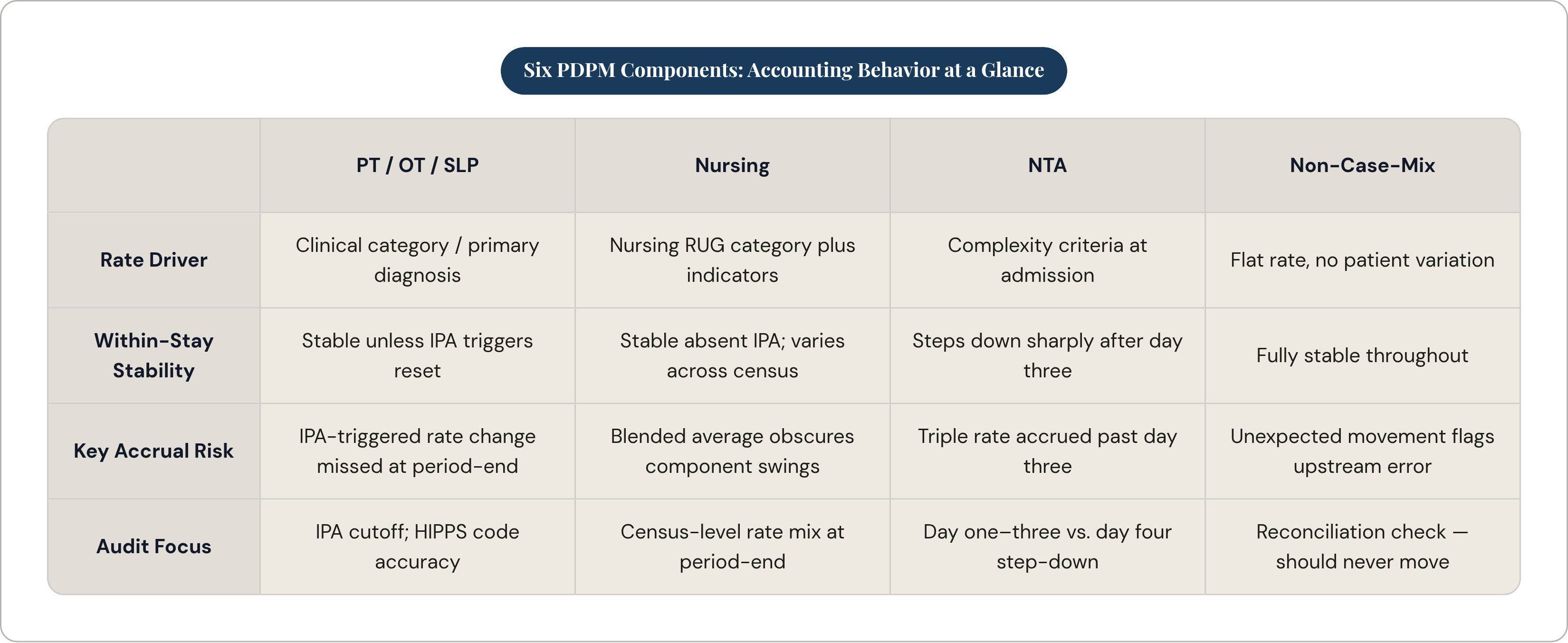
PT, OT, and SLP rates get set by the clinical category tied to the primary diagnosis, and they generally hold steady for the length of a stay. The exception is an Interim Payment Assessment, or IPA: if a patient's condition changes materially, a new MDS assessment resets the classification and resets the per diem with it. That mid-stay reset creates a real discontinuity in daily revenue that a simple point-in-time snapshot misses entirely. If your accrual model assumes the admission-day rate holds through discharge, and an IPA fires in week three, you've got a stretch where booked revenue and actual entitlement just don't match.
Nursing is usually the single largest driver of total per diem, set by nursing RUG category along with depression and restorative nursing indicators. Within one patient's stay it tends to sit still, absent an IPA. Across the census, though, it's highly variable, because different patients land in different nursing classification levels on the same day. The aggregate nursing revenue line on the income statement is really a blended average across dozens of individual rates, and that matters when someone asks why that line swung month over month.
NTA is the volatile one, and it's worth sitting with why. Residents meeting NTA complexity criteria get a triple reimbursement rate for the first three days of admission, then step down to the standard NTA rate from day four onward. That's a deliberate policy design meant to front-load resources toward the most clinically intense early days of a stay. But it also means admissions-heavy months produce disproportionately high NTA revenue concentrated in those first three days of each new stay, and any AR balance sitting on the books at period-end has to reflect the step-down already in effect for stays that have moved past day three. Miss that step-down, on the clinical documentation side or the billing side, and you get either an understatement or an overstatement of revenue, plus a matching error in AR. Neither direction is more forgivable than the other.
The non-case-mix component is the easy one: flat rate, no patient-level variation, simple to accrue. Don't ignore it just because it's simple, though. It's a useful reconciliation check for exactly that reason: it should never move unexpectedly, so when it does, something's wrong upstream.
A SNF's general ledger needs revenue visibility at the component level, not one lump Medicare Part A line. Otherwise period-end accruals can't be supported, and the audit tie-out turns into guesswork.
Revenue recognition under ASC 606 applied to PDPM's per diem structure
ASC 606 runs on a five-step model: identify the contract, identify performance obligations, determine the transaction price, allocate the price to obligations, recognize revenue as those obligations get satisfied. Applied to a SNF, the tricky step is determining transaction price, because under PDPM that price isn't pinned down at admission the way it might feel like it should be. Primary diagnosis drives clinical category, clinical category drives HIPPS code, HIPPS code drives six component rates, and any of those six can reset mid-stay if an IPA triggers. The transaction price is a moving target dressed up as a daily rate.
ASC 606's variable consideration guidance calls for an estimate of the revenue the facility expects to actually be entitled to, not just what was initially billed. For a SNF, that estimate has to account for case-mix assignment accuracy and the real chance of a mid-stay reassessment changing the rate. Care itself gets delivered continuously, so revenue recognition follows an over-time model, tied to daily care delivery, which is the easy part conceptually. The hard part: the per diem rate for any given day is only definitively known once the MDS assessment for that period is complete and the HIPPS code is locked in. You're recognizing revenue for a service whose price confirms itself after the fact.
Get this stage wrong and the damage doesn't stay contained. Errors in ICD-10 coding or MDS completion corrupt the top-line revenue figure, and everything downstream, every margin calculation, every trend analysis, inherits that corruption. Three failure patterns show up again and again in practice. Accruing the NTA triple rate past day three overstates revenue. Missing an IPA-triggered rate change at period-end misstates revenue for every day after the reassessment that got missed. Applying the prior fiscal year's Medicare rate to days billed after October 1 misstates revenue in whichever direction the rate moved.
One more wrinkle, because it resurfaces later: facilities that outsource MDS management or billing to a third party add a layer of dependency. The revenue recognition output is only as good as the vendor's processing controls, and that's exactly the kind of thing a SOC 1 report exists to address.
Accounts receivable complexity and the collections benchmark SNF finance teams use
AR days outstanding, calculated as AR divided by annual revenue times 365, is the metric most SNF finance teams live by. Most well-run facilities target 60 days or fewer. Cross that threshold and it's not just a slower collections cycle; real cash is tied up, and it's usually a sign of an underlying billing or collection problem that needs attention before it compounds.
PDPM adds its own specific complications to that math. Each Medicare Part A claim bundles six component rates into one bill, and a coding error on any single component can knock out the entire claim, whether that's a rejection or a partial denial, aging the whole balance rather than just the piece that was wrong. IPA-driven rate changes that don't make it onto the claim correctly require adjustment billing, which resets the aging clock on that balance. And NTA front-loading, predictable as it is in theory, is easy to fumble in practice; if the day-four step-down isn't reflected accurately on the billed claim, a recoupment demand follows, and what looked like clean AR quietly turns into a contingent liability sitting on the books.
Layer multiple payers on top and the picture gets messier still. Medicaid, now increasingly PDPM-based itself, plus Medicare Advantage, plus various managed care contracts, each run on different adjudication timelines and different denial patterns. None of them behave exactly like Medicare Part A, and none of them behave exactly like each other.
That has a direct consequence for the allowance for doubtful accounts. A flat percentage-of-revenue reserve, the kind of shortcut that got by reasonably well under RUG-IV's simpler structure, can't capture PDPM's component-level variance in denial and recoupment patterns. The historical data needs breaking down by payer and by component to build a reserve that actually reflects collection risk. And this matters past the AR schedule itself: the monthly Balance Sheet, Income Statement, and Cash Flow Statement that every SNF should be generating and reviewing are only as trustworthy as the AR balance feeding into them. If that balance doesn't reflect net realizable value after component-level adjustments, the whole set of statements is telling a story that isn't quite true.
The OIG audit series and coding intensity research that define the current audit risk environment
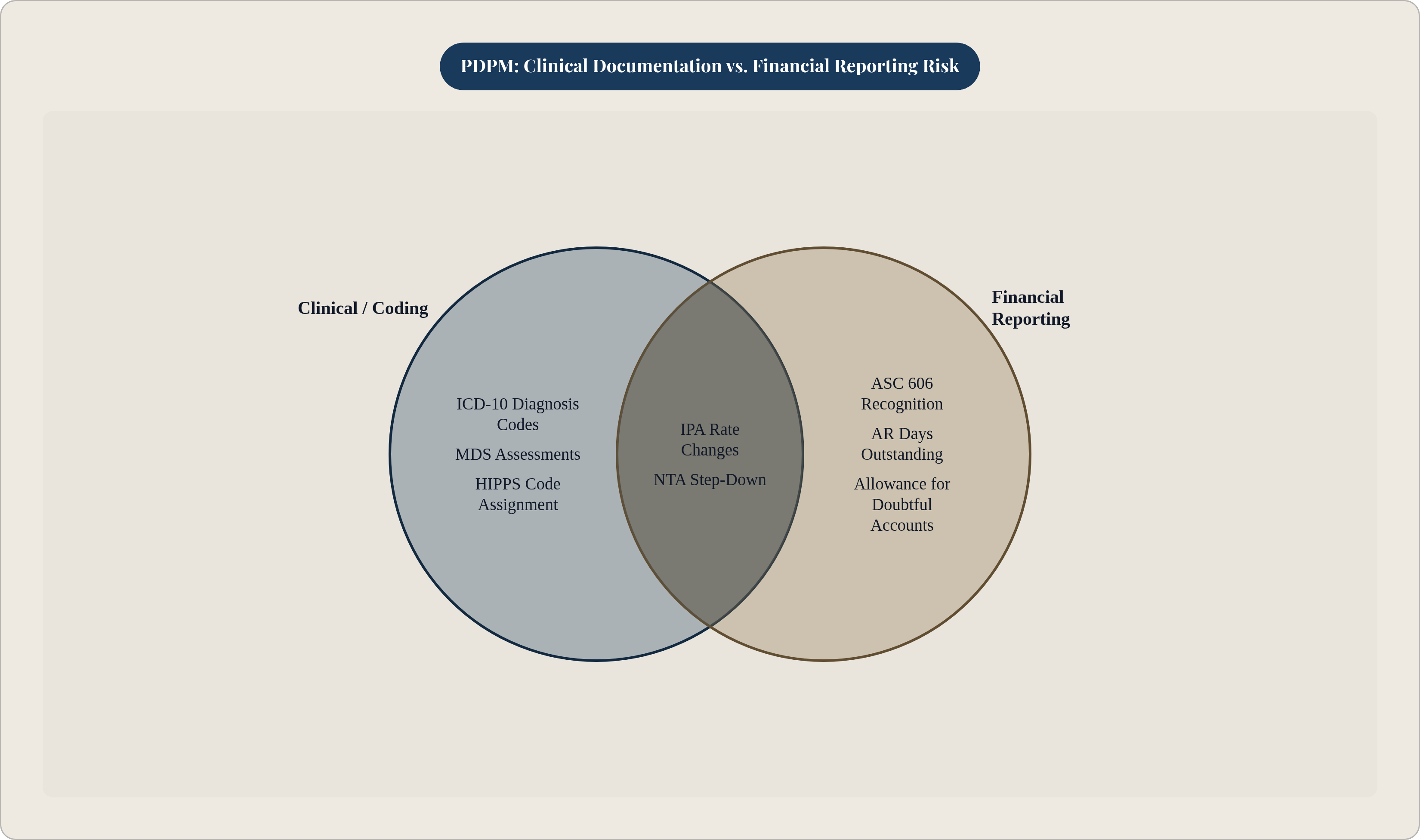
Some scale, first. SNFs represent roughly $25 billion in annual Medicare expenditures as of 2023, the kind of number that keeps a program on a federal auditor's priority list year after year. The HHS Office of Inspector General currently has eight active audit projects specifically examining whether Medicare payments to SNFs under PDPM complied with program requirements. The first released audit, of a New York-based SNF, found incorrect HIPPS code assignment, thin medical necessity documentation, and significant overpayments. Read that list again: those are the exact same failure modes that produce financial statement misstatement. This isn't a compliance issue running parallel to accounting; it's the same issue wearing two hats.
As of June 2025, that OIG work plan is still active, which points to sustained, multi-year scrutiny rather than a single review cycle that closes out and disappears.
The research literature backs up the concern from a different angle. A 2025 study published on PubMed, using retrospective cohort analysis, found that PDPM was associated with increased coding intensity and increased Medicare expenditures, with no corresponding change in patient mortality or readmission rates. Read plainly, that suggests some facilities responded to PDPM's financial incentives by changing how they coded, not by changing how they delivered care. A secondary analysis covering over 4.8 million hospital-to-SNF episodes, drawn from Traditional Medicare claims between 2018 and 2021, found the coding intensity increase was more pronounced among for-profit SNFs, and the authors called for continued monitoring of whether facilities are documenting clinical complexity accurately or inflating it.
What does that mean for the person signing off on financial statements? ICD-10 coding accuracy stops being purely a compliance checkbox and becomes a financial reporting risk area in its own right. Material misstatement of revenue can show up through systematic upcoding even without any fraudulent intent behind it; a facility can drift into inaccurate coding through plain process weakness, and the dollar effect on the books lands the same either way. Auditors need to treat this as a significant risk, not a routine test.
And OIG audits aren't the only exposure. RAC, ZPIC, TPE, CERT, and state Medicaid audits each carry their own potential for recoupment demands and civil money penalties, and Medicare appeals move through a long chain: Redetermination, then the Qualified Independent Contractor stage, then an Administrative Law Judge, then the Medicare Appeals Council, and potentially Federal District Court after that. Every open item sitting somewhere in that chain is a contingent liability that needs real assessment under GAAP, whether that lands as an accrual or a disclosure.
What a financial statement audit of a SNF must address given PDPM's structure
Revenue and AR are where the risk concentrates, so that's where audit procedures need to go deep rather than skim the surface. Testing the Medicare Part A aggregate line and calling it a day doesn't cut it anymore; the auditor needs to get below that line to test component-level accruals, HIPPS code accuracy, and cutoff around IPA-triggered rate changes at period-end.
MDS assessments function as audit evidence in a way that wasn't quite true under RUG-IV's simpler model. Auditors should be pulling and testing the MDS assessments that support the HIPPS codes actually billed during the period under review. Any gap between what the clinical documentation shows and what got billed is the primary channel through which both honest misstatement and the upcoding risk flagged by OIG and the research literature actually show up in the numbers.
NTA front-loading deserves its own specific audit step: confirming the triple rate applied only to days one through three of eligible admissions, and confirming the step-down shows up correctly in both the claims submitted and the accruals booked for stays still open at period-end. It's a narrow test, but it lands right where errors tend to pile up.
Contingent liabilities need real evaluation too, not a boilerplate footnote. Every open RAC, ZPIC, TPE, CERT, and Medicaid audit demand, plus every pending appeal, needs assessment against the ASC 450 threshold: is a recoupment probable and estimable, which calls for accrual, or merely reasonably possible, which calls for disclosure instead? Rate change cutoff at October 1 needs its own verification too; the auditor should confirm the new CMS rates got applied prospectively and correctly, not just assume they were.
Where a SNF outsources billing or MDS management, the auditor has to evaluate the vendor's controls as part of the engagement. A SOC 1 Type II report from that vendor is the most efficient way to do that. Without one, the auditor has to run alternative procedures instead, and that adds real cost and scope to the engagement.
All of which points to something easy to state and harder to act on: the auditor's own familiarity with PDPM matters. A firm that understands general healthcare audit work but hasn't spent real time inside the component structure, the MDS workflow, and the current OIG risk environment is likely to run procedures that miss where the actual risk sits. General experience isn't quite the same thing as specific experience here. Pease Bell's skilled nursing facility accounting and compliance practice is built around that distinction, shaping audit procedures around PDPM's mechanics rather than adapting them from a generic healthcare audit template.
How SOC 1 reports from billing and MDS vendors fit into a SNF's financial reporting controls
A SOC 1 report examines controls at a service organization that bear on a client's internal control over financial reporting. The Type II version covers whether those controls operated effectively over a defined period, which makes it the right instrument for evaluating a billing platform or an MDS management vendor a SNF depends on.
Two scenarios show up constantly in this industry. Third-party MDS management platforms have HIPPS code assignment logic, IPA triggering rules, and rate step-down calculations built directly into their software; if that logic has a flaw, the error doesn't stay isolated to one claim, it propagates systematically across every claim the platform touches. Revenue cycle management and billing vendors, separately, handle ASC 606 compliance calculations and claim submission processes that determine when and how much revenue gets recognized, which puts them squarely inside SOC 1 territory as well. The AICPA's February 2023 SOC 1 Audit Guide sharpened requirements around validating the accuracy and completeness of information a service organization provides, and that update applies directly to the data flows running through PDPM billing.
No SOC 1 report on file means the SNF's financial statement auditor can't rely on the vendor's controls, full stop. Compensating procedures fill the gap, but they add cost and scope to the audit, and they leave the SNF with weaker assurance sitting under one of its highest-risk revenue lines.
SOC 2 reports matter here too, though for a different reason. For EHR and MDS software vendors, the security, availability, and processing integrity trust service criteria speak to system reliability and protection of PHI-adjacent clinical data. That's relevant to HIPAA compliance on its own terms, but it also matters to financial reporting indirectly: the data feeding PDPM classification is only as trustworthy as the system storing and processing it. A SNF's revenue is downstream of clinical documentation, which is downstream of the software recording it. Follow that chain far enough and vendor controls stop looking like an IT question and start looking like an accounting one.