Medicaid Pending Residents Accounting Treatment

A resident shows up at the SNF's front door before Medicaid has said yes or no, and the facility has to decide what to book on day one. That decision sits at the center of Medicaid pending resident accounting, and it touches revenue recognition, receivable valuation, and allowance methodology all at once. Federal law gives Medicaid agencies a window to process applications, but states routinely run past it, so the pending period often stretches for months while services keep piling up. SNFs don't have to take pending residents; the ones that do are making a real business decision, one that immediately raises the question of what that receivable is actually worth. Eviction protections mean the facility can't just remove someone who isn't paying yet, so the exposure sits on the books, accumulating, until the state finally rules.
Why the retroactive eligibility window is shrinking and what that means for AR valuation going forward
Retroactive eligibility is the piece that makes all of this workable in the first place. If Medicaid approves an application, coverage can reach back to services already delivered, sometimes months before the determination date. That's the mechanism that turns a pending account into something closer to a real receivable instead of a self-pay write-off waiting to happen.
The Budget Reconciliation Act of 2025 shortens that lookback period for most applicants, including the elderly and disabled population that fills most SNF beds, and the change takes effect in January 2027. A shorter window means fewer days of service fall inside the range Medicaid will actually pay for. Any day that lands outside the new lookback becomes self-pay or uncompensated care by default, no matter how strong the resident's eventual approval turns out to be.
Facilities that have historically booked pending accounts at or near the Medicaid rate, leaning on the full retroactive window to justify it, need to look hard at that practice before 2027 arrives. States already differ on this: some narrowed retroactive coverage for aged, blind, and disabled populations years ago; others still run the standard window. Finance teams need to know their own state's rule, not just the federal floor, because the federal floor is about to move and not every state was starting from the same place.
What does this mean in practice? Allowance methodology and transaction-price estimates built on years of historical approval and retroactivity data will need a second look well before the effective date. Auditors reviewing periods that straddle January 2027 will ask whether management's estimates account for the shorter window or whether they're still running on assumptions that no longer hold. Facilities should be stress-testing their AR models now, because the rate of collectible revenue baked into current estimates may be overstated once the rule takes hold.
How ASC 606 frames the revenue recognition decision during the pending window
ASC 606 replaced the old, industry-specific revenue rules with one principle: recognize revenue only to the extent it's probable that a significant reversal won't happen later. For a Medicaid pending account, that's the whole ballgame. There's no signed contract, no confirmed payer, just a resident receiving care and a facility that has to estimate what it will actually collect.
The standard is direct about government payers. Any amount the provider expects to give back, including amounts subject to post-payment review, has to be estimated up front and kept out of the transaction price. It doesn't wait for the state's decision to show up in the mail.
There's a contract-existence wrinkle specific to this population. No Medicaid contract exists yet when the resident is admitted pending, so the provider is treating someone whose payer relationship hasn't been established. ASC 606 guidance addresses this head-on: where Medicaid qualification takes a while, the provider should use historical information to judge how likely qualification is, and use that judgment to estimate what it's entitled to collect.
One structural detail worth sitting with: SNF resident agreements often read as monthly contracts but function day to day in economic substance. Each day of care can be its own performance obligation, which matters for timing and for how much revenue gets recognized at what point. ASC 606 doesn't hand facilities a single correct number to book during the pending period. It asks for a rate that's grounded in evidence, not habit.
The rate estimation decision: booking at private pay versus booking at the anticipated Medicaid rate
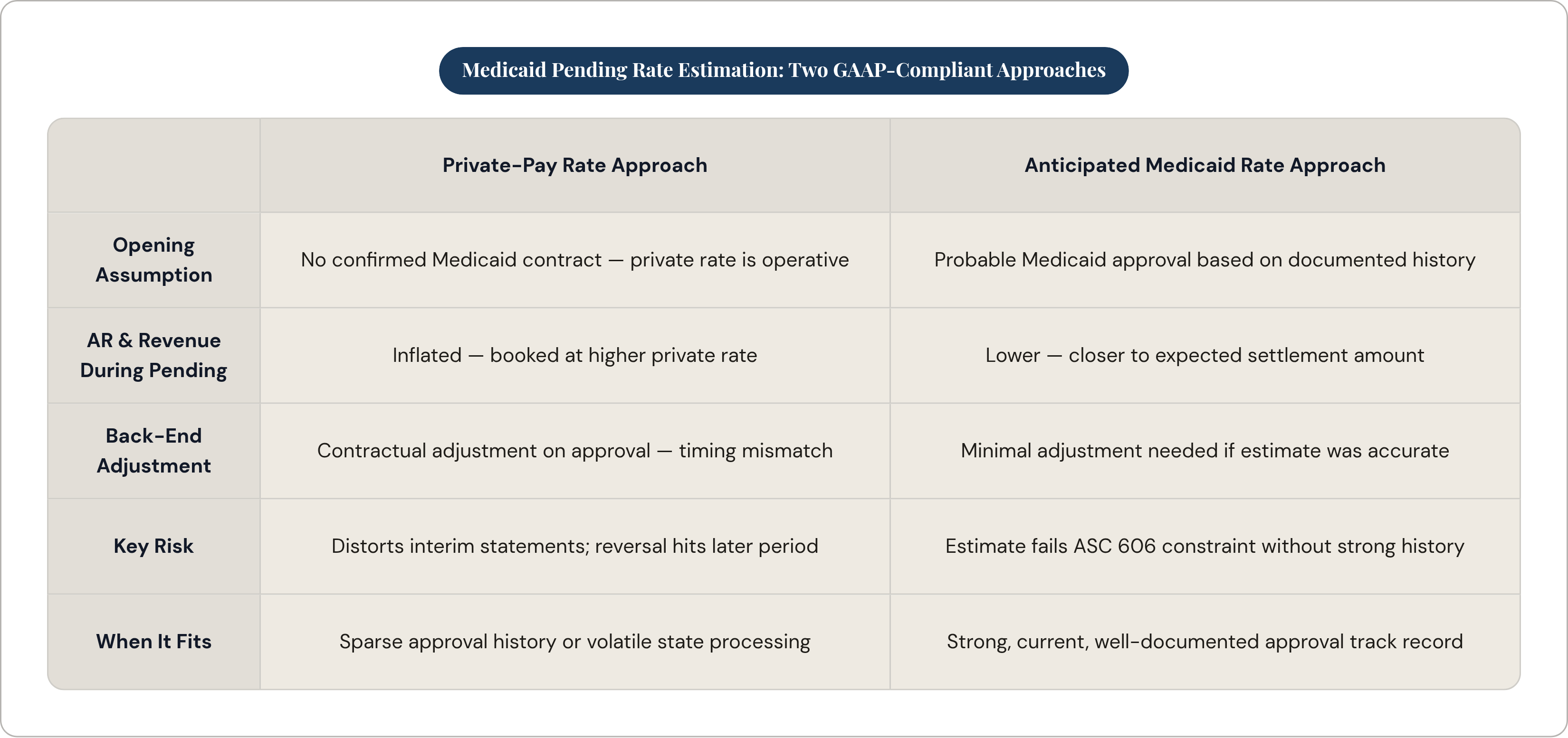
Two approaches hold up under GAAP, and they produce very different numbers on both the income statement and the balance sheet.
The first books the full private-pay rate, treating the absence of a confirmed Medicaid contract as the operative fact. If approval comes through retroactively, the gap between the private-pay rate booked and the Medicaid rate actually paid gets reclassified as a contractual adjustment. The second books the anticipated Medicaid rate from day one, on the theory that a facility with a strong, well-documented approval history is looking at a probable Medicaid relationship even before the paperwork clears. AICPA guidance supports this approach when the historical data backing it up is solid.
Neither is automatically right. Which one fits depends on the facility's own track record: how often pending applications get approved, how well that history is documented, and whether it still predicts outcomes given how state policy is shifting. The private-pay approach tends to inflate AR and revenue during the pending stretch, then requires a contractual adjustment on the back end, a timing mismatch that can make interim statements harder to read. The Medicaid-rate approach avoids that mismatch but demands real historical rigor; without it, the estimate doesn't survive the constraint ASC 606 puts on variable consideration.
Whichever approach a facility picks, it needs to be written down as policy and applied the same way across comparable accounts. Pick private pay for one pending resident and the anticipated Medicaid rate for another with no documented reason why, and that inconsistency is exactly the kind of thing an auditor flags. State-specific approval rates and processing backlogs aren't just context here; they're inputs into the estimate itself. A facility in a state with a two-year backlog and a high denial rate is carrying very different risk than one in a state that turns applications around in sixty days.
Applying the portfolio approach and implicit price concessions to Medicaid pending accounts
ASC 606 allows a portfolio approach as a shortcut, usable when grouping similar contracts together produces roughly the same financial result as analyzing each one individually. The FASB and the AICPA have both signed off on this for healthcare providers, and it's the practical way most SNFs handle a Medicaid pending census that might run into the dozens.
For pending accounts, that means grouping residents by shared traits: same state, same Medicaid program type, similar admission source, similar processing timeline, and applying one blended historical collection rate across the group rather than estimating each account from scratch.
The implicit price concession is how the expected shortfall gets recorded. If history shows that a meaningful share of pending applicants end up denied, or approved for fewer retroactive days than were billed, that shortfall gets recorded as a price concession right at the time services are provided. It reduces net revenue up front. It is not a write-off, and it doesn't create the matching-principle problems that come with writing off receivables after the fact once they've gone bad.
The catch is that the portfolio only works if it's actually homogeneous. Lump every pending resident together regardless of state, program, or case complexity, and the blended rate stops meaning anything. The historical data feeding that rate also has to be current. Running a rate built on approval patterns from five years ago, in a state that's since tightened eligibility or is about to see the 2027 retroactivity cut take hold, produces a number that looks precise and is actually stale. Facilities without much history to draw from, newly opened homes, recently expanded units, or ones in states where approval patterns swing year to year, are stuck with a harder job: either a more conservative blended rate or individual account analysis until enough history builds up.
Allowance for doubtful accounts: setting and maintaining the contra-asset for pending and denied accounts
The allowance for doubtful accounts brings gross AR down to what it's actually worth, and for a SNF with a sizable Medicaid pending census, this is one of the most judgment-heavy numbers on the balance sheet. It has to be set in the same period the related revenue is recognized. Waiting until an account is confirmed dead and writing it off directly breaks the matching principle, and GAAP doesn't allow that for entities with material credit-sale balances, which nearly every SNF is.
Three different situations need three different estimation approaches. Accounts still pending need an allowance built on a probability-weighted shortfall, informed by historical approval rates and whatever retroactive window applies. Approved accounts where the confirmed Medicaid rate differs from what was booked need that gap reclassified as a contractual adjustment, not left sitting in the allowance where it distorts the picture. And denied accounts convert to self-pay once the denial is final, with the allowance set at whatever that self-pay balance is realistically worth to collect, which in most cases isn't much.
Aging analysis alone doesn't capture what's going on here. A pending account sitting at ninety days might still have a strong shot at collection if the state's processing timeline routinely takes that long; raw days-outstanding, stripped of payer-status context, tells a misleading story. The allowance methodology should be documented, reviewed at least once a year, and updated whenever state policy shifts, processing times change, or historical approval rates start to slide. Given what's coming in 2027, that review needs to be happening now, not in the fourth quarter of 2026.
Charity care versus bad debt: the classification decision that affects both financial statements and the cost report
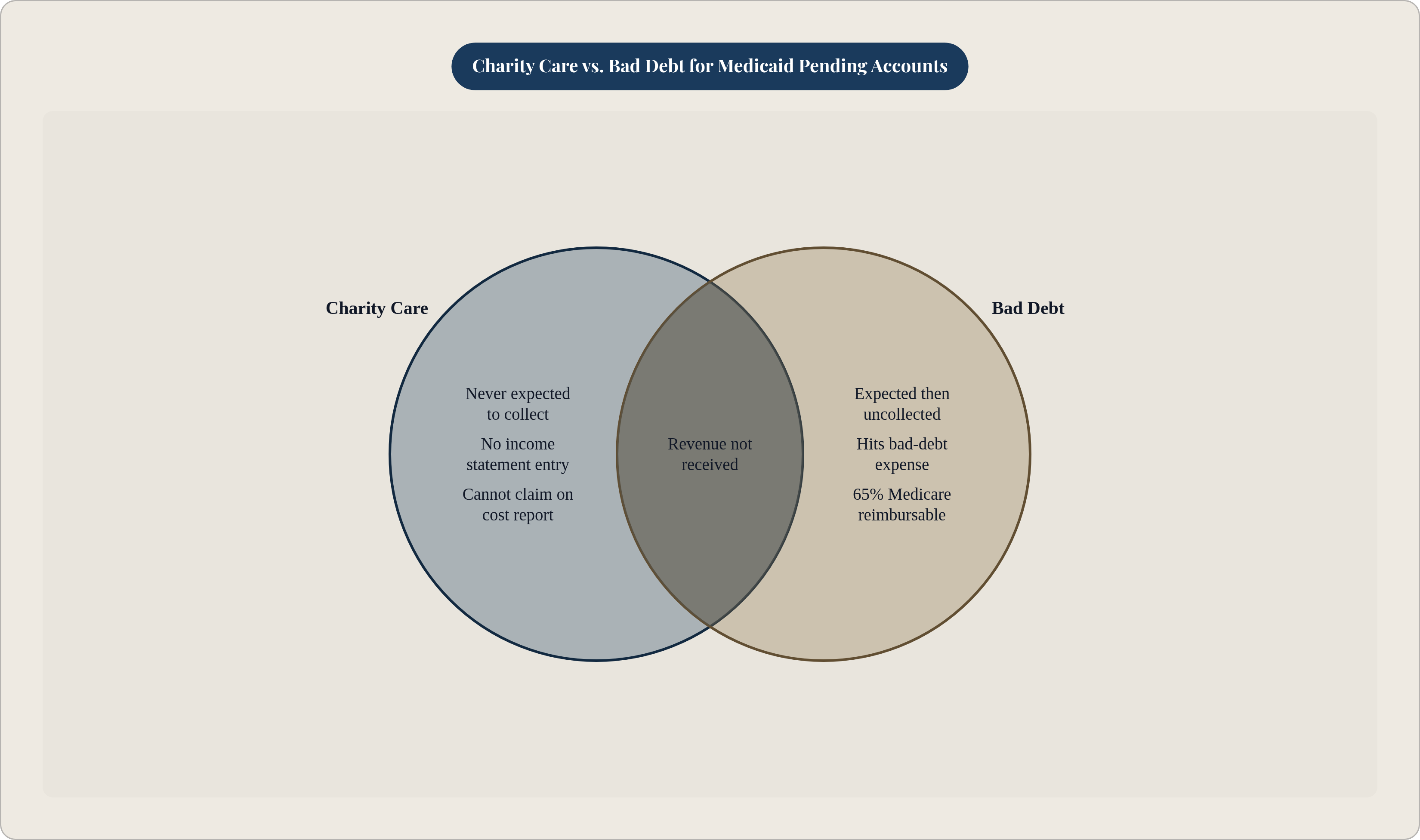
Charity care and bad debt look similar on the surface, both involve money the facility isn't collecting, but GAAP treats them completely differently. Charity care is never expected to be collected in the first place, so it never hits revenue or bad-debt expense at all. The gross charge just doesn't appear on the income statement. Bad debt is different: it's a balance the provider genuinely expected to collect and then couldn't, whether that's a self-pay patient who didn't pay or a payer who denied a claim the provider thought was solid.
For a Medicaid pending resident, the line between the two comes down to what the facility reasonably expected on admission. A resident with a credible application and a strong likelihood of approval isn't charity care on day one; calling it that understates revenue and understates the allowance both. On the other hand, a resident with no realistic shot at approval, no application filed, an asset disqualification staring the facility in the face, is close to charity care from the start. Booking revenue on that account and writing it off later gets the sequence backward.
This isn't just an accounting nicety. It has teeth on the cost report: allowable bad debt can be claimed for Medicare reimbursement, charity care cannot. Misclassify one as the other and the facility forfeits money it was entitled to. CMS is explicit that crossover bad debt, the deductible and coinsurance a dual-eligible patient's Medicaid doesn't cover, shouldn't be written off to a contractual allowance account. Properly documented, it belongs in bad debt. SNF finance teams should have a written policy spelling out exactly when a pending account crosses from a revenue-recognition question into charity care territory, and auditors ought to be testing whether that policy is followed consistently, not just written down and ignored.
Medicare bad debt on the cost report: what Medicaid pending and denial outcomes mean for the claim
Medicare pays back 65% of allowable bad debt through the cost report for SNFs treating dual-eligible residents, and for a facility with a heavy Medicaid census, that reimbursement adds up to real money. Claiming it requires satisfying four conditions, all of which need documentation: the debt has to relate to covered services and to deductible or coinsurance amounts, the facility has to show reasonable collection efforts, the debt has to be genuinely uncollectible at the time it's claimed, and sound business judgment has to support no real chance of recovery.
For pending accounts that end up denied, the crossover bad debt path needs proof that Medicaid actually looked at the claim and turned it down, usually a state remittance advice or a formal denial letter. Without that piece of paper, the Medicare bad debt claim doesn't hold up even when the underlying service was real and the dollar amount is accurate. This is where audits catch facilities off guard: the receivable might already be off the books, aged out and forgotten, but if nobody obtained the denial documentation at the time, the cost report claim built on it is vulnerable the moment someone checks.
New eligibility rules and work requirements are creating a fresh version of the same problem. When a dual-eligible resident loses Medicaid coverage in the middle of a stay, the clean remittance that would normally document the crossover obligation may never get generated, leaving the facility holding a real bad debt with no easy way to claim it. Cost report preparation for a SNF running a material Medicaid pending volume isn't a box-checking exercise. It calls for the same discipline around payer status and documentation that the financial statements demand.
Where Medicaid pending accounts accumulate into AR aging problems and what the audit risk looks like
Medicaid pending accounts are, in facility after facility with a long-stay Medicaid census, the single most consistent driver of stretched-out Medicaid AR aging. The mechanism is almost mundane: a resident gets admitted pending, nobody flags the intake as pending in the billing system, no Medicaid billing trigger ever fires, and the account just sits in the private-pay aging bucket, week after week, quietly compounding write-off risk.
By the time someone catches that this "private-pay" account is actually a Medicaid pending case, several problems have usually stacked up together. The retroactive billing window might be closing. The allowance sitting against the account is probably too thin, because it was calculated as if the account were private pay all along. And the rate booked likely doesn't match whatever the facility's stated policy calls for on accounts correctly identified as pending from admission.
Auditors looking at SNF receivables should treat unidentified payer status inside aged private-pay buckets as a real risk signal, not just a slow-collections problem. The right question isn't whether the account is old; it's whether a Medicaid pending case is hiding inside a category it never belonged in. CMS-reported improper payment rates for SNF claims have climbed in recent years, and probe-and-educate reviews targeting SNF billing have followed right along with that trend. Facilities with sloppy documentation around the pending-to-billed transition are exposed to that kind of claim-level scrutiny well beyond whatever the financial statement auditors find.
What this all points back to is control design at the admission desk itself: the trigger, whatever form it takes, that converts a pending account into an active Medicaid billing record the moment intake staff learn an application has been filed. Get that trigger right and most of the downstream problems in this piece, the stale allowance, the misclassified aging, the missing denial documentation, never happen in the first place. Get it wrong, and every section above becomes a live issue on the next audit.