AI Risk Management Framework Selection for Audit Firms
Audit firms must pick an AI risk framework now, before regulators write the rules.

Audit firms are choosing AI risk management frameworks right now, mostly without guidance and mostly without realizing how much the choice will matter in eighteen months. This piece walks through the four frameworks likely to land on a firm's desk, the regulatory backdrop that makes the choice matter, and the criteria that actually fit an audit practice instead of a generic enterprise checklist someone lifted from a consulting deck.
Audit firms sit in an odd spot. They use AI to draft memos, run tax research, and pull risk signals out of engagement data, and at the same time they're being asked to judge whether a client's own AI-driven controls hold up. That dual role is why a generic AI governance guide falls flat here. Three risks stack up in this profession more than almost anywhere else. Client data exposure comes first, since audit files hold some of the most sensitive financial and personal information a business generates. Then there's model reliability in assurance work, where a wrong AI-assisted conclusion doesn't just waste an afternoon; it can produce a deficient audit opinion or a bad tax position that follows a client for years. Regulatory accountability sits underneath both, and it's the CPA on the hook when AI gets something wrong in a financial statement, not the vendor who sold the tool. Add AICPA competence standards, PCAOB audit standards, SEC guidance, and a growing stack of state AI laws, and the liability stops being theoretical fast.
Then there's shadow AI: generative tools baked into everyday SaaS products, browser plug-ins, and team subscriptions that slip into audit workflows without anyone vetting them. A real chunk of those tools carry actual risk once someone bothers to look closely. None of this is a future problem, either. Generative and agentic AI moved from pilot project to daily workflow faster than most firms' governance structures could keep up, and the paperwork is still catching its breath.
The current regulatory environment audit firms must navigate before choosing a framework
As of mid-2026, there's no binding PCAOB or SEC standard written specifically for AI in audits. Firms are working off the assumption that existing standards permit AI use. Nothing formally confirms that read, though, so there's open ground and open risk sitting side by side.
What already applies is straightforward enough to state plainly. AS 1105, the audit evidence standard, requires auditors to judge the relevance and reliability of information pulled from technology-based tools, so AI output doesn't get a pass just because a machine produced it. AS 2301, on risk responses, requires that anything flagged through technology-assisted analysis actually gets chased down to see whether it points to a misstatement or a control gap. QC 1000 kicks in late 2026 and calls for a full, risk-based quality control system; AI tool governance needs to live inside that system, not off in some separate policy document nobody reads twice. Documentation completion windows are also getting shorter, which raises the stakes for AI-assisted work that has to be reviewable and finished before the report goes out the door.
One thing hasn't budged: significant audit judgments still belong to the engagement partner and team, not to a model. Where AI shapes a judgment, the file needs to show how a person reviewed it. The PCAOB has opened a comment process for its next strategic plan, with AI in auditing as a headline item, so the current voluntary period looks more like a window than a settled state of affairs.
Agentic AI raises a question nobody's really answered yet. If an agent spots a risk, designs a test, runs it, and writes up the result without a person kicking off each step, where does judgment actually sit in that chain? That's exactly the kind of gap a chosen framework needs to help a firm work through, not paper over with a checklist.
Firms doing private company audits and SOC work carry another layer from AICPA standards: due diligence on tool selection, an understanding of whether a given tool runs on deterministic or probabilistic logic, and AI monitoring folded into firm-wide technology oversight instead of handled engagement by engagement. Firms with European clients or vendors under EU jurisdiction also have to think about the EU AI Act, since enforcement is rolling out in stages over the next few years. Whatever framework a firm picks has to survive contact with an exam team, an engagement quality reviewer, or a regulator. Sounding coherent internally isn't the same as holding up under someone else's scrutiny.
The four frameworks audit firms are most likely to encounter and what each actually offers
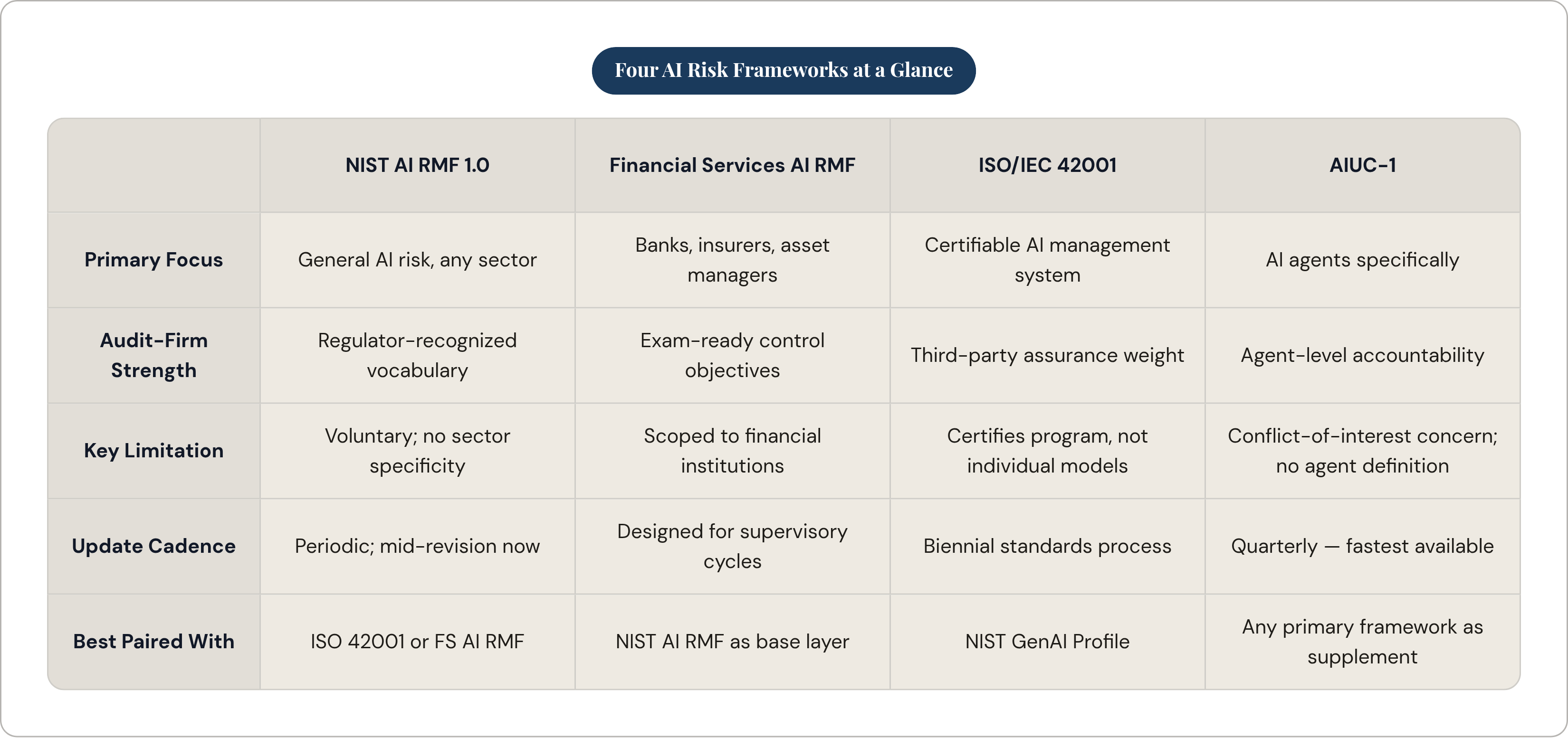
NIST AI RMF 1.0, released in early 2023 through a public, consensus-driven process, is what most people mean when they say "AI risk management" without qualifying it further. Its four functions, Govern, Map, Measure, and Manage, have become common vocabulary that other frameworks build on rather than replace. The GenAI Profile, added in mid-2024, stretches that core structure to cover risks specific to generative models: where the training data came from, hallucination, behavior that emerges unpredictably at scale, and the plain fact that old validation methods don't map cleanly onto these systems. For audit firms, its strength is recognition. It works well for a gap assessment, and it's increasingly the language regulators and exam teams expect management to speak. Its weakness is that it's voluntary and built for no sector in particular, so it hands a firm structure without handing a financial services client the specific control objectives it actually needs. It's also mid-revision right now as part of the White House AI Action Plan. Treat it as a target still moving, not one fixed in place.
The Financial Services AI RMF, launched in early 2026 by the Cyber Risk Institute working with the U.S. Treasury and a broad coalition of financial institutions, takes the NIST four-function skeleton and bolts on a long list of control objectives built for how banks, insurers, and asset managers actually run. It's designed with conformity assessments and supervisory exams in mind, which makes it audit-ready in a way the base NIST framework simply isn't. Firms already familiar with the CRI Profile from FFIEC cybersecurity work will spot the design approach right away, which flattens the learning curve for that group. It also tackles something that traditional model risk management never had to face: that discipline was built for predictive statistical models, and it doesn't hold up now that large language models are summarizing documents, generating advice, and handling client service directly. For firms serving regulated financial clients, this is probably the most credible sector-specific benchmark on the market today. Its limit is scope. The sector focus is banks and asset managers, so a firm has to judge how much of it maps onto its own operations versus how much is mainly useful for assessing clients.
ISO/IEC 42001, published in late 2023, is the only certifiable AI management system standard from a major international standards body. It covers model governance, bias, and explainability, areas SOC 2 doesn't touch at all. It's often paired with the NIST GenAI Profile rather than chosen instead of it; plenty of organizations run the two as complementary layers side by side. Its STAR Level 2 designation from the Cloud Security Alliance, shared with AIUC-1, gives it real third-party assurance weight, and enterprise clients are starting to expect it when they vet a vendor's AI practices. The catch: certification covers the management system as a whole, not any specific model or agent. A client asking "can I trust this particular AI tool" and a certification answering "does this organization manage AI responsibly overall" are related questions, not the same one, and firms that treat them as interchangeable tend to find out the hard way.
AIUC-1, introduced in mid-2025, aims at something narrower and newer: evaluating AI agents specifically, rather than an organization's AI program broadly. It organizes around six risk categories: security (including prompt injection and adversarial attacks), safety, reliability, accountability, data and privacy, and societal impact. It updates quarterly, the fastest cycle of any framework here, which tracks the pace of agentic AI development more closely than annual or biennial standards processes ever could. It shares STAR Level 2 status with ISO 42001, and its first authorized auditor was recognized in early 2026. But there's a wrinkle that any firm leaning on it should sit with before going further: the organization that writes the framework also runs the technical evaluations, issues the certificates, and sells AI agent insurance. That's a lot of hats for one entity to wear, and an independent analyst has flagged it as a conflict of interest worth watching. The framework also doesn't define what counts as an "AI agent," leaving that scoping call to the vendor being evaluated, which is an odd thing to leave open in a standard meant to police exactly that boundary. As agentic AI works its way into audit workflows, a standard built for agent-level risk is genuinely useful. It just needs scrutiny before it becomes a firm's primary framework instead of a supplement.
SOC 2 earns a mention here even though it isn't one of the four AI-specific frameworks, because it's become table stakes commercially. Most enterprise buyers won't work with an AI vendor without a SOC 2 report in hand, which has turned SOC examinations into a real growth line for firms serving tech clients. But SOC 2 was built around infrastructure and process controls; it doesn't reach training data poisoning, adversarial robustness, emergent model behavior, or drift. Research on data poisoning has shown that corrupting only a small slice of a model's pre-training data is enough to launch an effective attack, and SOC 2 access controls govern who can touch the data, not whether the data's content has been quietly tampered with. For an audit firm, SOC 2 is a floor, nothing more. NIST AI RMF or ISO 42001 layered on top covers ground SOC 2 was never built to examine.
The criteria that should drive framework selection for an audit firm specifically
Start with regulatory defensibility. Will the documentation this framework produces hold up under a PCAOB inspection, an AICPA peer review, or a state board inquiry? Frameworks that speak the language regulators already use, and NIST's Govern-Map-Measure-Manage structure is the clearest case, cut down on translation work the day an exam team shows up. Here's a quirk worth noticing: a voluntary framework can turn functionally mandatory the moment exam teams start treating it as the expected control taxonomy. The FS AI RMF looks to be heading exactly that way inside financial services supervision.
Client data protection architecture matters just as much. Audit work runs through the AICPA's Confidential Client Information Rule whether or not an AI tool ever touches that data, so a framework needs to demand clear data lineage, defined access controls, and real vendor due diligence, not a vendor's SOC 2 report waved around as if that settles everything. Shadow AI discovery has to be a named, active task too. A framework that doesn't push firms to go find the AI tools already running quietly in their own workflows wasn't built for how audit teams actually operate day to day.
Model reliability standards need to fit assurance work specifically. Audit conclusions require evidence a reviewer can defend, and a probabilistic model output doesn't validate itself just because it sounds confident. A good framework pushes the firm to know whether a tool runs deterministic or probabilistic logic and to document how outputs got checked before they became part of the audit file. Old-style model validation was built for predictive statistical models. Large language models call for something else, and a framework should either handle that directly or pair with one that does.
Human accountability has to survive the framework, not get diluted by it. PCAOB standards keep significant judgments with the engagement team, so any framework a firm adopts should back that line up rather than blur it. Look for frameworks that assign ownership down to the level of individual AI actions, which matters more with each passing month as agentic AI moves into workflows where no person kicks off each step. AIUC-1's accountability category speaks to this directly; the FS AI RMF does too, though from the angle of firm-level governance rather than individual agent behavior.
Scalability across firm size is easy to overlook and expensive to get wrong. A regional firm using AI mainly for tax research and memo drafting carries different exposure than a larger firm running AI inside substantive testing or SOC examination support. Modular frameworks like FS AI RMF and NIST AI RMF let a firm size its controls to actual use, rather than forcing full adoption of every control objective regardless of relevance. Certifiable frameworks like ISO 42001 add more overhead, but for firms serving enterprise clients who vet their advisors' AI practices, that overhead reads less like an optional extra and more like a cost of doing business.
Update cadence deserves its own look, because AI capability is moving faster than most standards bodies can revise their paperwork. A framework that looked complete at publication can be meaningfully stale eighteen months later. AIUC-1's quarterly cycle is the most aggressive by a wide margin; ISO 42001 and NIST work on longer timelines. Firms should ask whether a framework's governing body has actually shown it will revise substantively when the technology shifts, not just tweak language around the edges.
Fit with the dual role matters more than firms tend to assume going in, and this one gets skipped constantly. A framework governing a firm's internal AI use should line up with the framework it uses to evaluate a client's AI controls. Mismatched frameworks create real credibility problems, the kind a regulator or a sharp client notices fast. If a firm runs SOC 2 exams for AI companies, its auditors need real fluency in the model-level risks SOC 2 was never built to catch, and the framework governing the firm's own AI use is exactly where that fluency gets built.
How the SOC examination practice intersects with framework selection in ways most firms overlook
SOC 2 has quietly become a commercial floor for AI vendors. Most enterprise buyers now require a SOC 2 report before they'll even start a vendor conversation, and that's turned SOC examinations into a genuine growth area for firms working with technology clients. That's the opportunity. Now the catch.
SOC 2's Trust Services Criteria were built around infrastructure controls, not model behavior. An AI company can walk out of a SOC 2 examination with a clean report and still carry real, unexamined risk in training data integrity, model drift, and resistance to adversarial manipulation. The data poisoning research mentioned earlier makes the gap concrete: corrupting a very small share of a model's training data can be enough to corrupt its outputs, and that kind of attack doesn't need write access to production systems, which happens to be the exact thing SOC 2 access controls are built to catch. The attack surface and the audit's field of view just don't overlap.
AICPA guidance already points toward layering model-governance frameworks like NIST AI RMF or ISO 42001 on top of SOC 2 for AI-driven service organizations. Firms that understand this layering can offer an examination that actually reaches the risks a client's board loses sleep over, instead of one that checks the boxes a template happens to expect. Processing integrity criteria inside SOC 2 can stretch to cover some AI-specific concerns, but only if the auditor knows what to look for, and that kind of judgment doesn't appear out of nowhere. It comes from the firm having already built that analytical vocabulary through its own internal framework, the same one it picked using the criteria above.
A firm that has actually put NIST AI RMF or the FS AI RMF to work internally walks into a SOC engagement for an AI service organization with a real edge. It scopes the examination more accurately, catches the control gaps sitting between SOC 2 and model-governance standards, and can tell clients with some authority where their own AI governance still comes up short. That's the piece most firms miss when they treat framework selection as a box to check rather than a capability worth building over a couple of engagement cycles. Pick badly here, and it shows up later: in a peer review finding, in a client conversation where the firm has nothing sharp to say, in a SOC report that reads like every other template on the market.