SOC 1 Type I vs Type II Reports
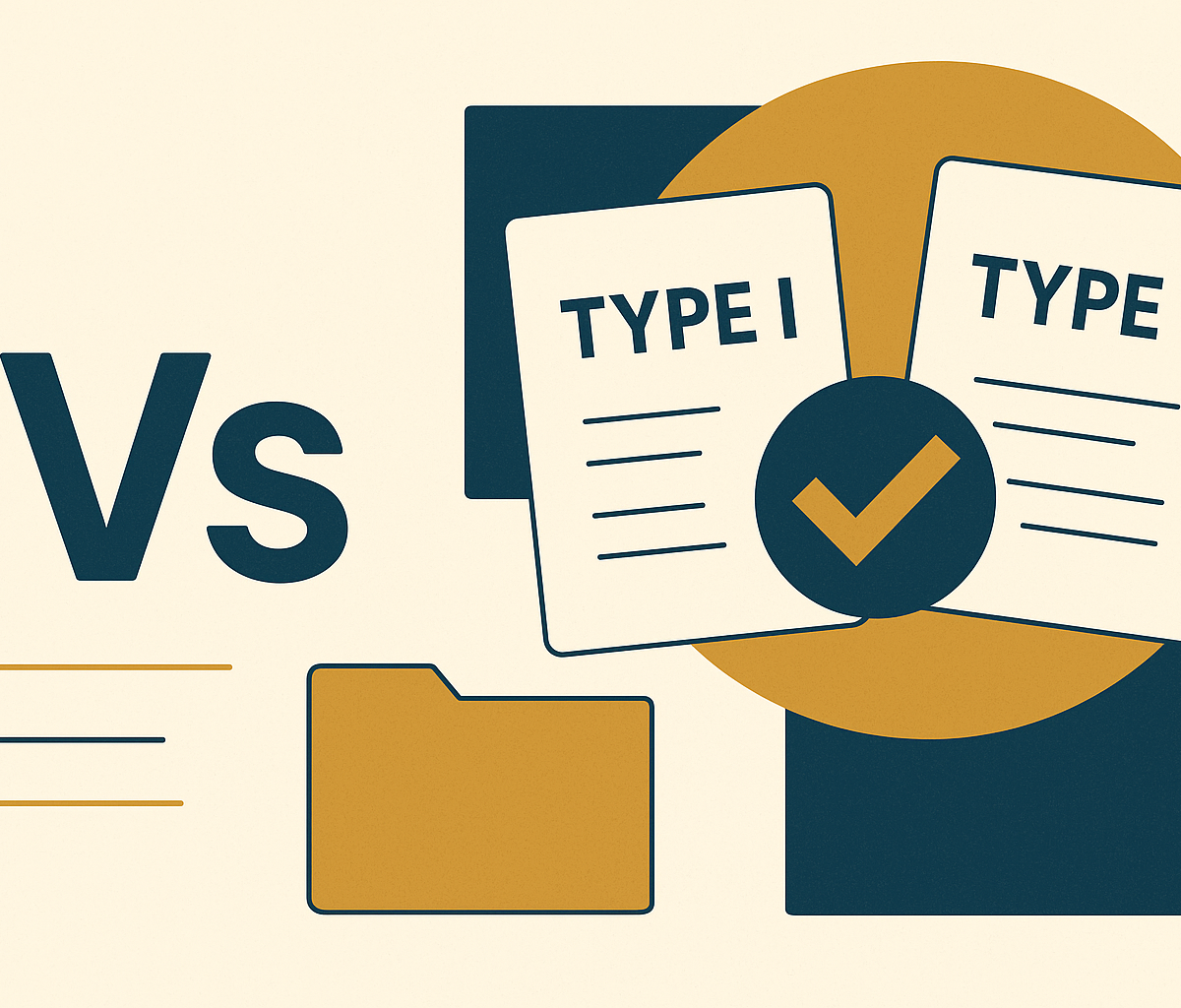
Type I proves controls exist on paper; Type II proves they actually worked month after month.
SOC 1 Type I and Type II answer two different questions. One says a control exists on paper as of a given date; the other proves the control actually worked, month after month, over a defined stretch of time. Confuse the two and you find out the hard way, usually when a bank auditor rejects the report your team spent three months producing.
How SOC 1 differs from SOC 2, and why choosing the wrong one is a real problem
SOC 1 exists for one narrow reason: controls at a service organization that could affect a user entity's internal control over financial reporting, or ICFR. A company outsources payroll processing, loan servicing, revenue calculations, something that touches its financial statements, and now its own auditors have to figure out whether the vendor's controls hold up. Without that assurance, the user entity's auditors end up testing the outsourced process themselves. That's expensive, and given the access constraints involved, often barely practical.
SOC 2 lives in a different world entirely, built around operational and data-security controls, with an audience of IT and operational leadership rather than financial auditors. A fund administrator or payroll processor needs a SOC 1; a SaaS company storing customer records in the cloud needs a SOC 2. Plenty of organizations get asked for both, and when that happens, running the engagements at the same time saves real hours, since the testing overlaps more than most people expect going in.
Guessing wrong costs you. A financial statement auditor can't use a SOC 2 to satisfy an ICFR assessment, and a security team evaluating data privacy practices gets nothing useful out of a SOC 1 either. SOC 2 runs on five Trust Services Criteria, security, availability, processing integrity, confidentiality, and privacy, and only security is mandatory; the rest get added depending on what the organization actually does. One thing saves confusion later: both SOC 1 and SOC 2 come in Type I and Type II flavors, and the logic separating the two types is identical across both frameworks. Learn it once and you've learned it for both, which is why the rest of this piece stays on SOC 1.
What a SOC 1 Type I report does and does not establish
The formal title is a mouthful: "Report on Management's Description of a Service Organization's System and the Suitability of the Design of Controls." Strip the language down and an auditor is really opining on two things: whether management's description of its system is fair, and whether the controls are designed well enough to meet their stated objectives, as of one specific date.
That date carries more weight than it seems to, because testing in a Type I stays shallow on purpose. The auditor confirms the controls exist and make sense on paper but never tests whether they operated correctly over any length of time. A payroll processor might have a clean approval workflow, documented and functioning, on the exact day the auditor shows up, and Type I can confirm that much. Whether that same workflow ran correctly every pay cycle for the prior twelve months is a separate question, and nobody checked it.
When does Type I actually earn its keep? First-time SOC engagements, mostly, since an organization that's never gone through this needs a documented baseline before anything else can happen. Some use it for internal benchmarking, sizing control design against industry norms before signing up for the heavier lift of an operating-effectiveness audit. It works as a deliberate stepping stone too, surfacing design gaps before the Type II clock even starts.
The timeline matches the lighter scope. Controls already documented and running? A Type I often wraps in a matter of weeks, considerably faster than a Type II. That speed has a ceiling, though: user entity auditors generally want a Type II, and often require one. A Type I by itself rarely satisfies Sarbanes-Oxley compliance needs or an ongoing vendor assurance program, and it's best thought of as a starting line rather than a finish.
What a SOC 1 Type II report adds and why it carries more weight
Three extra words in the formal title change everything: "Suitability of the Design and Operating Effectiveness of Controls." Everything from the Type I is still in there, and what gets added is testing of whether the controls actually operated effectively across the entire review period, not just whether someone designed them well on day one.
That testing happens through sampling. Auditors review policies, interview personnel, pull transaction samples, and check whether controls ran as designed rather than just sitting on paper looking tidy. The minimum review period runs six months, though a mature program aims for a full twelve, renewed annually, so coverage stays continuous year over year.
Why does continuous coverage matter this much? Any gap in SOC 1 reporting leaves a window where user entity auditors have zero third-party assurance over the outsourced controls. They either fill that gap with their own testing, which is expensive, or they accept the risk and move on anyway. The Type II opinion speaks to design and operating effectiveness both, a materially stronger statement, and it's the version that actually satisfies Sarbanes-Oxley testing expectations.
The tradeoff is time. A Type II takes considerably longer than a Type I, especially for an organization still building or fixing controls, since the review period clock doesn't start until those controls are actually in place and running. Type II is the destination Type I was preparing you for all along. For any ongoing, recurring vendor relationship, it's what user entity auditors expect, and settling for less just postpones a conversation you'll end up having anyway.
The structural differences between Type I and Type II, side by side
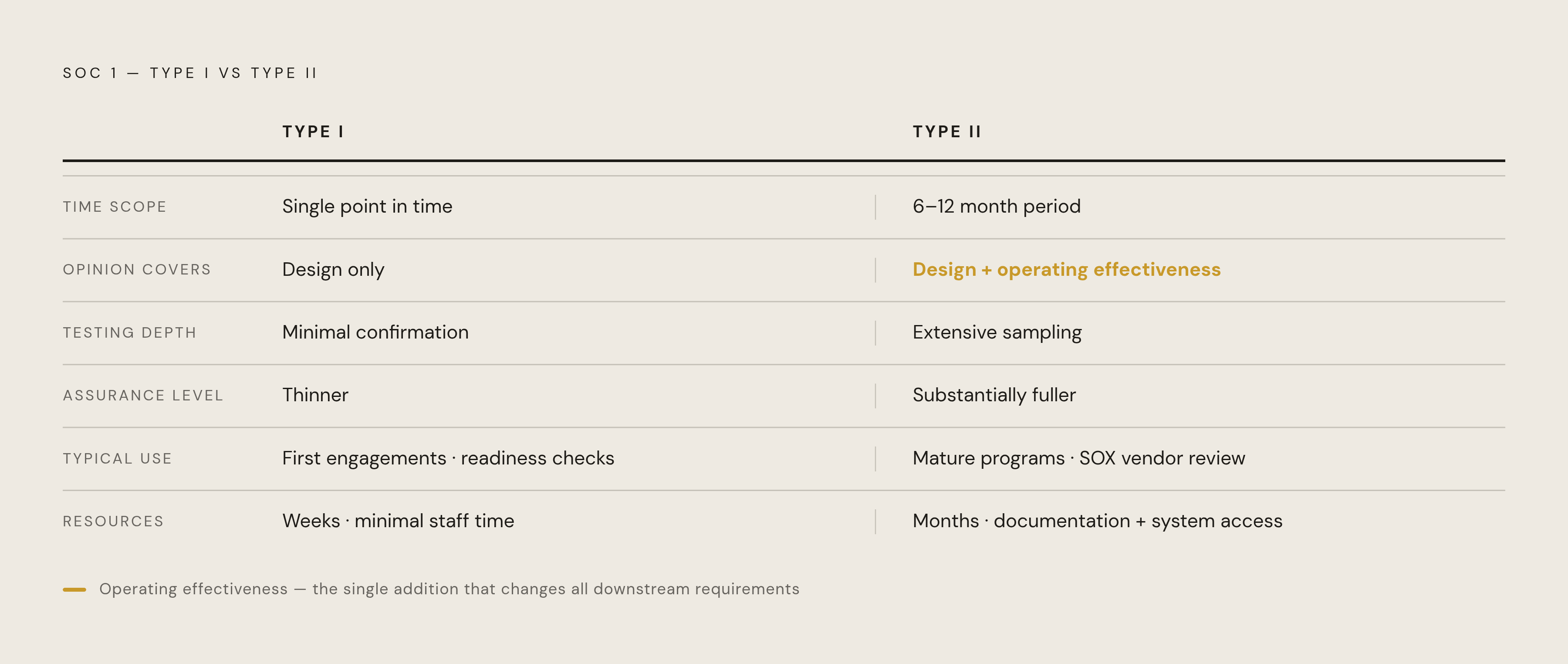
Put them next to each other and the gap is easy to spot. Type I is a snapshot, a single point in time; Type II covers a period, usually six to twelve months. Type I's opinion stops at design, while Type II covers design plus operating effectiveness. Testing depth follows the same split: minimal confirmation for Type I, extensive sampling across the full window for Type II.
Assurance to user entity auditors tracks the same pattern, thinner for Type I, substantially fuller for Type II. The typical use case echoes what's already been said: Type I for first engagements and readiness checks, Type II for mature programs and Sarbanes-Oxley-driven vendor review. Resource investment splits along the same line, with Type I asking little of anyone involved, while Type II demands sustained documentation, staff time, and system access over months, not weeks.
Both reports look alike on the surface: a management description of the system, a service auditor's report, control objectives laid out in detail. What actually shifts is the depth of the testing section and the scope of the opinion sitting up front. Skim past that section and the two reports blur together, but read it closely, and that's the whole difference, right there.
How to decide which report is right for the moment
Start with what the client's audit team is actually asking for, and don't assume you already know. If a user entity's auditors request a SOC 1, they usually mean Type II even when they don't say so outright. Ask the direct question before the engagement kicks off, not after the fieldwork is done and the invoice is sitting on someone's desk.
A few situations point toward Type I. The organization has never been through a SOC examination and needs a documented baseline first, or controls were recently redesigned or stood up from scratch and haven't run long enough to support a real opinion on effectiveness. Or a client wants proof of control design, something needs to land soon to keep the relationship moving, ahead of a full Type II down the road.
Type II becomes the obvious call elsewhere. Sarbanes-Oxley testing requires it, and a Type I won't clear that bar no matter how well it's written. The control environment is mature and documented, and it's time to show ongoing effectiveness alongside design. Or the organization is renewing an established annual SOC program, where dropping back to a Type I would make little sense once operating history already exists.
For a first-time SOC organization, Type I then Type II is the natural order. Jumping straight to Type II, that said, works fine if controls are already in place with a track record behind them, though one timing detail is worth repeating: if controls are still being built or patched up, don't start the Type II review period early, since starting too soon gets you a report riddled with exceptions, and an exception-heavy report undermines the exact confidence it was supposed to build in the first place.
Bridge letters and the coverage gap that arises after the report is issued
Here's the wrinkle that trips people up even after they've got Type I and Type II figured out cold. A SOC 1 Type II covers a defined window, often twelve months ending mid-year, while the user entity closes its books on its own fiscal year-end, which frequently doesn't line up with that window at all.
Say the SOC report runs through September and the user entity's fiscal year ends in December. That leaves several months of outsourced activity the report never touches. A bridge letter, sometimes called a gap letter, covers that space: a statement from the service organization's own management saying no material changes occurred in the control environment during the gap.
A bridge letter carries no independent assurance whatsoever. It's a representation from management, and user entity auditors treat it as a far lighter form of comfort than the SOC report itself. Bridge letters are a normal, accepted piece of the SOC ecosystem, meant to hold the line until continuous coverage catches up.
That raises a fair question: why not just skip the gap entirely? Some organizations do exactly that, lining up their review period's end date with the calendar year-end, or with the fiscal year-end of their biggest user entities, specifically so a bridge letter is rarely needed at all.
What service organizations in financial and regulated industries need to know about SOC 1 in practice
SOC 1 demand clusters in industries where the outsourced function sits directly inside a client's financial reporting: fund administration, mortgage servicing, benefits administration, payroll processing. For these organizations, Type II isn't really optional, since the biggest clients' auditors will ask for it, and showing up without one creates friction at exactly the worst moments, onboarding and renewal, when there's no room left to fix it.
Most first-time engagements get stuck at the same spot: defining control objectives. The AICPA doesn't hand out a prescribed list the way it does for SOC 2's Trust Services Criteria. Instead, the organization, working with its auditor, has to define objectives that map to the actual services it provides and the risks those services create for a client's ICFR. Objectives written too broadly, or too generically, produce a report user auditors can't actually rely on, no matter how clean the testing looks underneath.
That puts real weight on the auditor's own grasp of the industry. A SOC 1 engagement needs a CPA firm that understands ICFR at a technical level and also understands how the business itself runs day to day. An auditor unfamiliar with how payroll data feeds a general ledger, or how loan servicing activity flows through to a financial statement, tends to miss the controls that actually carry the risk. That combination of technical standards depth and industry-specific operational knowledge is what keeps control objectives credible once a user entity's auditor starts asking the hard questions.
A SOC 1, at the end of the day, is a trust instrument as much as it's a compliance document. A well-run Type II gives a service organization's clients real confidence in the financial controls sitting underneath the services they've handed off. That confidence shows up in fewer stalled renewals, fewer client audits that drag into extra rounds of testing, and a report that does the work of a hundred separate vendor questionnaires at once. It's earned the slow way, one testing period at a time, and it's worth every bit of the effort that goes into it.