Audit Committee Charter Provisions Governing SOC Report Review
Vague SOC review language leaves audit committees with obligations they can't measure or discharge.

A charter that says "review SOC reports" and stops there is writing a check the committee can't cash. You need to name what gets reviewed, on what clock, and what actually forces a response instead of just getting filed and forgotten. Skip any of those three, and you've built an obligation nobody can measure, which is worse than having no obligation at all.
I've sat through enough of these reviews to know the gap matters more than it sounds like it should on paper. Nasdaq requires a formal written audit committee charter for listed companies, and the Wachtell Lipton 2025 Audit Committee Guide is blunt about the consequence: the charter has to define scope precisely enough that failing to act on a stated duty can itself become evidence of a lack of due care. Vague language doesn't just fail to help the committee, because when something goes wrong, the paper trail shows a responsibility that existed on the books and nobody discharged.
What SOC reports actually contain and why that shapes what a charter provision must address
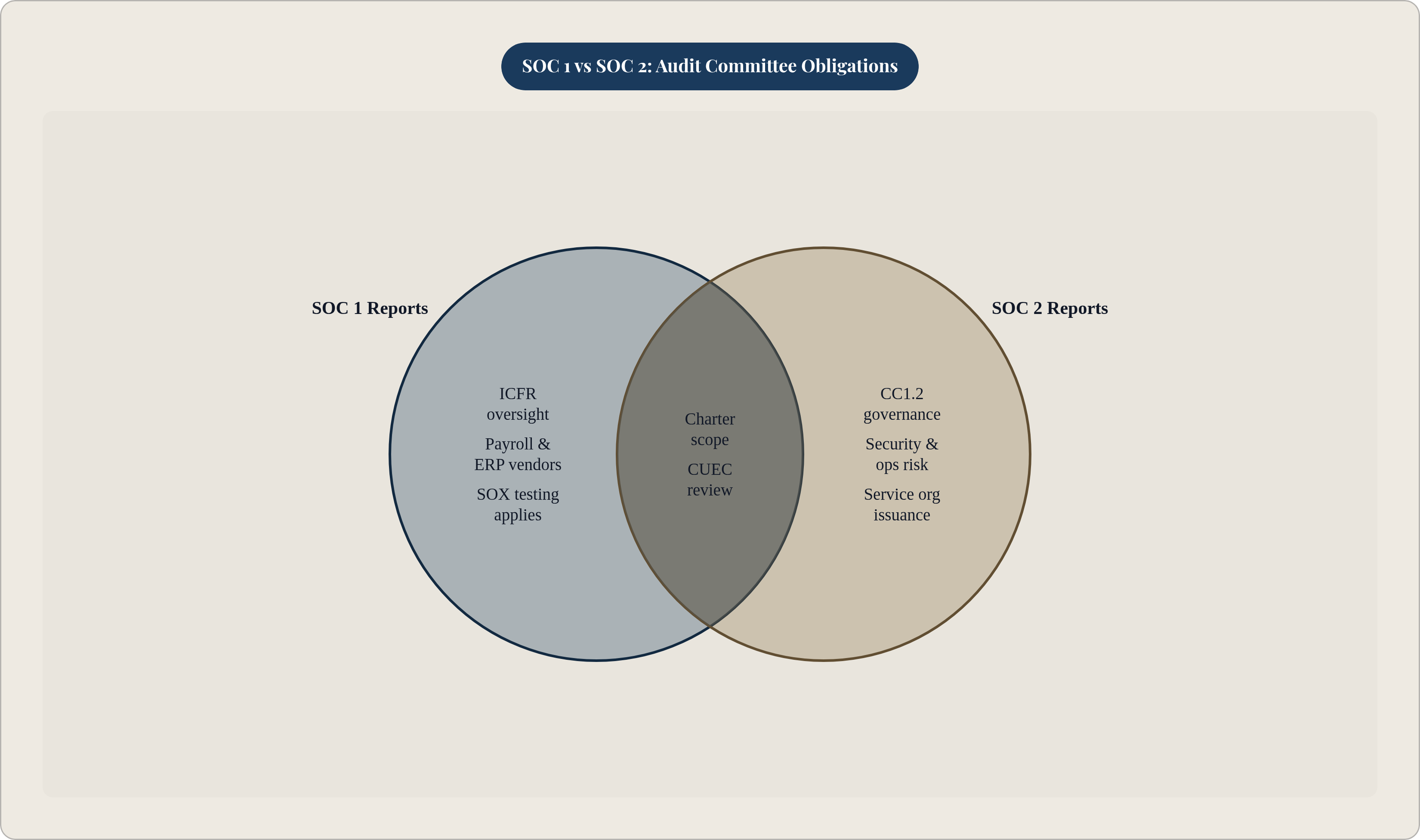
Start with the core mandate, since everything else hangs off it. Every audit committee charter covers oversight of internal controls over financial reporting, ICFR, and the integrity of whatever systems produce the numbers investors and regulators lean on. SOC 1 reports sit inside that mandate because they're independent examinations of a service organization's controls, specifically the ones capable of touching a user entity's ICFR. Outsource payroll, use a third-party loan servicer, run the general ledger through a hosted ERP platform: the controls at that vendor become, functionally, an extension of the company's own control environment, and it doesn't matter that the control lives at someone else's data center, because the committee still owns it.
SOC 2 comes in through a different door. COSO Principle 2, expressed in the Trust Services Criteria as Common Criteria CC1.2, requires the board or its designated oversight body to demonstrate independence from management and to actually oversee how internal controls get built and how they perform. That's a governance requirement the SOC 2 auditor tests directly, and it's a different animal from the ICFR logic behind SOC 1. Two report types, two separate legal reasons for the committee to care, even though in practice they both land in the same vendor risk binder by Tuesday.
The Type I versus Type II distinction gets less attention from charter drafters than it deserves. A Type I report says controls were designed appropriately as of one date, while a Type II says those controls actually worked over a stretch of time, usually six to twelve months. Think of a Type I as a photograph and a Type II as a security camera reel running the whole shift. A provision that just says "review SOC reports" without specifying which type is acceptable for which vendor tier leaves the real question, whether a snapshot is enough to justify ongoing reliance, sitting entirely with whoever happens to be putting together the board packet that quarter.
Scale gets skipped over too, and it shouldn't. The CBIZ 2024 SOC Benchmark Study found SOC 1 reports ranging from as few as 3 control objectives to as many as 65, with just over half, 52.5%, landing between 1 and 9; the average crept up from 10 to nearly 12 over the period studied. A report with 4 objectives is not the same review task as a report with 60, and language silent on that variance gives the committee no way to calibrate how much time any given report actually deserves. Throw in complementary user entity controls, the CUECs requiring action on the company's own side, plus whatever exceptions are buried in the report body, and naming these pieces explicitly is what turns the review into something that produces accountability instead of a checked box.
SOC 2+ reports make this harder still. These layer frameworks like NIST, HITRUST, HIPAA, or GDPR on top of the standard Trust Services Criteria, and a provision drafted before hybrid reports got common may not even say whether the committee reads the whole document or just the overlay sections tied to its own compliance obligations. Better to settle that now, because waiting until the ambiguity surfaces mid-review, with a report open on the table and nobody sure whose job it is to read which section, is how these things go sideways.
Defining the scope of the committee's review: which service providers, which report types, which sections
The fix for "review SOC reports" is a tiering framework, and it's not complicated once you write it down. Tier 1 covers providers whose controls touch ICFR directly: payroll processors, ERP platforms, loan servicing systems, custodians of financial data. These get full committee review of Type II SOC 1 reports, no substitutions. Tier 2 covers providers whose controls carry operational or security risk without touching ICFR directly; management-level review with a summary passed to the committee is proportionate here, and SOC 2 Type II is the relevant report. Tier 3 is everything lower-risk, where exception-based reporting, meaning the committee hears about it only when something breaks, does the job.
This tiering earns its keep for public companies in a very specific way. Outside auditors, under SOX, test whether the company actually read and acted on the SOC 1 reports it received, not just whether it collected them and stuck them in a folder somewhere. Private companies face no equivalent formal requirement, but they carry the same downside anyway: if a provider's control failure flows through to the financials, not having a formal review process on paper doesn't insulate anyone from what happens next.
Scope provisions should also draw a line inside each report between what the committee reads directly and what management can summarize. Some things belong at the committee level regardless of tier: the auditor's opinion, the scope period, any qualified or adverse language, the CUECs, and whatever exceptions or deviations got noted. The granular testing matrices, the page after page of control-by-control detail on Tier 2 and Tier 3 vendors, can live at the management level with a summary passed up. That's the committee exercising judgment about where its attention actually creates value, and it's not the committee ducking work; it's the committee doing the harder work of deciding what deserves its limited hours.
None of this holds together without a maintained vendor inventory sitting underneath it. The charter should require management to keep, and certify annually, a complete list of in-scope service providers, so the committee's obligation has an actual edge to it and a trail behind it. Without that list, the review depends entirely on whatever management happens to hand over that particular day, which is not a review process, it's a hope. And Wachtell Lipton's 2025 Guide flags the risk running the other way too: stretching charter scope past what the committee can actually execute in four or five meetings a year creates its own due-care exposure. Tiering is how you stay specific without promising oversight you can't deliver.
Setting frequency and timing: when the committee reviews, not just that it reviews
Here's something that sounds like a scheduling headache but is actually a substance problem, since SOC report periods and committee meeting calendars almost never line up on their own. A SOC 1 Type II report might cover the twelve months ending September 30, while the committee's relevant meeting sits in February. Left alone, that gap means the committee is reviewing information that's already five months stale by the time anyone in the room actually looks at it.
A workable provision handles this with three moving pieces. First, an annual cycle: Tier 1 SOC 1 Type II reports get reviewed within a defined window after issuance, no later than the quarter following the report date as a rule of thumb. Second, a bridge letter requirement: when the coverage period ends more than six months before the scheduled review, management has to get a bridge letter from the service auditor covering the gap in between. Third, triggered out-of-cycle reviews: a qualified opinion, a material exception, a known security incident, or a change in examination scope should pull an item onto the agenda automatically, rather than sitting around waiting for the next regularly scheduled meeting to roll up.
Why does the bridge letter carry so much weight? Outside auditors lean on SOC 1 Type II reports as part of their own ICFR assessment, and if the committee hasn't reviewed the same reports before the audit team wraps its work, the committee ends up reacting to findings it should have caught first, which is exactly backwards from where a committee wants to be sitting. Timing the review to land ahead of the audit's completion keeps the committee in front of the process instead of trailing behind it.
For SOC 2 reports on Tier 2 vendors, a quarterly summary dashboard from management, with full committee review saved for actual exceptions, keeps the committee informed without turning every meeting into a vendor-by-vendor slog. New providers entering Tier 1 or Tier 2 should be subject to defined SOC report requirements tied to the onboarding timeline, so the committee's expectations are enforceable rather than aspirational. That closes a gap I've seen play out more than once: vendor onboarding happening with no SOC report at all yet, just a verbal promise that one is coming eventually. A charter provision makes that promise enforceable instead of a nice thought somebody had in a vendor meeting.
Escalation criteria: what findings require committee action, not just committee awareness
A finding sitting unflagged on page 34 of a 40-page board packet is functionally identical to a finding nobody found. The committee technically "reviewed" it, sure, but awareness and action are different things, and only the charter can define what forces the jump from one to the other. Skip that definition and you've got a review that protects nobody.
Tier-one escalation events should require committee deliberation and a documented response, full stop, no exceptions for a busy agenda. That covers a qualified or adverse opinion from the service auditor on any Tier 1 provider, an unmitigated control exception at a Tier 1 provider where management can't point to a compensating control on the company's own side, CUECs identified in a report but not yet implemented or tested internally, and a service organization that stops producing a Type II report, or quietly narrows its scope, without explaining why. Any one of these should stop the meeting cold and get real air time, not a nod and a move to the next line item.
Tier-two triggers run lower stakes but stay time-bound: management has to report to the committee within a set window, say 30 days, instead of waiting for whatever the next scheduled meeting happens to be. A security incident touching a Tier 2 provider, disclosed in or near a SOC 2 report, belongs here, and so does a material shift in a provider's system description or control environment between periods.
The documentation piece is what turns escalation from a conversation into an actual record. For each escalated item, management should produce a written assessment: what the exception was, what compensating control or remediation plan addresses it, and the timeline for getting it resolved. Under PCAOB AS 1301, the committee's discussions with the independent auditor have to cover the matters required by that standard, and a well-drafted escalation provision keeps the committee engaged with those conversations rather than arriving to them unprepared. A well-drafted escalation provision gets the committee there before the auditor does. That ordering is exactly what the Wachtell Lipton due-care principle rewards, a documented escalation trail is evidence of judgment exercised, not just evidence that a meeting happened to occur on the calendar that quarter.
How the charter provision handles the committee's own role under CC1.2 when the organization issues SOC 2 reports
Plenty of organizations sit on both sides of this line at once. They receive SOC reports from their own vendors as a user entity, and they issue their own SOC 2 report to satisfy customers as a service organization. The charter has to address both directions, because the committee's obligations aren't identical in each role, and treating them as one problem tends to blur both.
CC1.2 is the criterion that puts the committee itself under the microscope, which is a strange position to be in until you sit with it a while. It requires the board, or whichever body holds oversight, to demonstrate independence from management and to actually oversee how controls get built and how they hold up over time. This gets tested in every SOC 2 examination the organization goes through as a service organization, and the auditor looks for it specifically, not as an afterthought.
What does that mean on the page? At least one member of the oversight body needs to sit outside the group actually executing the company's controls, and that segregation needs to be explicit in writing, not implied and left for an auditor to infer from an org chart. The charter itself becomes evidence here: auditors examining CC1.2 compliance look at the governance structure as documented, and clear, specific language separating oversight from operational execution is what satisfies the inquiry. Vague language on this point turns an easy conversation into a hard one, for no reason worth defending.
Worth noting, "board of directors" under CC1.2, per AICPA guidance, can take different institutional shapes depending on the entity. For a closely held company, or a private service organization, the function might sit with the audit committee, an advisory board, or some other governance body altogether. The charter needs to name, specifically, which body performs this function and say plainly why that body counts as independent from management. Vagueness here creates a documentation gap during the exact examination where documentation is the entire point.
There's a bigger payoff sitting underneath all this. SOC 2 reports, per AICPA guidance, serve governance, vendor management, risk management, and regulatory functions all at once, often for the same customers and regulators asking similar questions from slightly different angles. A charter provision addressing the committee's CC1.2 role clearly gives the organization something real to point to: a documented governance structure, not a hand-wave. That structure carries more weight, too, when the SOC engagement comes from a CPA firm with genuine, demonstrated depth in SOC work; the credibility of the report rests partly on the auditor's own independence and technical grounding, and the report says as much on its face.
Translating provisions into working process: what the committee actually does at each review
None of this means anything if it doesn't turn into an actual agenda item somebody prepares for. The charter should require a standardized pre-meeting package from management for each SOC report under review: report type and period, the auditor's opinion, the number and nature of exceptions, the status of open CUECs, and whatever changed materially from the prior period. Without that structure, the committee ends up reading full reports cold in the room, which burns everyone's limited attention on the wrong task at the wrong time.
At the meeting, Tier 1 provider reviews deserve a standing agenda slot, not a line on the consent calendar where things get waved through in a batch of ten. Two questions carry most of the weight in these reviews: are the identified CUECs actually implemented and tested on the company's own side, or is that still theoretical, and has any exception in the report been assessed for what it might do to the financial statements or to operational continuity, or is it just sitting there noted and unexamined?
Executive session matters here too, and it's underused. Consistent with how committees handle financial reporting oversight generally, the committee should be able to talk to the outside auditor about SOC-related concerns without management in the room, particularly when a provider's exception touches ICFR directly. That separation keeps a channel open where the auditor can actually speak freely.
Both NYSE and Nasdaq require annual charter review, and the SOC provisions deserve genuine reassessment at that point rather than a rubber stamp and a re-file. Has the vendor population shifted since last year? Has the organization's own SOC 2 examination scope moved? Are there new assurance frameworks worth folding into the tiering, AIUC-1 for AI systems entering financial workflows being one that's already on the horizon for a lot of committees I talk to? The charter is supposed to be a living document. Treat it like one, or don't bother writing it that carefully in the first place.
The minutes have to document that each required review actually happened, what got escalated, and how management responded. That record is the due-care evidence Wachtell Lipton keeps circling back to. Organizations juggling complicated service-provider relationships, or going through their own SOC examination for the first time, tend to do better with advisors who understand both halves of this problem at once: the governance structure that satisfies CC1.2, and the ICFR consequences flowing in from vendors on the other side. Miss one half and the charter provision is still just a sentence sitting on a page, waiting for someone to test whether it means anything.