Type I vs Type II SOC Report Distinctions
Type I proves controls exist on paper; Type II proves they actually work over time.
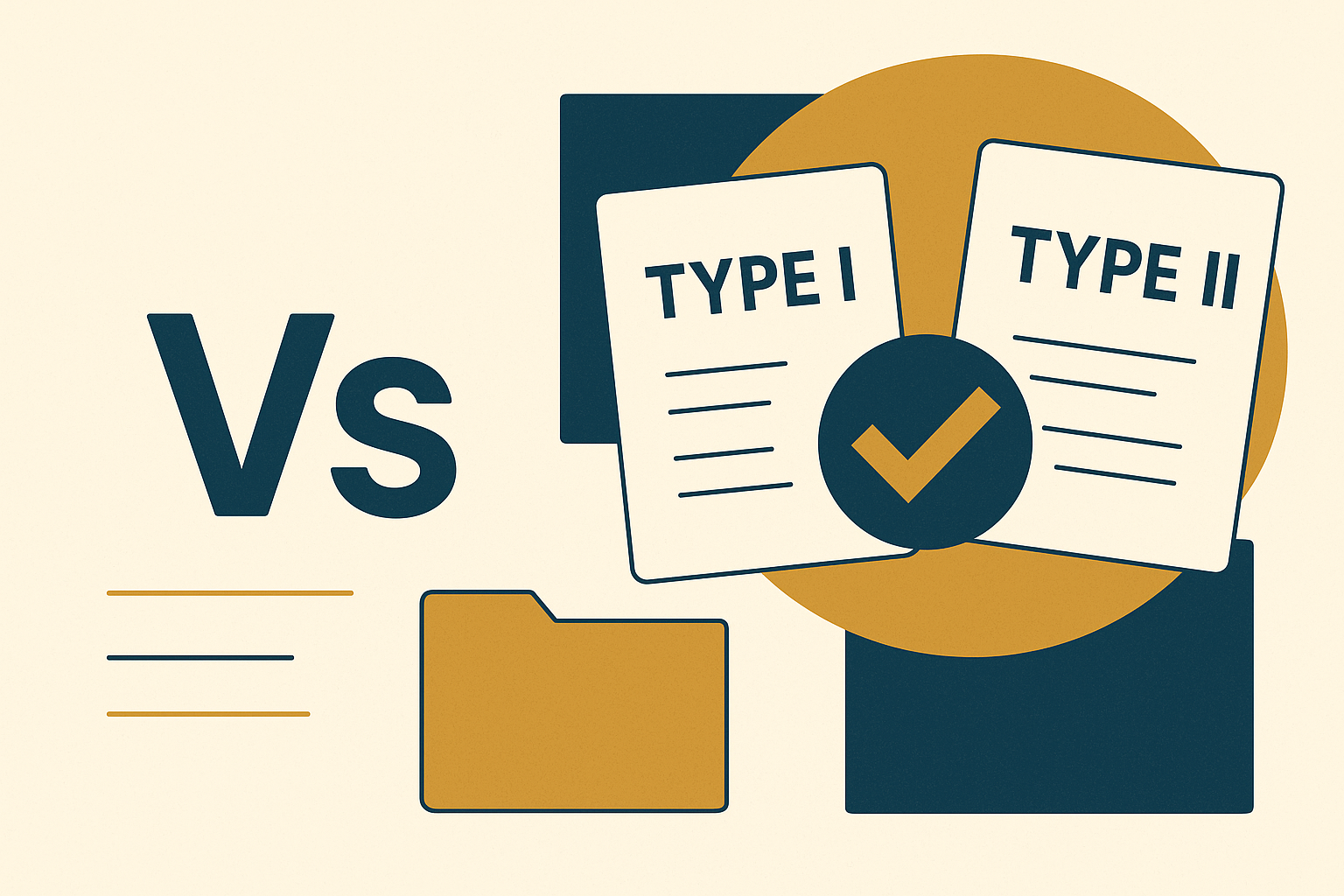
Type I and Type II answer two different questions about a service organization's controls, and the report you actually need depends on what your customers' auditors are willing to accept, not on which one sounds more thorough. This piece walks through what each report proves, where the SOC 1/SOC 2 split fits into the decision, and how the choice determines whether a user entity's auditor can lean on your controls or has to go do the testing themselves anyway.
SOC stands for System and Organization Controls. It's the AICPA's framework for having independent CPA firms issue assurance opinions on controls at service organizations, meaning companies that process, host, or manage something on behalf of another business. The suite today includes SOC 1, SOC 2, SOC 3, and SOC for Cybersecurity, each built for a different audience and a different flavor of risk. SOC 1 runs under SSAE 18, specifically AT-C Section 320. SOC 2 and SOC 3 run under a separate track, AT-C 105 and AT-C 205, measured against the Trust Services Criteria. That distinction carries more weight than it sounds like it should. Without an examination conducted under a recognized attestation standard, what you're holding is a nicely formatted description of your own controls, which is really just a marketing document with better formatting. The CPA firm's opinion, and the standard it's issued under, is what turns that document into something a user auditor can put weight on. Worth knowing too: the AICPA updated its SOC 1 Guide in 2025, folding in SAS No. 145 and expanding guidance on subservice organizations, SaaS providers, and how examiners judge whether control objectives are reasonable. It's a meaningful update, though not the focus here.
How SOC 1 and SOC 2 divide the territory before Type I / Type II even enters the picture
SOC 1 exists for one reason: a service organization's processes touch the accuracy of a user entity's financial statements. Payroll processors, revenue cycle systems, loan servicing platforms, claims clearinghouses, that whole category. These are businesses where a control failure on the service side can misstate numbers on somebody else's balance sheet. The audience is almost entirely financial professionals: the service organization's own management, user entities, and, most pointedly, the user entities' external auditors. People in the field sometimes call it "auditor to auditor" communication, and honestly, that's a fair way to describe what's happening. One flexibility worth flagging: the service organization gets to tailor its control objectives to the financial risks that actually matter for its customer base, instead of working off some fixed universal checklist.
SOC 2 is a different animal entirely. It's built around the five Trust Services Criteria, security, availability, processing integrity, confidentiality, and privacy, and it applies wherever a service organization stores or processes client data rather than touching financial statement line items directly. Think SaaS providers, managed service providers, cloud platforms. The audience widens considerably here: compliance officers, IT leadership, regulators, prospective customers running vendor due diligence. An organization can scope a SOC 2 to security alone, which is the most common starting point, or expand across all five criteria depending on what its customers are actually asking for.
Worth pausing on how often these two aren't mutually exclusive. Plenty of service organizations field SOC 1 requests from some clients and SOC 2 requests from others in the same year, and running both examinations concurrently tends to create real testing efficiencies, since a lot of the underlying control environment overlaps anyway. Once you know which report, or both, applies to your situation, the harder question shows up immediately: Type I or Type II? That's genuinely where the assurance decision lives, and it's the part most people skate past.
What a Type I report actually covers and what it leaves open
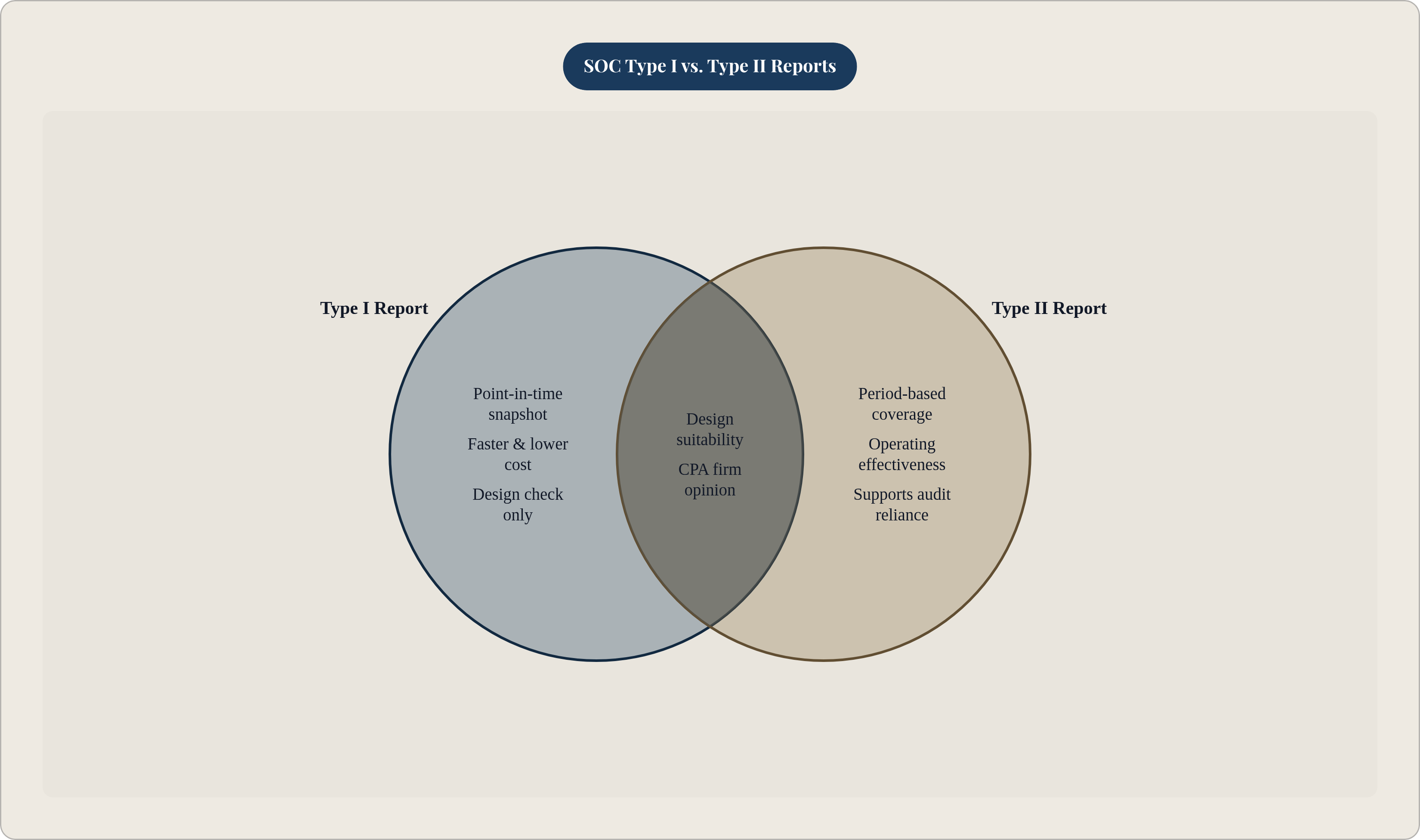
A Type I report is a snapshot, issued as of one specified date, and the service auditor is opining on exactly two things: whether management's description of the system is fairly presented, and whether the controls described are suitably designed to achieve the stated control objectives. That's the whole scope.
Notice what's missing. Nothing in a Type I opinion says those controls actually operated, consistently, over any stretch of time. There's no operating effectiveness testing involved; the auditor's work is typically limited to a single test confirming a control exists as described, or is designed the way management says it is. It's a design check, not a performance check.
That doesn't make it useless, to be clear. It's a legitimate tool for establishing a baseline when an organization is building its first SOC program, and it's often the honest answer after a gap analysis shows real remediation work still needs to happen. It draws a clean line: here are the controls in scope, here's what we can currently evidence, here's what needs to happen before a Type II period can even start. It completes faster and costs less too, which matters for an organization still finding its footing.
Here's the limitation that needs saying plainly, not buried somewhere in a footnote: a Type I report gives a user entity's auditor very little to actually rely on. Design suitability tells them the plan looks reasonable on paper. It tells them nothing about whether the plan got followed on the Tuesday in March when volume spiked, or the week two people on the control team were out sick. That gap is exactly what Type II exists to close.
What a Type II report covers and why operating effectiveness is the standard that actually carries weight
A Type II report covers a period, not a date. Minimum window is generally six months, though what mature programs work toward is a rolling twelve-month period, renewed annually without gaps. Within that period, the auditor tests two things: whether the controls were suitably designed, same as Type I, and whether they actually operated effectively across the whole stretch.
So what does operating effectiveness testing look like on the ground? A mix of reviewing policies and procedures, interviewing the people who actually run the controls day to day, and sample testing throughout the period, pulling transactions or instances from different months to confirm a control fired consistently rather than just once when someone knew the auditor was watching. If a reconciliation is supposed to happen monthly, the auditor wants to see it happen every month in the period, not three out of six.
The resulting opinion isn't a pass/fail grade. The service auditor provides reasonable assurance that controls were suitably designed and operated effectively across the period; if something didn't hold up, that shows up as an exception, and the report becomes a qualified opinion instead of an unqualified one. Either way, what a Type II delivers that a Type I simply can't is evidence that the controls weren't just documented. They were working, week after week, across the full period under review. That's the exact evidence a user entity's financial statement auditor needs to place reliance on the service organization instead of duplicating that testing themselves.
This is why user entity auditors lean so hard toward Type II. A Type I gives them design comfort but zero operating evidence, which caps how much of their own audit work they can offset by relying on your report. One more practical wrinkle: when a Type II period doesn't line up neatly with a user entity's fiscal year end, management issues what's called a bridge letter to cover the gap. Worth remembering that a bridge letter carries no independent assurance from the auditor at all; it's a management representation, nothing more, stating that nothing material changed in the interim.
How the Type I / Type II choice maps onto what stakeholders can actually rely on
Look at this from both sides of the table, because the math is different depending on where you sit.
If you're the service organization deciding what to pursue: a Type I makes sense when the program is genuinely new and a gap analysis has already shown that operating evidence for a full period simply doesn't exist yet. That's a fair, honest starting point. A Type II, though, is what most sophisticated customers and user auditors are going to require eventually, and a growing number are already declining to accept Type I reports as satisfying their vendor risk requirements at all. If your gap analysis shows you're actually ready, going straight to a Type II, informed by that gap analysis rather than preceded by a formal Type I engagement, saves you from paying for two sequential examinations when one would've done the job.
If you're the user entity or its auditor receiving the report: a Type I tells you the controls were designed adequately as of one date. It does not, and cannot, support reliance on those controls for financial statement audit purposes; the standard itself doesn't allow that leap. A Type II covering the relevant audit period is what lets a user auditor actually reduce or eliminate their own substantive testing of the service organization's processes. And if the Type II period falls short of full overlap with the audit period, a bridge letter can patch the gap, though its evidentiary weight stays limited precisely because no auditor stands behind it.
This distinction gets sharp fast in certain industries. In mortgage banking and loan servicing, a user entity's financial statement auditor is specifically trying to determine whether loan accounting controls at the servicer operated effectively across the year; a Type I simply doesn't speak to that question, no matter how well-designed the controls look on paper. Revenue cycle and claims processing environments in healthcare hit the identical wall: the user auditor needs operating effectiveness evidence, not a design narrative. Skilled nursing facilities and HUD-regulated multifamily housing operators leaning on third-party accounting or reporting platforms face the same scrutiny from their own auditors and regulators, for the same reason.
One might argue the compliance angle undersells the business angle here. A credible Type II report, renewed year over year without gaps, tells customers and partners something beyond "we passed an audit." It signals that controls are maintained, not just built once and left to quietly decay. In a competitive procurement process where a prospect is comparing three vendors side by side, that renewal history is often the thing that gets you past the security questionnaire stage.
The typical path from no SOC report to a mature annual Type II program
Nobody goes from zero to a clean twelve-month Type II overnight, and pretending otherwise sets organizations up to fail their first examination.
Step one is a gap analysis, and it's not optional in any meaningful sense. Before any formal examination begins, the gap analysis identifies which controls actually exist, which are documented well enough to survive scrutiny, and which need remediation first. This step routinely reveals an organization is less ready than it assumed. It's often the moment a management team realizes a Type I first is the smarter, cheaper path rather than an unnecessary detour.
Step two, a Type I, is conditional rather than automatic. It's the right call when the gap analysis surfaces meaningful remediation work still ahead, and it formally sets the scope: which controls, which control objectives, carry into the Type II reports that follow. Organizations with genuinely mature internal controls and solid documentation can skip this step entirely and move straight to Type II. There's no rule requiring the sequence.
Step three is the first Type II period itself, generally a minimum six-month observation window. Some organizations start with six months specifically to get their first report out faster, then extend to a full twelve months for the renewal. During this window the service auditor runs actual operating effectiveness testing, with sample sizes scaled to how often each control runs. A daily control gets tested differently than a quarterly one.
Step four is the part that actually builds trust over time: annual renewal, aimed at continuous twelve-month coverage with no gaps between periods. User entity auditors want to see an unbroken chain of Type II reports; a missing quarter here or there raises exactly the kind of question nobody wants raised mid-audit. Each renewal cycle is also a natural point to expand scope, add Trust Services Criteria for a SOC 2, or address whatever exceptions turned up in the prior period.
The service auditor relationship shapes all of this more than people expect going in, and it's underweighted in most conversations about SOC readiness. An auditor who actually understands mortgage banking, or healthcare revenue cycle, or housing finance is going to ask sharper questions and land on more meaningful control objectives than a generalist working from a template. It's not a minor point, and it's the subject of the next section.
Choosing a service auditor and what to look for in the engagement
The service auditor has to be a licensed CPA firm, and no substitute exists for that. The opinion issued under SSAE 18, AT-C 320, or AT-C 205 is precisely what makes the report credible to a user entity's auditor and to regulators, and only a CPA firm can issue it. That's the floor, not the differentiator.
Industry knowledge is where engagements actually separate from each other. A SOC 1 for a mortgage servicer demands real fluency in loan accounting, escrow administration, and the specific controls that flow into a user entity's financial statement assertions; a generalist auditor working outside their depth can miss control objectives that matter enormously to the people reading the report. Same logic holds for healthcare revenue cycle operators, skilled nursing billing environments, and HUD-regulated housing platforms, all of which sit inside regulatory frameworks that shape which controls actually carry weight.
So what does a good engagement look like from where the service organization sits? A clear scoping conversation up front, working through exactly which Trust Services Criteria or which control objectives belong in the report and why, rather than defaulting to a boilerplate list. Honest communication when testing turns up an exception, because a qualified opinion isn't a relationship-ending event. It's information the organization needs to fix something before the next period rolls around. And practical guidance between reporting periods, not silence until the final report lands on someone's desk.
Pease Bell conducts SOC 1 and SOC 2 examinations and brings particular depth in mortgage banking, multifamily housing, and skilled nursing, industries where the overlap between SOC assurance and financial statement audit reliance carries real consequence. The firm's role goes past the fieldwork itself, into helping clients understand what their report actually says and how a user auditor is going to use it. Worth emphasizing because a SOC examination isn't a commodity purchase where any signature does the job. Its value rises and falls with the rigor of the auditor's work and how well they understand the environment they're testing. A report that earns genuine reliance from the people reading it is the only outcome worth the cost of getting there.