ISO 42001 Alignment with AI Assurance Engagements
ISO 42001 certification now defines how organizations scope and prove AI governance maturity.
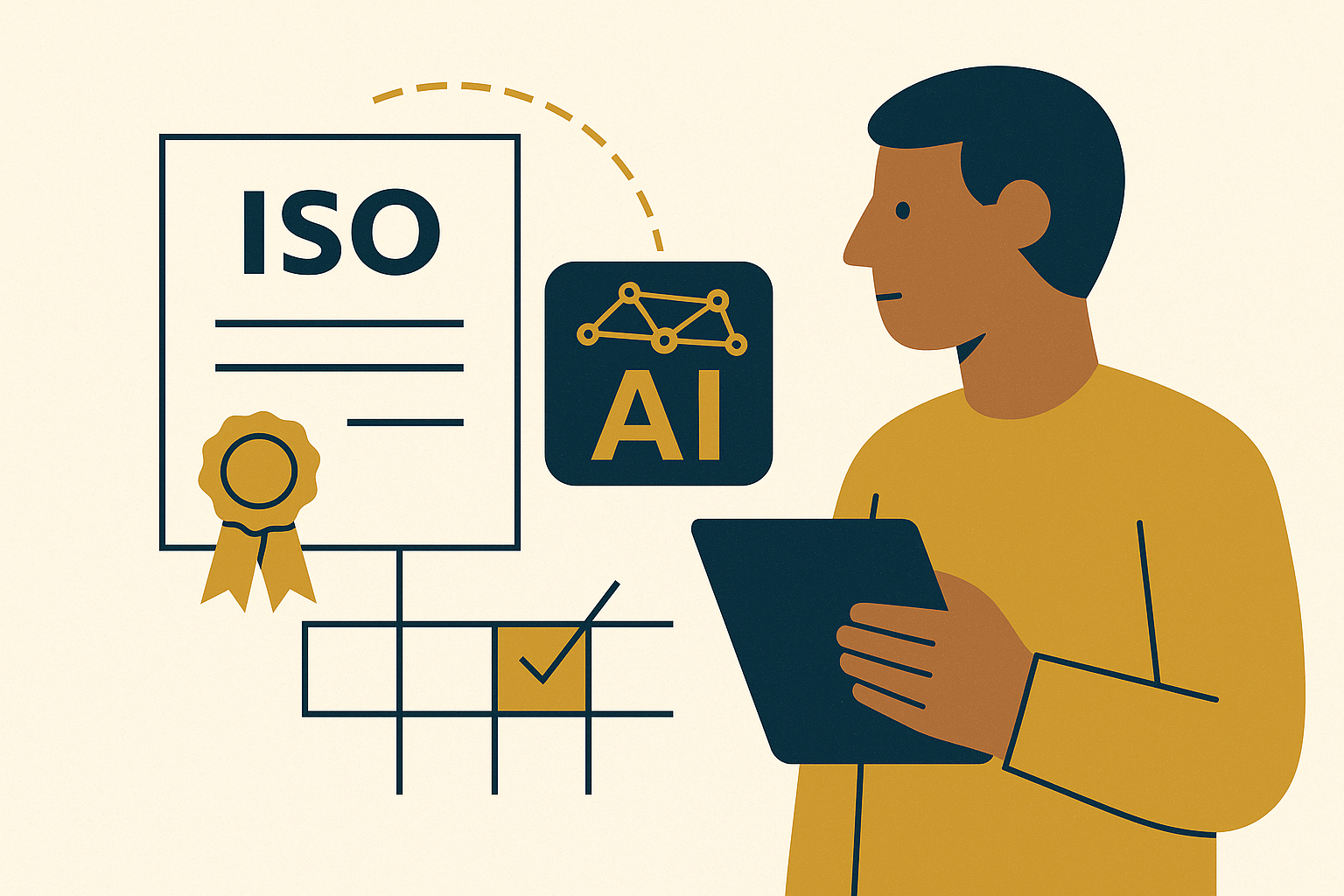
ISO 42001 is a certifiable management system standard for AI governance, and its clause structure now decides how AI assurance engagements get scoped, evidenced, and reported. Published in late 2023, it borrows the same Harmonized Structure that underpins ISO 27001, so auditors who already know that world find familiar scaffolding here. That familiarity matters, because the standard is fast becoming the thing organizations point to when they need to prove their AI governance actually does something.
The certifiable requirements sit in Clauses 4 through 10; Clauses 1 through 3 just cover scope, references, and terms. Under those clauses sit 38 controls organized into 9 control objectives, and they demand documented processes, named owners, and measurement that keeps going after launch, not just at launch. Scope runs wide: a model vendor, a SaaS company embedding someone else's LLM, and a bank running an internal credit model can all fall under this standard at once. What sets ISO 42001 apart from NIST's AI Risk Management Framework or the EU AI Act is the certification itself. NIST's framework has no certification scheme attached. The EU AI Act produces conformity for a product, not attestation for a management system. SOC 2 attests to controls, not governance maturity. Right now, ISO 42001 is the only major framework that ends in an outside, audited certificate saying an organization manages AI risk as a matter of process, not luck. Several major technology companies, including cloud providers and frontier AI labs, moved quickly to certify in the standard's early months. Enterprise appetite for this kind of proof isn't theoretical anymore; it's showing up in procurement questionnaires.
The clauses that generate the most auditor attention and why
Clause 6.1 draws the most scrutiny, and for good reason. It requires systematic identification and evaluation of AI risk, and 6.1.2 names the risks unique to AI systems, including categories like bias and model integrity issues. The clause also wants documented treatment plans that get revisited on a periodic basis, not written once and filed away in some shared drive nobody opens again. This is where gaps show up most often. Organizations tend to document risk at the moment of deployment, then stop. The treatment plan sits there as a snapshot from launch day, and nobody's gone back to check whether the risk picture still looks the same six months on.
Clause 9 is the other pressure point. It ties governance activity to measurable outcomes, which sounds obvious until you realize how often it just doesn't happen. An auditor needs some way to connect what leadership says it's doing with what's actually happening on the ground, and Clause 9 is supposed to be that bridge. The common failure: indicators get defined with nothing behind them. A company writes down what it intends to measure, but there's no record of the measurement itself, no log showing what changed when a threshold got crossed.
Then there's Annex A, home to the impact assessments and bias-identification requirements. These controls carry real weight for organizations whose AI touches high-stakes decisions: lending, housing, hiring. This is where governance paperwork and regulatory exposure meet head-on. One might argue this is the section that matters most, given how directly it maps to legal liability elsewhere. Across every clause, though, the standard wants documentation of the full AI system lifecycle, data management practices, and the policies behind them. That documentation layer is the first thing an auditor asks for.
How ISO 42001 clauses map to AI assurance engagement procedures
Scoping starts with Clause 4, context of the organization, paired with Clause 6's risk planning. Together they mark which AI systems are in scope and what risks the organization has already agreed to own. Auditors treat this pairing as the boundary line for the whole engagement; everything downstream gets measured against what these two clauses said would be covered.
Evidence collection follows the documentation the standard already demands, so nobody has to invent new categories out of thin air. Risk registers and treatment plans from Clause 6.1 become the backbone of any risk-related claim. Performance records under Clause 9 back up claims about ongoing monitoring. Policy and lifecycle documentation tied to the control objectives supports claims about how controls got designed in the first place. What it requires isn't new evidence types; it requires organizations to actually keep what the standard already asks them to produce.
Here's where the comparison to SOC 2 gets useful. A SOC 2 report covers security and availability well, but it says nothing about algorithmic bias detection, nothing about model drift, nothing about where training data came from. ISO 42001 requires all three. So an AI assurance engagement scoped against ISO 42001 reaches into evidence territory SOC 2 was never built to touch. SOC 2 isn't falling short here; it's just answering a different question. Reporting reflects that difference too: because ISO 42001 is a management system standard, findings map back to specific clauses and control objectives, which lets an auditor point to a governance gap with precision instead of filing it under a generic trust criterion. The shared clause language also cuts down on the back-and-forth that normally eats up fieldwork time, since both sides work from the same map of what evidence should exist and where.
Where ISO 42001 sits alongside SOC 2 in a combined assurance program
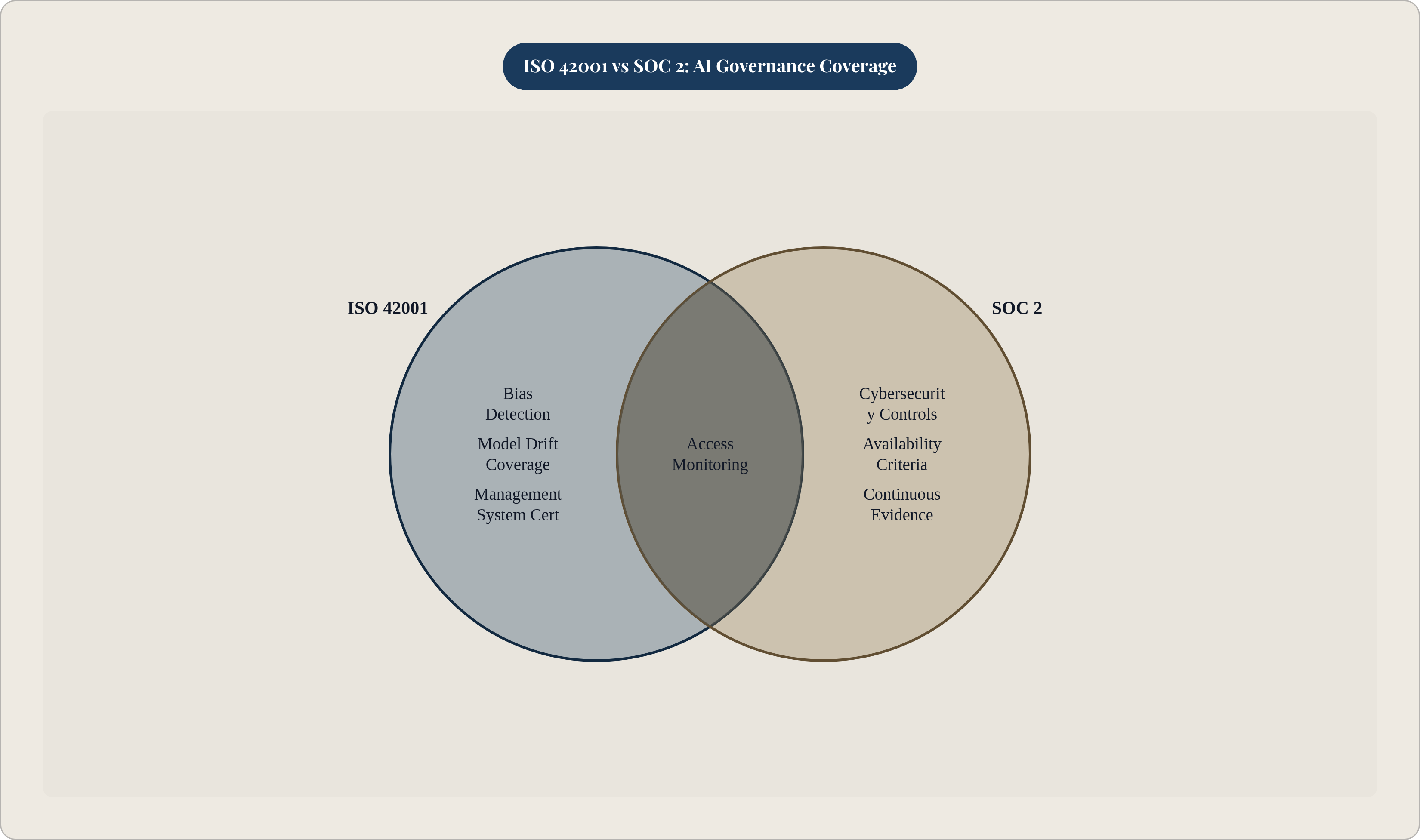
SOC 2 and ISO 42001 do different jobs that happen to fit together well. SOC 2 gives you the foundation: cybersecurity, availability, how data gets handled day to day. ISO 42001 builds on that foundation to cover AI-specific risk the Trust Services Criteria were never written to touch. In practice, the documentation, monitoring, and ownership work behind both programs overlaps more than people expect. SOC 2 wants a log of who changed which access control and when; ISO 42001 wants an explanation of how the AI system actually produced its output. Different questions, same underlying evidence pile a lot of the time.
There's a real tension worth naming, though. SOC 2 auditors expect continuous evidence across an observation period, usually months. ISO 42001 certification asks for proof of management system maturity at a single point in time. Run these as two separate, uncoordinated programs and you risk doubling the evidence collection work while opening gaps exactly where the two frameworks don't map cleanly onto each other. The upside: ISO 42001 follows the same three-year certification cycle as ISO 27001, so an organization already on an ISO 27001 rhythm has a real shot at folding ISO 42001 into the same audit calendar instead of running two tracks side by side.
For service organizations with international clients or complicated AI deployments, holding both attestations does real work with customers, partners, and regulators. It signals that governance got built into the security program rather than bolted on afterward. Demand backs this up: marketplace activity in 2025 matched or exceeded the 2024 rise in ISO 42001 interest, according to the Cloud Security Alliance, pushed along by AI-specific regulation and by supply chain requirements like the AI updates to Microsoft's SSPA program.
AIUC-1 and what it adds for organizations already aligned to ISO 42001
AIUC-1 asks a different question than ISO 42001 does. Where ISO 42001 certifies an organization's management system, AIUC-1 certifies the AI agent itself, the thing actually doing work in production. It came out of collaboration with MITRE, the Cloud Security Alliance, Stanford, and Orrick, and launched in mid-2025 with an accredited auditor in place. The standard runs 51 requirements and 130 controls, split 65 mandatory and 65 optional, across six risk pillars.
What's notable is what AIUC-1 deliberately leaves alone. It doesn't try to re-litigate ground ISO 27001, SOC 2, or GDPR already cover. Instead it publishes crosswalks to ISO 42001, NIST's AI RMF, the EU AI Act, MITRE ATLAS, and the OWASP Top 10 for LLM Applications, so organizations can see exactly where the frameworks connect instead of guessing. The relationship to ISO 42001 adds up rather than competes: ISO 42001 gives you the governance layer, documented policy, risk assessment, lifecycle control. AIUC-1 gives you technical testing at the agent level, including adversarial scenario testing run quarterly against a standard that itself updates every quarter. A buyer evaluating an AI vendor should reasonably expect to see both: ISO 42001 for the organization's posture, AIUC-1 or something like it for the agents actually doing the work.
AIUC-1 also maps more than 30 articles of the EU AI Act to auditable requirements, which matters for any organization with European exposure trying to figure out where its existing ISO 42001 work already covers EU AI Act obligations and where the gap still sits open. ElevenLabs was first to certify under AIUC-1. Intercom followed in December 2025, certifying its Fin agent.
How ISO 42001's bias and impact assessment controls become material in regulated industries
The bias-identification and impact assessment controls in Annex A aren't there for show. They're auditable obligations, and in regulated industries they carry weight well past the audit itself. Multifamily housing makes a good case study: a 2025 EliseAI survey of 280 multifamily executives found 68% had already worked AI into existing business systems and 86% were running multiple pilots at once. That's fast adoption, happening in a sector where getting it wrong has real regulatory teeth, not abstract ones.
Regulatory guidance has made clear that the Fair Housing Act applies to tenant screening and housing advertising no matter whether a human, a third-party vendor, or an AI tool made the call. Housing providers stay on the hook when an automated system produces a discriminatory outcome; the tool doesn't absorb the liability, the owner does. ISO 42001's bias-identification and impact assessment requirements map onto that obligation almost directly, giving a HUD 232-financed property owner a documented trail showing the fair housing question actually got examined, not assumed.
Mortgage banking carries a parallel exposure. Credit-model and pricing-model AI used in underwriting sits squarely inside fair-lending law, and the bias review ISO 42001 requires is exactly the documentation a lender needs when an algorithmic decision gets challenged. An auditor examining a HUD 232 borrower or a mortgage servicer using AI in underwriting can point to ISO 42001's treatment plans and impact assessment records as primary evidence for a fair-lending governance claim. In sectors like these, ISO 42001 alignment produces the paper trail that shows accountability the moment an adverse outcome gets questioned.
What organizations with documentation gaps typically encounter during an AI assurance engagement
ISO 42001 is still young as a standard, and that shows in how unevenly it gets audited right now. One auditor leans toward a COSO-style focus on financial integrity controls; another leans into ISO-style technical documentation review. That inconsistency should narrow as the standard matures and more auditors build a shared practice around it. But organizations preparing for a first engagement today should expect some variation depending on who walks in the door.
The gaps that surface cluster in predictable spots. Clause 6.1 risks get documented at the moment of implementation and then sit untouched, no ongoing record showing the treatment plan got reviewed again later. Clause 9 indicators exist as a written commitment with nothing behind them, no measurement log an auditor can actually test against. Annex A impact assessments were done right at launch, then never revisited when the system changed or the training data got refreshed.
Organizations running separate, uncoordinated evidence programs for SOC 2 and ISO 42001 tend to build exactly these gaps, right in the spaces where the two frameworks' mappings don't quite line up. A single integrated evidence program avoids a lot of this friction. Finance teams using AI in accounting workflows hit their own version of the same problem: traditional audit evidence covers the output, the reconciliation, the anomaly flag, but says nothing about the model governance sitting underneath it. ISO 42001's documentation requirements are what fill that hole.
Before an engagement starts, a few things are worth checking by hand. Confirm the AI systems actually in scope match what the Clause 4 documentation claims is in scope; drift between the two happens more than people admit. Verify risk treatment plans show evidence of periodic review, not just a creation date sitting alone. Make sure Clause 9 measurement records exist as real artifacts rather than policy statements promising measurement will happen eventually. And in regulated industries, confirm impact assessment records are versioned and get updated whenever the system itself changes.
Choosing an auditor with the right combination of AI governance and industry knowledge
An ISO 42001 engagement asks an auditor to hold three things at once: management system audit skill, real technical grounding in AI risk concepts like bias and drift and adversarial exposure, and, in regulated sectors, fluency in that industry's own compliance rules. Not many firms show up able to do all three well.
So what should a buyer actually look for? Familiarity with the Harmonized Structure and how its clauses turn into specific evidence requests matters more than generic IT audit experience on a resume. The ability to scope an ISO 42001 engagement so it fits with an existing SOC 2 or ISO 27001 program, instead of duplicating evidence collection from scratch, is another thing worth asking about directly, not assuming. In housing and mortgage banking, an auditor who actually understands HUD's fair housing guidance and fair-lending obligations will treat Annex A controls as the regulatory matter they are, rather than a checkbox to clear. And for organizations running AI agents specifically, some working familiarity with AIUC-1 and how agent-level certification sits next to organization-level ISO 42001 work is worth confirming up front, before the engagement letter gets signed.
This space moves fast, and auditors who've already worked through early ISO 42001 engagements have run into the documentation gaps and clause-mapping ambiguities a first-time organization hasn't hit yet. That prior scar tissue counts for something real. Firms working in specialized sectors, multifamily housing, skilled nursing, mortgage banking, bring regulatory context that shapes how a governance gap gets framed and how much weight it deserves against the rest of the picture. A well-scoped AI assurance engagement should catch governance gaps early enough to actually fix them, rather than just confirming they exist in a report nobody ends up acting on.