SOC 2 Readiness Assessment Steps
Identify gaps before your audit starts so you have time to fix them.
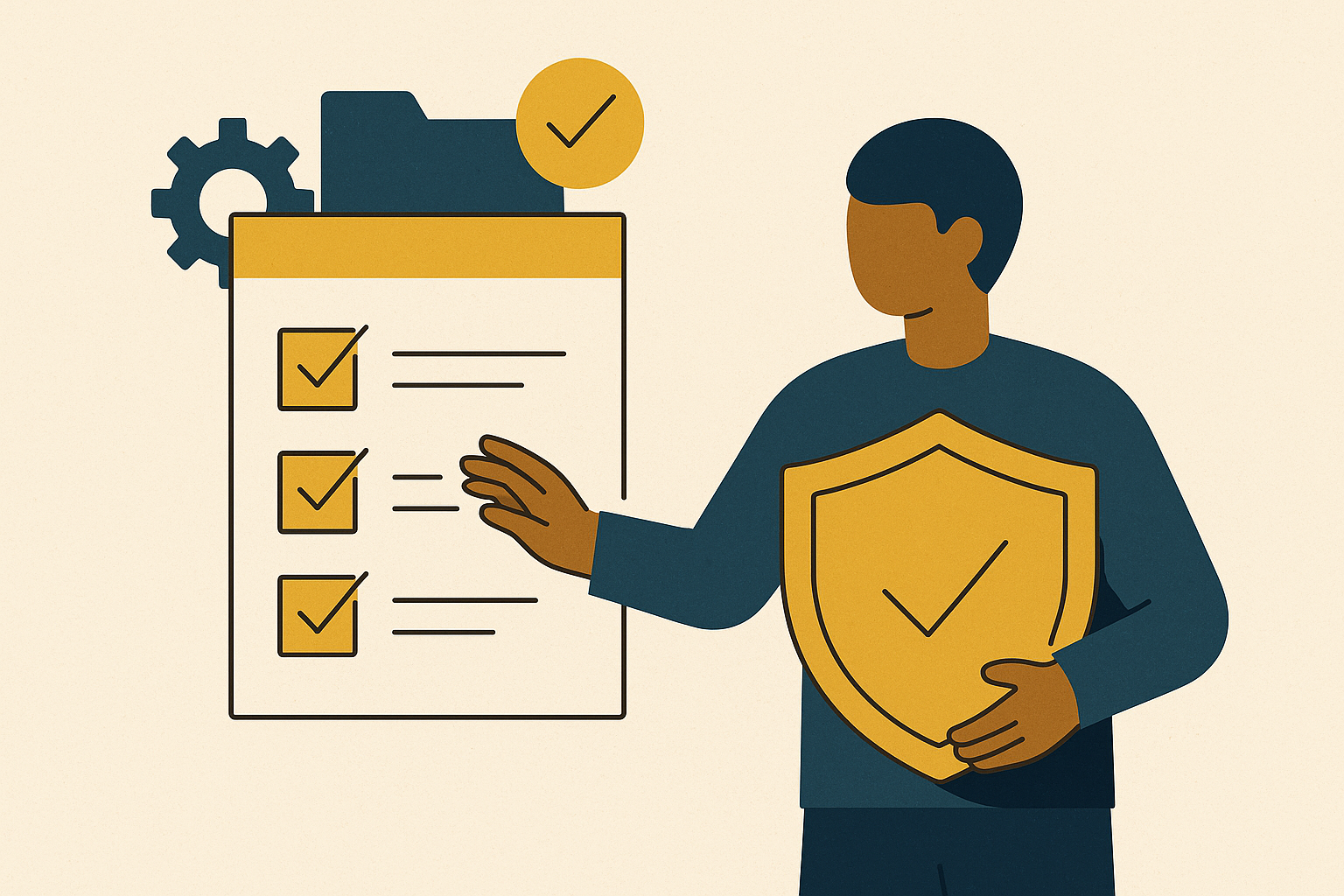
A SOC 2 readiness assessment is the dry run before the real exam: policies, procedures, and technical controls get checked, gaps get found, and the organization gets a window to fix them before an auditor is actually watching the clock. I've sat through enough of these to know where they go sideways, and it's rarely where people expect. This piece walks through the sequence from scoping to evidence collection, aimed at getting a service organization through the process without that gut-punch moment in month four of what was supposed to be a six-month engagement.
Here's the thing people get wrong most, and it's not a small thing: timing. A readiness assessment happens before the observation period starts. It's the rehearsal, not the performance, and once the formal audit clock starts running, especially for a Type II report, there's no going back to patch a control that was never designed properly in the first place. Type I checks whether controls exist at a single point in time, while Type II checks whether those controls actually operated, consistently, over a stretch of months, usually a minimum of three, though six is what most practitioners will quietly recommend when you ask them off the record. That difference changes how much runway you need before you can even start the audit clock.
Reports come from a licensed CPA firm attesting under SSAE standards, and there's a decent argument for having the same firm do both the readiness work and the formal audit afterward: less time spent re-explaining scope decisions, less redundant discovery, fewer "wait, why did we decide that" conversations six months later. Why an organization is even pursuing SOC 2, a customer contract demanding it, a new market requiring it, or just wanting to stand out against competitors who don't have it, shapes how aggressively the gaps need closing and on what timeline. A self-assessment run internally by someone who knows the Trust Services Criteria is cheap, sure, but people are bad at catching their own blind spots; I've watched smart, careful teams talk themselves out of flagging things that an outsider spots in twenty minutes. An external assessment from an accredited CPA firm tends to surface what an internal team would rationalize away, and its findings carry real weight with customers and boards in a way self-review never quite does. Either way: wrap the assessment up several months before the intended audit start, since remediation takes time, and that time has to come from somewhere.
Choosing which Trust Services Criteria apply and drawing the scope boundary
Security, sometimes called the Common Criteria, shows up in every SOC 2 report, no exceptions. The other four categories get picked based on what the business does and what it's promised customers in writing. Availability matters when uptime commitments sit at the center of the service, Processing Integrity matters when customers expect processing to be accurate, complete, on time, Confidentiality applies when sensitive information that isn't personal data still needs protecting under contract, and Privacy applies when personal information gets collected, used, stored, or shared.
Scope is not "the whole company," and I say this to nearly every client who walks in assuming it is. It's a specific set of systems, services, infrastructure, and people, and drawing that boundary is one of the first real decisions in the whole process. A few questions force clarity fast: which services actually need to show up in the customer-facing system description, which data flows cross a trust boundary where customer data is involved, and which third-party components are woven in so deeply that an auditor is going to treat them as in-scope whether you planned for that or not.
Unclear scope causes more delays and budget overruns than anything else in this process, by a wide margin. Write the scope decisions down early, and get the audit firm to sign off before moving forward, in writing, not a verbal nod on a call. The Trust Services Criteria sit on top of the COSO Internal Control Framework, and its five components (control environment, risk assessment, control activities, information and communication, monitoring) do real work translating what can feel like abstract audit language into things a team can actually operationalize. Close collaboration with the audit firm here is what keeps scope from creeping later and sets a timeline that's realistic instead of aspirational.
Mapping existing controls to the Trust Services Criteria to expose what is actually in place
This is usually the most labor-intensive phase of the whole process, and it pulls in more people than most organizations budget for. Engineering, HR, IT operations, sometimes finance, all get roped in because controls live scattered across departments and nobody in compliance alone can see all of them at once.
The mechanics are simple even when the work isn't. Take each applicable Trust Services Criterion and map it to a control that already exists: a written policy, a system configuration, a documented process, a technical safeguard. Four things get scrutinized closely during a real mapping exercise: what data is being processed, classified by sensitivity and whatever regulatory weight comes attached; where that data actually lives, across servers, cloud environments, other infrastructure; how data moves, inside the organization and out to third parties; and who can touch it, what the roles and permissions look like, and how often access gets reviewed.
None of this works without an asset inventory done first, since you can't map a control to a system you haven't catalogued. That's not really a controls problem, it's an inventory problem, and it trips up more organizations than it should, honestly. The AICPA's Points of Focus help here too, translating criteria language that can read as vague into specific operational practices, which keeps the mapping from getting interpreted too narrowly by a team eager to check a box. Automation tools earn their keep at this stage, tracking who owns which control, flagging evidence requirements per criterion, and catching anything still unmapped before the gap analysis even starts. What comes out the other side is a control matrix: a working document showing, for every applicable criterion, whether a control exists, who owns it, and what evidence would prove it's operating. Everything in the next phase runs off that matrix.
Reading the gap analysis results and building a remediation plan that closes the right gaps first
Once mapping wraps, the gap analysis sorts problems into two buckets. A design gap means the control doesn't exist at all, while an operating effectiveness gap means the control exists on paper but isn't actually followed in practice. The fix for one looks nothing like the fix for the other, and confusing the two wastes a remediation budget fast.
Certain gaps show up again and again, across nearly every audit I've been near: no centralized logging, or logging that exists but with nobody assigned to review it; no documented incident response plan, or a plan that exists but has never been run through a tabletop exercise, which auditors flag with almost boring consistency at this point; MFA rolled out to the obvious systems but not every in-scope one; a policy set that technically exists but that employees never formally acknowledged signing; and a vendor inventory that's incomplete, or vendor due diligence files missing outright, which the next section digs into.
Prioritize by lead time, not just by how scary something sounds. Centralized logging, MFA deployment, and building out a vendor assessment program routinely take the longest to stand up, so those start first even when they don't feel like the biggest risk on paper. Remediation windows typically run three to six months, and organizations sitting on significant gaps should plan for the longer end before locking in a Type II observation start date.
A remediation plan that holds up under audit scrutiny needs specifics: the exact gap and which criterion it touches, a named person accountable for closing it (a person, not a team, because "the team" never shows up to the meeting), a real timeline with milestone dates, and documentation, meeting notes, decisions made along the way, proving the remediation was actively managed rather than just promised in a kickoff call. Auditors want evidence of management, not a checkbox reading "done." Rank gaps by how likely they are to get flagged and how long they take to close, not severity alone; otherwise a team burns three weeks on a theoretical risk while an obvious, high-probability finding sits untouched in the corner.
Vendor management as a remediation priority most organizations underestimate
Vendor management is where SOC 2 audits fail most often, and it isn't close. Organizations pour money and attention into their own security posture, then treat the third parties touching their systems and data like an afterthought bolted on at the end. Auditors notice that gap every time.
The numbers explain why auditors have gotten sharper here. Recent industry research has found breaches tied to third-party involvement have doubled year over year. Auditors read that the same way anyone reading the headlines would: vendor risk stopped being a side issue a while ago.
What gets examined is specific: a complete, current inventory of every vendor with access to in-scope systems or data; documentation showing due diligence happened before a vendor was onboarded, not scrambled together after; contractual protections, data processing agreements, right-to-audit clauses, language that actually gives an organization recourse if something goes wrong; evidence of ongoing monitoring, not a questionnaire filled out once and forgotten; and periodic reassessment of the vendors that matter most, dated and documented so it's clear it happened on an actual schedule and not the week before the audit.
SSAE 18 tightened requirements around third-party oversight specifically, so an organization still running on an older internal framework may have a structural gap here that predates the current audit cycle entirely, sometimes by years. The practical fix runs in sequence: build the vendor inventory first, then backfill due diligence documentation for vendors already in place, then set up ongoing monitoring. Trying to do all three at once is the most common way this work stalls out. Vendor gaps close slowly, because closing them means waiting on other companies who move at their own pace on their own calendar, so this belongs near the top of the remediation list from day one. It is not paperwork to clean up at the end.
Collecting and organizing evidence so the audit team has what it needs from day one
Auditors don't take anyone's word for anything. Every control needs documented evidence that it exists and that it works, and that standard doesn't bend for a well-meaning explanation offered in a meeting, no matter how convincing.
The evidence itself falls into recognizable buckets: system configuration screenshots, access logs and records of access reviews, policies paired with proof employees actually acknowledged them, results from security scans and vulnerability assessments, training completion records, documentation from incident response tabletop exercises, vendor due diligence files.
Type II audits raise the bar further, since evidence has to show a control operated consistently across the whole observation window. That means evidence collection needs to run continuously, not get assembled in a scramble the week before the audit starts (and yes, teams still try this, and it goes about as well as you'd expect). The System Description needs a real check during readiness too, since it covers the services provided, infrastructure components, data flows, any subservice organizations involved, and how controls map to the applicable criteria. Gaps in that description don't stay gaps quietly; they turn into audit findings.
Automated evidence collection is close to standard practice at this point, especially for evidence that recurs on a schedule, like access reviews and log monitoring. How the evidence gets organized matters almost as much as whether it exists. Auditors request evidence by control and by criterion, and a disorganized pile of files creates delays, and, fairly or not, signals that the underlying control isn't well managed either. A closing checklist earns its keep here: confirm all five Trust Services Categories are addressed, the asset inventory is current, data flows are documented, policies have been reviewed, access controls are configured and reviewed, the vendor inventory is complete, and evidence collection is actually running, before anyone declares the organization ready.
What the full timeline and cost structure look like from readiness through audit completion
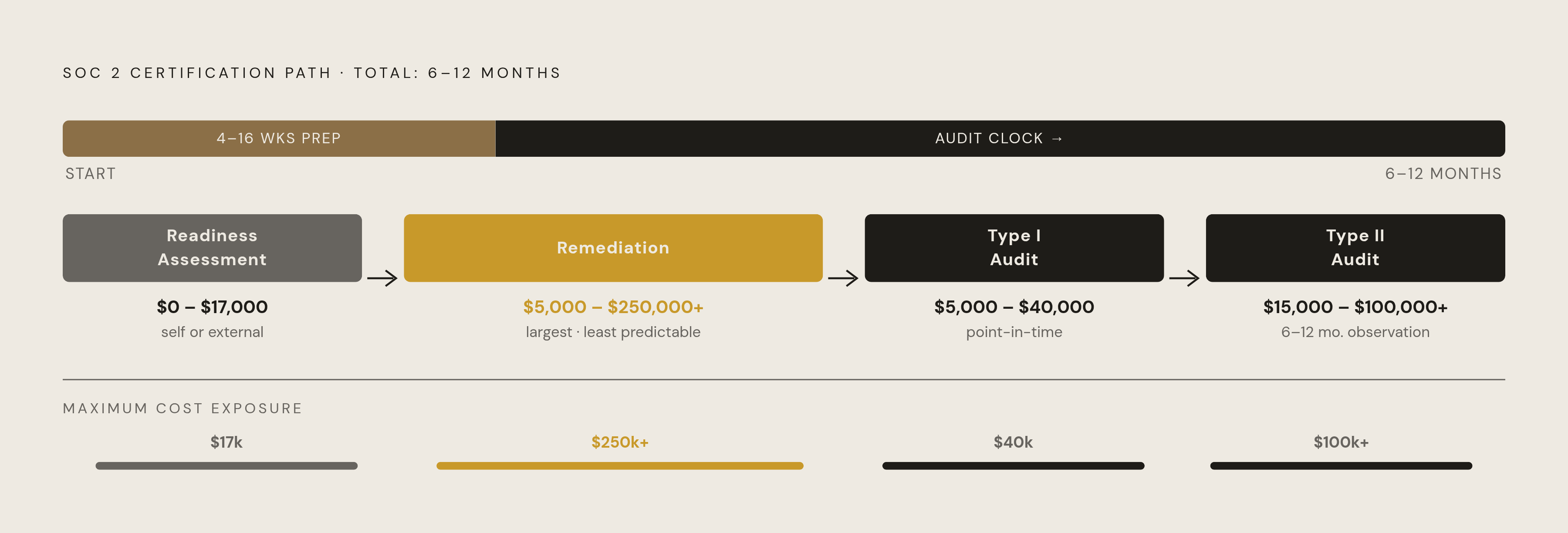
The full path from readiness assessment through a completed Type II report runs six to twelve months. That's a wide range, and the width reflects something real: how mature the organization's controls already are, and how many gaps have to close before the observation period can even start the clock.
Costs break down in stages. A self-conducted readiness assessment costs nothing in external fees, but it carries the risk of missing something an outside reviewer would catch in the first hour. A readiness assessment led by a consultant or CPA firm runs somewhere between $10,000 and $17,000 as of 2025, though broader consulting estimates for scope-dependent work range from $5,000 to $20,000.
Remediation is usually the biggest cost, and the least predictable one. A smaller organization with strong controls already in place might spend around $5,000 closing what's left, while a larger organization with significant gaps could spend $250,000 or more, covering new control implementation, documentation work, policy development built from scratch. Formal audit fees follow their own range: Type I typically runs $5,000 to $40,000, Type II runs $15,000 to $100,000 or more for larger, messier engagements. Preparation time before an audit can formally start runs four to sixteen weeks of active work, with the longer end showing up wherever remediation needs are heaviest.
What does skipping readiness actually cost, in the end? Gaps still open at audit time don't disappear quietly; they turn into qualified opinions or documented findings sitting in the final report for every customer and partner to read at their leisure. The reputational and commercial damage from a qualified opinion tends to outstrip the cost of a proper readiness assessment by a wide margin, and it's not a close comparison. For organizations running enterprise sales cycles or working with sponsor banks, that cost compounds further: deals don't close without a clean SOC 2 report, full stop, and an open gap can stall revenue for months while everyone waits.
Choosing an audit firm with the experience to serve as a genuine readiness partner
Readiness work runs most efficiently when the firm doing it is the same one performing the formal audit afterward. That firm already understands the scope decisions, has seen the control matrix, knows the remediation history, so nobody has to re-explain six months of work from scratch the moment the audit clock starts.
A few things are worth checking before picking a firm: real, demonstrated experience running SOC 2 examinations under SSAE standards, not general IT consulting relabeled as SOC work for a new market; familiarity with the specific industry involved, since control expectations and regulatory overlaps shift meaningfully between, say, healthcare and fintech; a willingness to stay involved as an advisor through remediation itself, not just show up at the start to assess and the end to sign off; and partner-level attention throughout, because readiness work is full of judgment calls that shouldn't get pushed down entirely to junior staff who weren't in the room for the scoping conversation.
That advisory role during remediation is where the choice of firm actually shows up in the outcome, more than almost anything else in this process. A firm willing to help design the remediation plan, not just hand over a spreadsheet of gaps and wish you luck, can meaningfully compress that three-to-six-month window and cut down on rework later. Regional CPA firms with dedicated assurance practices are worth a look too: they can offer technical depth close to what a much larger practice provides while staying responsive enough to keep pace with a tight remediation timeline, and proximity to the client's team tends to matter when gap closure depends on fast back-and-forth rather than a monthly check-in call that gets rescheduled twice.
One thing worth raising early: organizations supporting payroll processing, revenue cycle systems, or payment platforms may need a SOC 1 report alongside SOC 2, since SOC 1 focuses on controls relevant to a user entity's financial reporting. Running both examinations concurrently with the same firm tends to be cheaper and less painful overall than treating them as separate engagements on separate calendars. And as AI tools work their way into financial and operational processes, firms building real experience with emerging AI assurance frameworks, AIUC-1 being one example worth watching, are better positioned to help organizations think through the next round of control requirements before those requirements show up as a surprise finding in some audit a couple years from now.