Continuous Monitoring of AI Systems Post-Deployment
Testing can't predict how AI systems behave once deployed in the real world.

AI systems don't stay put. A model that scored high accuracy in a validation set six months ago is running against a population, a use case, and an adversarial landscape that has already moved on, and the gap between what got approved and what's actually running in production is where most of the real risk in AI governance now lives. This piece looks at what continuous post-deployment monitoring actually requires, why NIST's newest guidance treats it as an unsolved problem rather than a checkbox, and where the standards meant to backstop it (AIUC-1, SOC 2, the EU AI Act) still leave gaps.
Start with the assumption that's been quietly failing organizations for years: that a system performing well in controlled testing will keep performing well once it meets the world. Large language models and adaptive ML architectures interact with users whose behavior and needs shift month to month. Vendors push updates, fine-tune underlying models, and change configurations in ways the deploying organization often can't see happening in real time. And in sectors like healthcare, finance, criminal justice, and public administration, a system that quietly degrades doesn't just produce a worse output. It produces a wrong denial, a missed diagnosis flag, a biased sentencing recommendation. Pre-deployment testing catches known failure modes. It cannot catch the failure mode nobody thought to test for, in a context nobody anticipated, against a population nobody sampled. Traditional software has monitoring precedents going back decades, but AI monitoring, as a discipline, is still arguing about its own vocabulary.
What NIST AI 800-4 says organizations are failing to do
NIST AI 800-4, published in March 2026, is a federal-level effort to map out where post-deployment AI monitoring falls short, and it's built on real fieldwork rather than theory: three practitioner workshops involving more than 200 experts across academia, industry, and over ten federal agencies, backed by a review of 87 papers. The report doesn't hand down a mandate. It does something arguably more useful for a field this immature: it names the gaps, sorts them, and gives them shared terms.
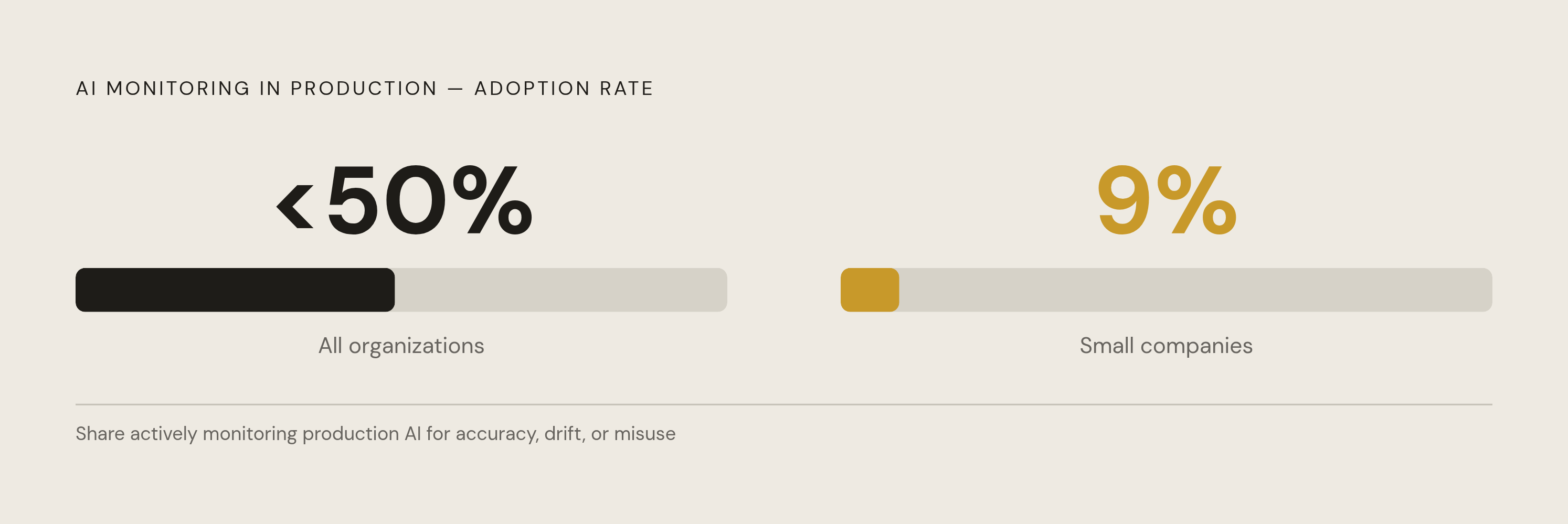
What it finds is not encouraging. Research finds that fewer than half of organizations actively monitor their production AI systems for accuracy, drift, or misuse. Among small companies, that share falls to just 9%. If the deploying organizations themselves aren't watching their systems after launch, external oversight has nothing to inspect. Auditors, regulators, and insurers all depend on some baseline of internal visibility to do their jobs, and if that baseline doesn't exist, the whole chain of assurance is resting on air.
NIST frames post-deployment monitoring as an ongoing assurance problem, not a one-time validation event you complete and file away. That reframing changes how monitoring obligations are treated over time, since it makes assurance an ongoing requirement rather than a box to check once. A validation exercise has an end date. Assurance doesn't, and the field still lacks standardized benchmarks for what "acceptable real-world performance" even looks like across contexts.
The six dimensions of post-deployment monitoring NIST identifies
NIST organizes the problem into six categories, arrived at through thematic coding of workshop transcripts and the literature review. Functionality asks whether the system still does what it was built to do. Operational asks whether it delivers consistent service across whatever infrastructure it runs on. Human Factors asks whether the system stays transparent to the people using it and whether its outputs hold up in quality. Security asks whether it resists adversarial manipulation and misuse. Compliance asks whether it still adheres to the regulations and directives that governed it at launch. Large-Scale Impacts, the broadest and vaguest of the six, asks whether the system is contributing to human flourishing or working against it.
Each category comes with its own unresolved research problem baked in. Human Factors reveals how little is actually known about human-AI feedback loops, the ways users adapt their behavior around a system and the system adapts back. Security surfaces how underdeveloped current methods are for detecting deceptive behavior in a model, as opposed to just detecting obvious jailbreak attempts.
The six categories aren't meant to be a checklist so much as a shared language, something the field currently doesn't have across its various sub-disciplines. The taxonomy doesn't say who is responsible for monitoring, how often it should happen, or by what method. Those questions are explicitly left open in the report itself.
Consider what that means for a typical deployer that's only watching functionality and uptime, the two categories closest to traditional software monitoring. That's two out of six dimensions covered. Security drift, compliance erosion, and downstream social impact are sitting completely unexamined, and nobody's even measuring whether that's a problem until it becomes one.
The structural barriers that make continuous monitoring hard in practice
NIST's analysis finds that even organizations that want to monitor across all six categories run into the same five obstacles, and these apply regardless of which dimension is in question. There's no trusted set of tools: no standardized benchmark exists for real-world AI performance, so organizations can't even agree on what "good monitoring" looks like, let alone measure against it. Information sharing across the industry is immature; companies rarely disclose data on AI incidents or performance failures, so nobody is building on anyone else's experience.
The pace of the technology itself is a barrier on its own. Monitoring frameworks and guidance documents take time to write and vet, and by the time they're published, the models they were written for have already been superseded. Then there's the incentive barrier, which might be the hardest one to solve through policy alone: competitive pressure pushes companies to cut corners on monitoring because oversight costs money and time without producing any visible short-term return. And finally, resources. Continuous monitoring is computationally expensive, and it needs specialized talent that most organizations, especially smaller ones, simply don't have on staff.
Layer onto that the reality that in most real deployments, the developer, the deployer, the integrator, and the end user are four different entities, each able to point at another when something goes wrong. In most real deployments, the developer, the deployer, the integrator, and the end user are four different entities, and each one can point at another when something goes wrong. Nobody owns the failure because everybody can plausibly claim it wasn't their layer.
The incentive barrier deserves a closer look, because it's structural rather than just cultural. Monitoring, by design, exposes risk. And once an organization finds that risk, it owns it, legally and reputationally. There's no competitive advantage in being the company that discovers its own system is failing first. That's a genuinely hard problem to fix with better tooling alone, and NIST doesn't pretend to have an answer. Questions of monitoring cadence remain unsettled across the field: should frequency be risk-tiered, use-case specific, or based on some other standard? No consensus has emerged.
Governance Frameworks' Formal Requirements and Where They Break Down
Regulation has started catching up, at least on paper. The EU AI Act devotes an entire chapter, Chapter IX, to post-market monitoring, information sharing, and market surveillance for high-risk AI systems and general-purpose AI models. The message embedded in that structure is clear: governance doesn't end at deployment.
But the Act's language runs into a familiar problem when it hits implementation. Providers are required to document and assess "substantial modifications" to their systems, but the statute's definition leaves significant room for interpretation in auditable, operational practice. According to analysis presented at FAccT '26 by Ferrario, that ambiguity leaves enormous interpretive discretion in the hands of the providers themselves, the exact parties with the least incentive to classify a change as substantial if doing so triggers new compliance obligations. It's a textbook gap between what a regulation intends and what it can actually enforce.
Other frameworks point the same direction without closing the gap either. NIST's own AI Risk Management Framework, along with its 2024 Generative AI Profile, treats post-deployment monitoring as core to responsible AI management rather than an optional add-on. OMB M-25-21, the directive on accelerating federal AI use through governance and public trust, references continuous monitoring obligations for federal agencies. ISO/IEC 42001:2023, the AI management system standard, is built around the same premise: monitoring is ongoing.
What all of these share is a mismatch with the regulatory model they were built on. Most existing frameworks assume a checkpoint structure suited to static technology: a system gets assessed, gets approved, and is presumed compliant unless something visibly breaks. AI doesn't behave that way. It drifts quietly, and quiet drift doesn't trip any of the alarms a checkpoint model is designed to catch. What the underlying sources point toward instead is a risk-proportionality principle: monitoring obligations should scale with a system's risk tier, get written down explicitly, and get revisited every time the model updates, the deployment context shifts, or a new risk signal appears.
How AIUC-1 Makes AI Monitoring Auditable and Recurring
AIUC-1 is one attempt to close that gap for a specific slice of the problem: AI agents and autonomous systems. Introduced in mid-2025 and still being updated into 2026, it was built with input from Orrick, MITRE, the Cloud Security Alliance, and a group of enterprise security leaders. Rather than invent a new governance philosophy from scratch, AIUC-1 operationalizes what already exists, publishing formal crosswalks to ISO 42001, the NIST AI RMF, the EU AI Act, MITRE ATLAS, and the OWASP Top 10 for LLM Applications.
Its structure runs across six pillars: data and privacy, security, safety, reliability, accountability, and society. That maps closely, though not identically, onto NIST AI 800-4's six monitoring categories, which suggests some early convergence in how the field is starting to think about this problem even before a shared vocabulary is fully settled.
What actually gets tested under AIUC-1 is concrete. Agents are stress-tested against jailbreak attempts, hallucination triggers, and data leak scenarios, drawing on a bank of 5,000 risk-and-attack combinations tailored to the type of business being assessed. The structural feature that sets it apart from a typical annual audit is the pairing of a governance review with recurring adversarial testing, and the standard itself gets refreshed on a quarterly basis, which is a meaningfully faster cycle than most compliance frameworks run on.
Certification runs through independent audits conducted by accredited firms, with Schellman and Coalfire named as accredited auditors. Companies that have certified products against the standard include Cursor, ElevenLabs, Harvey, KPMG, Lovable, UiPath, and Fin. AIUC has raised significant venture funding, including a $40 million Series A led by Ribbit Capital, with First Harmonic and Terrain participating, following an earlier $15 million seed round. That puts total reported funding at $55 million, a signal that investors see real demand for this kind of certification layer.
A conflict-of-interest concern has been flagged regarding AIUC's business model. The organization authors the framework, runs the technical evaluations, and issues the certificates, while also being positioned to benefit commercially from the certification ecosystem it controls. That structure raises well-documented questions about whether the certifying body has adequate incentive to find and flag problems. AIUC-1 does not define what counts as an "AI agent," so the vendor being audited gets to decide which of its systems qualifies for certification. It's a real limitation on how much weight the certification alone should carry.
SOC 2's Coverage, Its Gaps, and What AI-Aware Auditors Ask For in 2026
SOC 2 was never built to answer questions about how an AI system behaves. It attests to the controls at the service organization running the system, telling a buyer that the company has sound security practices in place. A vendor can hold a spotless SOC 2 report and still have no answer for whether their agent resists prompt injection, leaks data across customer tenants, or invents a refund policy when a user pushes hard enough in a conversation.
The formal criteria haven't changed. The 2017 Trust Services Criteria, revised in October 2022, are still the operative standard in 2026, and no new version has been issued. What's shifted is auditor behavior, not the rulebook itself. Where auditor questions about AI were once broad and general, they have since become far more specific: what AI systems touch customer data, what data goes into them, where that data goes afterward, who reviews the output, and what controls exist to stop prompt injection before it happens.
The first things an AI-aware auditor now asks for reflect that shift: model lineage documentation, prompt and inference logs with personal data redacted before logging even happens, drift-monitoring output, and a vendor risk assessment covering every third-party LLM the system calls. There's also a newer accountability question specific to autonomous agents. When an agent takes a privileged action on its own, without a direct human request behind it, auditors now treat that as an accountability gap, because SOC 2's underlying expectation is that privileged actions trace back to an accountable person, not a system account acting independently.
The evidence bar has moved too. A 2023 audit might have accepted a screenshot of security group configurations taken on a single day as sufficient evidence. A 2026 audit asks a harder question: how does the organization know those settings didn't change at any point across the entire audit period? The expected answer now is a continuous monitoring tool with a logged alert history, not a point-in-time snapshot. That shift alone says something about how far the bar for "evidence" has moved in just a few years.
One number captures the scope creep well. The CBIZ 2024 SOC Benchmark Study found that confidentiality, as a criterion, now appears in 64.4% of SOC 2 reports, up from 34% in 2023. That's not a small jump, and it signals buyers are asking for attestation on a wider slice of what a vendor actually does with their data.
None of this replaces AIUC-1, and AIUC's own documentation says as much: the standard is not meant to duplicate non-AI frameworks like SOC 2, and organizations are expected to maintain both independently rather than treat one as a substitute for the other.
What a credible post-deployment monitoring program requires organizations to build
Putting the pieces together reveals a pattern. Monitoring needs to scale with risk: a higher-risk system needs more frequent, more granular monitoring, and that requirement should be written down explicitly and revisited every time the model updates, the deployment context shifts, or a new risk signal appears. That's not a one-time policy decision. It's a living document.
On the technical side, the sources point to a few concrete intervention points: inspecting inputs for adversarial manipulation before they reach the model, filtering outputs that cross a defined line, and, for more advanced systems, monitoring the model's chain-of-thought for early signs of a harmful plan forming before it turns into a harmful action.
None of that comes free. Building this kind of infrastructure requires upfront investment in tooling, not something bolted on after a product ships. It requires sustained engineering maintenance and specialized skills that most internal audit teams simply don't have in-house. It requires secure handling of the sizable volumes of sensitive data that monitoring logs themselves generate, which is its own security surface. And it requires oversight of the monitoring tools, because an automated system watching another automated system creates a regress problem: who's checking that the checker still works?
Continuous monitoring earns its keep most clearly at the level of system controls and model-adjacent technical signals, the places where assurance can degrade fast and real-time visibility actually matters. Incident sharing remains one of the field's most stubborn gaps. Organizations still rarely disclose their own performance failures to each other, which means the field can't accumulate collective experience the way, say, aviation safety or cybersecurity threat intelligence eventually did. NIST AI 800-4 calls this out directly as a barrier holding back the entire monitoring ecosystem, not just individual companies.
Internal teams can build a lot of this monitoring infrastructure on their own. But independent examination, whether through an AI-specific standard like AIUC-1 or an AI-aware SOC 2 audit, provides a layer of verification that internal attestation alone can't produce, because an organization checking its own homework has an obvious incentive problem. Firms with real depth in SOC examinations, compliance audits, and assurance work in regulated industries are natural partners for building out that external layer.
None of it is cheap. A 2026 estimate from Knowlee puts a first-year SOC 2 Type II engagement for an AI startup at somewhere between $40,000 and $120,000, depending on scope and how much remediation work is needed. That's a real number to weigh against the cost of the alternative: a system making consequential decisions, in a sector where those decisions land on real people, drifting quietly for months with nobody watching closely enough to notice.
Sources
- New Report: Challenges to the Monitoring of Deployed AI Systems
- Challenges to the monitoring of deployed AI systems: Center for AI Standards and Innovation
- The Post-Deployment Monitoring of Artificial Intelligence: Emerging Challenges in Oversight, Evaluation, and Accountability
- High-Risk AI Systems and the Problem of Identity in the European AI Act
- aiuc-1.com
- labs.cloudsecurityalliance.org
- soc2auditors.org