Value of AIUC-1 Certification for CPAs
CPAs need independent proof that agentic AI won't fail under attack.
Agentic AI does not sit quietly in the background the way a spreadsheet macro does. It takes actions, crosses system boundaries, and makes decisions on its own inside workflows that are already live, already touching client data, already feeding into deliverables. A tool that only suggests is a different animal from a tool that acts, and that distinction affects how much oversight a workflow needs. Accounting has, in the space of a couple of years, started handing real tasks to the second kind.
The risks that follow are specific to that shift, and they compound rather than sit side by side. An agent can hallucinate a figure that quietly becomes a journal entry, an opinion, or a line in a client deliverable. It can misuse the tools it has been given, wandering outside the scope a firm intended to authorize inside its own systems. It can leak data across client engagements it was never supposed to touch. And it can be manipulated through prompt injection, a class of attack built specifically to steer an agent's output toward something the attacker wants and the firm did not intend.
None of that is a governance problem in the traditional sense. It is a behavior problem, and that difference is exactly where the existing frameworks run out of road. ISO 42001 checks whether an organization has the right management system wrapped around its AI use. SOC 2 checks general service organization controls. Both are useful, and neither one asks the only question that matters once an agent is acting autonomously on a client's live data: what does this thing actually do when someone tries to break it?
NIST offers guidance, not a badge. The frameworks CPAs already know were built for a world where software behaved predictably and organizations needed policies. Agentic AI breaks that assumption at the root.
The confidence numbers back this up. Cisco's 2025 AI Readiness Index found only 29% of companies believe they are actually equipped to defend against AI-specific threats, and that gap in confidence sits widest exactly where agents are doing the most work Cisco 2025 AI Readiness Index. That is not a hypothetical risk sitting somewhere out on a horizon. It has already cost real money at real firms.
Largely on the vendor's word. A firm that cannot describe how its AI tools behave under adversarial pressure, what happens when someone tries to manipulate them, is operating on assurance rather than evidence. That is the gap AIUC-1 was built to close, and it is worth understanding exactly what the framework does and does not claim to do before treating it as an answer. According to EY, 64% of companies with over $1B in revenue have already lost more than $1M to AI-related failures, underscoring that this is not a theoretical risk. CPAs who cannot articulate how their AI tools behave under pressure are operating on vendor assurances alone, and that is where the framework gap lives.
AIUC-1's structure, controls, and differences from the frameworks CPAs already know
AIUC-1 was launched in 2025 by the Artificial Intelligence Underwriting Company, a venture-backed startup founded by people with backgrounds at organizations including Anthropic, and built in partnership with Orrick, Stanford, the Cloud Security Alliance, MIT, and MITRE. AIUC-1 did not emerge from a standards body in the traditional sense, though that pedigree matters less than what the framework actually tests. It emerged from a company with a specific commercial interest in the outcome.
Structurally, the framework runs more than 50 controls across six domains: Safety, Security, Reliability, Accountability, Data & Privacy, and Society AIUC-1. Those controls map to MITRE ATLAS, the threat framework built for adversarial machine learning, and to the OWASP Top 10 for Agentic Applications AIUC-1. That mapping is what separates AIUC-1 from a generic checklist. It is built around documented attack patterns, not abstract principles.
The cadence is where AIUC-1 diverges most sharply from anything CPAs have dealt with before. Certificates last 12 months, the same as most attestation cycles. But maintaining that certification requires quarterly technical retesting, a pace faster than SOC 2, faster than ISO 42001, faster than nearly any other framework in the compliance world. The January 2026 update alone changed 26 requirements and added more than 40 voice-specific controls, which says something about how quickly the underlying technology, and the attacks against it, are moving. A framework built around annual snapshots would already be behind.
Schellman, described as the largest specialized cybersecurity auditor, became the first authorized AIUC-1 auditor, and ElevenLabs became the first voice AI company to earn the certification. That means the honest answer to "which one do I need" is often "more than one."
Here is the caveat. AIUC itself accredits AIUC-1's auditors. ISO 42001 relies on external accredited certification bodies, SOC 2 sits under AICPA governance, and NIST frameworks carry federal agency authority behind them. AIUC-1 has none of that external scaffolding. Calling it a "standard" rests on AIUC's own authority, not an independent accreditation structure.
Lenny Zeltser's analysis lays out three structural questions. First, scope: AIUC-1 does not define what counts as an "AI agent," so the vendor gets to decide which agent, exactly, is being certified. Second, auditor selection: the vendor picks its own auditor, the same dynamic that has, at times, eroded confidence in SOC examinations when firms shop for the path of least resistance. Third, and most structurally interesting, the incentive chain. AIUC writes the framework, runs the technical evaluations, issues the certificates, and sells the insurance that the certification is designed to enable. That is vertical integration reminiscent of the issuer-pays model that credit rating agencies have been criticized for. AIUC's founders argue the insurance arm actually creates a counter-incentive, since a loss on a certified agent hits AIUC's own balance sheet. Whether that argument holds up over time is something the market, not this article, will settle.
None of that is a reason to dismiss the framework. Every early-stage assurance standard starts as a claim and earns its credibility through repeated scrutiny, and AIUC-1 is no exception to that pattern. Read a certificate carefully rather than waving it away or accepting it uncritically. What CPAs need is a clear-eyed sense of what the certification actually proves, and that requires understanding why the professional stakes here are not abstract. SOC 2 addresses service organization controls at the organizational level.
Why CPA liability makes independent AI agent assurance a professional necessity, not a vendor amenity
When AI makes an error in a financial statement, an audit opinion, or a tax filing, the CPA carries the liability. The software vendor does not. That single fact reframes everything else in this piece. A vendor's marketing claim about its AI agent's reliability is not a shield a CPA can stand behind if that agent produces a misstatement.
The obligation stack sitting on top of that principle keeps getting taller. The PCAOB followed up with Staff Guidance in October 2025 that included concrete examples, and major firms responding to the PCAOB's March 2026 strategic request pushed hard for further clarity, signaling a body of regulators still catching up to the technology firms are already using.
State legislatures are moving even faster. In 2025 alone, state legislators introduced more than 1,100 AI-related bills across all fifty states, and 145 of them were actually enacted, a compliance surface expanding in real time that means the rules a firm operates under this year may look different next year opsintel.io.
AICPA guidance gets specific about what documented practice needs to look like. AI-generated financial analysis has to be checked against primary source data before it goes anywhere near a client deliverable, and that verification has to appear in the working papers, not just live in someone's head. CPAs also need to actually understand the tools they are using, including training data limitations, known error patterns, and the domain-specific weaknesses of whatever AI system sits inside the workflow.
That raises an obvious question. Where does a CPA get that understanding, short of reverse-engineering a vendor's model? Vendor marketing is not sufficient, and the professional expectation is an independent basis for concluding a tool is fit for purpose in the specific audit context it is being used in. AIUC-1 is one way to supply that independent basis. It is documented, third-party evidence a CPA can point to when demonstrating due care in selecting a tool.
Automation bias is a second layer to this. The inaugural AICPA and CPA.com Audit Transformation Survey, run across 54 U.S. firms, found firms overwhelmingly chasing time savings while actively fighting the instinct to just trust whatever the technology outputs. Auditors are trained in independent thought, and that training is an asset here, but only if it is paired with independent verification of the tools themselves, not just the outputs those tools produce. Certification on a vendor's platform does not replace a CPA's judgment. It gives that judgment something solid to stand on. The SEC has issued guidance on AI use in registered reporting. AICPA guidance identifies documented practices CPAs must maintain when using AI tools.
How AIUC-1 functions in financial statement audit and assurance engagements specifically
The same survey names AI as the principal force reshaping how audit firms operate, changing how evidence gets gathered, tested, and documented. That transformation is already underway, which makes the question of tool assurance urgent rather than theoretical.
A standard vendor security review answers a narrower question than most CPAs assume. It looks at how the company operates: its policies, its internal controls, its organizational posture. AIUC-1 asks something else entirely. It asks how the agent behaves on a client's actual data, under active attempts to manipulate it, tested against adversarial scenarios built from real-world incidents. For financial statement audits, that distinction maps directly onto the risks that matter most: hallucinations turning into misstatements buried in working papers, agents exceeding the scope of what an engagement actually authorized, and data leaking across client files inside a platform serving multiple clients at once.
Fieldguide gives this a concrete shape. On May 6, 2026, Fieldguide announced its Field Agents had achieved AIUC-1 certification, becoming the first AI platform in the audit and advisory category to hit the standard, with Schellman conducting the audit. Fieldguide holds AIUC-1 alongside ISO 42001 and SOC 2 Type 2 simultaneously, which means agent behavior, organizational governance, and service organization controls are each independently validated rather than assumed. Fieldguide's CTO described what the certification actually tests as how the agents behave on real engagement data, under pressure, against attacks built specifically to break them, with attention to traceability, human oversight, and guardrails.
That example gives CPAs a template for the questions to ask when evaluating any audit platform claiming AI capability. Which specific agents does the certificate actually cover, which model versions, which data flows? What has quarterly retesting turned up since the last annual audit? And does the vendor also hold ISO 42001, so that agent behavior and the governance system wrapped around it are both independently checked rather than just one or the other? A certificate that cannot answer the first question is not worth much, regardless of how impressive it looks on a vendor's website.
Circle back to the working paper requirement raised earlier. AIUC-1 certification on a vendor's platform gives a CPA the documented, third-party basis that AICPA guidance requires to appear in those working papers when justifying a tool-selection decision. It is not a formality. It is the paper trail that turns a defensible judgment into a demonstrably defensible one.
How AIUC-1 and SOC examinations relate
SOC 1 evaluates different things than SOC 2, and precision about which one does what helps before asking where AIUC-1 fits alongside them. SOC 1 evaluates a service organization's processes as they relate to a client's internal control over financial reporting, governed by SSAE 18 AT-C 320, and it matters most for payroll processors, fund administrators, and payment processors. SOC 2 covers organizational-level controls across the Trust Services Criteria. It is technically voluntary, but plenty of enterprise and healthcare clients treat it as a contractual requirement, and some will not engage a vendor at all without a SOC 2 report or an equivalent like ISO 27001.
The 2024 SOC benchmark study shows scope creeping outward in a way that is hard to ignore. Reports containing more than 150 security controls rose from 16% to 23% AIUC-1 SOC Benchmark Study KPMG LLP Becomes First Big Four Firm with AIUC-1 Certified AI Capability. Confidentiality now shows up in 64.4% of SOC 2 reports, up from 34% in 2023 SOC Benchmark Study. Availability now appears in 75.3% of reports SOC Benchmark Study. Read together, those numbers describe service organizations broadening what they cover because clients are demanding it, and the bar for what counts as an adequate SOC report keeps rising. Reliance on internal audit to reduce testing dropped to just 5.2% of SOC reports in that same study, consistent with tightening AICPA guidance on how much weight internal audit work can carry SOC Benchmark Study.
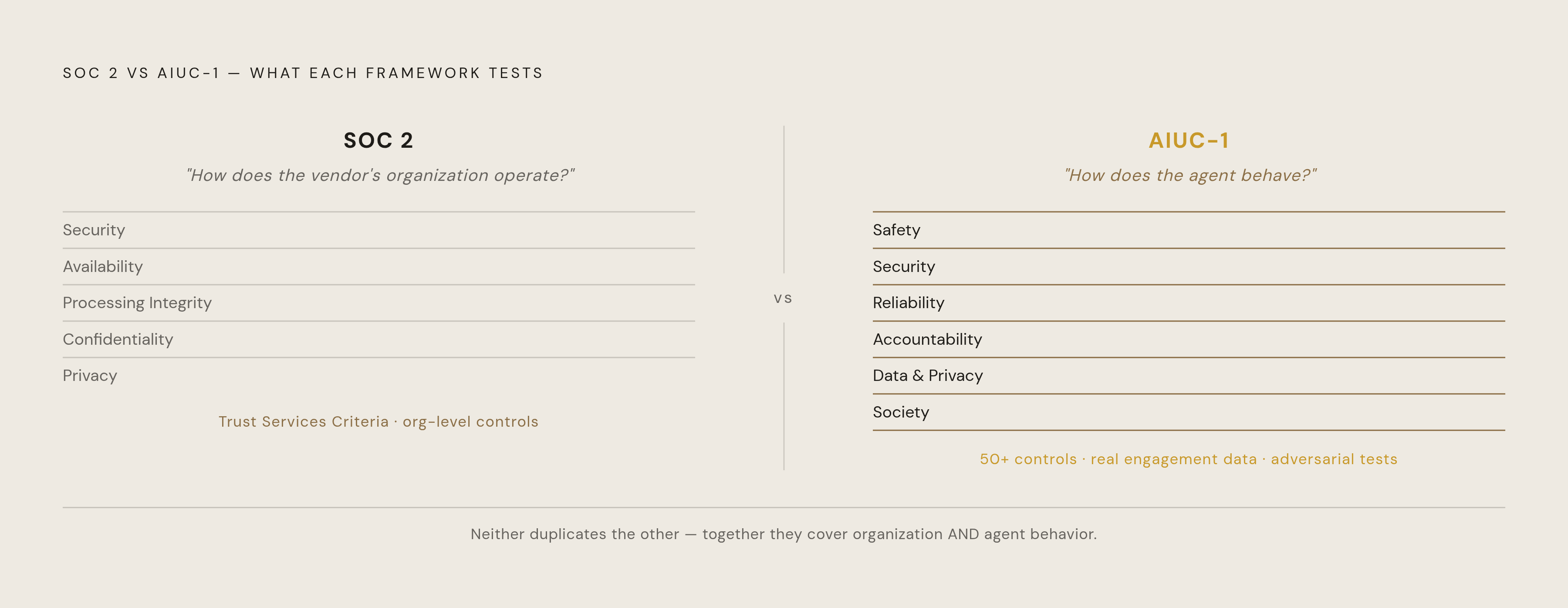
So how does AIUC-1 sit next to all of this? SOC 2 covers the vendor's organizational controls. AIUC-1 tests how the agent behaves in production. Neither one duplicates the other, and a firm requiring both is simply asking a more complete set of questions than a firm requiring only one. Some platforms market SOC 2 readiness achieved in days or hours, tossing around the word "compliance" in ways that have no place in an actual SOC 2 examination. A CPA who understands what AIUC-1 actually tests is better equipped to spot that gap and tell rigorous assurance apart from something dressed up to look like it.
As agentic AI works its way into workflows already covered by SOC 1 or SOC 2 engagements, the scope of those examinations will eventually need to account for what the agents inside them actually do. AIUC-1 offers a working precedent for what agent-level testing looks like in practice. The AICPA is already convening working groups on SOC 2 enhancement, cybersecurity, AI practices, sustainability, and digital assets, which is a fair indication that the regulatory landscape here is still being written, not settled. The newest governing standard, SSAE 23, effective for engagements beginning on or after December 15, 2025, aligns attestation engagements with AICPA quality-management standards (SQMS Nos. 1–3, along with SAS No. 146 and SSARS No. 26), affecting how audit firms must document and manage engagement quality.
How AIUC-1 applies to specialized audit areas: HUD 232, skilled nursing, and mortgage banking
These practice areas share something that general commercial audits do not: a single misstatement or a missed compliance requirement carries consequences well beyond an adverse opinion. Getting the audit methodology right is necessary but not sufficient. The auditor, and any tool assisting the auditor, has to understand the regulatory environment itself.
Take HUD Section 232. It covers audits of nursing homes, intermediate care facilities, and board-and-care homes carrying mortgages insured under Section 232 of the National Housing Act. The current Section 232 Handbook was updated with provisions effective January 5, 2026, applying to all new loan applications and to transactional requests on existing Section 232 projects. Financial statements in this space have to comply with HUD's Uniform Financial Reporting Standards under 24 CFR 5.801 and 24 CFR 200.36, and the submission deadlines leave little room for error: multifamily for-profit housing project audits are generally due within 90 days of fiscal year-end, hospital project audits within 120 days, and Ginnie Mae and FHA project audits generally within 90 days ISACA - Wikipedia. Missing any one of those windows can trigger a HUD compliance flag ISACA - Wikipedia.
The most common error in this space is a reclassification mistake: HUD escrow accounts, covering replacement reserves, property tax escrows, and insurance escrows, get recorded on the operating company's books instead of the borrower's. That is exactly the kind of categorization error an AI agent could propagate at scale if it is not properly constrained, since an agent trained on patterns rather than regulatory nuance has no inherent reason to know which entity's books an escrow belongs on. Audited financial statements are required for multifamily profit-motivated projects once annual expenditures or HUD-insured loan balances hit $500,000, and for multifamily non-profit projects regardless of size, while operator statements can sometimes be operator-certified rather than fully audited, unless the operator is also the borrower, in which case a full audit is required AIUC-1.
An AI agent assisting on a HUD 232 engagement is not just summarizing numbers. It is making classification decisions inside a regulatory framework with strict deadlines and specific reporting standards, which is precisely the kind of behavior AIUC-1 is built to test rather than assume. The same logic that applies to a general financial statement audit applies here with less room for error: a CPA needs independent, documented assurance that the agent handling escrow classifications, deadline tracking, or reporting-standard compliance behaves correctly under pressure, not just under ideal conditions. AIUC-1 does not replace professional judgment in any of these specialized areas. It gives that judgment something concrete to stand on when the stakes run higher than a standard opinion letter.