SOC Report Frequency and Renewal Considerations
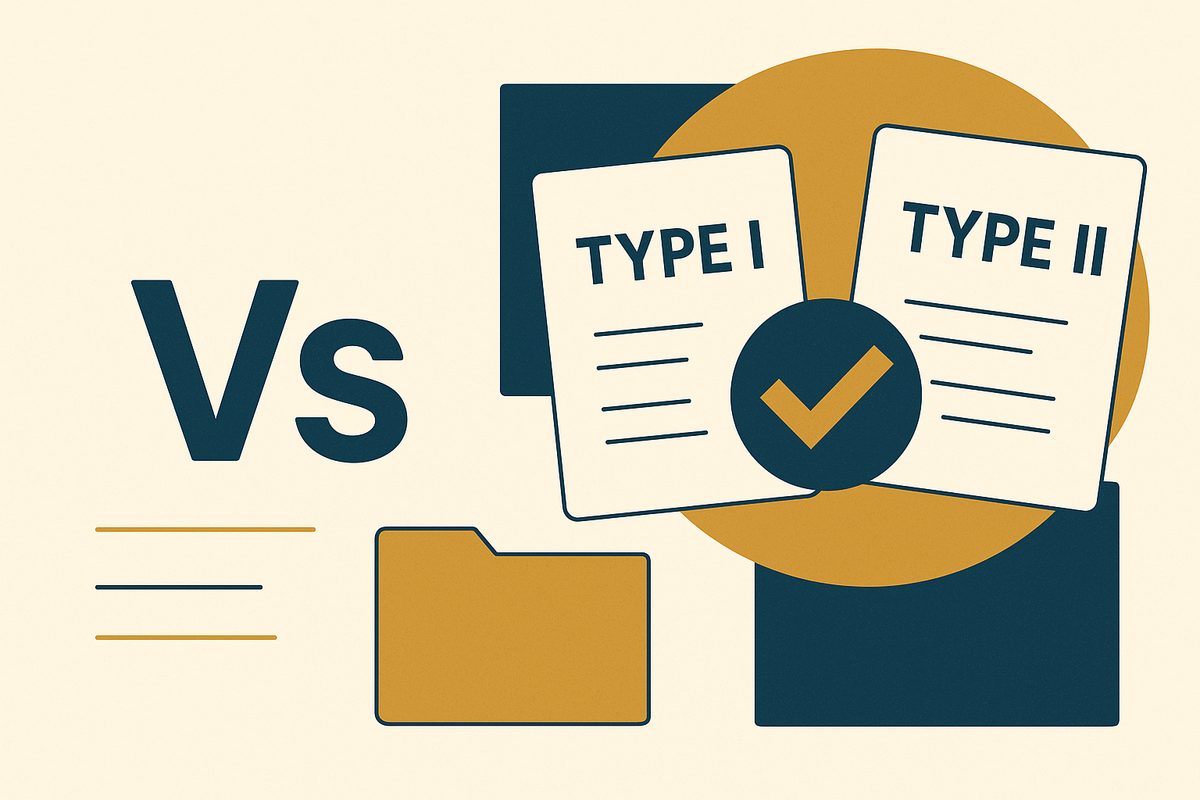
Type I and Type II serve different purposes and expire on different schedules.
Type I and Type II reports answer different questions, and that difference shapes how each one ages. A Type I report is a snapshot: it confirms that controls were designed appropriately as of a single date, with no testing of whether those controls actually worked over time. Because it's a point-in-time opinion, it's generally accepted for 6 to 12 months after issuance, and it holds up longest for organizations that haven't changed much since the report date.
Type II is the one enterprise buyers actually mean when they ask for "a SOC 2 report." Sending a Type I when someone asked for Type II is not a paperwork mismatch, it's a wrong answer to the actual question, which is whether these controls held up in practice and not just on paper. Procurement teams that know what they're looking at will bounce it back within a day, and vendors who make this mistake more than once start to look like they don't understand their own compliance program. That reaction is fair. A design opinion and an operating opinion are not two flavors of the same credential, they're answers to two different questions, and conflating them in a sales cycle costs trust that's hard to rebuild.
Type II covers both design and operating effectiveness over a defined observation window. The AICPA sets no formal minimum length for that window, but practice has settled into a rough hierarchy: 3 months is about as short as anyone accepts, 6 months is the common industry recommendation, and 12 months is what most enterprise buyers expect to see. Once the observation period ends, that Type II report stays valid for 12 months from issuance.
None of that makes Type I a lesser move, and organizations that skip it just to look more mature usually pay for that decision later. For an early-stage company, Type I is the correct first step, not a shortcut around the real work. Type I engagements typically run $5,000 to $20,000 in auditor fees and take 5 weeks to 2 months to complete, cheap enough to build momentum without committing to a full observation period. Many organizations then run a shortened, 3-month Type II as their first real cycle, proving the model works before stretching to the full 12-month window enterprise buyers expect. The arc looks like this: Type I, then a short-window Type II, then the annual 12-month Type II that becomes the steady-state renewal cycle.
Skipping straight to a 12-month Type II without ever testing the control environment first is technically allowed, and it's also the wrong move for most first-time organizations. It's a harder audit to pass cleanly on the first attempt, and organizations that try it tend to walk away with more exceptions than a shorter dry run would have caught. That defeats the point of trying to look advanced in the first place.
SOC 1 follows a parallel structure, with one added wrinkle: because user entity auditors lean on the report for financial statement audit work, they almost always require Type II, no exceptions in practice. A Type I showing controls as designed on a single date doesn't give them the operational testing over a meaningful observation window that a financial audit actually needs. From here on, the rest of this piece is really about Type II, since that's where renewal conversations live.
What drives the choice between annual and more frequent renewal cycles
Annual, 12-month observation periods are the default for both SOC 1 and SOC 2, and most organizations never need anything shorter. Going semi-annual "just to be safe" is usually the wrong call, not a cautious one. It doubles audit fees and fieldwork hours for coverage that most customers never actually ask for, and organizations that pick a tighter cadence out of general nervousness are usually solving a problem nobody has raised yet. The decision should follow specific pressure, not a vague sense of prudence, and that distinction is worth holding onto through the rest of this section.
Semi-annual, 6-month cycles show up most often among organizations serving heavily regulated enterprise customers or operating in sectors where the threat profile runs hot. The tradeoff is real: continuous attestation coverage costs more, in audit fees and in the internal hours spent supporting two fieldwork cycles instead of one. That cost has to buy something specific, faster detection of control drift, tighter alignment with a bank's onboarding cycle, not just a feeling of thoroughness.
SOC 1 has its own driver, and this one isn't optional the way the SOC 2 cadence question is. The observation period needs to overlap substantially with user entities' financial statement periods, and the overlap generally needs to be substantial to be useful for financial statement audit purposes. That's straightforward when a service organization's customers share a fiscal year-end. It gets complicated fast when they don't. Payroll processors and cloud computing companies routinely serve customers spread across a wide variety of fiscal year-ends, which can push them toward more frequent than annual reporting just to keep enough overlap with everyone relying on the report.
A handful of factors tend to push organizations toward tighter cycles. Some customer contracts or RFPs specify semi-annual attestation outright. Entry into banking or healthcare brings third-party risk programs that scrutinize vendors more closely than most commercial buyers do, and the 2023 Interagency Guidance on Third-Party Relationships directs banking organizations to conduct both initial due diligence and ongoing monitoring of third-party relationships, not just a one-time review at onboarding. Rapid internal change, a merger, an acquisition, a new service line, can also render a report unreliable well before its 12-month window technically closes, even though nothing forces an early renewal on paper.
Scope decisions interact with all of this. Adding Availability or Confidentiality to the Trust Services Criteria typically adds something like 10 to 20% to audit cost, and additional criteria beyond those bring further testing on top of that. So the cadence question and the scope question end up getting decided together, not separately. What's actually being optimized for isn't the cheapest defensible cycle, despite what a lot of cost-conscious finance teams assume going in. It's whichever cadence keeps the report genuinely useful to the specific user entities and customers the organization serves. A technically compliant report that nobody trusts anymore isn't doing much for anyone.
What the renewal cycle actually entails, and when it has to start
Renewal is not a rerun of the initial audit. Treating it like one is the mistake that does the most quiet damage. The first audit establishes a baseline and validates that controls are designed properly. Renewal asks something harder: did those documented controls operate continuously, without gaps, across the next 12 months? That's a test of sustained execution, and it can't be faked retroactively the way design documentation sometimes can.
The cycle runs in a fairly fixed sequence. Preparation comes first: reviewing and updating controls, policies, and procedures, often paired with internal gap analyses meant to catch weaknesses before the auditor does. Then comes prior-year review, going back through the last report's exceptions one by one and confirming the remediation actually closed the root cause. If the previous audit flagged incomplete sampling in an access review population, renewal prep has to show that gap is closed, not just acknowledged on paper somewhere.
Fieldwork follows. The independent CPA firm tests both control design and operating effectiveness across the full observation window, through documentation review, testing, and interviews with the people who actually run the controls day to day. Report issuance comes next, with the auditor's opinion and any exceptions documented in full. Then remediation, addressing whatever the report flagged before the next cycle starts. And then, critically, renewal has to begin before the current report approaches the edge of its 12-month window, not after it's already crossed that line.
Timing is where most of the damage gets done, and it's rarely a control failure that causes it. It's a calendar failure, plain and simple. A useful benchmark: readiness assessments should be scheduled well in advance of when the observation period concludes, not a few weeks before fieldwork starts. Evidence has to be collected at the pace the controls actually require, quarterly access reviews, monthly vulnerability assessments, continuous log monitoring, documented incident response, starting on day one of the observation period rather than reconstructed in a scramble near the end. Stakeholders across security, IT operations, compliance, legal, and vendor management all need defined roles too, with control owners assigned per Trust Services Criteria domain before the period even begins.
Here's the failure mode worth naming directly, because it's the one that repeats across nearly every stale or exception-heavy report: a team lets evidence collection slide for months, then tries to compress a year's worth of quarterly access reviews and monthly vulnerability scans into the six weeks before fieldwork starts. Auditors can tell the difference between evidence generated as controls ran and evidence assembled after the fact to look that way. That difference shows up as a cluster of exceptions all dated in the final month of the observation window, and once a reviewer spots that pattern, it colors how they read everything else in the report.
Bridge letters: what they cover, how long they hold, and where they fail
A bridge letter fills the interim gap when a current report's validity period is closing but the renewal audit isn't finished yet. It's signed by management, not by the auditor, and that distinction matters more than it looks at first glance. It affirms that no material changes have occurred in the control environment since the prior report's observation period ended. It does not, and cannot, demonstrate that controls kept operating effectively during that gap, because nobody independently tested them during that time.
Bridge letters are typically valid for 3 to 6 months from issuance. Most enterprise procurement teams will accept one within that window without much friction. Stricter vendor risk programs still escalate scrutiny or ask for supplementary documentation anyway, treating the bridge letter as a flag worth a second look rather than a clean pass.
Under AICPA AT-C Section 205, the practitioner has an obligation to inquire about subsequent events, meaning control changes, acquisitions, or major incidents that happen after the examination period ends but before the report is actually issued, and to take action if those aren't adequately disclosed. A bridge letter doesn't substitute for that disclosure obligation. It runs alongside it, addressing a different gap entirely.
Used once, as a genuine contingency, a bridge letter is a legitimate tool and nobody should read guilt into it. Used every single cycle, it stops covering for one late audit and starts admitting that renewal planning never got fixed, and that's worth being blunt about. Customers who see the same letter twice tend to notice. They ask the obvious question: were controls actually running consistently during the stretch nobody tested? A vendor that can't answer that cleanly has already lost some ground, even if the deal doesn't die over it.
The business consequences of a lapsed or stale report
The stakes here aren't abstract. A 2024 Panaseer survey found that 83% of enterprise buyers require SOC 2 compliance before vendor onboarding, which means a lapsed report isn't a minor compliance footnote. It's a blocker for the large majority of enterprise deals in the pipeline, full stop.
When an attestation lapses, the downstream effects show up fast. Security questionnaires get longer. Procurement teams ask for more documentation. Contract negotiations pause while everyone waits for an updated report. Enterprise security reviews already run 4 to 6 weeks on average, and an expired report doesn't just delay that timeline. It can restart the clock entirely, sending a deal back to the start of a review it had already cleared.
Vendor risk management programs treat staleness as a signal in its own right, not a technicality. Some procurement systems are set up to automatically escalate any vendor whose attestation is considered stale, regardless of how the underlying controls are actually performing. For SOC 1 specifically, the stakes shift toward the user entity's own audit timeline: if their auditor is relying on the service organization's report for financial statement work, a late or lapsed report can create scheduling problems that ripple into someone else's audit entirely, not just the service organization's.
There's also a question that's hard to answer cleanly once a gap opens up. Were controls consistently operational during the unaudited interval? Without independent testing covering that stretch, the only available answer is a management assertion, and that's worth something, but it isn't what an auditor's opinion is worth. Procurement teams that have been burned before know the difference. Internally, irregular cadence carries its own cost too: continuous testing is what surfaces control deterioration early, before it turns into an incident or a finding in the next report. Skip a cycle or let timing slip, and problems get more room to compound quietly, out of view until the next audit finds them all at once.
In a competitive procurement process, the organization that can hand over a current report immediately has a real edge over the one that has to say "renewal's in progress, give us a few weeks." That gap in responsiveness looks small on any single deal. Across a full pipeline, it adds up to lost time nobody gets back.
Treating renewal as a continuous discipline rather than an annual project
Most organizations still treat SOC renewal as a discrete annual project: intense for a few weeks, then quiet for the rest of the year. That approach is backwards, and every section above points at the same conclusion from a different angle. The gap tends to surface at the worst possible moment, right when a procurement team asks for a current report and the honest answer is "not quite yet."
Continuous discipline looks different in practice. Renewal milestones get built into the compliance calendar from day one of the observation period, not bolted on near the end. Control owners are assigned per Trust Services Criteria domain before the period starts, rather than scrambled into place when the auditor first asks who owns what. Evidence, quarterly access reviews, monthly vulnerability scans, incident response documentation, gets collected as it happens, so nothing needs to be reconstructed from memory or backfilled from scattered tickets.
A readiness assessment gets scheduled 4 to 6 months out from the end of the observation period, giving enough runway to actually fix what it finds rather than just document it. And each renewal becomes a moment to reassess scope. Growth, new services, or new customer segments might justify expanding Trust Services Criteria coverage, rather than defaulting to whatever scope got chosen years earlier and never revisited.
One habit matters more than it gets credit for: reviewing prior-year exceptions first, before anything else. Remediation that wasn't fully carried through is the most predictable source of the next report's findings, and it's usually visible well in advance to anyone who actually looks instead of assuming last year's fix held.
On the auditor relationship, there's no requirement to rotate CPA firms between cycles, and most organizations shouldn't bother, whatever the general governance instinct says. Continuity with the same firm builds institutional knowledge of the control environment that speeds up both preparation and fieldwork, while switching auditors mid-stream tends to cost more in re-explaining context than it gains in a fresh set of eyes. Periodic rotation gets floated as good practice in some circles, but for most organizations, a firm that already knows where the bodies are buried is worth more than a clean slate. Organizations juggling both SOC 1 and SOC 2 obligations can also look for ways to align observation periods, cutting down on the duplicated effort of running two separate evidence-collection and stakeholder-coordination cycles side by side.
Working with a CPA firm that understands not just the AICPA attestation standards but the downstream reliance context, how user entity auditors use the report, how enterprise procurement programs screen it, turns the whole exercise into a durable operational habit instead of a recurring scramble. The organizations that handle renewal best aren't the fastest to respond when a customer asks for a current report. They're the ones who never have to scramble in the first place, because the report was already current when the question came in.