Regulatory Landscape for AI in Financial Services
Financial firms are deploying AI faster than regulators can govern it.
The Cambridge Centre for Alternative Finance, working with Financial Innovation for Impact, the BIS, IMF, WEF, World Bank Group, IDB, CGAP, and the Arab Monetary Fund, found that 81% of financial services firms have adopted AI in some form. This piece looks at what happens in the gap that opens up when adoption moves faster than the regulators meant to watch it, and argues that waiting for clean rules before building governance is the worst bet a firm can make right now.
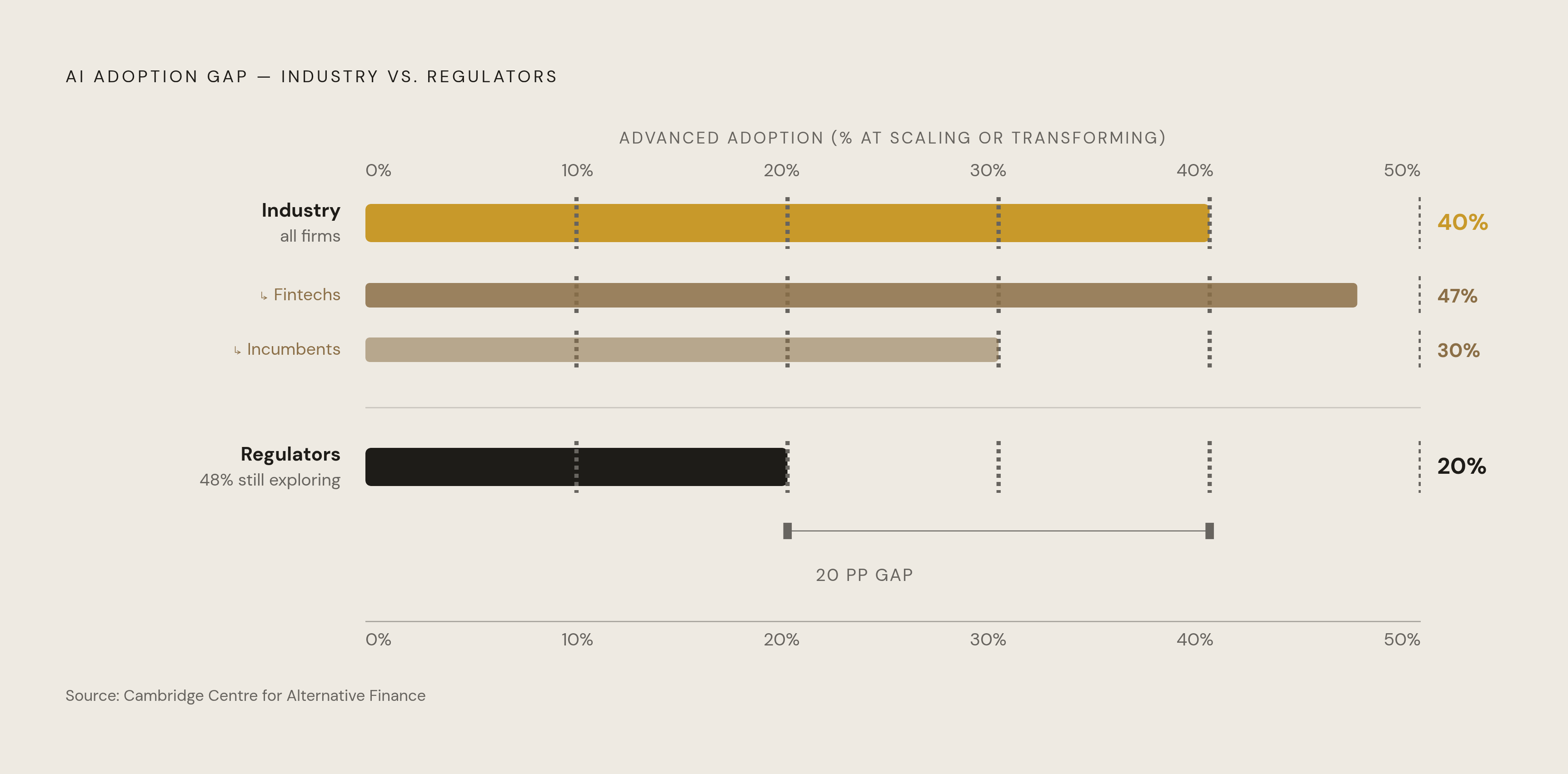
Start with the numbers, because they tell a sharper story than any summary. Forty percent of industry respondents in the Cambridge report say they have reached advanced adoption stages, what the report calls "Scaling" or "Transforming." Only 20% of regulators say the same, and 48% of regulatory authorities describe themselves as still "Exploring" AI or not engaged with it. Inside the industry, fintechs are pulling away from incumbents: 47% of fintechs are at advanced adoption versus 30% of incumbents, and on agentic AI specifically the gap holds, 57% against 45%. Agentic AI, meaning systems that don't just answer questions but take actions and make decisions on a firm's behalf, is already in active use among 52% of industry respondents. That's a steep curve for a category that barely had a name two years ago.
And yet only 14% of firms say AI is transformational to their organizational strategy. Read against the adoption numbers, that gap says something most firms would rather not say out loud: they are deploying AI everywhere without rebuilding the governance, oversight, or accountability structures meant to catch it when it breaks. That is not a compliance problem that appears in an exam and gets patched with a memo. It is a trust problem, and trust in financial services breaks in ways that are expensive and slow to put back together. What follows traces where the accountability gaps sit today, what regulators can already enforce without writing a single new rule, what's coming next, and what a firm can actually do before a regulator or a client forces the question.
The patchwork of frameworks firms must navigate: federal, state, and cross-border
No single federal law governs AI in US financial services. Firms answer instead to a stack of overlapping rules that shifts by jurisdiction, sector, and use case, and the stack gets taller every month. Anyone waiting for one clean national standard to settle the matter is going to wait a long time, and probably miss several state deadlines while waiting.
A federal executive order signed December 11, 2025 aims to build one national policy framework. It directs the FTC to issue guidance on how existing unfairness and deception standards apply to AI, and it signals a preference for a more unified national approach. As of this writing it has produced no binding rules. States have not waited around: tracking from opsintel.io counts over 1,100 AI-related bills introduced across all 50 states in 2025, with 145 of them signed into law. That is most of the country legislating at once, often pulling in different directions.
Colorado's AI Act, originally signed in 2024, now takes effect January 1, 2027, after being substantially rewritten and replaced by SB 26-189 (signed May 14, 2026). It places real obligations on developers of high-risk AI systems, including anything with a material effect on financial services: public disclosures, consumer notifications, impact assessments, and a "reasonable care" duty to prevent algorithmic discrimination. Texas took a narrower path with its Responsible AI Governance Act, barring intentional discrimination against protected classes by any AI developer or deployer. A consumer who asks whether they're talking to generative AI must receive disclosure from Utah the moment they ask. California's CCPA rules on automated decision-making go further, requiring pre-use notice, a right to opt out or appeal to a human reviewer, and a right to see what information fed into the decision.
Crossing the ocean changes the picture completely. The EU AI Act (Regulation (EU) 2024/1689) took effect August 1, 2024, and its high-risk obligations, covering standalone systems under Annex III, become enforceable December 2, 2027, pushed back from an original August 2026 date by the Digital Omnibus (Regulation (EU) 2026/1744). Penalties run up to €35 million per violation. For financial firms this cuts close: credit scoring, life and health insurance underwriting, risk assessment, and pricing all look likely to land in the high-risk bucket. Fraud detection, notably, is carved out.
The UK took a third route. The FCA, PRA, and Bank of England lean on existing, technology-neutral, principles-based oversight rather than writing AI-specific rules, though supervisory expectations keep climbing regardless of that choice. The House of Commons Treasury Committee published a report warning bluntly that a wait-and-see approach risks serious harm to consumers and the financial system.
So the US federal government pushes toward one national standard while states race ahead with their own laws. The UK leans on principles rather than prescription while the EU builds a detailed, penalty-backed rulebook. A firm operating across any two of these jurisdictions has to track all of it at once, because none of these approaches looks temporary: they reflect genuinely different regulatory philosophies, rules-based against principles-based, federal against state, and nothing suggests they're converging anytime soon. Betting on convergence, at this stage, is a delay tactic wearing a strategy's clothes.
How existing consumer-protection laws already reach AI-driven financial products
Firms sometimes act as though AI sits in a regulatory gap, waiting on lawmakers to catch up before liability attaches. That reading is backwards, and it may be the single most expensive misjudgment a compliance team makes right now. A whole layer of consumer-protection law already reaches AI-driven decisions. No new statute required, no waiting period, no grace window.
Take UDAAP, the unfair, deceptive, or abusive acts and practices standard rooted in the Consumer Financial Protection Act of 2010. An AI chatbot that gives an inaccurate answer, omits a material loan term, or reframes pricing in a way that misleads a borrower creates exposure under a law that predates the technology by more than a decade. Regulators pay close attention to situations where automated tools block a consumer's path to a human who could actually fix the problem, and that failure mode (the dead-end chatbot loop) is already turning up in enforcement actions.
ECOA and Regulation B prohibit discrimination in any part of a credit transaction and require specific, accurate reasons when an application gets denied. That requirement does not bend for machine learning models. If a model rejects an applicant, the firm still has to explain why in terms a person can understand, and a black-box scoring engine that can't produce a plain-language reason code is a compliance failure sitting there, waiting to be found. It's a compliance failure sitting there, waiting to be found. TILA and Regulation Z add another layer, requiring clear and conspicuous disclosure of credit terms, and dynamic pricing driven by machine learning, or negotiated by an agentic AI system talking directly to a consumer, complicates what "clear and conspicuous" even means once the price on screen can shift mid-conversation.
EFTA and Regulation E keep functioning too. If an AI system misreads a payment instruction, or an AI-driven dispute-triage tool mishandles an error claim, the underlying investigation timelines and provisional credit obligations still apply exactly as they did before any AI touched the process. FCRA governs how consumer reports get used and furnished, including mandatory credit score disclosures, and none of that changes because a machine learning model generated the score instead of a traditional statistical one.
The pattern across all five statutes holds steady. Regulators grow uneasy whenever AI cuts a consumer off from a human being, or makes the basis of a decision genuinely opaque, because that is exactly where these older protections start to lose their grip. This sits ahead of the newer AI-specific rules covered above, not behind them. For most firms right now it is the primary source of legal exposure, and treating it as secondary is where the real risk hides.
What supervisors are expecting from AI governance programs in 2026
Supervisory guidance in 2026 keeps circling back to four themes: explainability, bias management, human oversight, and fitting AI into risk-management structures that already exist. Citrin Cooperman's report on regulatory changes lays this out clearly, and the pattern is visible across multiple regulators, not just one.
Global and regional supervisors are sending a consistent signal: AI used in credit underwriting, trading, surveillance, or customer interaction needs the same model risk rigor applied to any other high-stakes model. No lighter treatment because it's new, no pass because it's "just a pilot." The OCC has said it supports banks folding AI into core functions, provided that happens in a safe and sound manner, but the interagency model risk guidance from the OCC, Federal Reserve, and FDIC explicitly excludes generative and agentic AI models from its scope, on the grounds that they move too fast and look too novel to fit the existing framework. That leaves a gap regulators expect firms to fill on their own. Filling it badly, or not at all, is exactly the kind of decision an examiner asks about a year later, once the gap has already caused a problem.
The UK situation echoes this. The PRA's Supervisory Statement 1/23 on Model Risk Management remains the operative framework, and industry broadly supports its principles-based structure, but firms have raised a fair question: can traditional model validation approaches actually scale to widespread generative and agentic AI deployment? Nobody has a settled answer yet. FCA Chief Executive Nikhil Rathi addressed a related point directly in a June 24, 2026 speech, arguing that accountability for regulated activities has to stay clear even when agentic systems coordinate and transact rather than simply assist a human decision-maker. Oversight, in his framing, needs to be built into the system from the start, not bolted on after deployment, a distinction that sounds obvious until you look at how most firms actually build their systems.
Agentic AI keeps surfacing as the pivot point in this conversation, and for good reason. The practical question is sharp: firms need compliance infrastructure sturdy enough to deploy agentic systems safely at scale, because the technology itself mostly works already. What doesn't work yet is the infrastructure wrapped around it, and that mismatch is the real bottleneck. Formal requirements and informal signals both matter here. Reading only the binding rules while ignoring where supervisors are pointing their attention next is a good way to get caught flat-footed twelve months from now.
How AI is reshaping the audit and assurance obligation for financial firms
The PCAOB still has no binding AI-specific auditing standard as of 2026, and the timeline behind that gap explains a lot. The Technology Innovation Alliance Working Group finished its "Future State Deliverable" in May 2024, but the document didn't reach the public until August 2025, a 15-month delay. As of mid-2026, the TIA's work has not translated into binding standards. The frontier work exists. It just hasn't been enacted.
What has taken effect is narrower but still consequential. Updated auditing standards now require auditors to evaluate the relevance and reliability of any information obtained or processed using technology-based tools, and testing of a company's controls over electronic information has to reach the IT general controls tied to that information. Amended control standards kick in for fiscal years beginning on or after December 15, 2026, and the new PCAOB quality control standard, QC 1000, had its effective date pushed back a year to that same December 15, 2026 date. QC 1000 requires every registered audit firm to design a quality control system, and firms performing engagements under PCAOB standards must implement, operate, and monitor it as well.
COSO weighed in with guidance published February 23, 2026, "Achieving Effective Internal Control Over Generative AI," and its central demand is concrete: monitoring AI-driven processes needs a complete audit trail, capturing prompts, inputs, outputs, model and configuration versions, and evidence that a human actually reviewed the output. Enough detail, in other words, to reconstruct after the fact what the AI actually acted on and on what basis. Retention rules differ by regime, which adds its own headache: SOX-relevant systems need at least 366 days of operational logs and seven years of audit work papers, while Article 12 of the EU AI Act sets a six-month floor for high-risk AI systems.
One question remains genuinely unresolved, and it's a strange one for an industry built on precision. Does AI-enabled 100% journal-entry testing satisfy PCAOB standards better than traditional sampling? There is an uncomfortable possibility that inspectors might effectively penalize a firm for running 100% AI-based testing, simply because no standard yet defines what counts as an acceptable AI-based audit. More thorough testing, treated with more suspicion, purely because the rulebook hasn't caught up yet. That's a strange incentive to leave standing.
Liability doesn't transfer to the software vendor, either. When AI produces an error in a financial statement, an audit opinion, or a tax filing, the CPA carries that liability, full stop. Audit firms leaning on third-party AI tools need an independent basis for believing those tools are fit for purpose, and a vendor's marketing page does not count as that basis. AI that touches the books, in any capacity, is already part of internal control over financial reporting, whether a firm has formally admitted that yet or not. Treat 2026 as the year to write down how those tools get picked, supervised, and evidenced, before an examiner asks and the honest answer is a shrug.
SOC examinations as a trust-building mechanism for AI-enabled service organizations
SOC 2 is an AICPA auditing standard, governed under SSAE 18 section 320, that examines how a company protects customer data. It's a report an independent auditor issues after testing a company's controls against the Trust Services Criteria, and the report expires the moment the underlying controls change.
There are five of those criteria. Security is mandatory in every SOC 2 audit, covering access management, encryption, and incident response. The other four (Availability, Processing Integrity, Confidentiality, and Privacy) get chosen based on what the business actually does. A Type I report confirms controls existed at a single point in time. A Type II report confirms those same controls operated effectively across a stretch of months, and enterprise customers almost always ask for the Type II, since a snapshot proves far less than a track record does.
The real SOC 2 shift in 2026 is a change in how auditors apply the ones already on the books. It's a change in how auditors apply the ones already on the books. Auditors now scrutinize AI systems more closely under the same 2017 Trust Services Criteria that have governed SOC 2 for years, expecting documented controls around model governance, training-data lineage, and vendor risk tied to AI or LLM subprocessors. No formal AI-specific criteria got added to the TSC framework itself. The bar just moved higher under the rules that already existed. AI governance has quietly become table stakes for any service organization handling sensitive financial data, whether or not the word "AI" shows up anywhere in its SOC 2 scope.
SOC 1 focuses specifically on controls over financial reporting, which matters most for service organizations whose processing feeds directly into a client's financial statements. Either way, a SOC examination isn't a box a firm checks once a year and files away. For a financial services firm running AI against client data or financial workflows, a SOC 2 Type II report has become close to a threshold expectation, both from enterprise clients doing vendor due diligence and from regulators asking pointed questions during exams. It's one of the only assurance mechanisms flexible enough to reach AI systems in financial workflows right now, which makes it the practical near-term accountability layer while AI-specific standards keep maturing elsewhere.
AIUC-1 and the emerging assurance framework specifically designed for AI systems
SOC 2 and traditional financial statement audits weren't built with AI systems as the subject matter. They stretch to cover AI, and auditors are doing exactly that, but every application requires interpretation: a judgment call about how a framework written for a different era of technology should apply to model governance, training data, and autonomous decision-making. AIUC-1 comes at the problem from the other direction. It's built specifically for assurance over AI systems, instead of adapted to reach them after the fact.
Context matters here. The PCAOB is still collecting stakeholder input through RFC No. 2026-001 on its 2026-30 strategic plan. COSO published its generative AI internal control guidance in February 2026. Set against that backdrop, AIUC-1 reads as the next logical step in a standard-setting process that's moving, just not fast enough yet to have produced a finished answer.
AIUC-1 assurance looks at the reliability, fairness, transparency, and governance of AI systems running inside financial workflows, and that's not an accidental choice of scope. Those are the exact dimensions regulators keep asking about in credit underwriting, fraud detection, and financial reporting: the same explainability, bias management, human-in-the-loop oversight, and audit trail requirements traced through the supervisory expectations covered earlier. AIUC-1 gives those requirements a structured place to live, instead of leaving each firm to work them out alone from scratch.
The stakes sharpen in specialized corners of financial services. Mortgage banking, multifamily housing finance, skilled nursing facility accounting: these sectors carry their own regulatory overlays on top of general AI governance obligations, and an AIUC-1 examination could give auditors and regulators structured evidence that an AI system operating inside one of those environments meets the standards specific to it, not just AI standards in the abstract.
None of this has settled yet, and AIUC-1 is fair to treat as a leading-edge tool rather than a mature one. But firms that start building AI governance documentation now (the prompt logs, model version records, and human-review evidence that COSO's guidance already calls for) put themselves in a far stronger position to undergo an AIUC-1 examination once the standard matures. Strip away the specific frameworks and one question remains: who can credibly say that an AI system inside a financial workflow works as intended, treats people fairly, and can be checked after the fact? This is the real driver behind all these frameworks, produced by the absence of a credible answer to that question, as the report's findings on adoption gaps and governance structures show. That question is the real driver behind all these frameworks, and AIUC-1 is one serious attempt at answering it directly. Right now, that's a better answer than waiting around for a fuller one.
What a proactive AI governance posture looks like for financial firms today
Regulatory fragmentation looks, on the surface, like a good reason to wait for clarity before spending money on governance. That reading has it backwards. Precisely because no single rulebook covers everything, the smart move is building internal structures sturdy enough to satisfy several frameworks at once, rather than betting on which regulator moves first and losing that bet.
Start with inventory, because nothing else here works without knowing, concretely, what's actually running. A firm needs a complete list of every AI system that touches financial data, credit decisions, customer interactions, or financial reporting. From there, audit trail architecture follows naturally: COSO's February 2026 guidance specifies capturing prompts, inputs, outputs, model and configuration versions, and evidence of human review, and building that in at deployment costs far less than bolting it on later, after an examiner asks for records that were never kept.
Human-in-the-loop controls deserve the same seriousness. PCAOB standards already require that significant audit judgments come from the engagement team, not from an AI system running unsupervised, and wherever AI helps shape a judgment, the file needs to show a human actually reviewed it. That principle doesn't stay confined to audit work. It reaches into any regulated decision an AI touches: credit denials, fraud flags, pricing changes, anywhere a consumer's outcome hangs on what a model spits out.
Third-party vendor accountability rounds this out. Independent assessment of AI tools, not reliance on a vendor's own claims about accuracy or fairness, is what regulators and auditors increasingly expect to see. Service organizations offering AI-enabled processing to financial firms should expect SOC examination questions specifically about their AI governance, and that is a present requirement. It's a present one.
For firms with exposure across borders, cross-jurisdictional compliance mapping isn't optional either. Meeting EU AI Act obligations doesn't automatically satisfy Colorado's requirements, and satisfying Colorado says nothing about the UK's principles-based expectations. Firms that treat governance as one internal function, built once and mapped against every applicable framework, rather than a pile of separate regional compliance projects, are the ones positioned to move fast when the next state law passes or the next regulator issues guidance. Given the pace shown throughout this piece, that next move is a matter of when, not if, and the firms still waiting on a single clear signal are the ones most likely to get caught flat by it.
Sources
- UK Financial Services Regulators’ Approach to Artificial Intelligence in 2026
- Regulatory Changes Affecting Financial Services in 2026 - Read More
- 2026 Global AI in Financial Services Report – Adoption, Impact and Risks
- AI in Financial Services: Popular Use Cases and the Regulatory Road Ahead | Insights | Venable LLP
- Rethinking regulation for the age of AI
- Developments in Artificial Intelligence Regulation in Financial Services
- freshfields.com
- aiuc-1.com