Top Accounting Firms Publishing Compliance Guidance on HUD 232 Surplus Cash and Distribution Rules
Accountants clarify how HUD 232 surplus cash rules determine owner distributions.

A growing number of accounting firms are now publishing compliance guidance on HUD Section 232 surplus cash and distribution rules, and the timing is not incidental. This article works through what the surplus cash rule actually requires, what causes the number to move, where the risk compounds for borrower-operators, and what the published guidance is telling practitioners to do about it.
Why HUD 232 surplus cash rules exist
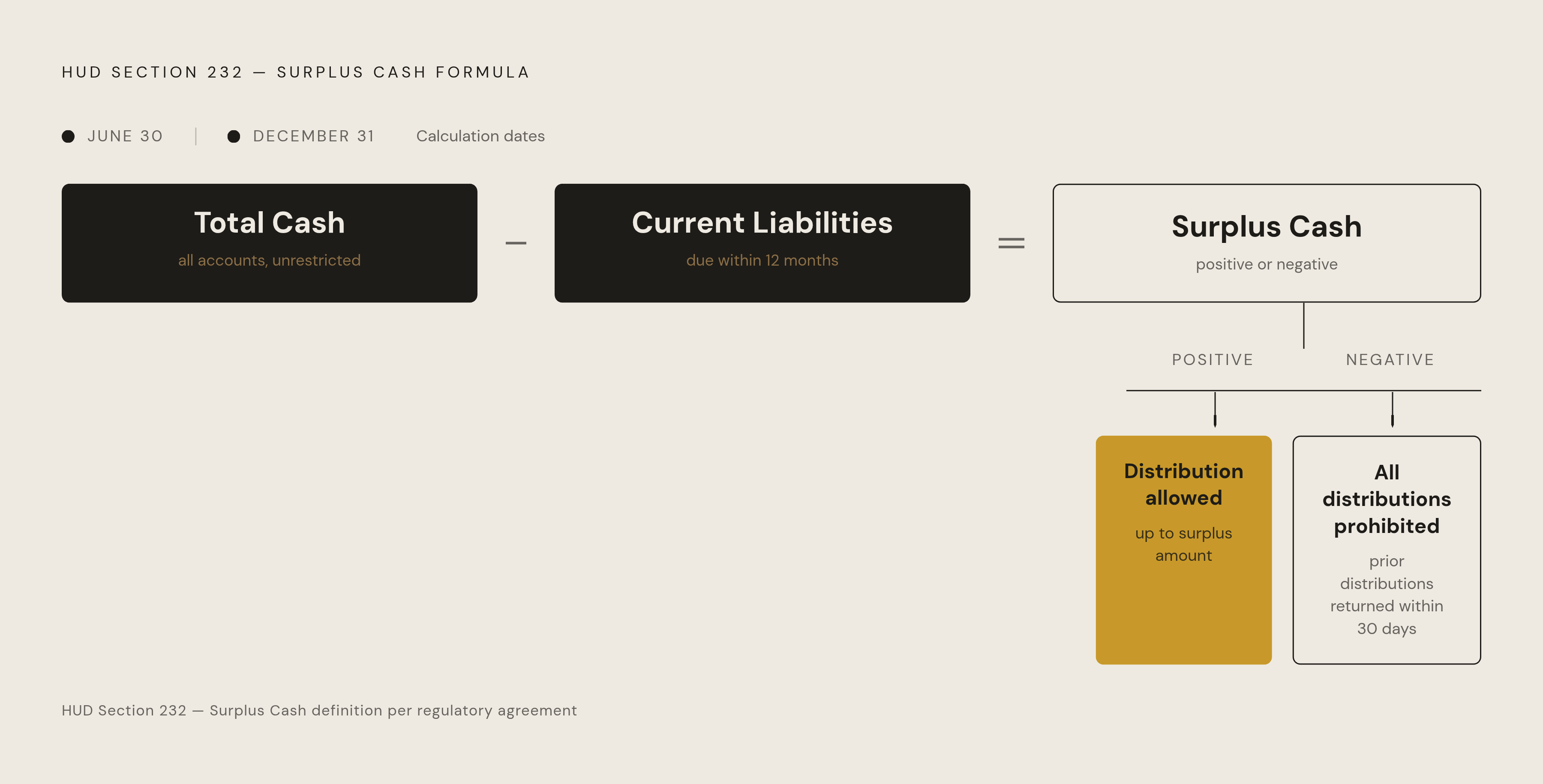
The surplus cash rule is a gate. Before an owner can take any distribution, cash out, or dividend, the borrower has to complete Form HUD-93486-ORCF, and the formula behind it is plain arithmetic: total cash minus total current liabilities equals surplus cash. If that number comes out positive, the owner may distribute up to that amount. If it comes out negative, every distribution is off the table, and if the owner already took money out during that period, it has to go back within 30 calendar days unless HUD grants an extension.
The calculation does not run on a schedule of the owner's choosing. It happens twice a year, at June 30 and December 31, and nowhere in between. There is no annual version and no version that fires on demand when an owner wants to check in on cash position before making a decision. The two dates are fixed, and everything downstream (the compliance obligation, the repayment deadline, the audit trail) is built around them.
None of this is informal policy. The authority for it sits in the Healthcare Regulatory Agreement itself, specifically Forms HUD 92466, HUD 92466-EH, and HUD 92466-ORCF, and it is reinforced in HUD Handbook 4370.2 REV-1, Chapter 2, which governs the financial operations and accounting practices for HUD-insured multifamily projects broadly, including how surplus cash is calculated and how distributions to owners are permitted. Borrowers sign onto these terms at closing, and they remain binding for the life of the mortgage. Understanding this structure is the baseline for everything that follows: the inputs that move the number, the added complexity when borrower and operator are the same party, the audit apparatus that surrounds the calculation, and the enforcement environment that has made getting it wrong considerably more costly.
What moves the surplus cash number
The surplus cash formula looks static on paper, but the inputs behind it shift constantly: several of them respond directly to decisions borrowers make well before June 30 or December 31 arrives, which is what makes the calculation manageable rather than fixed. Treating the calculation as something that simply happens to a project, rather than something a project's management can shape, is where many owners get into trouble.
Mortgage amortization is one of the quieter forces at work. As the current portion of long-term debt shrinks over the life of the loan's amortization schedule, surplus cash tends to improve gradually, and borrowers who model their amortization schedule can see that improvement coming rather than being surprised by it (worked through more fully below). Short-term obligations move the number in the other direction: accounts payable, accrued expenses, and other current liabilities all reduce surplus cash, and when an owner pays those obligations relative to the June 30 or December 31 cutoff can shift the result meaningfully. That timing has to be planned in advance; it is not something that can be adjusted productively in the final days before the calculation date.
Subordinate financing introduces its own constraint. A Surplus Cash Note, filed on Form HUD-92223, is only available when surplus cash is positive, so an owner counting on subordinate debt service to cover other obligations needs to project surplus cash carefully enough to avoid a period where the note simply cannot be serviced. Unlike payables, subordinate debt service is a planned, recurring obligation that depends entirely on a number the owner does not control in real time.
The practical fix published guidance points to is running the calculation more often than HUD requires. A preliminary surplus cash calculation done quarterly, rather than only at the two official dates, gives management a window to adjust payable timing or rein in spending before the number locks in officially. Two small examples make the stakes concrete. A project holding $100,000 in cash against a modest level of current liabilities produces a distributable surplus, money the owner can legitimately take out. The same project, with current liabilities that happen to exceed that $100,000 in cash, produces a negative result and prohibits every distribution for the period, full stop on the math. Those two outcomes differ not by drama but by bookkeeping, and that is why the inputs deserve more attention than they tend to get.
The distinct distribution rules that apply when borrower and operator are the same entity
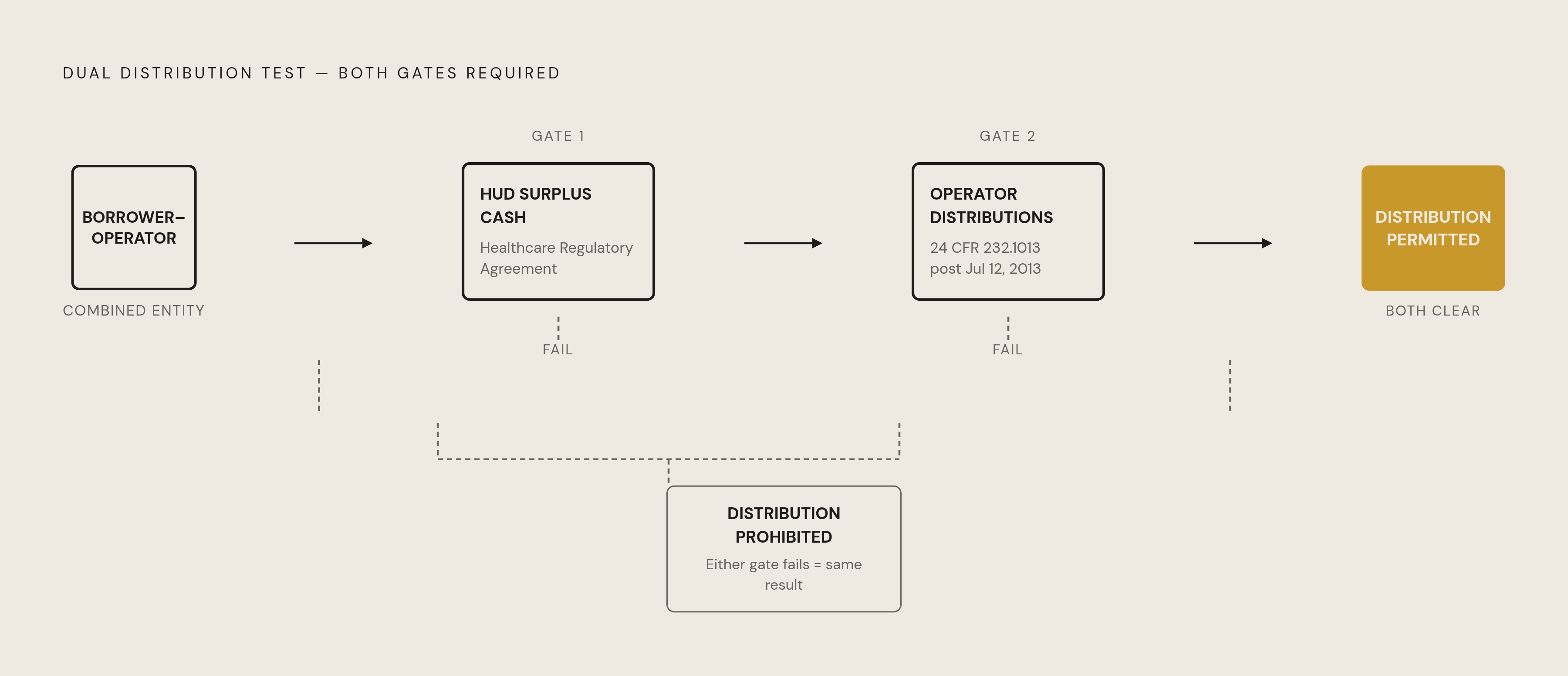
Some Section 232 structures separate the borrower (the entity that holds the HUD-insured mortgage) from the operator (the entity running the facility day to day). Others collapse the two into a single legal entity. When that happens, the entity is no longer subject to one compliance framework but two running at the same time.
For transactions where a firm commitment was issued on or after July 12, 2013, operator distributions are governed separately by 24 CFR 232.1013, in addition to the borrower restrictions under the surplus cash rule. A borrower-operator in this category has to satisfy both frameworks before taking a dollar out. Passing one test while failing the other still results in a prohibited distribution; there is no partial credit for compliance here, since the two rules operate independently of each other rather than as alternates.
The reporting obligations layer on top of that. The Section 232 Handbook, Section III, Chapter 4 requires operators to submit quarterly and year-to-date financial statements within 60 days of each period's close, with one exception: the final fiscal year-end quarter gets a 90-day window instead of 60. Annual statements carry their own additional deadline beyond fiscal year end. That cadence runs separately from, and in addition to, the borrower's own annual submission schedule. Master Tenants, where they exist in a transaction structure, carry an equivalent submission schedule under that same chapter.
Why does the compliance calendar matter this much to a borrower-operator specifically? Because a single entity now has to track two sets of deadlines, two sets of financial statement content requirements, and two distribution tests, all while running the facility itself. The margin for a missed submission or an overlooked regulatory citation narrows considerably compared to a structure where borrower and operator are separate parties with separate compliance teams.
One more date belongs in this picture. The updated Section 232 Handbook, with provisions effective January 5, 2026, applies to all new loan applications and transactional requests involving existing Section 232 projects. Anyone handling an application filed after that date needs to work from the revised standards, not the prior version of the handbook, and borrower-operators in particular should confirm which version of the rules governs their specific transaction before assuming continuity with how things worked before.
What the annual audit and financial reporting framework requires
Surplus cash compliance does not exist in isolation. It depends entirely on financial statements that meet HUD's audit and submission standards, because those statements are what HUD and loan servicers actually examine when deciding whether a given round of distributions was legitimate in the first place. A surplus cash calculation that looks correct on an internal spreadsheet means little if the underlying financial statements do not hold up to the scrutiny HUD requires.
The submission timeline differs by borrower type. For-profit borrowers must file an audited Annual Financial Statement electronically within 90 days of fiscal year end, no exceptions built in for a certification step. Non-profit borrowers get a two-step option: a borrower-certified AFS within that same 90-day window, followed by a fully audited AFS no later than nine months after year end under 2 CFR 200, or they can skip the interim step entirely by filing the audited version within the original 90-day deadline. That flexibility matters for non-profit operators managing a tighter audit timeline internally, but it also means two different compliance paths need to be tracked depending on entity type.
Every submission flows through HUD's Financial Assessment Subsystem, known as FASS, which then uploads into iREMS. FASS runs an initial check of financial condition and compliance, and any deficiencies it flags, or any that the project's own auditor identifies, can be referred onward to ORCF or to HUD's Departmental Enforcement Center. That referral path is the mechanism by which a financial statement problem turns into a regulatory one.
The audit requirement itself has two distinct parts. A financial statement audit has to be performed under GAAS (AICPA), and a separate compliance audit of major HUD programs has to be performed under GAGAS (Comptroller General). Both apply across the board to nursing homes, intermediate care facilities, and board and care homes insured under Section 232. HUD's Quality Assurance Operations Division, in turn, runs its own quality control reviews of the independent public accounting firms performing these audits, and the program describes those audits as HUD's "first line of defense" for assessing the financial condition of a public housing agency, tribally-designated housing entity, or multifamily ownership entity. A very large share of Multifamily Housing and ORCF participants are required to file annual electronic financial statement data with HUD under this framework, and that volume is why FASS flags carry weight and why submission quality cannot be treated as a formality.
The April 2026 HUD OIG Audit Report
A 2026 HUD Office of Inspector General report found that ORCF had not consistently acted on financial risks that were already sitting in borrowers' own audited financial statements. The audit process alone, in other words, does not protect a borrower who takes a distribution without valid surplus cash behind it, because the agency reviewing those statements does not always catch the problem in time.
The specifics of that finding give the stakes real shape rather than abstract weight. In an audit, HUD OIG reviewed four portfolios made up of 70 properties and found cash deficiencies along with distributions that had been taken without valid surplus cash, deficiencies ORCF had not acted on despite the fact that they were disclosed, in writing, in the borrowers' own audited statements. The OIG recommended stronger policies in response, which signals that ORCF will come under pressure to act more consistently on flagged financial risks going forward, raising the practical cost of a misstep for any borrower whose file already contains a deficiency.
That April report is not an isolated data point. HUD OIG is separately reviewing a not-for-profit residential care facility in New York City operating a skilled nursing facility, under Report BO 26 0008, with the audit objective of determining whether the facility was run in accordance with its regulatory agreement and HUD requirements. In a different report, 2026-BO-1002, HUD OIG found that Huntington Apartments had not been properly managed in accordance with HUD requirements or its regulatory agreement. None of these are hypothetical risks drawn from speculation about future enforcement; they are documented findings from an active inspector general.
Scale explains why the OIG treats these as systemic rather than isolated problems. HUD's Office of Residential Care Facilities administers a program insuring thousands of loans, with an unpaid principal balance running into the tens of billions of dollars. A gap in oversight at that scale is not a minor administrative footnote; it is a material risk to the department, and that is precisely how OIG has characterized it. The practical consequence for practitioners is straightforward: confirming that distributions taken in past periods were actually backed by valid surplus cash calculations is now an active area of OIG attention, not a background item to revisit only if a problem surfaces on its own.
What accounting firms publishing guidance on these rules are covering
Given the formula, the variables that move it, the compounded risk for borrower-operators, the audit apparatus wrapped around all of it, and an inspector general actively flagging trailing-period failures, the question becomes what accounting firms are actually telling clients to do about all of this. The compliance guidance firms are publishing addresses the surplus cash calculation as an operational workflow problem, not just a regulatory one, because the consequences of a negative result arrive fast and the OIG's heightened posture makes trailing-period errors newly dangerous.
Core guidance covers how to run Form HUD-93486-ORCF accurately at each semi-annual date, what inputs drive the result, how to document that any distribution taken was supported by a positive calculation, and what to do if the result is negative. Guidance from specialized HUD audit practitioners defines surplus cash as a HUD-financed property's cash and cash-equivalent assets minus its current obligations and required reserves, and describes that figure as the number that determines what an owner is permitted to distribute, closely reviewed as part of the audited financial statements rather than treated as a side calculation.
Confirming that distributions taken in trailing periods were properly supported by surplus cash is now an OIG focus area, and practitioners are advising clients to treat every prior semi-annual period as a potential audit target, not just the current one. That is a meaningful shift in posture. It means a clean calculation this June 30 does not retroactively fix a problem from two years ago, and firms are telling clients that explicitly.
The guidance itself has been evolving quickly, which is its own kind of evidence that the environment is moving. AHACPA, the specialist practitioner network serving HUD auditors and operators, published guidance in November 2024 on mid-year surplus cash calculations specifically for Section 232 leased nursing homes, a sign that leased-facility structures carry enough nuance to need dedicated treatment rather than general guidance. Less than a year later, AHACPA's September 2025 guidance warned practitioners against issuing June 30, 2025 single audits before the 2025 Compliance Supplement had actually been released, and it separately flagged issues with multifamily audit thresholds and FASSUB validation. That kind of rapid, specific correction is why firms track this guidance as it comes out rather than relying on what was accurate a year prior.
Firms that audit Section 232 properties do not treat the surplus cash calculation as something separate from the audit engagement. They prepare it directly as part of the audited financial statements, as an embedded audit deliverable rather than a parallel management exercise. That is part of why the guidance keeps surfacing from audit firms specifically, rather than from general compliance consultants: the people producing the number are the same people who have to defend it.
Preparing for Each Semi-Annual Calculation Date
The calculation runs semi-annually, at June 30 and December 31. Proactive preparation ahead of each date is the direct, practical response to the enforcement environment described above, not an optional best practice.
- Run a preliminary surplus cash calculation quarterly, not only at June 30 and December 31, so management has time to adjust payable timing or reduce spending before the official date locks the result.
- Confirm that distributions taken in prior periods were documented with a completed Form HUD-93486-ORCF showing a positive result at the time the distribution was made. Given the OIG's current focus on trailing-period distributions, documentation of past calculations matters as much as the current one.
- Keep the amortization schedule current in any projection model. The current portion of long-term debt changes as the mortgage amortizes, and a model that is not updated to reflect that produces a stale forecast that understates improving surplus cash.
- For borrower-operators under commitments issued on or after July 12, 2013, confirm that both the borrower surplus cash framework and the 24 CFR 232.1013 operator distribution rules are satisfied before any distribution goes out. A compliance checklist that covers only one framework is incomplete.
- Bring in a CPA firm with direct Section 232 audit experience before the financial statement deadline arrives, since the audit produces the exact financial statements HUD and the loan servicer will later examine, and the firm's preparation of the surplus cash calculation within that engagement functions as the primary quality control checkpoint.
Borrowers navigating the dual-deadline audit regime, particularly non-profits splitting their submission into a certified interim statement followed by a full audit, benefit from working with advisors who know HUD 232's specific reporting cadence and financial statement requirements firsthand. Pease Bell, an audit and assurance firm specializing in multifamily housing and HUD-insured projects, works with borrowers on the timing, documentation, and submission process needed to produce financial statements that support a defensible surplus cash calculation and hold up under FASS review. Firms offering that kind of coordinated audit and reporting support, covering REAC and FASS submissions, owner and management certifications, and the HUD Consolidated Audit Guide together, reduce the odds of a compliance flag that complicates a borrower's standing with its servicer or with HUD. Given how closely the OIG is now watching trailing-period compliance, that kind of preparation before each calculation date is no longer a marginal advantage. It is the baseline.