HUD Management and Occupancy Review Process
HUD uses risk ratings and review scores to schedule multifamily housing inspections.

The Management and Occupancy Review is HUD's primary tool for checking that multifamily housing programs run the way they were designed to run. It exists to catch deficiencies before they become fraud, waste, or mismanagement, and it does this by measuring a property's actual practices against the Regulatory Agreement, the Mortgage, the Management Certification, and the Housing Assistance Payments (HAP) Contract that govern it. None of that work falls to the property owner. HUD staff, Performance Based Contract Administrators (PBCAs), Traditional Contract Administrators (CAs), and Mortgagees of Coinsured Projects carry out the review, which keeps the party being evaluated out of the evaluation itself. Beyond the monitoring function, a documented MOR gives HUD something it needs when an owner or agent won't fix what's broken: a paper trail specific enough to support enforcement action. That dual purpose, routine oversight paired with the capacity to escalate, runs through every phase described in the sections that follow.
How HUD decides when a property gets reviewed
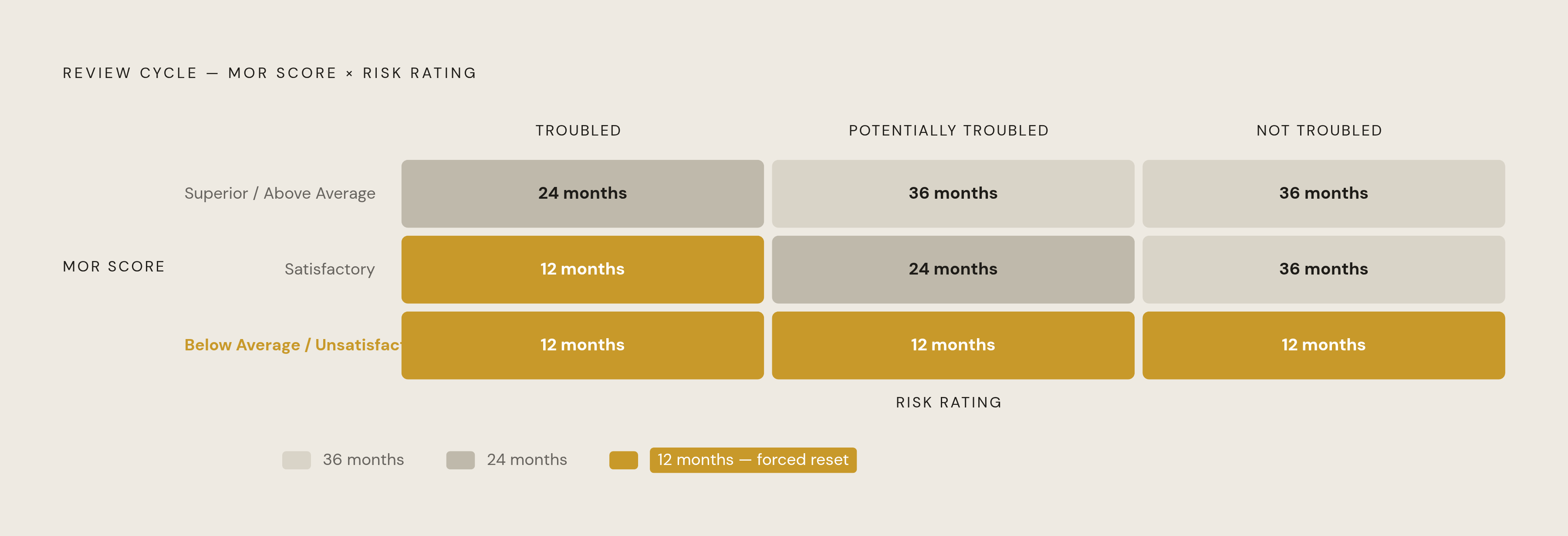
MOR scheduling isn't a lottery, and it isn't fixed to a calendar date picked at random. A final rule published by HUD's Office of Multifamily Housing Programs on June 27, 2022, and effective September 26, 2022, ties review frequency to two numbers: a property's risk rating and its score on the previous MOR. Combining those two numbers produces a cycle of 12, 24, or 36 months before the next review comes due. The risk rating itself sorts properties into one of three categories, "Troubled," "Potentially Troubled," or "Not Troubled," using a mix of qualitative signals (tenant complaints, local code violations) and quantitative ones (vacancy rate, REAC inspection score, debt service coverage ratio for HUD-insured properties). A strong score on the current review buys a longer stretch before the next one; a weak score shortens it.
Two exceptions override that schedule regardless of where a property sits in the cycle. A change in ownership or management triggers a mandatory MOR within six months, no matter how recently the last one happened. HUD or a CA can also schedule a review at any time, independent of the standing cycle, if a property's risk profile worsens or new concerns surface. Owners don't get to see their own risk rating, either. HUD treats those ratings as part of its internal deliberative process, partly because publishing them could make it harder for a struggling property to line up the resources it needs to improve. The practical consequence for ownership is straightforward: the score earned on this review sets the review calendar for the next one to three years. Every MOR is really two things happening at once, an assessment of the past and a bet on the near future.
The three-part structure of Form HUD-9834
Every review, regardless of who conducts it, runs through the same instrument: Form HUD-9834, Management Review for Multifamily Housing Projects. The form has three parts, and the order matters, Desk Review, On-Site Review with Addenda, and Summary Report, each one feeding the next rather than standing alone.
The addenda attached to the On-Site Review section carry most of the form's operational weight. Addendum A, the Tenant File Review Worksheet, serves as the scorecard reviewers use for grading individual resident files against program requirements. Addendum C lists the documents an owner or agent must have on hand the day the reviewer arrives, and it goes out with the scheduling letter so there's no ambiguity about what needs to be pulled. Addendum D covers State Lifetime Sex Offender Statistics. Which addenda get completed depends on what kind of project is under review: subsidized projects require Addenda A, B, C, and D in full, while unsubsidized projects only need B and C. The form also splits its questions by reviewer type. Some are reserved for HUD staff and mortgagees, others for HUD staff alone, and CAs answer neither of those reserved sets, working instead from the portion of the form built for their role. Understanding this architecture matters before walking through the phases themselves, because each phase that follows corresponds to one part of this same form.
Phase one: what happens during the Desk Review before anyone visits the property
The Desk Review happens before anyone sets foot on the property, and it is not a formality or a rubber stamp. A reviewer works through project files, system reports, and documents already on file with HUD, building a working hypothesis about where a property's compliance posture stands before a single tenant interview or file inspection takes place. That hypothesis then shapes what gets scrutinized on-site. Among the materials examined at this stage are the Tenant Selection Plan, House Rules, Lease, Application, and the property's EIV Policies and Procedures, each one offering a different angle on how the property is actually managed, on paper, before the reviewer can compare it to practice.
The scheduling letter that kicks off this phase has to reach the owner or agent in writing at least two weeks before the on-site visit, and it has to specify which documents must be ready that day. Addendum C travels with that letter, along with Part A of Addendum B, so there's no mystery about what the reviewer expects to find waiting. Addendum B also carries the Fair Housing and Civil Rights review requirements, and reviewers use it at this desk stage specifically to flag potential civil rights concerns before anyone visits in person. A handful of items checked during the Desk Review tend to surface problems reliably: whether the Affirmative Fair Housing Marketing Plan is current, whether the Owner/Agent certification has been submitted in APPS with Previous Participation clearance active, and whether financial reports, including surplus cash calculations, line up with the audits already on file. An owner who waits until the on-site date to get organized has already missed the window where most of the groundwork gets laid.
What the on-site review covers
The on-site review is where the Desk Review's hypothesis gets tested against the property itself, and it's the phase that generates most of what ends up in the final rating. CAs walk the physical property, interview staff, inspect tenant files directly, and follow up on findings from the property's most recent REAC inspection. Tenant files are checked through random sampling rather than a full audit of every unit, but PBCAs are required to complete these file reviews, along with reviews of tenant selection plans, waiting lists, and EIV master files, entirely on-site. HUD doesn't allow those materials to leave the property electronically or physically, so there's no shortcut that lets this phase happen remotely.
The physical assessment that happens during the MOR is not a replacement for the separate REAC inspection. It supplements it, with reviewers checking whether the property is being kept in decent, safe, and sanitary condition as a complement to REAC's own scoring. Staff interviews are a formal, scripted part of this phase too: reviewers use Form HUD-9834 itself to question on-site staff and gauge how well they actually know fair housing rules and occupancy requirements, beyond simply confirming that a policy binder exists somewhere in the office.
No area gets more attention during the on-site review than EIV, the Enterprise Income Verification system. Reviewers check whether the Owner/Agent Approval Letter authorizing EIV access is on file, whether User Access Authorization Forms are current for every staff member who touches the system, and whether each user's security training certification is still valid within the required 12-month window. They check whether Income Discrepancy Reports were printed and filed at recertification, and within the required window after move-in, alongside the Income Report itself. They check whether the New Hires Report gets printed at least quarterly. Any one of these gaps can turn into a documented finding.
One detail with operational consequences: HUD's October 2023 memo reinstated in-person MORs starting January 1, 2024, closing out the pandemic-era guidance that had allowed parts of the process to happen virtually. Owners who got used to a remote or hybrid review format should assume that flexibility is gone.
The on-site visit closes with a close-out session between the reviewer and the owner or agent, and this conversation carries more weight than its informal tone might suggest. It's the first moment an owner hears what the reviewer found, and in some cases it opens a window to start correcting curable deficiencies before the written report locks anything in. Treating the close-out as a courtesy rather than an opportunity is a mistake; it's the last chance to shape the record before it becomes final.
How findings are documented in the Summary Report
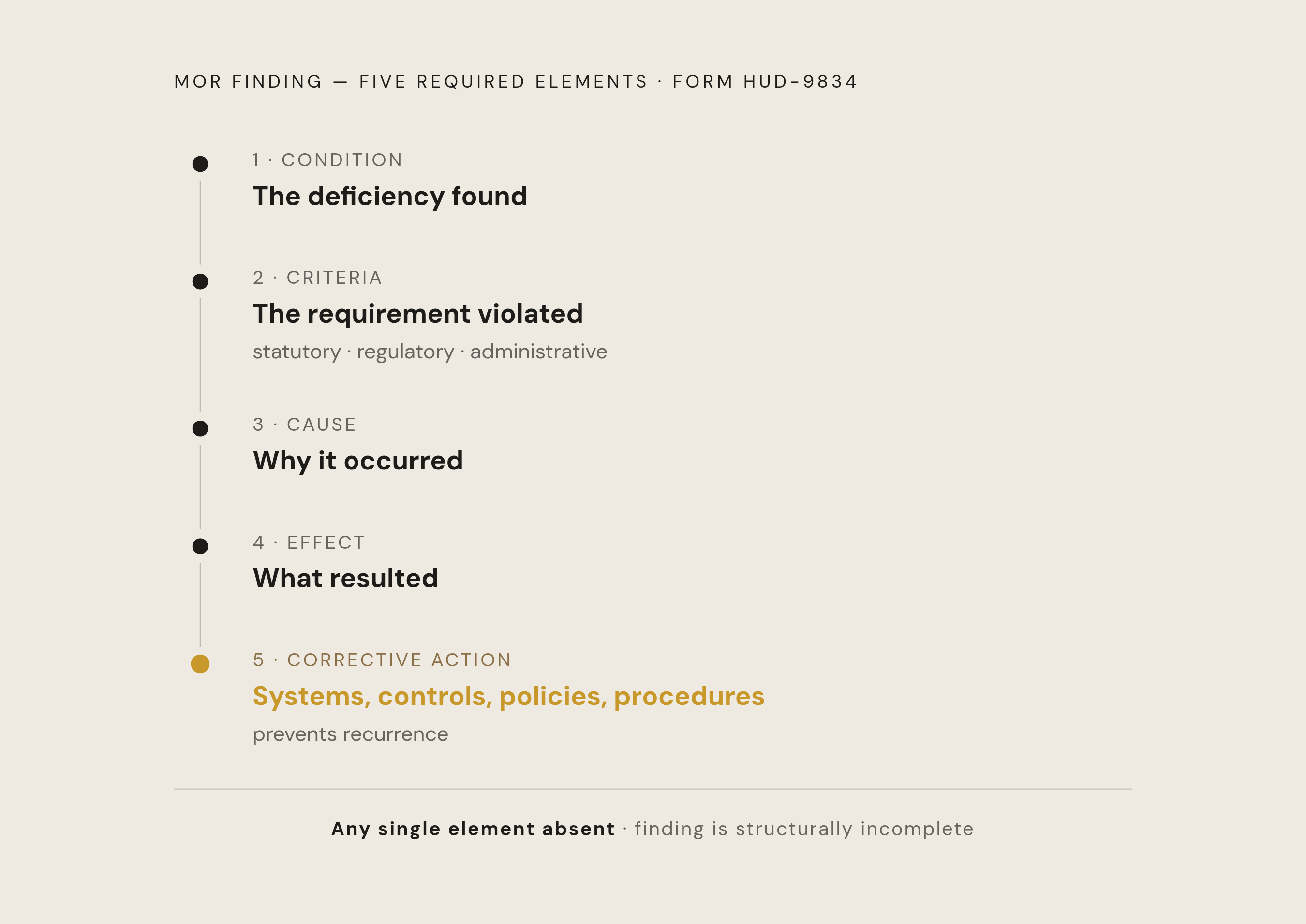
Everything observed on-site gets formalized in the Summary Report, the third and final section of Form HUD-9834, where the reviewer records every deficiency, every finding, and the corrective action each one requires. Each finding has to include five distinct elements: the condition, the specific deficiency found; the criteria, the statutory, regulatory, or administrative requirement the property failed to meet; the cause, why the condition happened in the first place; the effect, what resulted from it; and the corrective action required to fix it. A finding missing any one of these five elements isn't a complete finding under the form's own structure.
Fixing the immediate error isn't where the owner's obligation ends. The corrective action has to describe what changed at the level of systems, controls, policies, and procedures so the same deficiency doesn't recur at the next recertification cycle or the next review. Every finding carries a target completion date attached to it, giving both the owner and HUD a fixed point to measure progress against.
Once the report is finished, it goes to both the owner/agent and HUD within a set window after the on-site visit, and the CA assists the owner in responding to the findings within a set period following the report date. Addendum B gets forwarded separately to the Fair Housing and Equal Opportunity office, along with the Affirmative Fair Housing Marketing Plan, keeping the civil rights review on its own track within HUD's internal process.
The report's overall score, one of "Superior," "Above Average," "Satisfactory," "Below Average," or "Unsatisfactory," does more than summarize the current review. It feeds directly into the risk-based scheduling model described earlier. A "Below Average" or "Unsatisfactory" score resets the property to a 12-month review cycle and can draw additional oversight attention on top of that shortened timeline. The Summary Report determines how soon the whole review cycle starts again, so the compliance areas covered next deserve attention well before the next scheduling letter arrives.
The compliance areas that most frequently generate MOR findings
Tenant files generate the largest share of gaps that show up often enough across MORs to function as a reliable preparation checklist. A missing or incorrectly timed EIV Existing Tenant Search is one of the costliest, because if the report wasn't run before move-in, there's no way to correct that retroactively once the date has passed. Citizenship Declaration Forms signed after the move-in date, or missing from the file altogether, appear with similar frequency. So do lease addendums that were never approved by HUD, generic templates or locally drafted language that an owner assumed was acceptable but that HUD never cleared.
Financial management findings tend to follow a different pattern: they occur when surplus cash calculations don't reconcile with the audited financials already on file with HUD, a mismatch that points straight back to the Desk Review stage where those figures first get compared. AFHMP-related findings follow a pattern of their own, appearing when a property's Affirmative Fair Housing Marketing Plan has gone more than five years without an update and there's no documented review on file showing that an update wasn't needed. None of these three categories, tenant files, financial reconciliation, and AFHMP currency, requires sophisticated detective work to catch. They require someone checking the file before the reviewer does.
HOTMA and proposed Form HUD-9834 revisions
HUD's compliance checklist is not static, and a notice published in the Federal Register on August 4, 2026, shows where it's headed next. The notice seeks approval to revise Form HUD-9834 and to fold HUD-91067, the VAWA Lease Addendum for Multifamily Housing Programs, into the MOR's information collection. Public comments on the proposal were due September 3, 2026. None of this is final yet, and it shouldn't be treated as though it were. The notice is a 30-Day Notice of Proposed Information Collection under the Paperwork Reduction Act, a procedural step in the rulemaking process that precedes a rule taking effect. The forms it describes are drafts until that process runs its course.
The proposed revision would write HOTMA requirements directly into the MOR checklist, giving reviewers explicit authority to examine tenant files and procedures covering income and asset limits, asset self-certification and the verification of self-certified assets, actual and imputed income from assets, safe-harbor income determinations, applicable deductions and allowances and hardship provisions, and the income and rent calculations built from all of it. Owners already have a deadline to work against separately: HUD Notice 2025-07, issued December 17, 2025, extended the HOTMA full compliance deadline for Multifamily Housing Owners, covering income and asset documentation requirements for income certifications, to January 1, 2027.
The proposed form would update physical inspection terminology so reviewers ask specifically whether the most recent inspection turned up Life-Threatening or Severe conditions, whether those deficiencies were corrected, and whether the same problems keep recurring. And a new Addendum E would be added, dedicated entirely to Violence Against Women Act review, covering whether owners use the correct VAWA lease addendum, keep written lease bifurcation procedures on file, and provide the required VAWA notices and certification forms. None of this is enforceable today. Owners who start aligning their HOTMA documentation and VAWA procedures now won't be caught flat-footed when the proposed form, or some version of it, becomes the one reviewers actually use.
MOR outcomes for HUD Section 232 properties
For properties financed under HUD Section 232, the program covering residential care facilities such as nursing homes and assisted living, MOR outcomes carry weight that extends past the standard HAP Contract monitoring relationship. The scheduling consequences described earlier, where a weak score shortens the review cycle to 12 months, apply here as they do to any other property under HUD's risk-based model. Section 232 properties sit inside a financing structure where HUD is also the insurer of the mortgage, so the lender relationship and the regulatory relationship are harder to separate than they are for a conventional HAP property. A documented finding doesn't just set the next review date. It becomes part of the record HUD can draw on if it ever needs to take enforcement action tied to the Regulatory Agreement underlying the insured loan itself, the same evidentiary function described at the start of this piece, now applied to a financing structure where the stakes of an unresolved deficiency are tied directly to the mortgage insurance that makes the property's financing possible.
Sources
- Management Review for Multifamily Housing Projects
- HUD Multifamily Publishes Streamlining Management and Occupancy Review (MOR) Final Rule
- HUD publishes Final Rule on Streamlining Management and Occupancy Reviews for the Section 8 Programs - National Center for Housing Management
- HUD Returns to In-Person Management and Occupancy Reviews
- mainehousing-management-and-occupancy-review-guide. ...
- 1 U.S. DEPARTMENT OF HOUSING AND URBAN DEVELOPMENT WASHINGTON, DC 20410-8000
- HUD Implements Long-Awaited Risk-Based Schedule for MORs